June 22, 2026
The Engineering Challenge of Powering Remote Iron Ore Operations
Across the global mining industry, the transition from fossil fuels to renewable energy has been debated for decades. Yet for most large-scale operations, particularly those located in remote, off-grid environments, the conversation has rarely moved beyond feasibility studies and pilot programs. The fundamental challenge is not one of ambition but of engineering complexity: how do you reliably power an industrial operation that runs continuously, across hundreds of kilometres of isolated terrain, using energy sources that are inherently intermittent?
That question sits at the heart of what is being built in Western Australia's Pilbara region right now. The Fortescue solar and battery project for iron ore mining represents one of the most technically ambitious industrial decarbonisation programmes ever attempted globally, combining utility-scale solar generation, multi-site battery storage, a purpose-built high-voltage transmission network, and a full fleet electrification programme into a single integrated system.
Understanding why this project matters requires looking beyond the headline figures and examining the engineering logic, operational mechanics, and economic forces that are driving construction forward.
When big ASX news breaks, our subscribers know first
What the Pilbara Energy Problem Actually Looks Like
Before any renewable infrastructure can be assessed, it helps to appreciate the scale of the energy challenge in the Pilbara. Iron ore mining operations in this region are not simply large mines. They are vertically integrated industrial complexes encompassing open-cut mining, primary crushing, long-haul rail corridors stretching hundreds of kilometres, and deep-water port facilities at Port Hedland, one of the highest-tonnage bulk export terminals in the world.
Each of these operational nodes has its own continuous energy demand profile. Mining equipment such as electric rope shovels, haul trucks, and drilling rigs consumes energy at rates measured in megawatts per unit. Rail haulage systems, conveyors, and processing equipment compound this load across the full operational chain. Historically, meeting this demand in a location this remote required either diesel generation or access to natural gas, both of which carry significant cost exposure and emissions liability.
Diesel dependency in remote mining creates a layered risk structure that is often underappreciated:
- Fuel costs are directly linked to global crude oil price movements, creating unpredictable operating cost structures
- Supply chain logistics for remote fuel delivery introduce both cost premiums and operational vulnerability
- Scope 1 emissions from diesel combustion represent a growing liability as downstream steel customers face their own decarbonisation obligations
- Long-term energy price certainty is essentially impossible to achieve under a fossil fuel dependency model
The economic case for renewable energy in mining has therefore strengthened not purely because of environmental commitments, but because the financial risk profile of diesel dependency has become increasingly difficult to justify at scale.
The Pilbara Green Grid: Architecture of an Industrial Microgrid
The Pilbara Green Grid is best understood not as a collection of individual renewable energy projects, but as a purpose-built industrial microgrid operating entirely off-grid. Its architecture is designed around four interconnected subsystems: solar photovoltaic generation, wind generation, battery energy storage, and a high-voltage transmission backbone.
How the Generation and Transmission System Works Together
The transmission infrastructure is the critical enabling component that most analyses understate. Unlike conventional utility grids that benefit from interconnection with large synchronous networks, an off-grid industrial microgrid must manage its own frequency, voltage, and load-balancing in real time. This requires a fundamentally different control architecture than grid-connected systems.
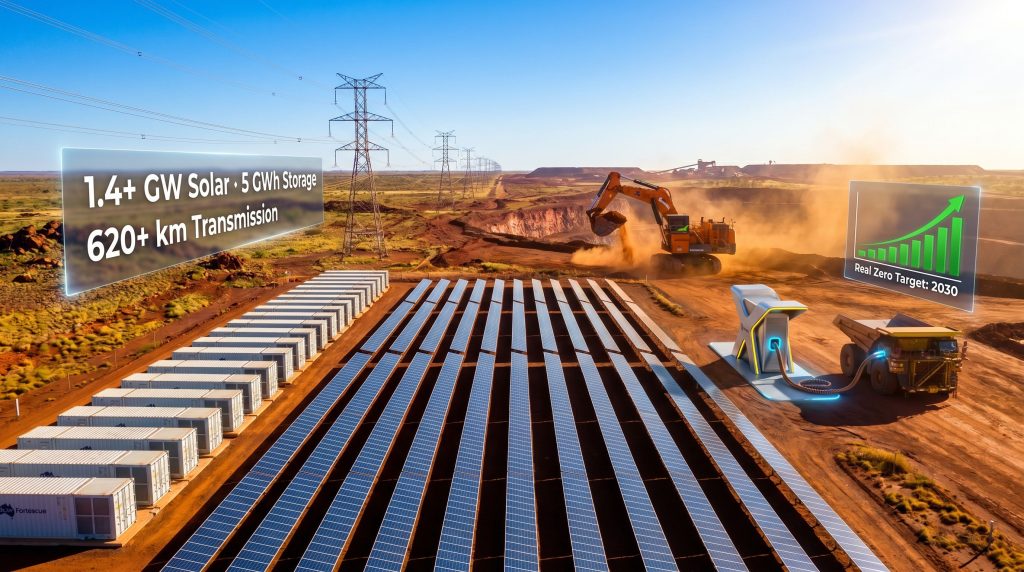
The high-voltage transmission network being built across the Pilbara serves as the physical backbone that links dispersed generation assets to multiple industrial load centres. More than 480 kilometres of high-voltage infrastructure has already been constructed as of mid-2026, with the completed network expected to extend beyond 620 kilometres once all generation sites and load points are connected.
Technical Insight: Managing intermittent solar and wind output across a 620+ km transmission network serving continuous industrial loads represents a grid control challenge with no direct precedent in the global off-grid mining sector. Battery energy storage at multiple nodes is essential to maintain system stability without fossil fuel backup generation.
The total generation capacity being integrated into this network includes:
- Over 1.4 GW of solar photovoltaic capacity across five sites
- More than 600 MW of wind generation capacity planned
- Up to 5 GWh of battery energy storage distributed across multiple sites
Solar Generation Portfolio: A Site-by-Site Breakdown
Consolidated Solar Asset Summary
| Solar Asset | Capacity | Status | Key Notes |
|---|---|---|---|
| Turner River | 690 MW | Under Construction (completion 2028) | ~120 km south of Port Hedland; federal approval January 2026 |
| Solomon Airport | 440 MW | Under Construction | Largest single-site build currently underway |
| Cloudbreak | 190 MW | Nearing Completion | Co-located with 74 MW / 650 MWh BESS |
| North Star Junction | 100 MW | Operational | First major commissioned asset in the portfolio |
| Chichester (APA Group) | 60 MW | Operational | Originally built by Alinta Energy; third-party supply arrangement |
| Total Portfolio | ~1.48 GW | Multi-stage | Final piece: Turner River (2028) |
The Turner River solar farm is strategically significant beyond its 690 MW capacity figure. It has been identified as the final solar installation needed to complete the full generation plan underpinning the decarbonisation roadmap. Federal environmental approval was received in January 2026, and construction is expected to reach completion in 2028.
At the Cloudbreak site, the 190 MW solar farm nearing construction completion is paired with a 74 MW / 650 MWh battery energy storage system, construction of which commenced in 2026 and is targeted for completion in FY2027. This co-location model reflects a deliberate design philosophy: placing storage capacity directly adjacent to generation reduces transmission losses and improves dispatch flexibility at individual mine sites.
The North Star Junction 100 MW installation, now fully operational, delivered an important early proof point for the broader programme. In December 2025, a 50 MW / 250 MWh battery energy storage system powered by BYD technology was delivered and commissioned at this site, providing the first real-world demonstration of multi-hour storage integration within the Pilbara microgrid framework.
Battery Energy Storage: Why Scale and Distribution Both Matter
The Physics of Off-Grid Renewable Continuity
Solar generation in the Pilbara benefits from exceptional irradiance conditions, but it shares the same fundamental limitation as all photovoltaic technology: generation ceases at night and is significantly reduced during cloudy periods. For a mining operation that runs three shifts per day, seven days per week, the gap between solar generation hours and operational hours must be bridged by stored energy.
This is where the architecture of up to 5 GWh of total battery storage capacity becomes critical. Rather than centralising storage at a single location, the Pilbara Green Grid deploys battery systems at multiple mine sites, creating a distributed storage topology that improves both grid resilience and renewable energy penetration rates.
The operational logic of distributed BESS deployment in an off-grid mining microgrid works as follows:
- Solar generation peaks during daylight hours, producing energy in excess of real-time demand at high-irradiance periods
- Excess generation is captured and stored across battery systems at multiple sites simultaneously
- Stored energy is dispatched during evening, overnight, and low-generation periods to maintain continuous operational load coverage
- Wind generation (600+ MW planned) provides a complementary generation profile that partially offsets nighttime solar shortfalls
- Battery capacity across all sites acts as the balancing buffer, eliminating the need for diesel or gas backup generation
Key Figure: The Cloudbreak BESS at 74 MW / 650 MWh, combined with the North Star Junction system at 50 MW / 250 MWh, represents the first tranche of what is ultimately planned as a 5 GWh distributed storage network. At full build-out, this would rank among the largest off-grid industrial battery deployments ever constructed.
Fleet Electrification: The Hardest Part of Real Zero
Why Mobile Equipment Defines the Decarbonisation Challenge
Eliminating diesel from electricity generation is technically straightforward once sufficient renewable capacity and storage are in place. Eliminating diesel from a fleet of large-format mobile mining equipment is an entirely different engineering proposition, and it is the dimension of the real zero target that attracts the least public attention despite being the most technically complex.
Open-cut iron ore mining relies on a hierarchy of mobile equipment, each with distinct energy demand and operational cycle characteristics:
- Electric rope shovels and hydraulic excavators are the primary loading tools, operating in continuous duty cycles at individual mine benches
- Haul trucks in the 200-300 tonne payload class are the highest diesel consumers per unit in the fleet, operating on fixed haul routes at full load for extended shifts
- Ancillary equipment including wheel loaders, dozers, graders, and water carts collectively contribute significant diesel consumption across mine-wide operations
Current Electrification Progress
| Equipment Type | Current Status | Target Milestone |
|---|---|---|
| Battery-Electric Excavators | 16 units operational | ~50% of excavator fleet electric by end of 2026 |
| Electric Drill | 1 unit operational | Fleet expansion ongoing |
| Battery-Electric Haul Truck | Commissioning phase | First unit operational before end of 2026 |
| 6 MW Fast Charger (in-house) | Commissioning / testing | Operational mid-2026 |
| XCMG Electric Wheel Loader, Dozer, Grader, Water Cart | Facility testing in China | Pilbara site testing pending |
The 6 MW fast-charging system developed in-house is a particularly important piece of the electrification puzzle. A large-format haul truck operating on a mine haul cycle cannot afford extended charging downtime without disrupting productivity. A charging system capable of fully restoring haul truck battery capacity in approximately 30 minutes is functionally equivalent to the refuelling time of a diesel truck, which is the threshold at which battery-electric operation becomes operationally viable without productivity penalties.
Furthermore, mining electrification of this scale introduces supply chain considerations that extend well beyond the mine gate. The involvement of XCMG, one of China's largest construction and mining equipment manufacturers, introduces an interesting dimension to the programme. The facility testing of battery-electric prototypes covering four ancillary equipment categories reflects the reality that no single manufacturer currently offers a complete electric fleet solution for large-scale open-cut mining. Fortescue is effectively participating in the development of equipment categories that do not yet exist in commercial production form.
The next major ASX story will hit our subscribers first
What Real Zero Actually Demands of an Industrial Operation
Net Zero Versus Real Zero: An Important Distinction
The mining industry's decarbonisation landscape is complicated by a terminology problem. Many large mining companies have adopted net zero commitments, which permit the continued use of fossil fuels provided that equivalent carbon is offset through external mechanisms such as reforestation, carbon capture credits, or renewable energy certificates.
Fortescue's real zero target is structurally different. It requires the complete physical elimination of fossil fuel combustion from all operational processes at Pilbara iron ore sites by 2030. This covers:
- Electricity generation (replacing all diesel and gas generators)
- Land transport (electrifying the full mobile mining fleet)
- Drilling operations (converting drill rigs to electric power)
- Hauling operations (transitioning haul trucks to battery-electric systems)
The 2030 deadline is ambitious given that battery-electric haul trucks in the required payload class are only now entering the commissioning phase. Achieving full fleet conversion within four years will require that both technology development and commercial supply chains mature simultaneously, which carries execution risk that investors and analysts should weigh carefully. In addition, zero-emissions mining trucks represent one of the most technically demanding frontiers in the broader push toward fossil-free industrial operations.
This article contains references to forward-looking targets and operational timelines. Actual outcomes may differ materially from stated goals. This is not financial advice.
The Competitive and Economic Logic of Investing in Green Iron Ore
Why This Is Not Simply an Environmental Programme
The Fortescue solar and battery project for iron ore mining is frequently framed as a decarbonisation initiative. That framing is accurate but incomplete. There is a parallel economic rationale that explains the pace and scale of investment.
Steel manufacturers in Europe, Japan, South Korea, and increasingly China are facing tightening emissions obligations under various regulatory frameworks. As these pressures intensify, the carbon intensity of raw material inputs, including iron ore, becomes commercially relevant. Green iron production with zero fossil fuel combustion carries a demonstrably lower embedded carbon footprint than conventionally produced ore, which may translate into pricing advantages as steel producers seek to reduce their Scope 3 emissions exposure.
The energy sovereignty dimension is equally significant. By replacing diesel and gas with owned renewable generation capacity, Fortescue converts a variable, globally priced cost input into a largely fixed, infrastructure-based cost. Over a multi-decade asset life, this structural cost advantage compounds meaningfully against competitors who remain exposed to fuel price volatility.
The Iron Bridge Precedent
The 150 MW solar PV plant and 42 MW of battery storage integrated into the Iron Bridge Magnetite project under the Pilbara Energy Connect framework provided an important technical proof point before the full Pilbara Green Grid buildout accelerated. Demonstrating that solar-plus-storage integration could reliably support the energy demands of a major magnetite processing facility de-risked the broader programme and validated the design assumptions underpinning the larger network. Consequently, green iron production in Australia has gained significant momentum as other jurisdictions observe what is being achieved in the Pilbara.
Frequently Asked Questions
What is the total solar generation capacity being built in the Pilbara?
Fortescue's solar portfolio across the Pilbara region is designed to exceed 1.4 GW of total installed capacity, drawing on five sites: Turner River (690 MW), Solomon Airport (440 MW), Cloudbreak (190 MW), North Star Junction (100 MW), and Chichester (60 MW). Fortescue's decarbonisation operations provide further detail on how these assets fit within the company's broader energy strategy.
How does the Cloudbreak battery energy storage system work?
The 74 MW / 650 MWh battery system being constructed at Cloudbreak stores surplus solar generation during daylight hours and dispatches it during periods when solar output is insufficient to meet mine-site load requirements. Construction commenced in 2026 and is scheduled for completion in FY2027.
When is the Pilbara Green Grid expected to be complete?
The integrated off-grid renewable network is targeted for completion as early as 2027, with the final solar asset, Turner River, scheduled for completion in 2028. The full real zero operational target covering all fossil fuel elimination across iron ore sites is set for 2030.
How much transmission infrastructure has been built so far?
More than 480 kilometres of high-voltage transmission lines had been constructed across the Pilbara as of mid-2026. The completed network is expected to extend beyond 620 kilometres.
What makes the 6 MW fast charger significant?
The in-house developed 6 MW fast-charging system is capable of fully recharging a large-format haul truck battery in approximately 30 minutes, achieving a charging cycle comparable to diesel refuelling time. This is the threshold at which battery-electric haul trucks become operationally viable without productivity loss, making the charger a critical enabling technology for full fleet electrification.
Key Takeaways: Building a Fossil-Free Mining Operation
The Fortescue solar and battery project for iron ore mining is not a single project but an integrated system of interdependent components that collectively define what industrial decarbonisation at scale actually requires:
- Generation at 1.4+ GW of solar and 600+ MW of wind provides the renewable energy foundation
- Storage at up to 5 GWh across distributed sites enables 24/7 renewable coverage for continuous industrial operations
- Transmission across 620+ km of high-voltage infrastructure physically connects generation to load
- Fleet electrification covering excavators, drills, haul trucks, and ancillary equipment eliminates the final diesel consumption category
- Proprietary technology including in-house fast-charging systems addresses the gaps where commercial solutions do not yet exist
Whether the 2030 real zero target is achieved precisely on schedule will depend on technology maturation rates, supply chain execution, and the pace at which battery-electric heavy equipment development advances. What is already clear is that the physical infrastructure being constructed across the Pilbara represents a structural template for how energy-intensive remote industrial operations can systematically eliminate fossil fuel dependency, with implications that extend well beyond Australian iron ore mining.
Want to Capitalise on the Next Major Mineral Discovery Before the Market Moves?
Discovery Alert's proprietary Discovery IQ model scans ASX announcements in real time, delivering instant alerts on significant mineral discoveries across 30+ commodities — giving investors a decisive edge the moment opportunities emerge. Start your 14-day free trial today, or explore Discovery Alert's discoveries page to see how historic finds have generated extraordinary returns for early movers.