June 9, 2026
What Makes Fortescue's Approach to Sustainable Mining Unique?
Fortescue sustainable mining strategies distinguish themselves through comprehensive operational transformation rather than incremental improvements. The company's approach eliminates carbon offsetting mechanisms entirely, focusing instead on direct fossil fuel replacement across all major operational components. Furthermore, recent developments in battery recycling breakthrough technologies are supporting this transition by addressing end-of-life concerns for large-scale energy storage systems.
Beyond Carbon Neutrality: The Real Zero Strategy
Traditional mining decarbonization typically relies on purchased carbon credits to achieve net-zero emissions targets. Fortescue's methodology rejects this approach, implementing what industry analysts term "Real Zero" strategies that eliminate fossil fuel dependency through infrastructure replacement. However, achieving these ambitious goals requires understanding the broader energy transition essentials that support sustainable operations.
The company has committed $6.2 billion to green technology development, representing one of the largest mining sector renewable energy investments globally. This capital allocation extends across multiple technology platforms:
• Battery energy storage systems exceeding 4-5 GWh planned capacity
• High-voltage transmission networks connecting distributed renewable sources
• Electric fleet procurement including excavators and locomotive systems
• Solar generation infrastructure with installations exceeding 300,000 panels
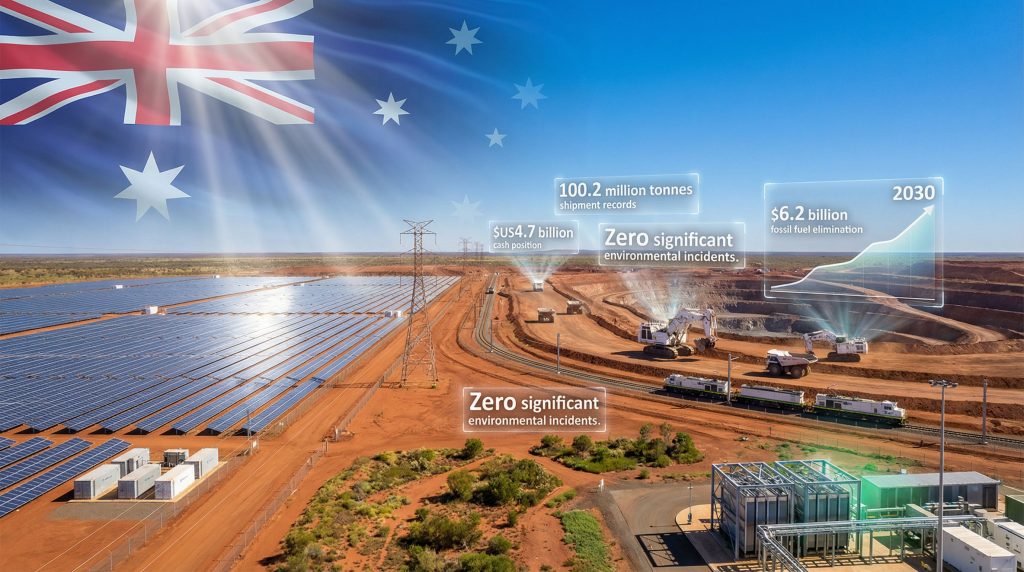
By 2030, Fortescue aims to eliminate fossil fuels entirely without relying on carbon offset purchases. This timeline represents aggressive decarbonization compared to industry standards, where most major miners target 2040-2050 for similar objectives.
Integrated Energy Infrastructure Transformation
The technical complexity of Fortescue sustainable mining operations requires coordinated energy infrastructure spanning hundreds of square kilometers across Pilbara mining sites. The high-voltage transmission network functions as the central nervous system, aggregating renewable generation from geographically dispersed sources and distributing power to mining equipment and processing facilities.
North Star Junction Battery System Specifications:
| Component | Specification | Operational Status |
|---|---|---|
| Total Capacity | 250 MWh | Operational Q4 2025 |
| Primary Function | Load balancing, frequency regulation | Active deployment |
| Grid Integration | High-voltage transmission network | Connected |
| Future Expansion | 4-5 GWh planned rollout | 2026-2030 timeline |
The Cloudbreak Solar Farm installation demonstrates industrial-scale photovoltaic deployment with over 300,000 solar panels currently operational. This capacity generates an estimated 75-100 MWp of renewable energy, though specific megawatt ratings remain proprietary.
Battery storage systems address the inherent intermittency challenges of renewable generation in mining environments. The 250 MWh North Star Junction facility provides grid stability services while enabling 24-hour mining operations powered entirely by renewable sources during optimal weather conditions.
When big ASX news breaks, our subscribers know first
How Does Fortescue's Battery Technology Stack Up Against Industry Standards?
Large-scale battery deployment in mining environments represents cutting-edge industrial technology rather than proven commodity-scale systems. Most operational mining battery installations range 10-100 MWh, making Fortescue's 250 MWh North Star Junction system one of the largest mining-specific deployments globally. Additionally, the broader mining industry innovation landscape is increasingly focused on sustainable technology integration.
Large-Scale Energy Storage Implementation
The North Star Junction installation positions Fortescue sustainable mining operations at the forefront of industrial battery technology. The system architecture integrates with existing high-voltage transmission infrastructure, providing multiple grid services simultaneously:
• Load leveling during peak demand periods
• Renewable energy firming for consistent power delivery
• Frequency regulation maintaining grid stability
• Peak demand response reducing electricity costs
Industry benchmarks for mining-scale battery systems typically achieve 85-90% round-trip efficiency. The North Star Junction facility incorporates advanced battery management systems designed for high-cycle applications, with daily charge-discharge cycles exceeding 250 annually to support continuous mining operations.
Electric Fleet Integration Metrics
Fortescue's operational fleet electrification demonstrates production-scale deployment beyond pilot testing phases. For instance, the company's electric mining fleet deployment represents one of the most comprehensive transitions from diesel-powered equipment in the mining sector.
Current Electric Fleet Statistics:
• 12 battery-powered excavators in continuous operation
• 2 battery electric locomotives with 14.5 MWh capacity each
• 100 million liters annual diesel displacement across operations
• 264,000 tonnes CO₂ equivalent emissions avoidance annually
The locomotive systems require approximately 4x larger battery capacity compared to excavator units, indicating differentiated battery architectures for different equipment classes. Mining excavator battery packs typically range 300-500 kWh for standard operations, while the 14.5 MWh locomotive systems enable heavy-haul transportation electrification.
Battery Fleet Performance Indicators:
| Equipment Type | Units Operational | Battery Capacity | Operational Status |
|---|---|---|---|
| Excavators | 12 | 300-500 kWh est. | Production deployment |
| Locomotives | 2 | 14.5 MWh each | Active service |
| Total Fleet | <15% electrified | Various | Expanding deployment |
The current electrification rate represents initial phase deployment, with the majority of Fortescue's equipment fleet still operating on conventional diesel systems. Full fleet electrification requires substantial battery capacity expansion and charging infrastructure development across multiple mining sites.
What Are the Economic Implications of Fortescue's Green Transition?
Fortescue sustainable mining economics demonstrate that aggressive decarbonization can occur simultaneously with production growth and financial stability. The company's H1 FY26 results provide evidence of this economic viability during the transition phase. Moreover, Fortescue's sustainability strategy demonstrates comprehensive environmental stewardship beyond carbon reduction alone.
Capital Expenditure and Return Analysis
Fortescue's financial position indicates substantial capacity to fund renewable infrastructure without compromising operational performance:
H1 FY26 Financial Performance:
• $759 million quarterly capital expenditure
• $4.7 billion cash position maintained
• $1.0 billion net debt stable
• 100.2 million tonnes record shipments (+3% year-over-year)
The quarterly capital expenditure represents approximately 30-40% of estimated revenue, indicating disciplined capital deployment balancing production maintenance and decarbonization investment. Cash generation exceeds debt obligations, providing financing capacity for the planned 4-5 GWh battery rollout estimated at $1.6-3.0 billion total program cost.
Production Efficiency During Transition
Operational metrics demonstrate that Fortescue sustainable mining initiatives enhance rather than compromise production efficiency:
Operational Excellence Indicators:
• Hematite C1 unit costs: $19.10 per wet metric tonne
• Iron Bridge Concentrate revenue: $121.68/dmt premium pricing
• Record H1 production: 100.2 Mt including 2.2 Mt premium concentrate
• Positive free cash flow: Revenue exceeding capital expenditure and debt service
The maintenance of competitive unit costs during renewable infrastructure deployment indicates successful operational integration. Iron Bridge Concentrate commands premium pricing, suggesting market recognition for higher-quality products potentially linked to sustainable production methods.
Economic Sustainability Assessment: Fortescue's ability to maintain $4.7 billion cash reserves while investing $759 million quarterly in renewable infrastructure demonstrates the economic viability of aggressive mining decarbonization when supported by strong commodity pricing and operational efficiency.
How Does Fortescue's Biodiversity Strategy Complement Mining Operations?
Environmental stewardship in Fortescue sustainable mining extends beyond carbon emissions to encompass ecosystem restoration and biodiversity conservation. The company's approach integrates ecological management with operational mining activities rather than treating environmental protection as a separate compliance function.
Ecosystem Restoration Methodology
The Biodiversity Positive Change Collaboration framework establishes systematic approaches to habitat restoration across Pilbara mining sites. This methodology combines:
• Ecological mapping of native species and habitat areas
• Species assessment protocols for flora and fauna protection
• Habitat restoration techniques specific to arid Pilbara environments
• Water stewardship programs preserving groundwater resources
Fortescue Marsh biodiversity programs received $5.5 million AUD investment during FY25, focusing on wetland preservation and native species protection. These programs demonstrate integration of conservation objectives with operational mining activities.
Environmental Performance Indicators
FY25 Environmental Achievements:
• Zero significant environmental incidents across all operations
• Water conservation initiatives reducing consumption per tonne produced
• Waste reduction targets achieved through operational efficiency
• Native vegetation preservation in non-mining areas
The zero-incident environmental record indicates robust management systems and operational controls. Water stewardship becomes particularly critical in Pilbara environments where groundwater resources support both mining operations and ecosystem health.
What Role Does Green Hydrogen Play in Fortescue's Future Operations?
Green hydrogen integration represents the next technological frontier in Fortescue sustainable mining, potentially revolutionising iron ore processing and creating entirely new revenue streams through green metal production. Furthermore, the development of hydrogen mining trucks demonstrates the expanding role of hydrogen technology in mining operations.
Green Iron Metal Project Specifications
Fortescue's green iron initiative targets 1,500+ tonnes annual production by 2025, utilising green hydrogen in combination with electric smelting furnaces. This "green pit to product" model eliminates fossil fuel dependency across the entire value chain:
Green Metal Production Framework:
• Green hydrogen generation from renewable electricity
• Electric smelting furnaces replacing coal-based reduction
• Integrated supply chain from mining to finished metal products
• Carbon-free iron production for environmentally conscious steel markets
Market Impact Projections
The planned green iron supply to China targets 100 million tonnes annually by 2030, representing substantial market transformation if achieved. This volume would displace traditional blast furnace iron production, potentially reducing global steel sector emissions by 200+ million tonnes CO₂ annually.
Revenue Diversification Strategy:
• Fortescue Future Industries developing green hydrogen technology
• Premium pricing for carbon-free metal products
• Market differentiation through sustainable production certification
• Export opportunities to carbon-conscious international markets
The green iron premium pricing model creates economic incentives for sustainable production methods while generating new revenue streams independent of traditional iron ore commodity pricing. Additionally, Fortescue's green metal development represents pioneering work in zero-carbon iron production.
How Does Fortescue's Social License Strategy Support Sustainable Operations?
Social licence considerations in Fortescue sustainable mining encompass indigenous partnerships, community investment, and regional economic development. These initiatives create stakeholder support essential for long-term operational sustainability.
Indigenous Partnership Metrics
Fortescue's indigenous engagement demonstrates substantive economic participation rather than token consultation:
Aboriginal Economic Participation:
• 15% Aboriginal employment rate across Pilbara operations
• $2.3 billion AUD contract value with Aboriginal businesses since 2011
• Training programs focused on technical skills and economic development
• Cultural heritage protection integrated with mining operations
The 15% employment rate exceeds industry benchmarks and provides meaningful economic opportunities for traditional landowners. Contract values approaching $2.5 billion represent substantial business development in Aboriginal communities.
Community Investment Framework
Fortescue Innovation Grants launched October 2024 focus on renewable energy, sustainable education, and healthcare initiatives. These programs create local economic benefits while supporting regional development:
• Economic contribution: $13.1 billion including $2.8 billion taxes and royalties
• Local procurement prioritising regional suppliers and contractors
• Education partnerships with universities and technical institutions
• Healthcare initiatives supporting rural and remote communities
The substantial tax and royalty contributions demonstrate Fortescue sustainable mining operations generating significant public revenue while pursuing environmental objectives.
The next major ASX story will hit our subscribers first
What Challenges Could Impact Fortescue's Sustainable Mining Timeline?
Despite impressive initial deployment, several technical and market risks could affect the 2030 fossil fuel elimination timeline. Understanding these challenges provides realistic assessment of Fortescue sustainable mining feasibility.
Technical Implementation Risks
Critical Technical Challenges:
• Battery technology scalability across harsh Pilbara mining environments
• Grid stability management with high renewable energy penetration
• Equipment reliability during transition from proven diesel systems
• Maintenance capabilities for complex integrated energy systems
Mining equipment operates in extreme conditions including temperature variations from 15-45°C ambient (higher in pit environments), dust exposure, and continuous heavy-duty cycles. Battery systems must demonstrate comparable reliability to diesel equipment or risk production disruptions.
The planned 4-5 GWh battery rollout requires successful scaling from the initial 250 MWh North Star Junction installation. Technical challenges include:
• Cycle life performance under daily charge-discharge operations
• Thermal management in extreme temperature conditions
• Maintenance access for geographically dispersed installations
• Supply chain reliability for replacement components
Market and Regulatory Considerations
External Risk Factors:
• Global iron ore demand fluctuations affecting investment returns
• Regulatory changes in key export markets potentially impacting green premiums
• Competition from other sustainable mining initiatives
• Technology cost trends for renewable energy and battery systems
Iron ore commodity pricing volatility could affect capital availability for renewable infrastructure investment. If commodity prices decline significantly, maintaining aggressive capex programs becomes challenging despite current strong financial position.
Regulatory frameworks supporting sustainable mining transitions remain evolving. Changes in carbon pricing, green steel incentives, or environmental regulations could impact the economic case for Fortescue sustainable mining investments.
How Does Fortescue's Model Compare to Global Mining Sustainability Leaders?
Comparative analysis positions Fortescue sustainable mining initiatives against industry peers, revealing both leadership areas and competitive challenges.
Competitive Analysis Framework
Decarbonisation Timeline Comparison:
• Fortescue target: Fossil fuel elimination by 2030
• BHP timeline: Net zero by 2050 with interim targets
• Rio Tinto approach: Carbon neutrality by 2050 with offset strategies
• Industry average: 2040-2050 decarbonisation targets
Fortescue's 2030 timeline represents the most aggressive major mining company commitment globally. This accelerated schedule creates competitive advantages through early technology deployment and market positioning but also increases execution risk.
Innovation Differentiation Factors
Fortescue Unique Positioning:
• Real Zero strategy eliminating carbon offsets entirely
• Vertical integration of renewable energy infrastructure
• Green hydrogen development through Fortescue Future Industries
• Indigenous partnership models exceeding industry benchmarks
The integrated approach combining mining operations with renewable energy development distinguishes Fortescue from competitors focusing primarily on purchased renewable energy or carbon offset strategies. This vertical integration provides greater control over decarbonisation timeline and costs.
Technology Adoption Rates:
• Battery deployment scale: 250 MWh operational, 4-5 GWh planned
• Electric fleet integration: 12 excavators, 2 locomotives operational
• Renewable generation: 300,000+ solar panels deployed
• Investment intensity: $6.2 billion committed to green technology
What Are the Long-Term Implications for the Mining Industry?
Fortescue sustainable mining developments signal broader industry transformation with implications extending far beyond a single company's operations.
Industry Transformation Indicators
The successful deployment of large-scale battery systems and electric mining equipment creates technology precedents that other miners may adopt:
Potential Industry Changes:
• Widespread battery-electric equipment adoption across multiple commodity sectors
• Green hydrogen integration in processing and smelting operations
• Supply chain pressure for sustainable mining practices from downstream customers
• Premium pricing models for environmentally certified metal products
Steel manufacturers increasingly seek low-carbon iron ore to meet their own decarbonisation targets. This demand creates market pull for Fortescue sustainable mining products while pressuring competitors to develop similar capabilities.
Investment and Market Dynamics
ESG Investment Implications:
• ESG-focused capital flows increasingly directing investment toward sustainable mining operations
• Cost of capital advantages for companies with credible decarbonisation strategies
• Regulatory compliance potentially requiring sustainable mining practices
• Stranded asset risks for high-carbon mining investments
The success of Fortescue's renewable transition could accelerate similar investments across the mining sector, creating new competitive dynamics based on environmental performance rather than purely operational efficiency or resource quality.
Industry Outlook Disclaimer: Projections regarding mining industry transformation, technology adoption rates, and market dynamics involve significant uncertainty. Actual outcomes may vary substantially based on commodity pricing, regulatory changes, technology development, and competitive responses not currently anticipated.
Long-term market implications include potential bifurcation between sustainable and conventional mining operations, with premium pricing for certified low-carbon metals creating new value propositions. However, the economic sustainability of these premiums depends on downstream market demand and regulatory frameworks that remain evolving.
The Fortescue sustainable mining model demonstrates that aggressive decarbonisation can be economically viable when supported by strong commodity pricing, technological innovation, and strategic capital allocation. Whether this approach becomes industry standard depends on successful scaling, technology maturation, and broader market adoption of sustainable mining practices.
Interested in Sustainable Mining Investment Opportunities?
Discovery Alert's proprietary Discovery IQ model delivers real-time alerts on significant mineral discoveries across the ASX, including opportunities in companies pioneering sustainable mining technologies. Subscribers gain instant access to actionable investment insights, positioning themselves ahead of the market in the growing sustainable resources sector. Begin your 30-day free trial at Discovery Alert today to identify the next breakthrough in sustainable mining innovation.