June 15, 2026
When Regulatory Frameworks Determine Mining Destinies
Across the global mining industry, the single most underappreciated variable in project valuation is not ore grade, commodity price, or even capital cost. It is time. Specifically, the time consumed navigating environmental and permitting frameworks before a single tonne of ore is processed. In jurisdictions where regulatory processes stretch across years rather than months, projects bleed capital through holding costs, lose momentum with investors, and face compounding uncertainty that erodes their risk-adjusted return profiles.
This reality makes the Fortuna Diamba Sud ESIA approval in Senegal a case study worth examining well beyond its status as a routine corporate announcement. The nine-month interval between submission and approval is not merely a project milestone. It is a data point that illuminates how regulatory architecture, institutional capacity, and documentation quality intersect to either accelerate or destroy value in frontier gold jurisdictions. Understanding mining permitting basics is therefore essential context for evaluating what this approval genuinely represents.
When big ASX news breaks, our subscribers know first
Understanding the ESIA as a Capital Gating Mechanism
What an Environmental and Social Impact Assessment Actually Controls
An Environmental and Social Impact Assessment is the primary regulatory instrument through which host governments evaluate whether a proposed mining project meets the environmental, social, and technical standards required before capital commitment and construction can proceed. It is not a formality. In most major mining jurisdictions, ESIA outcomes determine one of three paths:
- Unconditional approval, enabling the project to proceed to exploitation permitting.
- Conditional approval, where the project must address identified deficiencies before advancing.
- Rejection, which either terminates the project or triggers a full resubmission process.
For project financiers and institutional investors, ESIA approval functions as a de-risking event of the first order. Prior to approval, a project carries what analysts classify as regulatory risk in its fullest form. The existence of this risk depresses valuation multiples, increases the cost of capital, and limits the pool of investors willing to participate. Post-approval, the project transitions from a speculative development-stage asset toward a construction-stage asset, which attracts a structurally different and typically larger category of institutional capital.
The Two-Stage Permitting Architecture in Senegal
Senegal operates a bifurcated ministerial permitting structure that separates environmental oversight from mining sector administration. The Ministry of Environment and Ecological Transition, through its technical arm the Direction de la Réglementation Environnementale et du Contrôle, is responsible for evaluating submitted ESIAs and issuing environmental decrees. The Ministry of Energy, Petroleum, and Mines then governs the exploitation permit process, which follows the environmental decree as a sequential prerequisite.
Critically, Senegal's environmental review process embeds stakeholder consultation requirements directly into its formal regulatory sequence. This means that community engagement outcomes are not merely a social licence consideration. They are a documented, verified component of the environmental decree itself. When the decree is issued, it carries a formal certification that the project has received stakeholder social acceptance, a regulatory output that is distinct from the informal concept of social licence to operate.
Furthermore, the broader global shift toward mining permits reform in several jurisdictions underscores just how pivotal streamlined processes are to unlocking capital in the current environment.
The formal embedding of community acceptance within the regulatory record represents a governance model that is gaining traction across African mining jurisdictions, as it reduces the risk of post-permit community opposition derailing projects that are already in construction or production phases.
The Diamba Sud Timeline: What Nine Months Signals
Benchmarking Senegal's Approval Cycle Against Regional Comparators
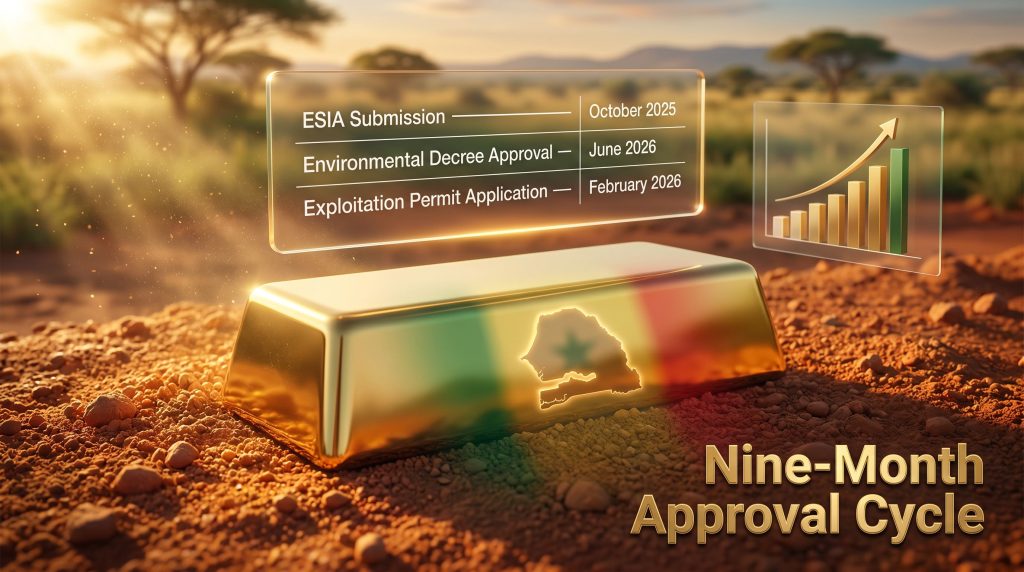
The Fortuna Diamba Sud ESIA approval in Senegal followed a submission in October 2025 and resulted in an environmental decree in June 2026, representing approximately nine months from lodgement to approval. To understand the significance of this timeline, it is necessary to benchmark it against comparable West African jurisdictions.
| Jurisdiction | Typical ESIA-to-Decree Timeline | Political Stability Index (World Bank) | Recent Mining Capital Flows |
|---|---|---|---|
| Senegal | 9 months (Diamba Sud) | Stable | Increasing |
| Côte d'Ivoire | 12 to 18 months | Moderate | Active |
| Guinea | 18 to 24 months | Volatile | Declining |
| Mali | 24 to 36+ months | High risk | Severely constrained |
| Burkina Faso | 24 to 36+ months | High risk | Near suspended |
Note: Regional timeline estimates are based on publicly reported project development histories and do not represent official government statistics.
The competitive advantage Senegal has established through institutional capacity and regulatory transparency is not incidental. Jurisdictions that demonstrate consistent, timely, and procedurally transparent permitting processes attract disproportionate capital allocation from risk-sensitive institutional investors who manage against benchmark risk thresholds. In a region where political instability has materially disrupted mining investment in Mali, Burkina Faso, and Guinea, Senegal's regulatory performance at Diamba Sud reinforces its positioning as a preferred destination for gold development capital. This is closely tied to the wider mining geopolitical risk landscape that investors must navigate in 2025 and beyond.
The Permitting Sequence: From ESIA to Construction Decision
The following table outlines the full regulatory and development sequence for the Diamba Sud project as it stands following the June 2026 environmental decree.
| Permitting Stage | Responsible Authority | Status (as of June 2026) |
|---|---|---|
| ESIA Submission | Ministry of Environment and Ecological Transition | Completed, October 2025 |
| Environmental Decree Approval | Ministry of Environment and Ecological Transition | Approved, June 2026 |
| Exploitation Permit Application | Ministry of Energy, Petroleum, and Mines | Submitted, February 2026 |
| Exploitation Permit Issuance | Ministry of Energy, Petroleum, and Mines | Pending |
| Feasibility Study Completion | Fortuna Mining (internal) | In progress |
| Final Construction Decision | Fortuna Mining (internal) | Targeted mid-2026 |
One noteworthy aspect of the Diamba Sud permitting sequence is that the exploitation permit application was submitted to the Ministry of Energy, Petroleum, and Mines in February 2026, four months before the environmental decree was issued in June 2026. This parallel-track approach, where the mining permit application is lodged ahead of the environmental decree being finalised, reflects sophisticated project management designed to compress the overall critical path to first production.
Fortuna Mining's Strategic Position at Diamba Sud
A Mid-Tier Producer Expanding Its West African Footprint
Fortuna Mining is a TSX- and NYSE-listed mid-tier precious metals producer with a multi-jurisdiction operating portfolio spanning West Africa and Latin America. The company's strategic rationale for advancing Diamba Sud reflects a broader trend among mid-tier gold producers seeking to add construction-stage assets in jurisdictions that offer a combination of geological prospectivity and manageable sovereign risk.
Diamba Sud is located within Senegal's established gold belt, a geological corridor that has attracted sustained exploration interest due to its structural setting and mineralisation characteristics consistent with orogenic gold systems. According to Fortuna's published preliminary economic assessment, the project delivers an after-tax IRR of 72% and an NPV5 of US$563 million at a gold price of US$2,750 per ounce, underlining its exceptional economic credentials. The project is currently transitioning from advanced exploration and feasibility into early construction, positioning it as one of the more advanced development-stage gold assets in the West African pipeline.
Early Construction Works: Reducing the Critical Path
An often-misunderstood aspect of large mining project development is the concept of early construction works, which are pre-final investment decision activities that do not require a full exploitation permit but allow a project to meaningfully reduce its time to first production. Typical activities in this category include:
- Site clearing and preparation.
- Access road and infrastructure development.
- Construction camp establishment.
- Long-lead equipment identification and preliminary procurement.
- Geotechnical investigation programs to support detailed engineering.
These activities carry a fraction of the total project capital requirement but can shorten the post-FID critical path by several months. For a gold project in a rising price environment, this compression can translate directly into accelerated revenue generation and improved project economics. Completing a definitive feasibility study to the required standard is a parallel imperative during this phase.
Fortuna has confirmed that early construction works are progressing at Diamba Sud concurrently with the feasibility study completion, with a final construction decision targeted for mid-2026.
How the ESIA Approval Reshapes the Investment Risk Profile
De-Risking Across Four Dimensions
The Fortuna Diamba Sud ESIA approval in Senegal addresses risk across four distinct categories that institutional investors monitor when evaluating development-stage mining assets:
- Regulatory risk: The environmental decree confirms compliance with all applicable environmental regulations, removing the possibility of project rejection on environmental grounds.
- Social risk: The formal certification of stakeholder social acceptance reduces the probability of community-driven project disruption during construction and operations.
- Environmental risk: The ESIA process requires comprehensive environmental baseline studies and mitigation plans, which are now documented in the regulatory record.
- Reputational risk: Projects with formally certified environmental and social credentials are better positioned for ESG screening by institutional capital pools that apply responsible investment filters.
Effective mining risk management across these four dimensions is increasingly a prerequisite for accessing institutional capital, particularly as ESG mandates tighten across major fund managers globally.
For ESG-aligned investors, the formal social acceptance certification embedded in Senegal's environmental decree creates a documented compliance record that is increasingly required by fund managers operating under responsible investment mandates.
What Remains Before Diamba Sud Enters Production
Several critical milestones must align before Diamba Sud can transition from a permitting-stage asset to an operating mine. African Mining Market has reported that Fortuna is targeting mid-2028 for first production, making the sequencing of the following steps particularly important:
- Exploitation permit issuance by the Ministry of Energy, Petroleum, and Mines following its review of the February 2026 application.
- Feasibility study completion, which must confirm project economics, capital requirements, and processing parameters to the standard required for a final investment decision.
- Final construction decision by Fortuna's board, expected around mid-2026, contingent on exploitation permit receipt and feasibility study outcomes.
- Full construction execution, encompassing process plant, tailings management facility, power infrastructure, and all associated site development.
- Commissioning and first production, the commercial outcome that converts the regulatory and capital investment into revenue-generating operations.
Each milestone carries its own timeline risk, and investors should note that the final construction decision remains conditional on the exploitation permit being issued by the Senegalese mining ministry. The environmental decree is a necessary but not sufficient condition for construction commencement.
This article contains forward-looking statements and projections. Actual outcomes may differ materially from those discussed. Readers should conduct independent due diligence before making investment decisions.
The next major ASX story will hit our subscribers first
Frequently Asked Questions: Fortuna Diamba Sud ESIA Approval
What is the Diamba Sud gold project?
A gold development project located in Senegal's gold belt, being advanced by TSX- and NYSE-listed Fortuna Mining, currently progressing through the final permitting stages ahead of a targeted construction decision.
What did the ESIA approval confirm?
The environmental decree from Senegal's Ministry of Environment and Ecological Transition formally certified that the project meets all applicable environmental regulatory standards and has received documented stakeholder social acceptance.
How long did the approval process take?
Approximately nine months elapsed between the ESIA submission in October 2025 and the environmental decree issuance in June 2026, a timeline that compares favourably to regional and global benchmarks for comparable mining projects.
What happens next after the ESIA is approved?
The exploitation permit application, already lodged with the Ministry of Energy, Petroleum, and Mines in February 2026, advances through its review process. Simultaneously, Fortuna is completing its feasibility study ahead of a targeted mid-2026 final construction decision.
Why does Senegal's regulatory performance matter for investors?
Jurisdictions that deliver consistent, transparent, and timely regulatory processes attract disproportionate capital from risk-sensitive institutional investors. The nine-month ESIA approval at Diamba Sud reinforces Senegal's positioning as a competitive mining destination in a region where regulatory uncertainty has constrained investment in several peer jurisdictions.
Want To Stay Ahead of Significant ASX Mineral Discoveries as They Happen?
Discovery Alert's proprietary Discovery IQ model scans ASX announcements in real time, delivering instant alerts on high-potential mineral discoveries across more than 30 commodities — turning complex data into actionable opportunities for investors at every level. Start your 14-day free trial today, or explore Discovery Alert's discoveries page to see how historic finds have generated substantial market returns.