July 10, 2026
West Africa's Permitting Paradox: Why Speed Is the New Competitive Moat in Gold Mining
Across the global mining industry, one constraint consistently separates exceptional projects from exceptional returns: time. A deposit can hold world-class grades and still destroy shareholder value if it spends a decade mired in regulatory processes. This reality has quietly elevated permitting as a value driver to the same strategic importance as geology itself. In this context, what is unfolding in Senegal deserves careful attention from anyone tracking the evolution of West African gold mining.
The Fortuna Diamba Sud Senegal gold project permit progression has become something of a case study in what streamlined mineral governance can look like when institutional frameworks function as designed. The numbers are striking, but the implications extend well beyond a single project.
When big ASX news breaks, our subscribers know first
How Senegal's Regulatory Speed Stacks Up Against Global Benchmarks
A Nine-Month ESIA: Rare by Any Standard
Environmental and Social Impact Assessments are typically the most time-consuming component of the pre-development regulatory process. In jurisdictions such as Peru, Mexico, and much of North America, the full ESIA review cycle routinely extends between 18 and 36 months, often longer when public consultation periods, appeals, or bureaucratic backlogs are factored in.
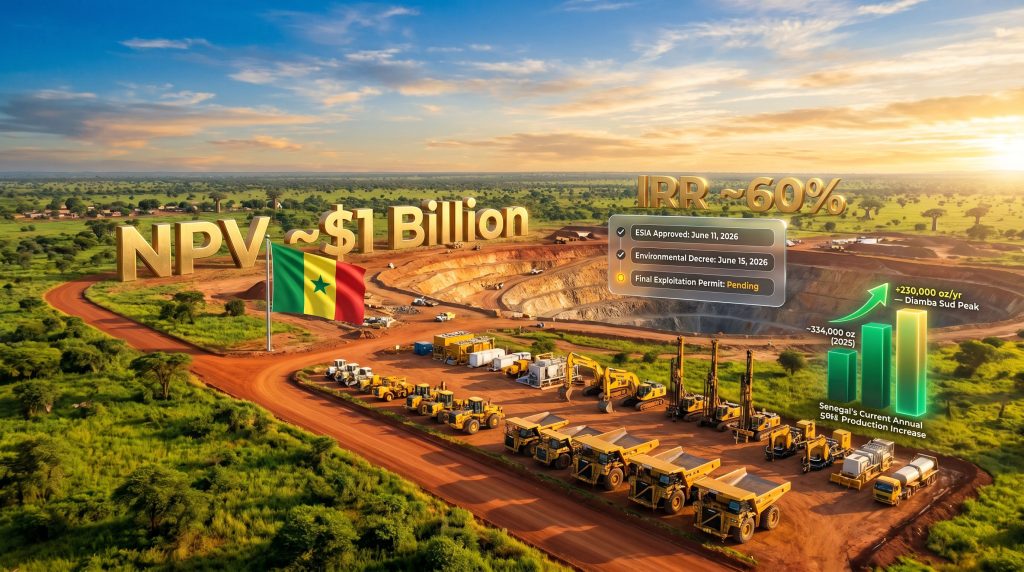
Senegal processed the full ESIA for Diamba Sud in approximately nine months. The formal mining permit application was submitted on February 4, 2026. The ESIA was approved on June 11, 2026, with the associated environmental decree issued just four days later on June 15, 2026.
| Permit Milestone | Status | Date |
|---|---|---|
| Mining Permit Application Filed | Complete | February 4, 2026 |
| ESIA Approval Granted | Complete | June 11, 2026 |
| Environmental Decree Issued | Complete | June 15, 2026 |
| Final Exploitation Permit | Pending | Expected mid-2026 |
| First Gold Production Target | Planned | 2028 |
Only the final exploitation and construction permit remains outstanding, with issuance anticipated within weeks of mid-2026. For a project of this capital magnitude, that is a remarkably compressed timeline.
Permitting efficiency is not simply a bureaucratic metric. It directly determines the internal rate of return of a mining project by compressing the gap between capital deployment and revenue generation. Every month shaved from the approval process translates into measurable NPV uplift.
Why This Matters Beyond Diamba Sud
The significance of Senegal's pace is not isolated to Fortuna Mining. It sends a broader signal to the global mining investment community: that a coastal West African jurisdiction is capable of processing complex environmental approvals at a speed that rivals the most efficient mining-friendly nations. Furthermore, for capital allocators weighing risk-adjusted returns across multiple geographies, this is material information. The current gold price outlook only amplifies the strategic importance of such efficiency.
Unpacking the Economics of Diamba Sud
Feasibility Metrics That Command Attention
Fortuna's June 2026 feasibility study produced results that are difficult to dismiss. The project's financial profile is among the most compelling of any undeveloped gold asset currently in the West African development pipeline.
| Financial Metric | Value |
|---|---|
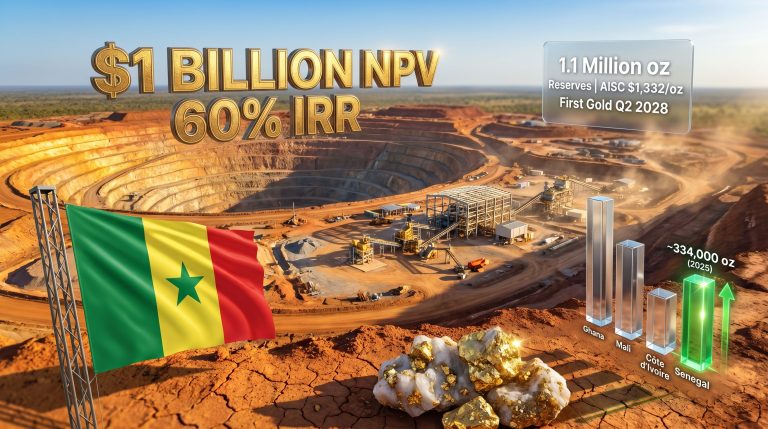
| After-Tax IRR | ~60% |
| After-Tax NPV | ~$1 billion |
| Gold Price Assumption | $3,500 per ounce |
| Total Development Capital | ~$400 million |
| Peak Annual Production | ~230,000 oz/year |
| First Gold Target | 2028 |
To contextualise the 60% after-tax IRR: mining projects generating returns of 20 to 25% are typically described as economically robust and commercially viable. A 60% figure sits in a category occupied by very few undeveloped assets globally. It reflects a combination of factors including mine design efficiency, relatively contained capital requirements relative to output, and a gold price environment that has remained elevated above $3,000 per ounce through much of 2025 and 2026.
It is worth noting that these economics are built on a gold price assumption of $3,500 per ounce. Investors should recognise that IRR and NPV projections are inherently sensitive to commodity price assumptions, and actual outcomes will depend on the gold price prevailing at the time of production. Forecasts of this nature carry inherent uncertainty and should not be treated as guaranteed returns.
Exploration Upside Still on the Table
Beyond the core development budget, Fortuna has committed more than $15 million to ongoing exploration at Diamba Sud. This is a meaningful allocation that signals genuine belief in the district's geological prospectivity. Additional resource discoveries could expand mine life, improve strip ratios, or unlock satellite deposits that feed the central processing facility, each of which would improve project economics further.
State Participation: A Structured Partnership Model
Upon issuance of the exploitation permit, the Senegalese state is entitled to a 10% free-carried interest in the project. Additionally, Senegal retains an option to acquire up to 25% equity. This structure reflects the broader trend of resource nationalism that has accelerated across sub-Saharan Africa in recent years, but it does so within a framework that still leaves meaningful economic upside for the project developer.
The free-carried interest mechanism means the state participates in project economics without contributing to capital costs up to that threshold, a model that has proven acceptable to institutional mining capital across multiple West African jurisdictions.
Pre-Permit Capital Deployment: A Signal Worth Interpreting
What Early Equipment Orders Actually Tell Investors
Fortuna has begun placing orders for critical long-lead equipment ahead of the final construction permit. Site access roads are already under development, and camp expansion works are progressing to accommodate an incoming construction workforce.
This is not simply operational pragmatism. In the mining industry, pre-commitment of capital before a final construction decision carries significant reputational and financial weight. Companies do not typically absorb the costs and risks of early procurement unless internal confidence in permit issuance is extremely high.
There is a practical rationale as well. Global mining equipment supply chains have tightened considerably over the past several years, with lead times for major components such as mills, crushers, and haul trucks extending to 12 to 24 months in some cases. Locking in delivery schedules now compresses the timeline between permit receipt and first production, protecting the 2028 first gold target.
Early procurement in mining is a calculated form of conviction signalling. It compresses timelines, manages supply chain risk, and communicates to host governments and investors alike that development momentum is real and not contingent on further delay.
Senegal's Position Within West Africa's Gold Production Hierarchy
A Transformational Addition to a Small Production Base
Senegal is not traditionally associated with gold. Its historical mining identity has been built around mineral sands and phosphate extraction. Gold production remains modest by regional standards, with national output reaching approximately 334,000 ounces in 2025. However, the Fortuna Diamba Sud Senegal gold project permit process signals a meaningful shift in the country's ambitions.
| Country | Approximate Annual Gold Output | Key Operators |
|---|---|---|
| Ghana | 4,000,000+ oz | Newmont, Gold Fields, AngloGold Ashanti |
| Mali | 2,000,000+ oz | Barrick, B2Gold, Allied Gold |
| Senegal | ~334,000 oz (2025) | Endeavour Mining, Managem |
Diamba Sud's projected peak output of approximately 230,000 ounces per year would, on its own, represent a ~69% increase in Senegal's entire national gold production. That is not a marginal addition. It is a structural transformation of the country's mining sector.
Currently, Senegal's gold sector features two significant operators:
- Endeavour Mining, which runs the Sabodala-Massawa complex, the country's largest producing gold mine.
- Managem (Morocco), which operates the Boto gold mine.
Diamba Sud would establish Fortuna as Senegal's third major gold producer, creating a more diversified operator landscape and deepening the country's gold mining infrastructure. In addition, broader gold market trends suggest that West Africa will attract increasing institutional attention as a preferred development corridor.
Political Risk in Context: Separating Noise from Structural Risk
Institutional Resilience as the Key Variable
Senegal experienced notable political disruption through 2025 and into 2026, including cabinet reshuffles and a high-profile breakdown in the relationship between President Bassirou Diomaye Faye and former Prime Minister Ousmane Sonko. For mining investors accustomed to assessing political risk premia, this backdrop warrants consideration.
What the Diamba Sud experience suggests, however, is that Senegal's mining bureaucracy maintained operational continuity throughout the political turbulence. The permitting process advanced on schedule despite executive-level instability. Fortuna's leadership has confirmed that its investment plans for the project remain entirely unchanged.
This distinction matters. Political noise at the executive level does not automatically translate to project-level risk when the institutional layers responsible for permitting and mining governance continue to function. Investors should monitor three specific variables going forward:
- Stability of the mining code and whether fiscal terms remain consistent across government transitions.
- Consistency of permitting timelines for new project applications entering the system.
- Tax framework predictability, particularly as Senegal's gold sector grows in national economic significance.
The next major ASX story will hit our subscribers first
Fortuna's Regional Ambitions: Diamba Sud as an Opening Move
A Broader West African Consolidation Thesis
Fortuna has publicly indicated it is evaluating acquisition and exploration opportunities across Senegal, Ivory Coast, and Guinea. The company's strategy reflects a thesis gaining traction among mid-tier gold miners: that concentrating capital in jurisdictions where permitting efficiency and geological prospectivity intersect creates compounding advantages over time. Consequently, gold M&A activity across West Africa is intensifying as peers take note.
Additional deal announcements in the region could emerge before the close of 2026. If that materialises, Diamba Sud would represent the first chapter of a multi-asset West African platform rather than a standalone project.
The macro environment supports this strategy. Sustained gold prices above $3,000 per ounce through 2025 and 2026 have dramatically improved the economics of West African development-stage assets. Simultaneously, geopolitical instability across parts of the Sahel has redirected institutional mining capital toward more stable coastal and southern West African jurisdictions, with Senegal, Ivory Coast, and Ghana among the primary beneficiaries.
Investors evaluating junior and mid-tier gold exposure in West Africa should consider that capital concentration in jurisdictions with proven permitting efficiency may generate structural advantages that are not fully reflected in current market valuations.
Understanding the junior mining risk-reward dynamic is therefore essential context for positioning within this evolving landscape.
FAQ: Fortuna Diamba Sud Senegal Gold Project Permit
When is the final permit expected?
The final exploitation and construction permit is anticipated within weeks of mid-2026, following receipt of the environmental decree on June 15, 2026.
What are the project's headline economics?
The June 2026 feasibility study confirmed an after-tax NPV of approximately $1 billion and an after-tax IRR of approximately 60%, modelled on a gold price of $3,500 per ounce.
How much capital is being invested?
Total development capital is approximately $400 million, with an additional $15 million-plus allocated to ongoing exploration.
What ownership does Senegal hold in the project?
Upon permit issuance, the Senegalese state receives a 10% free-carried interest, with the right to acquire up to 25% equity.
How does Senegal's permitting speed compare globally?
Senegal processed the Fortuna Diamba Sud Senegal gold project permit ESIA in approximately nine months. Comparable reviews in Peru, Mexico, and North America typically require 18 to 36 months.
Did political instability affect the project?
Fortuna has confirmed that Senegal's political turbulence in 2025 and 2026 did not alter investment plans. The permitting process continued to advance through the period of transition.
This article is intended for informational purposes only and does not constitute financial advice or a solicitation to invest. Mining project economics, including NPV and IRR projections, are based on feasibility study assumptions and are subject to change. Commodity price forecasts are inherently uncertain. Readers should conduct their own due diligence before making any investment decisions.
Want to Track the Next Major ASX Mineral Discovery Before the Market Moves?
Discovery Alert's proprietary Discovery IQ model delivers real-time alerts on significant ASX mineral discoveries, cutting through complex geological data to surface actionable investment opportunities the moment they are announced — explore Discovery Alert's discoveries page to see the kind of historic returns major finds have generated, and begin your 14-day free trial at Discovery Alert to position yourself ahead of the broader market.