
July 10, 2026
The Capital Allocation Trap That Misleads Mid-Tier Mining Investors
In the world of mid-tier gold mining, few analytical errors are more costly than misreading the purpose of a capital deployment announcement. When a company publicises a multi-million dollar investment program across multiple jurisdictions, the instinct is to assume all spending carries equal growth implications. It rarely does. Understanding the difference between capital that maintains production and capital that grows it is one of the most important distinctions any serious mining investor can make, and it sits at the heart of how to correctly interpret Fortuna Mining's current strategic positioning.
The Fortuna Mining investment in Argentina and Peru to boost gold production has attracted considerable attention in the Latin American mining media cycle. However, the framing of that narrative deserves scrutiny. Unpacking where Fortuna's genuine production growth is originating, and why West Africa has quietly become the company's most strategically significant geography, reveals a picture quite different from the headline.
When big ASX news breaks, our subscribers know first
Understanding Fortuna's Three-Mine Portfolio After Divestiture
Fortuna Mining has undergone a meaningful portfolio rationalisation in recent years, moving from a five-asset operating base to a more concentrated three-mine structure following the divestiture of the Yaramoko mine in Burkina Faso and the San Jose silver mine in Mexico. This consolidation was not merely a balance sheet exercise. It represented a deliberate strategic narrowing toward assets with stronger growth profiles and lower operational complexity relative to their output potential.
The consequence of this transition, however, was a temporary production gap — a period where consolidated output dipped before new assets fully ramped into their operational stride. Bridging that gap is the operational challenge Fortuna's management team is currently navigating.
On the financial side, Fortuna enters this growth phase in an unusually strong position for a mid-tier producer. The company holds approximately US$438.3 million in cash with a minimal debt load, a balance sheet configuration that separates it from many peers who have had to resort to dilutive equity raises or expensive streaming arrangements to fund growth programs. This financial flexibility is not incidental; it is the structural enabler of Fortuna's ability to fund organic West African expansion without compromising shareholder value.
In mid-tier gold mining, a cash-rich, low-debt balance sheet is arguably more valuable during a production transition period than at any other time. It removes the funding constraint that forces weaker-balance-sheet companies into value-destructive capital raises at precisely the moment their share price is under pressure.
What the Latin American Assets Actually Represent
Lindero: Operational Maturity, Not Expansion
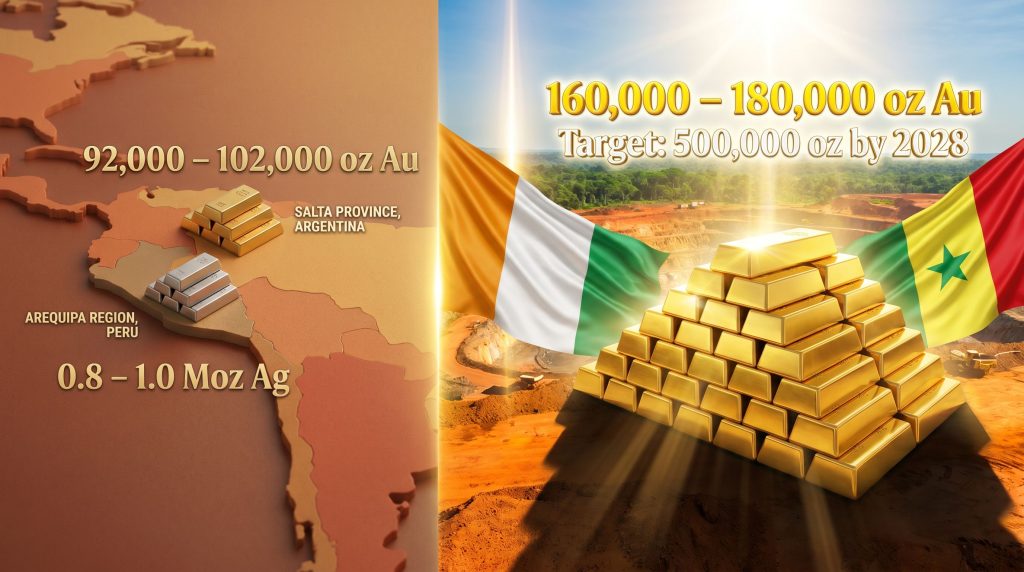
The Lindero gold mine, situated in the Salta Province of northern Argentina at an elevation exceeding 4,000 metres above sea level, is a heap-leach operation processing porphyry copper-gold ore. Its 2026 production guidance sits in the range of 92,000 to 102,000 ounces of gold, and with a remaining mine life of approximately nine years, it falls firmly into the category of a mid-stage, mature asset.
What is critical to understand about Lindero is the nature of capital being directed toward it. The investment focus at this operation centres on:
- Tailings management system improvements
- Processing efficiency optimisations
- Sustaining infrastructure maintenance
- Operational cost management in a high-inflation Argentine peso environment
None of these initiatives are designed to materially increase throughput or expand the gold ounce output beyond the current guidance band. They are sustaining programmes, essential for keeping the asset producing at current rates and managing the practical challenges of operating in Argentina's macroeconomic environment, which includes currency controls and significant inflationary pressure on local operating costs.
| Metric | Detail |
|---|---|
| Location | Salta Province, Argentina (~4,000m elevation) |
| Ore Type | Porphyry copper-gold, heap leach |
| 2026 Production Guidance | 92,000 to 102,000 oz Au |
| Remaining Mine Life | ~9 years |
| Capital Purpose | Sustaining and optimisation |
Caylloma: A Polymetallic Asset Incorrectly Framed as a Gold Story
The Caylloma mine in Peru's Arequipa region is frequently grouped into discussions about Fortuna's gold production, but this grouping obscures the asset's true character. Caylloma is fundamentally a silver, lead, and zinc operation with incidental gold output. Its 2026 silver production guidance of 0.8 to 1.0 million ounces is the primary revenue metric, supplemented by significant base metal by-products.
Gold production at Caylloma is a minor contributor to the site's overall revenue profile. The mine's primary value to Fortuna's portfolio lies in:
- Providing a polymetallic revenue stream that partially offsets gold price volatility
- Generating operating cash flows from base metals during gold price weakness cycles
- Diversifying jurisdiction risk within the Latin American segment of the portfolio
Investors who interpret Fortuna's Latin American capital allocation as a gold production growth catalyst at Caylloma are making a classification error that could lead to materially incorrect production forecasts. Furthermore, understanding mining investment risks and rewards in this context is essential for avoiding such misinterpretations.
Investor Clarification: Neither Lindero in Argentina nor Caylloma in Peru is the subject of a capacity expansion programme. Capital allocated to both assets in 2026 is primarily sustaining in nature. Interpreting this spending as a production growth catalyst is analytically incorrect.
Where Fortuna's Gold Growth Is Actually Being Generated
Séguéla: The Engine Behind the 2028 Ambition
The Séguéla gold mine in Côte d'Ivoire is the centrepiece of Fortuna's medium-term growth narrative, and the numbers support that assessment. Production guidance for 2025 sits at 134,000 to 147,000 ounces of gold, with the 2026 range expanding to 160,000 to 180,000 ounces. That represents a year-on-year growth rate of approximately 15 to 22 percent at the midpoint, which is exceptional for an operating asset at this stage of its mine life.
Séguéla is a high-grade, open-pit operation with ore characteristics that have consistently allowed for efficient processing. The deposit style found at Séguéla is typical of West African orogenic gold systems, which are known for producing structurally controlled, high-grade shoots within broader lower-grade halos. These systems are well understood geologically and tend to respond well to targeted exploration drilling programmes, which is why resource growth through the drill bit remains a credible pathway at the operation.
| Mine | Location | Primary Metal | 2026 Production Guidance | Strategic Role |
|---|---|---|---|---|
| Lindero | Salta, Argentina | Gold | 92,000 to 102,000 oz Au | Stable, mature cash-flow asset |
| Caylloma | Arequipa, Peru | Silver, Lead, Zinc | 0.8 to 1.0 Moz Ag | Polymetallic by-product contributor |
| Séguéla | Côte d'Ivoire | Gold | 160,000 to 180,000 oz Au | Primary gold growth engine |
Séguéla's operational scalability is central to Fortuna's stated target of reaching 500,000 gold-equivalent ounces per annum by 2028. That target represents a substantial uplift from current consolidated run-rates, and the mine's infrastructure base, including its processing plant and site services, has been designed with throughput flexibility in mind. According to Fortuna's Q3 2025 webcast, management has outlined a clear roadmap toward achieving this production milestone through disciplined capital deployment.
Diamba Sud: Building the Next Reserve Base in Senegal
Beyond Séguéla, Fortuna's West African growth thesis extends into Senegal through the Diamba Sud gold project. Senegal has been steadily building its reputation as an emerging mining jurisdiction, with a regulatory framework broadly considered more predictable than several neighbouring West African states. For Fortuna, geographic proximity between Diamba Sud and its existing Côte d'Ivoire operational infrastructure creates a potential capital efficiency advantage if the project progresses toward development.
Diamba Sud currently sits in the exploration and resource delineation phase. Key milestones to monitor include:
- Completion of follow-up drilling programmes designed to expand the known resource envelope
- Publication of maiden or updated mineral resource estimates
- Permitting progress within Senegal's mining regulatory framework
- Preliminary economic assessment timelines if resource delineation justifies advancement
The speculative but plausible scenario is that Diamba Sud could transition from exploration to development-stage classification within a three to four-year window. Fortuna's robust PEA for Diamba Sud highlights an after-tax IRR of 72% and an NPV5 of US$563 million, reinforcing its potential to contribute meaningfully to Fortuna's post-2028 production profile.
Comparing Risk and Opportunity Across Fortuna's Jurisdictions
Understanding Fortuna's asset base also requires a balanced view of the jurisdictional risk landscape across its operating geographies. Each location carries a distinct risk-reward profile that investors should weigh independently. In addition, broader gold M&A activity across the sector can shift competitive dynamics rapidly, making jurisdictional assessments even more critical.
| Jurisdiction | Key Risk Factors | Opportunity Factors |
|---|---|---|
| Argentina (Salta) | Currency controls, inflation, fiscal policy uncertainty | Established infrastructure, long mine life |
| Peru (Arequipa) | Community relations complexity, permitting timelines | Stable polymetallic cash flow stream |
| Côte d'Ivoire | Historical political instability episodes | High-grade ore, strong and growing production |
| Senegal | Emerging jurisdiction, limited operating track record | Significant exploration upside, regional proximity |
The US$71 million capital programme allocated to Argentina and Peru in 2026 is a number that has been widely cited in regional mining coverage. However, the composition of that figure matters more than the headline number. When disaggregated, the vast majority of that capital represents:
- Sustaining capital directed at maintaining existing infrastructure and processing capacity
- Tailings and environmental management spending required by regulatory compliance obligations
- Exploration drilling within existing licence areas, which is incremental rather than transformative
Growth capital — defined in mining analysis as expenditure genuinely designed to increase future production output above current run-rate levels — is concentrated in West Africa, not Latin America. This distinction is not a minor technical nuance; it is the difference between correctly and incorrectly forecasting Fortuna's production trajectory through 2028.
Analytical Framework: In mining sector analysis, the sustaining versus growth capital distinction is foundational. Sustaining capital keeps today's mines producing. Growth capital builds tomorrow's ounces. Conflating the two is one of the most common errors in retail mining investment analysis.
Scenario Analysis: The Path to 500,000 Ounces
Fortuna's 2028 production target requires meaningful output growth beyond what the current three-mine portfolio can deliver at steady state. Mapping out the scenarios reveals where the execution risk is concentrated. Consequently, the relationship between gold price and mining equities will play a pivotal role in whether that target is reached on schedule.
Bull Case: Séguéla delivers above mid-guidance performance through 2027, Diamba Sud advances into development faster than the base timeline suggests, and Lindero sustains the upper end of its guidance range. In this scenario, Fortuna reaches or approaches 500,000 ounces without a major acquisition.
Base Case: Séguéla tracks at or near guidance midpoints, Diamba Sud remains in exploration through 2027, and the Latin American assets perform in line with current forecasts. The 500,000-ounce target remains achievable but requires either a bolt-on acquisition or accelerated Séguéla resource growth.
Bear Case: Operational disruptions at Séguéla, driven by factors such as community relations challenges, weather events, or geotechnical issues common in open-pit West African operations, compress output. Combined with Senegalese permitting delays and below-guidance performance at Lindero, the 2028 target shifts materially out of reach on an organic basis.
Investor Suitability at a Glance
| Investor Profile | Fortuna Suitability | Key Consideration |
|---|---|---|
| Conservative / Income-focused | Low | No dividend; near-term production gap creates uncertainty |
| Balanced / Growth-oriented | Moderate | West African growth thesis intact but execution risk remains |
| Aggressive / Speculative | Higher | Strong balance sheet plus West African upside warrants consideration |
The next major ASX story will hit our subscribers first
Key Metrics Every Investor Should Track
For investors monitoring Fortuna's progress against its stated strategy, the following indicators are the most informative. Furthermore, definitive feasibility studies for projects such as Diamba Sud will be critical signposts in this process:
- Quarterly Séguéla production reports relative to the 160,000 to 180,000-ounce 2026 guidance range
- Capital expenditure disclosures with explicit sustaining versus growth capex categorisation
- Diamba Sud resource update announcements and any preliminary economic assessments
- All-in sustaining cost trends across the three-mine portfolio, particularly whether Séguéla's AISC is improving as throughput scales
- Balance sheet evolution, specifically whether the cash position is being deployed into growth or depleted by operational underperformance
The Fortuna Mining investment in Argentina and Peru to boost gold production narrative will continue to circulate in regional media. However, for investors seeking a rigorous understanding of where the company's production trajectory is actually being shaped, the answer lies overwhelmingly in West Africa. The Latin American assets provide cash flow stability and operational diversification, but they are not the chapter of this story that determines whether the company reaches its 2028 ambitions. Investors who understand that distinction are positioned to evaluate the company on the metrics that actually matter.
This article is intended for informational purposes only and does not constitute financial advice. All production guidance figures and financial data referenced are drawn from publicly available company disclosures. Investors should conduct independent due diligence before making any investment decisions. Forecasts, scenario projections, and analytical frameworks presented here involve inherent uncertainty and should not be relied upon as predictions of future performance.
Want to Catch the Next Major West African Gold Discovery Before the Market Does?
Discovery Alert's proprietary Discovery IQ model scans ASX announcements in real time, instantly identifying significant mineral discoveries across gold and beyond — turning complex data into actionable insights for investors at every level. Explore historic discoveries and the returns they generated, then begin your 14-day free trial at Discovery Alert to position yourself ahead of the broader market.