July 10, 2026
The Electrification Ceiling: Why South Africa Needs More Than Renewable Power
The global energy transition has a structural blind spot. For more than a decade, the dominant narrative has centred on electrification: replacing fossil fuels with wind turbines, solar panels, and batteries. Yet the physics and economics of industrial energy use reveal a fundamental constraint that even the most ambitious grid expansion cannot overcome. A growing body of engineering and energy system analysis confirms that direct electrification can realistically decarbonise only between 60% and 70% of the total economy. The remaining 30% to 40% requires something fundamentally different.
That something is green molecules and green hydrogen in South Africa — and understanding why they matter is essential for anyone tracking the country's energy transition trajectory.
South Africa, with its extraordinary renewable resource base and unique position in global platinum group metal (PGM) supply chains, sits at the intersection of this challenge and its solution. Furthermore, the country's exceptional solar irradiation and consistent wind resources create a structural cost advantage that few other nations can replicate, making the case for green molecule production both compelling and commercially credible.
When big ASX news breaks, our subscribers know first
Why Electrons Cannot Do It All
The concept of an electrification ceiling is not widely understood outside specialist energy circles, yet it is one of the most consequential constraints shaping decarbonisation strategy worldwide. SLR Consulting's Power Sector lead for the Middle East and Africa, Stuart Heather-Clark, has articulated this constraint clearly: renewable electricity, even at full grid penetration, can decarbonise only 60% to 70% of the economy. The remaining portion requires molecular energy carriers that can deliver the heat intensity, chemical reactivity, or energy density that electrons cannot economically provide.
The sectors where this constraint bites hardest include:
- Primary steelmaking, which requires carbon or hydrogen as a chemical reductant, not merely a heat source
- Long-haul aviation, where battery energy density remains orders of magnitude below jet fuel
- Deep-sea shipping, where the weight and volume of battery systems make electrification impractical at scale
- Ammonia-based fertiliser production, which relies on hydrogen as a feedstock through the Haber-Bosch process
- High-temperature industrial chemistry, including cement and petrochemical refining, where process temperatures exceed what electric resistance heating can practically achieve
The thermodynamic case is straightforward: many industrial processes require energy delivered in a specific chemical or thermal form, not simply as electrical current. Green molecules, particularly green hydrogen and its derivatives, are the only credible pathway to decarbonising these sectors.
What Are Green Molecules and How Are They Produced?
The term green molecules encompasses a family of chemical energy carriers produced using renewable electricity. The primary members of this family include:
- Green hydrogen: produced via electrolysis, splitting water into hydrogen and oxygen using renewable-powered electricity
- Green ammonia: synthesised by combining green hydrogen with nitrogen via the Haber-Bosch process, powered by renewables
- E-methanol: produced by combining green hydrogen with captured carbon dioxide
- Sustainable aviation fuel (SAF): derived from green hydrogen and carbon feedstocks through Fischer-Tropsch or methanol-to-jet synthesis
Crucially, renewables account for approximately 80% of the total cost of producing green hydrogen. This single fact reshapes the entire competitive geography of the sector. Unlike industries where capital costs, logistics, or labour dominate, green hydrogen production is primarily a function of how cheaply and abundantly renewable energy can be generated. That reality creates a profound structural advantage for geographies with exceptional solar irradiation, consistent wind resources, and large areas of developable land.
South Africa possesses all three in abundance.
South Africa's Structural Competitive Advantages
The Northern Cape alone receives among the highest solar irradiation levels recorded anywhere on earth. Combined with strong coastal and inland wind corridors, vast undeveloped land, access to both the Atlantic and Indian Oceans for desalination feedstock, and the world's largest known platinum reserves, South Africa's competitive position in green hydrogen production is structurally distinctive rather than simply aspirational. Indeed, critical minerals demand globally continues to accelerate, reinforcing South Africa's strategic importance in the energy transition supply chain.
| Competitive Factor | South Africa's Position |
|---|---|
| Solar irradiation | Among the globally highest, concentrated in the Northern Cape |
| Wind resources | Prime coastal and inland corridors |
| Land availability | Extensive undeveloped zones in key production areas |
| Coastal water access | Atlantic and Indian Ocean desalination potential |
| PGM reserves | World's largest platinum deposits for electrolyser catalysts |
| Industrial chemistry heritage | Established green molecule processing expertise |
The PGM dimension deserves particular attention. PEM electrolysis technology, currently considered the most efficient technology for producing high-purity green hydrogen, relies on platinum as a catalyst. South Africa produces the majority of the world's platinum, meaning the country could theoretically capture value at multiple points in the green hydrogen supply chain simultaneously: from mining the platinum used in electrolysers, to manufacturing those electrolysers, to producing the green hydrogen itself.
This vertical integration potential is rarely discussed in mainstream green hydrogen commentary but represents one of the most significant long-term economic opportunities embedded in South Africa's energy transition positioning.
It is worth noting, however, that alkaline electrolysis technology, which requires significantly less platinum, is advancing rapidly. If alkaline systems achieve cost and performance parity with PEM at scale, the PGM catalyst advantage could diminish. Investors should monitor electrolyser technology trajectories alongside production cost milestones.
South Africa's Green Hydrogen Cost Target: How Does It Compare?
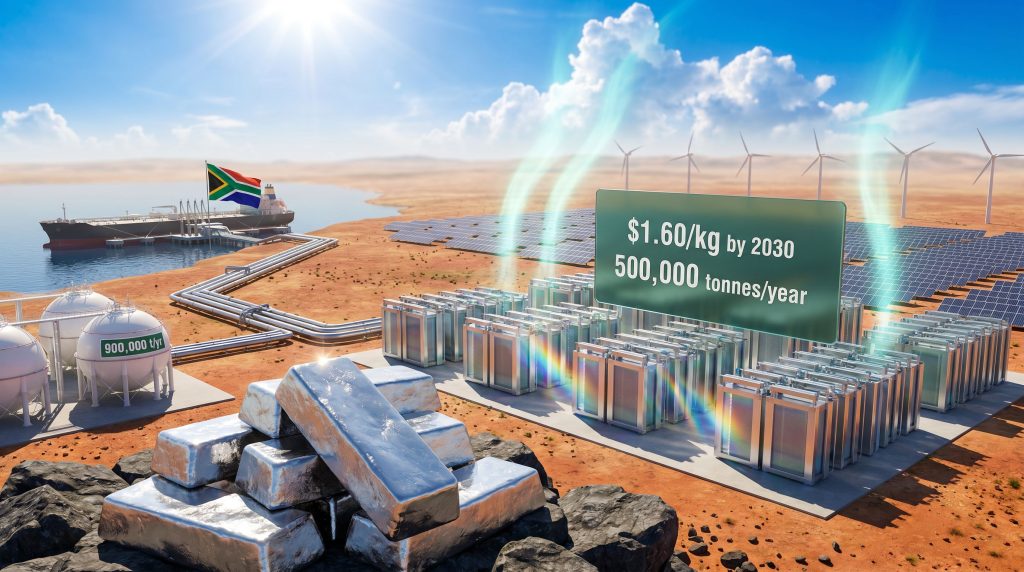
Current green hydrogen production costs in most markets range between $3 and $6 per kilogram, depending on the renewable energy mix, electrolyser technology, and local financing conditions. South Africa has established a national production cost target of $1.60 per kilogram by 2030, which, if achieved, would place the country among the lowest-cost producers globally.
The primary driver behind this target is the Northern Cape's renewable energy advantage. When renewable electricity is both abundant and cheap, and when it constitutes roughly 80% of production cost, even modest improvements in capacity factor or energy procurement pricing can translate into significant reductions in the final hydrogen cost.
| Country | Estimated Green H2 Cost Target (2030) |
|---|---|
| South Africa | ~$1.60/kg |
| Australia | ~$2.00/kg |
| Chile | ~$1.80/kg |
| Morocco | ~$1.70/kg |
| Namibia | ~$1.60/kg |
Note: International cost estimates vary by source and methodology. Figures above represent approximations based on publicly available national strategy documents and should be treated as indicative rather than definitive.
Analysts note that Chile and South Africa could become competitive green hydrogen exporters, though both nations face significant financing challenges in establishing these industries without excessive sovereign debt exposure.
National Production Targets and What the Numbers Mean
South Africa's green hydrogen ambitions are framed around a set of headline targets that, taken together, describe a substantial industrial transformation:
| Milestone | Target |
|---|---|
| Green hydrogen production by 2030 | 500,000 tonnes per annum |
| Northern Cape electrolysis capacity by 2030 | 10 GW |
| Northern Cape electrolysis capacity by 2040 | 15 GW |
| Projected GDP contribution by 2050 | 3.6% of national GDP |
| Jobs created by 2050 | 380,000 direct and indirect roles |
The 2030 production target of 500,000 tonnes per annum is significant in its own right. To put this in context, achieving 500,000 tonnes annually would require roughly 10 GW of installed electrolysis capacity, paired with a substantially larger renewable energy generation base. Electrolysis systems operate most efficiently when matched with near-continuous renewable supply, which means wind-solar hybrid configurations are likely to underpin major projects.
The 380,000 jobs projection by 2050, covering both direct and indirect employment, signals the scale of industrial ecosystem development that would need to accompany green hydrogen production at this level. Construction, operations, water management, logistics, electrolyser maintenance, and downstream molecule processing all contribute to this employment multiplier.
The next major ASX story will hit our subscribers first
The Major Green Hydrogen Hubs: Where Production Will Happen
Boegoebaai: The Mega-Scale Anchor Project
Boegoebaai, located on the Northern Cape coastline, represents the most ambitious single green hydrogen development site in South Africa's portfolio. Planning figures indicate an electrolysis capacity target of 40 GW, supported by 80 GW of combined solar and wind generation, with projected annual green hydrogen output of approximately 4 million tonnes. At full build-out, this would make Boegoebaai one of the largest green hydrogen production sites on earth.
The scale of Boegoebaai underscores a critical point: achieving South Africa's national targets is not simply a matter of aggregating small projects. It requires successfully delivering mega-projects of unprecedented industrial complexity in regions with limited existing infrastructure.
Saldanha Bay to Namakwa: The Near-Term Investment Corridor
The Saldanha Bay to Namakwa green hydrogen zone, approved in May 2024, represents a more immediately investable opportunity. With 1 GW of planned electrolysis capacity, this corridor is targeting annual output of 72,000 to 88,000 tonnes of green hydrogen, with renewable-powered Atlantic Ocean desalination providing water feedstock. Green ammonia exports from this zone are targeted to begin by 2029, making it the earliest credible large-scale export timeline in South Africa's green hydrogen pipeline.
Coega and Nelson Mandela Bay: The Industrial Export Gateway
The Coega special economic zone in the Eastern Cape hosts plans for a $4.6 billion green ammonia production facility, targeting 900,000 tonnes of ammonia per annum from 15 GW of dedicated renewable capacity. Export markets include Europe, Japan, South Korea, and the United States, with the Ngqura deep-water port serving as the primary logistics interface. Ammonia's energy density and compatibility with existing shipping infrastructure make it the preferred export vector for long-distance trade. This also aligns with the growing interest in green shipping fuels manufactured in South Africa, which the World Bank has identified as a significant near-term opportunity.
Domestic Hubs: Johannesburg, Durban, and Mogalakwena
South Africa's Hydrogen Society Roadmap designates three inland and coastal demand centres alongside the coastal export hubs. Mogalakwena in Limpopo is particularly notable for its dual role: the region hosts major PGM mining operations and is identified as a site for integrating green hydrogen production with existing industrial infrastructure. Durban functions as a logistics and industrial decarbonisation anchor, while Johannesburg represents the primary demand-side centre for industrial green molecule consumption.
Who Is Financing the Transition?
Public and Blended Finance Structures
The SA-H2 Fund, backed by the Industrial Development Corporation (IDC) and the Development Bank of Southern Africa (DBSA) alongside international development partners, provides a blended finance mechanism designed to de-risk early-stage project capital. The Netherlands government has committed €50 million to green hydrogen pilot projects in South Africa, and Germany's KfW development bank has been involved in concessional financing discussions for early-stage initiatives.
Blended finance is critical in this sector because green hydrogen projects carry a distinctive risk profile: high upfront capital costs, long project development timelines, and offtake markets that are still maturing. Concessional finance from development institutions can absorb first-loss risk, making it possible for private capital to enter at a commercially acceptable return threshold.
Corporate Industrial Participation
Sasol's ecoFT business unit represents one of the most significant corporate commitments to green molecule production in South Africa, targeting sustainable aviation fuel, e-methanol, and carbon capture-integrated green hydrogen production. Approximately 20 green hydrogen projects have been registered as Strategic Integrated Projects (SIPs), a designation intended to streamline permitting and planning processes, though this does not constitute direct government funding or capital commitment to specific projects.
Investment Consideration: The absence of confirmed direct capital commitments to specific plant sites remains a material risk for the sector's near-term scaling trajectory. Monitoring SIP project progression and offtake agreement announcements provides the clearest leading indicators of which projects are moving toward financial close.
The Export Versus Domestic Tension
One of the least-discussed strategic tensions in South Africa's green hydrogen planning is the allocation of green molecule output between export revenue and domestic industrial decarbonisation.
The export case is compelling: the EU Hydrogen Strategy and REPowerEU framework create structural demand for imported green hydrogen and ammonia, and Japan and South Korea have both established green hydrogen import targets. South Africa's ports are well-positioned to serve these markets.
However, the domestic case is equally significant:
- Green iron production through green hydrogen direct reduction (DRI) offers a compelling model for decarbonising South Africa's steel sector, supporting export competitiveness under the EU's Carbon Border Adjustment Mechanism (CBAM)
- Replacing grey hydrogen in existing chemical and refining processes offers near-term emissions reduction without requiring entirely new infrastructure
- Green hydrogen in heavy road transport and freight rail could reduce South Africa's transport emissions while supporting energy security
The tension between maximising export revenue and prioritising domestic energy resilience will require explicit policy resolution as the sector scales.
Key Barriers That Cannot Be Overlooked
Infrastructure and Grid Constraints
The Northern Cape's transmission grid was not designed to evacuate the volumes of renewable energy required to support gigawatt-scale electrolysis. Water scarcity adds a further constraint: large-scale desalination infrastructure requires significant capital and energy input. Port and pipeline connections between inland production zones and coastal export terminals represent additional bottlenecks. Consequently, the broader challenge of renewable energy in mining and industrial zones highlights just how significant grid expansion investment must be to unlock this potential.
Regulatory Complexity
Environmental authorisation timelines and permitting processes remain a practical constraint on project development velocity. The CBAM coming into effect in the EU also creates compliance obligations for South African exporters, requiring robust green hydrogen certification frameworks that do not yet fully exist at the required scale.
Social Licence and Community Equity
Large-scale renewable energy and green hydrogen development in the Northern Cape intersects with existing pastoral and agricultural land use, raising questions about equitable benefit distribution. Embedding local content requirements, skills development commitments, and community benefit agreements into project structures is not simply an ethical imperative; it is a practical prerequisite for maintaining the social licence to operate across multi-decade project timelines.
Frequently Asked Questions: Green Molecules and Green Hydrogen in South Africa
What is the difference between green electrons and green molecules?
Green electrons are electricity generated from renewable sources. Green molecules are chemical energy carriers, including green hydrogen, ammonia, and methanol, produced using that renewable electricity. While green electrons can power most of the economy through electrification, green molecules serve sectors where direct electrification is technically or economically impractical.
Why is South Africa well-positioned to produce green hydrogen?
South Africa benefits from world-class solar irradiation, strong coastal wind resources, abundant land availability, Atlantic and Indian Ocean access for desalination, the world's largest platinum reserves for electrolyser catalysts, and an established industrial chemistry base. Renewables account for approximately 80% of green hydrogen production costs, making South Africa's resource endowment a direct cost advantage.
What is green ammonia and why does it matter for exports?
Green ammonia is produced by combining green hydrogen with nitrogen through the Haber-Bosch process powered by renewable energy. It serves as an energy-dense and easily transportable carrier for green hydrogen, making it the preferred export format for long-distance trade with Europe and Asia.
When will South Africa's first large-scale green hydrogen exports begin?
The Saldanha Bay to Namakwa corridor is targeting green ammonia exports by 2029, representing the earliest credible large-scale export timeline. Larger initiatives such as Boegoebaai are expected to scale progressively through the 2030s.
What is South Africa's green hydrogen production cost target?
South Africa is targeting a production cost of $1.60 per kilogram by 2030, which would position it among the globally lowest-cost producers of green molecules and green hydrogen in South Africa's expanding industrial landscape.
Summary: Key Statistics at a Glance
| Metric | Figure |
|---|---|
| Economy decarbonisable by electrons alone | 60-70% |
| Economy requiring green molecules | 30-40% |
| Renewables share of green hydrogen production cost | ~80% |
| Green hydrogen cost target by 2030 | $1.60/kg |
| National production target by 2030 | 500,000 tonnes/year |
| Boegoebaai electrolysis capacity target | 40 GW |
| Boegoebaai annual hydrogen output | ~4 million tonnes |
| Saldanha Bay zone annual output | 72,000-88,000 tonnes |
| Coega green ammonia plant investment | $4.6 billion |
| Coega annual ammonia output | 900,000 tonnes |
| GDP contribution by 2050 | 3.6% |
| Jobs created by 2050 | 380,000 |
| SIP-registered green hydrogen projects | ~20 |
| Netherlands funding commitment | €50 million |
The Strategic Outlook: A Credible Superpower or a Structural Promise?
South Africa's green molecule ambitions rest on a genuinely compelling set of natural and industrial advantages. The combination of exceptional renewable resources, the world's largest platinum reserves, established industrial chemistry expertise, and deepwater export infrastructure creates a structural foundation that few other jurisdictions can replicate. Furthermore, the broader mining energy transition underway across the continent reinforces why South Africa's positioning is structurally significant rather than merely aspirational.
However, the gap between structural advantage and executed delivery is where most resource transitions stall. The 2026 to 2030 window is critical: projects that achieve financial close, secure anchor offtake agreements, and begin construction during this period will define whether South Africa's green molecule ambitions translate into a durable export industry or remain an underutilised strategic asset.
If the country successfully delivers 10 GW of electrolysis capacity by 2030 at a production cost of $1.60/kg, the resulting 500,000 tonnes of annual green hydrogen output would represent a meaningful contribution to the EU's projected green hydrogen import demand. This would simultaneously catalyse hundreds of thousands of domestic jobs and a multi-percentage-point contribution to national GDP by mid-century.
The physics of decarbonisation make green molecules structurally necessary. South Africa's geography and geology make it structurally competitive in green molecules and green hydrogen in South Africa's emerging industrial landscape. Whether governance, finance, and execution can close that gap is the defining question of the decade ahead.
This article contains forward-looking projections, including production cost targets, capacity milestones, and economic contribution estimates. These figures are drawn from national strategy documents and publicly available project announcements and should not be interpreted as guaranteed outcomes. Readers are encouraged to conduct independent due diligence before making investment decisions related to any green hydrogen or green molecule projects referenced above. Ongoing coverage of South Africa's green hydrogen sector and broader energy transition developments is available through Mining Weekly at miningweekly.com.
Want to Capitalise on the Next Major Mineral Discovery Powering the Energy Transition?
South Africa's green hydrogen ambitions depend on a vast supply of critical minerals — and Discovery Alert's proprietary Discovery IQ model delivers real-time ASX alerts the moment significant mineral discoveries are announced, transforming complex geological data into actionable investment insights. Explore historic discoveries and their market returns on Discovery Alert's dedicated discoveries page, and begin your 14-day free trial today to position yourself ahead of the market.