August 5, 2026
When Price Becomes the Product: Understanding the Economics Behind Fresnillo's Earnings Surge
There is a counterintuitive truth embedded in the way precious metals mining companies generate wealth. Unlike most industrial businesses, where revenue growth requires producing more, high-quality precious metals miners can see profits expand dramatically while output contracts. The mechanism is straightforward in theory but rarely as stark in practice as what Fresnillo delivered in the first half of 2026: Fresnillo profit triples as gold and silver prices rally, even as production volumes fell across nearly every major operation.
This dynamic, commonly called price leverage, is the defining financial characteristic of the precious metals mining sector. When the commodity you extract rises faster in value than your costs increase, each ounce sold generates exponentially more margin. At a certain price threshold, even double-digit volume declines become financially immaterial. Fresnillo's H1 2026 results are a textbook illustration of that principle at scale, and they raise deeper questions about what happens when the pricing environment eventually shifts.
When big ASX news breaks, our subscribers know first
What Actually Drove Fresnillo's Profit to Nearly Triple?
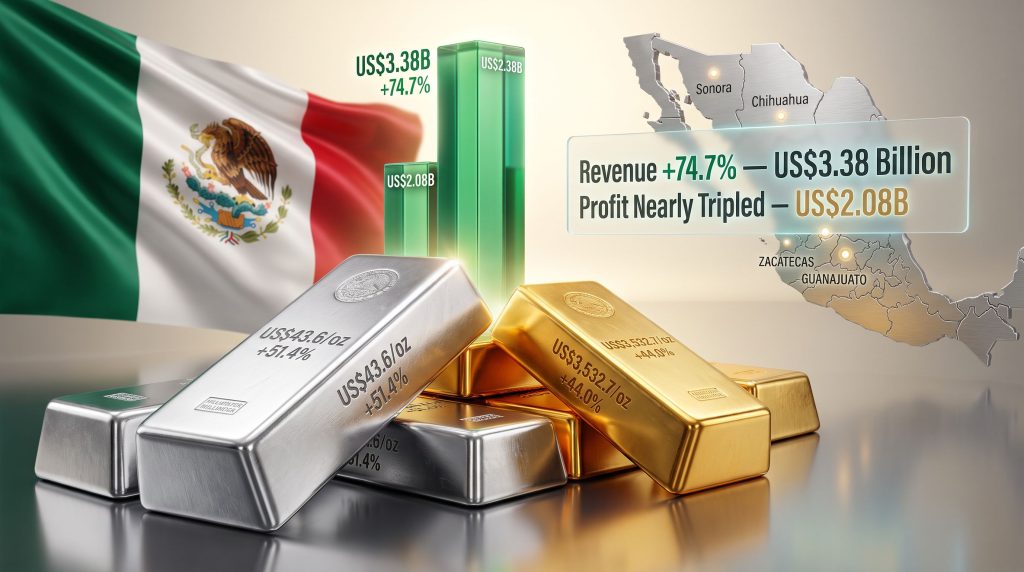
The headline numbers are striking. Revenue surged 74.7% to US$3.38 billion in the first half of 2026, while full-year 2025 pretax profit reached US$2.08 billion, compared to just US$743.9 million in the prior year. Gross profit more than doubled to US$2.664 billion on adjusted revenue of US$4.645 billion, a 27.6% year-on-year increase.
None of this was driven by selling more metal. It was driven entirely by selling metal at dramatically higher prices. Understanding how gold prices affect miners helps explain why these results are so remarkable in scale.
Average realised silver prices climbed 51.4% to US$43.6 per ounce across the full year, while average realised gold prices advanced 44.0% to US$3,532.7 per ounce. When realised prices rise at that pace, the mathematics of mining economics transform rapidly. A 51% uplift in silver prices means each ounce sold in 2025 generated roughly half as much again in revenue as an identical ounce sold the prior year, before a single additional dollar of operational cost is incurred.
In precious metals mining, price leverage is not a bonus feature of the business model. It is the central mechanism through which value is created or destroyed. Fresnillo's 2025 results demonstrate this with unusual clarity: the company sold less metal and made dramatically more money.
The table below summarises the full financial and operational picture:
| Metric | Value | Year-on-Year Change |
|---|---|---|
| H1 2026 Revenue | US$3.38 billion | +74.7% |
| Full-Year 2025 Revenue | US$4.56 billion | +31% |
| Full-Year Pretax Profit | US$2.08 billion | vs. US$743.9M prior year |
| Gross Profit (FY2025) | US$2.664 billion | More than doubled |
| Adjusted Revenue (FY2025) | US$4.645 billion | +27.6% |
| Avg. Realised Silver Price | US$43.6/oz | +51.4% |
| Avg. Realised Gold Price | US$3,532.7/oz | +44.0% |
| H1 Silver Production | 22Moz | -11.4% |
| H1 Gold Production | 290,900oz | -7.3% |
| Lead Production | Increased | +8.8% |
| Interim Dividend | US$0.43/share | Raised |
| Full-Year Dividend (2025) | 128.92 US cents/share | Highest since listing |
| Market Capitalisation | Post-results | |
| Sinda Placement | US$95.3 million | 7.94M shares at US$12 |
| 2026 Capex Guidance | US$500M to US$550M | Revised downward |
| 2026 Exploration Spend | ~US$260 million | Maintained |
| 2026 Silver Production Guidance | 42Moz to 46.5Moz | Full-year target |
| 2026 Gold Production Guidance | 500,000oz to 550,000oz | Full-year target |
How Production Declines Across Mexico Shaped the Financial Narrative
Silver: The Silverstream Wind-Down and Grade Deterioration
Attributable silver production, including the Silverstream royalty contribution, fell 11.4% year-on-year to 22Moz in H1 2026. The primary structural driver was the progressive wind-down of Silverstream's royalty contribution, compounded by deteriorating ore grades at multiple core assets. Furthermore, the broader silver demand drivers that have elevated prices globally make this production shortfall all the more financially consequential.
The affected operations span a significant portion of Mexico's premium silver belt:
- The Fresnillo and Saucito mines in Zacatecas state, both mature underground polymetallic systems operating on vein-style mineralisation
- The Juanicipio joint venture in Zacatecas, jointly operated with MAG Silver and the company's single highest-performing asset
- The San Julián vein system straddling the Chihuahua-Durango border, a relatively newer operation that has experienced throughput constraints
- Reduced processing capacity at several facilities compounding the grade-related shortfalls
Understanding why ore grade matters so much requires a brief technical note. In silver mining, the grade of the rock being processed, typically expressed in grams of silver per tonne (g/t), determines how much payable metal can be extracted from each tonne of ore milled. As a mine matures and higher-grade zones are progressively depleted, operators must either mine more tonnes to maintain production, which raises costs, or accept lower output. Neither outcome is ideal, and both are playing out simultaneously across several Fresnillo operations.
Gold: Mechanical Failures, Weather Events, and Structural Grade Decline
Attributable gold production fell 7.3% to 290,900oz during the first half, with the Herradura open-pit mine in Sonora bearing the largest structural burden. Herradura is a heap-leach gold operation, meaning crushed ore is stacked on lined pads and irrigated with a cyanide solution that percolates through the material, dissolving gold and carrying it to collection facilities. The process is highly sensitive to ore grade consistency and leach pad performance.
Several compounding factors hit Herradura simultaneously:
- Lower ore grades in the zones being mined during the period, a geological reality rather than an operational failure
- A mechanical fissure in a ball mill at Dynamic Leaching Plant I, creating unplanned maintenance downtime at a critical processing stage
- Commissioning delays for a new leaching pad, which postponed the addition of fresh processing capacity
- Adverse weather disruptions that further constrained operational continuity
The only meaningful production counterpoint came from by-products. Lead output rose 8.8% on improved grades at the Fresnillo and Juanicipio operations, while zinc production remained broadly stable, providing incremental revenue support without altering the broader volume trajectory.
The Grade Decline Problem: A Systemic Challenge Across Mexico's Silver Districts
Fresnillo's production challenges do not exist in isolation. They reflect a wider geological reality confronting Mexico's established precious metals mining sector. Zacatecas state alone hosts approximately 25% of Mexico's authorised gold-silver mining projects, making its grade trajectory a leading indicator for the national industry.
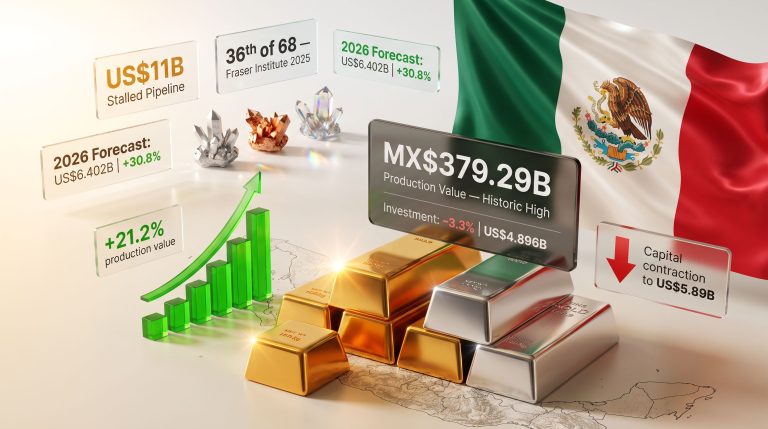
Mexico's mining investment fell 3.3% in 2025, according to data from Mexico Business News, a decline that predates any commodity price correction and signals underlying capital allocation concerns across the sector. The combination of falling investment and declining grades creates a compounding challenge: the ore bodies become less productive precisely when capital availability to develop replacement resources is tightening.
The relationship between elevated commodity prices and declining ore grades creates what can be described as a dual dependency risk: miners benefit financially from high prices in the short term, but require sustained exploration and infrastructure capital deployment to avoid a structural production shortfall when prices eventually normalise. Current profitability is, in part, obscuring the urgency of that longer-term challenge.
What Happens When the Price Cushion Narrows?
The financial mechanics are straightforward. At current gold and silver price levels, Fresnillo generates sufficient cash flow to absorb grade decline, fund exploration, and return capital to shareholders simultaneously. If gold were to retreat toward US$2,000/oz and silver toward US$20/oz, the revenue gap created by declining grades would become structurally exposed. The cost base does not contract proportionally with prices, meaning margin compression would be rapid and severe.
This is not a near-term prediction. It is a framework for understanding why Fresnillo's exploration commitment of approximately US$260 million annually matters far more than a single-year earnings figure, however impressive that figure may be. The gold-silver ratio analysis provides additional context for evaluating where relative value between the two metals currently sits.
How Fresnillo Is Reshaping Its Portfolio Beyond Mexico
The Probe Gold Acquisition: First Steps Outside Mexican Borders
In January 2026, Fresnillo completed the acquisition of Canada's Probe Gold, marking the company's first operational presence outside Mexico across its entire corporate history. The transaction added the Novador development project in Quebec to Fresnillo's pipeline, a jurisdiction widely regarded as one of the most mining-friendly in North America from a regulatory and infrastructure standpoint.
The acquisition was funded from the cash position generated by the company's elevated pricing environment, preserving balance sheet flexibility. CEO Octavio Alvídrez confirmed that the resulting financial position allowed the company to fund the acquisition, maintain capital spending and exploration commitments, and simultaneously lift the dividend, without compromising the balance sheet. This sequencing matters: it demonstrates that the Probe Gold move was an opportunistic use of windfall cash flows rather than a leveraged expansion bet.
The MAG Silver Exit and Its Strategic Logic
The Probe Gold acquisition was preceded by Fresnillo's exit from its stake in MAG Silver, following Pan American Silver's acquisition of that company. The transaction would have diluted Fresnillo's position to below 1%, a threshold the company determined was misaligned with its strategy for meaningful asset participation.
Critically, the exit had no impact on Fresnillo's 56% interest in the Juanicipio joint venture. This is an important technical distinction that some market observers initially misread. The MAG Silver equity stake and the Juanicipio joint venture interest are separate legal structures. Divesting the former left the latter completely intact, preserving Fresnillo's exposure to what remains its best-performing single asset and one of Mexico's top-ranked silver-producing operations based on data from Mexico's Mining Chamber.
The Sinda Investment: Geological Adjacency in Guanajuato
On July 27, 2026, Fresnillo closed a US$95.3 million private placement in Sinda Ltd, a junior explorer that had recently listed on the New York Stock Exchange with silver projects in Guanajuato Sur. Fresnillo's investor relations page provides further detail on how the company frames this strategic investment within its broader portfolio.
Several aspects of the transaction structure are worth examining closely:
- Fresnillo paid the full IPO price of US$12 per share for 7.94 million shares, accepting no negotiated discount despite its status as a large institutional buyer
- A 180-day lock-up period prevents resale until late January 2027, eliminating any short-term trading optionality
- Sinda's projects report 369Moz of silver-equivalent inferred resources, with vein mineralisation that Fresnillo has characterised as comparable to its own flagship Fresnillo, Guanajuato, and Pachuca mining systems
Paying full IPO price with a lengthy lock-up is unusual behaviour for a company of Fresnillo's scale and negotiating leverage. It signals genuine long-term strategic intent rather than financial engineering. The geological rationale is straightforward: Sinda's concessions in Guanajuato Sur sit adjacent to Fresnillo's existing concessions, meaning exploration success at Sinda would directly increase the value of surrounding ground that Fresnillo already controls.
This is what geologists and mining strategists call district consolidation positioning: acquiring early-stage exposure in a geological district where you already possess operational infrastructure, geological knowledge, and processing capacity. The marginal cost of adding production from an adjacent discovery is a fraction of greenfield development costs.
It is also worth noting that the Sinda transaction coincided with the Sheinbaum administration granting Fresnillo seven new mining concession titles, reflecting an improving permit approval cadence that increases the strategic value of early district positioning.
Comparing Fresnillo's Capital Allocation to Broader Sector Trends
| Strategic Dimension | Fresnillo's Approach | Broader Sector Trend |
|---|---|---|
| Geographic diversification | Selective (Canada entry via Probe Gold) | Aggressive multi-jurisdiction expansion |
| Junior exposure | Adjacency-focused (Sinda in Guanajuato) | Broad portfolio accumulation |
| Dividend policy | Progressive (highest payout since listing) | Variable, often deferred |
| Capital spending | Disciplined reduction (US$500M to US$550M) | Elevated across peers |
| Exploration commitment | Maintained (~US$260M) | Increasingly cut by peers |
The pattern that emerges from this comparison is one of precision over scale. Where many peers are expanding aggressively across multiple jurisdictions during the price rally, Fresnillo is concentrating incremental capital within districts where its existing geological competency creates genuine informational and operational advantages. As reported by Mining.com, this measured approach has resonated positively with analysts tracking the company's results.
The next major ASX story will hit our subscribers first
Production and Financial Targets for the Remainder of 2026
Full-Year Guidance and the H2 Acceleration Requirement
Fresnillo's full-year guidance creates a significant implied acceleration requirement for the second half of the year:
- Silver production guidance: 42Moz to 46.5Moz for the full year, against an H1 run rate of 22Moz
- Gold production guidance: 500,000oz to 550,000oz, against an H1 run rate of 290,900oz
- Capital expenditure guidance revised downward to US$500M to US$550M, reducing cash deployment while maintaining operational momentum
- Exploration spending projected at approximately US$260 million, held steady despite the capex reduction
Jefferies characterised the downward capex revision as a positive signal for free cash flow generation, while simultaneously noting that shares trade at approximately 1.2 times forward net asset value, suggesting the market has already priced in a substantial portion of the price-driven upside. The broker described the H1 results as a clean beat across earnings, cash flow, and sales volumes.
Shareholder Returns: A Record Dividend Signals Balance Sheet Confidence
The interim dividend was raised to US$0.43 per share for H1 2026. The full-year 2025 dividend reached 128.92 US cents per share, the highest payout since Fresnillo's stock market listing, with a final dividend component of 108.12 US cents per share. Markets responded with a 3.6% share price increase to 2,586p, valuing the company at approximately £19 billion, or roughly US$25 billion. However, it is worth noting that Fresnillo shares faced pressure earlier in the year when the silver rally faltered amid US tariff delays, highlighting how sensitive the stock remains to commodity price momentum.
Frequently Asked Questions: Fresnillo Profit, Gold, and Silver Prices
Why did Fresnillo's profit nearly triple if production actually fell?
The earnings surge was driven entirely by precious metals price appreciation rather than volume growth. When average realised silver prices rise by more than 51% and gold prices by 44%, the revenue impact of selling fewer ounces is more than offset by the higher value received per ounce. This is the price leverage dynamic that defines high-margin precious metals producers during commodity bull cycles, and it is precisely why Fresnillo profit triples as gold and silver prices rally even with declining output.
What is Juanicipio and why does it matter so much to Fresnillo's results?
Juanicipio is a silver-gold joint venture in Zacatecas, Mexico, in which Fresnillo holds a 56% interest. It is the company's best-performing individual asset and ranks among Mexico's top silver-producing operations according to Mexico's Mining Chamber data. Despite the MAG Silver divestment, Fresnillo retained its full Juanicipio stake, preserving its most productive operational exposure.
What is inferred mineral resource and how does it differ from a reserve?
An inferred mineral resource is an estimate of the quantity and grade of a mineral deposit based on geological evidence and limited sampling, but with insufficient confidence to be classified as a reserve. Mineral deposit tiers provide a useful framework for understanding these classifications in more detail. Sinda's 369Moz silver-equivalent inferred resource at its Guanajuato Sur projects represents geological potential rather than a certainty of recoverable metal. It must progress through indicated and measured resource categories, then economic feasibility assessment, before a portion could be designated a reserve and incorporated into mine plans.
How does Fresnillo's 2026 capital spending guidance affect free cash flow?
Reducing 2026 capex guidance to US$500M to US$550M while maintaining approximately US$260M in exploration spending concentrates cash deployment on reserve replacement rather than infrastructure expansion. Combined with elevated commodity prices, the reduced capex ceiling creates a materially stronger free cash flow profile, the dynamic Jefferies highlighted as a key positive in its assessment of the results.
Is Fresnillo's current profitability sustainable if gold and silver prices fall?
This is the central risk facing the company and the broader Mexican precious metals sector. Declining ore grades at Herradura, Saucito, Fresnillo mine, and San Julián mean production costs per ounce are rising structurally. If gold and silver prices retreat significantly, the financial buffer that currently masks these grade challenges would narrow, exposing the gap between current revenue levels and the underlying cost base. Interpreting drilling results from ongoing exploration programmes will be a key indicator of whether Fresnillo can replenish grades before this risk materialises.
The Longer-Term Outlook: Building a Production Base That Outlasts the Price Rally
Reserve Replacement and the Infrastructure Investment Imperative
Grade declines at Herradura, Saucito, Fresnillo mine, and San Julián represent a systemic challenge that no amount of price appreciation can permanently resolve. Every ounce mined from a finite ore body at declining grades moves the production profile closer to a structural inflection point. Fresnillo's commitment to approximately US$260 million in annual exploration spending is calibrated specifically to identify and advance the next generation of reserve additions before that inflection arrives.
Infrastructure projects remain equally important. The new leaching pad at Herradura, once fully commissioned, will restore processing throughput and partially offset the grade headwinds at that operation. These are not discretionary improvements. They are prerequisites for holding the production base stable during the period when exploration investment is converting new discoveries into mineable reserves.
The Efficiency-First Operating Model Under Elevated Prices
Management's focus on supply chain efficiencies and cost management within controllable parameters reflects a conservative operational philosophy that is well-suited to the current environment but also prudent preparation for a less favourable pricing scenario. The narrowing of capital spending guidance rather than broad expansion suggests Fresnillo is prioritising margin quality over production volume growth, a distinction that becomes especially important if precious metals prices correct.
Fresnillo's near-term financial performance will ultimately be determined by three variables: the persistence of elevated gold and silver prices, the pace of grade recovery or stabilisation at flagship operations, and the timeline for new assets including Novador and Sinda's Guanajuato projects to reach meaningful production contribution. How these three variables align will define whether the current earnings cycle, in which Fresnillo profit triples as gold and silver prices rally, represents a durable step change or a price-dependent peak.
This article contains forward-looking statements and financial projections that are subject to material risks and uncertainties. Commodity prices, production volumes, and capital expenditure outcomes may differ materially from guidance. Nothing in this article constitutes financial or investment advice. Readers should conduct their own independent research before making any investment decisions.
Want to Catch the Next Major Precious Metals Discovery Before the Market Does?
Discovery Alert's proprietary Discovery IQ model delivers real-time alerts on significant ASX mineral discoveries — instantly translating complex geological data into actionable investment insights for both short-term traders and long-term investors. Explore how historic discoveries have generated substantial returns on Discovery Alert's dedicated discoveries page, and begin your 14-day free trial today to position yourself ahead of the broader market.