August 3, 2026
Silver Mining's Invisible Fault Line: When the World's Biggest Producer Slows Down
The mechanics of silver supply rarely attract the same attention as gold discoveries or copper demand cycles, yet the structural forces shaping primary silver output may be among the most consequential and least understood dynamics in commodity markets today. Underground silver mining, particularly within the mature epithermal vein systems of central Mexico, operates under a set of geological constraints that are both inevitable and frequently underestimated by markets until the production data makes them impossible to ignore.
The Fresnillo silver output drop that has unfolded across 2025 and into 2026 is not simply a quarterly operational blip. It reflects a convergence of geological depletion, processing inefficiency, and mine-plan sequencing challenges that, when viewed through the lens of global supply concentration, carry implications well beyond one company's financial results.
When big ASX news breaks, our subscribers know first
Why Silver Supply Concentration Amplifies Single-Producer Risk
Unlike gold, where annual mined output is distributed across major operations on six continents, the primary silver mining sector is structurally narrow. Roughly 28 to 30% of global silver supply comes from dedicated primary silver mines, where silver is the principal economic driver. The remainder arrives as a by-product from lead, zinc, copper, and gold operations, meaning extraction decisions at those sites respond to base metal or gold economics rather than silver price signals.
This creates a critical asymmetry: when primary silver producers reduce output, by-product silver supply does not automatically compensate. A zinc miner in Peru will not increase throughput simply because the silver price rises if zinc margins are under pressure. Primary producers like Fresnillo plc are therefore uniquely price-responsive and uniquely consequential to global supply balances.
Fresnillo operates as the single largest primary silver mining company in the world. Its four principal silver-producing assets — the flagship Fresnillo underground mine, Saucito, Juanicipio (a joint venture with MAG Silver Corp), and Ciénega — collectively represent a meaningful proportion of annual global mined silver output. Mexico as a whole contributes approximately 23 to 25% of global mined silver supply, and Fresnillo accounts for a substantial share of that national output. Consequently, any sustained production deterioration at this scale is, in practical terms, a global supply event.
The Geological Reality Behind Declining Ore Grades
To understand the Fresnillo silver output drop at its root, it is necessary to understand the geology of the ore bodies being mined. Fresnillo's operations are hosted within epithermal vein systems, a deposit type formed by hydrothermal fluids circulating through fractures in the earth's crust at relatively shallow crustal depths. These systems are well known for their high-grade silver and gold mineralisation, but they also carry a structural characteristic that creates long-term mining challenges: grade distribution within epithermal veins is highly irregular, with bonanza-grade zones often flanked by lower-grade or barren rock.
As mining progresses deeper into these systems, several geological realities become operationally significant:
-
Vein narrowing at depth: Many epithermal systems pinch at depth, meaning the physical width of the ore-bearing vein decreases. When a vein narrows below the minimum practical mining width, operators are forced to extract surrounding waste rock to create a workable excavation, a process that mechanically dilutes the ore grade reaching the processing plant.
-
Grade zonation: The highest-grade silver zones in epithermal systems frequently correlate with specific structural features or boiling zones from ancient hydrothermal activity. Once these zones are mined through, the remaining ore body may grade substantially lower.
-
Ore shoot continuity: Individual high-grade ore shoots within a vein can terminate laterally or at depth, requiring expensive lateral and vertical development to locate the next economic zone.
Fresnillo has explicitly attributed a significant portion of its output weakness to grade deterioration across multiple mine sites. Lower silver content per tonne of ore, combined with narrower vein widths driving higher dilution, has reduced mill feed grades across operations. This is not a temporary scheduling anomaly; it is the geological progression of mature underground mines advancing through the natural grade profile of their host ore bodies. For further context, understanding silver's dual nature as both a precious and industrial metal helps explain why these supply-side pressures carry such wide-ranging consequences.
Quantifying the Fresnillo Silver Output Drop: Production and Guidance Data
The scale of the production decline becomes clear when the numbers are laid out sequentially.
| Period | Silver Production | Change | Primary Driver |
|---|---|---|---|
| Full-Year 2024 | ~56.3 million oz (implied) | Baseline | Reference period |
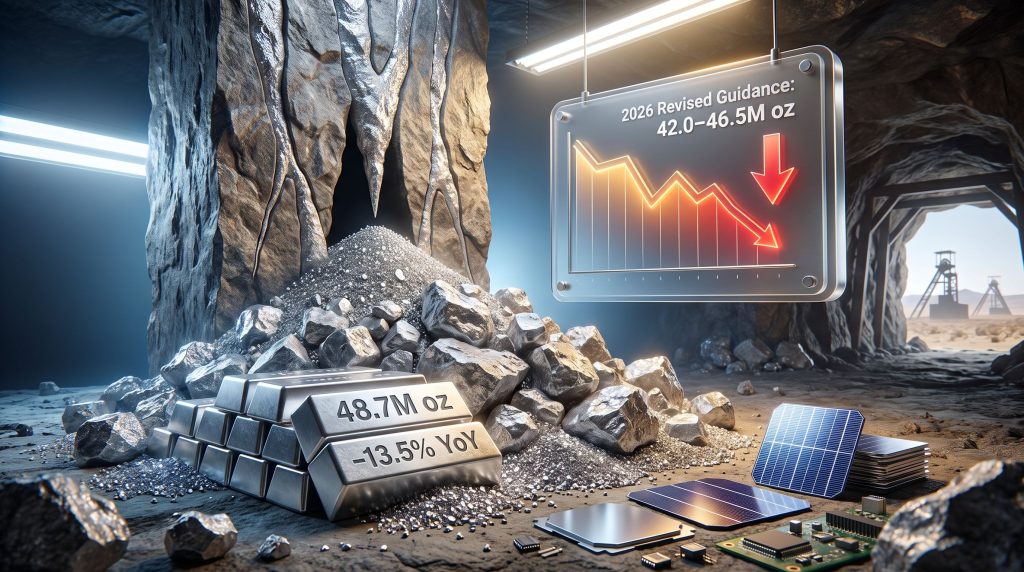
| Full-Year 2025 | 48.7 million oz | -13.5% YoY | Grade decline, throughput reduction |
| Q1 2026 | 11.1 million oz | -8.5% QoQ | Lower ore grades, reduced ore processed |
| Q2 2026 | Slight sequential recovery | -15% YoY | Comparison against strong prior-year quarter |
The guidance revision that accompanied this production trajectory is equally significant. Fresnillo cut its 2026 full-year silver production guidance from an original range of 45.0 to 51.0 million ounces to a revised range of 42.0 to 46.5 million ounces, representing a midpoint reduction of approximately 3.75 million ounces, equivalent to roughly 8% of the original forecast midpoint.
The lower boundary of the revised guidance range, at 42.0 million ounces, would represent the company's weakest annual silver output in recent memory, a threshold that transforms the narrative from operational challenge to structural concern.
The multi-variable nature of the decline is what makes it operationally resistant to quick fixes. Grade deterioration, reduced ore throughput volumes, and lower silver recovery rates have occurred simultaneously across multiple assets. When a single variable underperforms, targeted interventions are feasible. However, when three variables deteriorate concurrently across four mines, the recovery timeline extends considerably.
Asset-Level Analysis: Where the Shortfalls Are Concentrated
Fresnillo Mine (Flagship Operation)
The namesake underground mine remains the company's highest-volume silver contributor, but grade deterioration in deeper mining zones has progressively compressed mill feed quality. As the operation advances into narrower vein geometries, dilution from waste rock increases and the recovered silver grade per tonne processed declines accordingly.
Saucito Mine
Saucito has historically performed as a reliable secondary contributor, but mine-plan sequencing through transitional ore zones has introduced periods of below-average silver recovery. This type of grade variability is characteristic of operations moving between ore shoots within a vein system.
Juanicipio (Joint Venture with MAG Silver Corp)
Perhaps the most closely watched asset from a market perspective, Juanicipio was expected to serve as a production growth driver following its commissioning ramp-up. The mine hosts exceptionally high-grade silver mineralisation in the Valdecañas vein, with reported grades that rank among the highest-grade silver ore bodies currently in production globally. However, near-term operational sequencing through development-phase lower-grade zones has tempered its production contribution in 2025 and early 2026. The long-term reserve-backed potential of Juanicipio remains intact, but the ramp-up timeline has extended beyond initial market expectations.
Ciénega Mine
Ciénega operates at a smaller scale than the other three principal assets, meaning individual operational disruptions carry proportionally larger impacts on its quarterly output figures. Furthermore, narrow vein geometries and grade variability have contributed to the company-wide shortfall.
Mexico's Broader Silver Sector: Systemic or Isolated?
A critical question for silver market analysts is whether the Fresnillo silver output drop is company-specific or reflects a wider depletion trend across Mexico's silver-producing districts.
The evidence points toward a sector-wide dynamic. Mexico's silver-producing regions — primarily in the states of Zacatecas, Durango, and Chihuahua — host mature epithermal vein systems that have been mined for decades in some cases and for over a century in others. Grade depletion across ageing mine districts is a geological inevitability, and the timeline of that depletion is now making itself visible in production statistics. Indeed, global silver production data for 2025 reflects this creeping structural tightening across several key producing nations.
The supply structure comparison below illustrates why primary mine declines in Mexico are difficult to offset through other supply channels:
| Supply Source | Share of Global Silver Output | Sensitivity to Silver Price |
|---|---|---|
| Primary silver mines | ~28-30% | High |
| By-product from lead/zinc mines | ~35-38% | Low |
| By-product from gold mines | ~12-15% | Low |
| By-product from copper mines | ~15-18% | Low |
Because by-product silver producers base extraction decisions on their primary metal economics, a contraction in primary silver supply creates a gap that the market cannot automatically self-correct through increased by-product volumes.
The next major ASX story will hit our subscribers first
Industrial Demand: The Collision Course
The timing of the production shortfall matters enormously when placed against the trajectory of industrial silver demand. The photovoltaic solar manufacturing industry has become the single fastest-growing source of silver consumption globally. Modern solar cells rely on silver paste for electrical conductivity within the cell, and the per-panel silver loading, while declining incrementally as manufacturers pursue thrifting strategies, has not fallen fast enough to offset the explosive growth in panel production volumes.
The Silver Institute has projected that industrial silver demand will remain elevated through the late 2020s, with solar PV alone consuming an estimated 200 million or more ounces annually at scale. Electric vehicle charging infrastructure, 5G telecommunications components, and advanced electronics add further layers of structural industrial demand. In addition, the silver supply deficits already emerging in 2025 suggest these pressures are intensifying faster than many analysts anticipated.
When primary mine supply from the world's largest primary producer contracts against this demand backdrop, the silver market faces a tightening dynamic that cannot be quickly resolved. Above-ground inventories held in COMEX and LBMA-registered warehouses, as well as ETF holdings, serve as the buffer during supply-demand imbalances. Sustained drawdowns of these inventories historically correlate with upward price pressure over multi-quarter timeframes.
Three Scenarios for Fresnillo's Production Trajectory Through 2027
Scenario A: Operational Recovery
Mine-plan sequencing returns to higher-grade ore zones in the second half of 2026. Juanicipio advances through its development-phase lower-grade areas and begins contributing more substantial ounces. Full-year 2027 production recovers toward the 48 to 52 million ounce range. Market impact remains neutral to modestly constructive for silver supply.
Scenario B: Prolonged Grade Decline
Grade deterioration continues at Fresnillo and Saucito without successful near-mine exploration offsetting depletion. Annual production remains below 45 million ounces through 2027. This scenario would represent meaningful primary supply tightening and could support silver prices above prevailing levels.
Scenario C: Structural Decline Requiring Major Capital Deployment
Persistent underperformance triggers a fundamental reassessment of mine life and reserve estimates across the portfolio. The company initiates a major capital programme to develop new ore bodies, but the typical 3 to 5 year development timeline for new underground capacity creates a prolonged production gap. This scenario carries the most significant upward implications for silver prices, as markets would be forced to price in sustained primary supply reduction from the world's largest primary producer. For comparison, Endeavour Silver's expansion strategy in Peru demonstrates how mid-tier producers are positioning themselves to fill emerging supply gaps.
Disclaimer: Scenario projections are speculative and based on publicly available production data and geological reasoning. They do not constitute investment advice. Past production trends are not necessarily indicative of future performance.
What Investors and Analysts Should Monitor
For those tracking the production shortfall and its market implications, the following indicators provide the earliest signals of directional change:
-
Quarterly ore grade disclosures per mine site, as the most direct leading indicator of whether deterioration is stabilising
-
Annual reserve and resource estimate updates, particularly reserve replacement ratios showing whether new mineralisation is being added at the rate of depletion
-
Juanicipio ramp-up progress, given the asset's high-grade potential and its importance to any medium-term production recovery
-
Capex guidance trends, as reductions in exploration or development spending in response to short-term cost pressures would signal compounding medium-term risk
-
Mexico's regulatory environment for mining, including legislative developments that affect permitting, water rights, and community consultation requirements, all of which add operational risk layers to an already-challenged production outlook
-
Silver price trajectory relative to all-in sustaining costs, since higher prices improve the marginal economics of processing lower-grade ore and can partially offset volume declines
Recent reporting from the Mining Journal confirms the depth of these operational challenges, while revised output targets for 2026 underscore that this is not a short-term deviation. Furthermore, the silver market backwardation observed in 2025 may well be an early pricing signal that traders are beginning to absorb what primary supply data is already showing.
The Fresnillo silver output drop, taken in isolation, is a company-specific operational challenge. Placed within the context of Mexico's broader grade depletion trend, rising industrial silver demand, and the structural limitations of by-product supply response, it becomes something more significant: an early indicator of a primary silver supply cycle that markets may not yet be fully pricing.
Want to Capitalise on Structural Shifts in Silver Supply?
Discovery Alert's proprietary Discovery IQ model scans ASX announcements in real time, instantly identifying significant mineral discoveries — including silver — and delivering actionable alerts before the broader market reacts; explore historic examples of exceptional discovery returns to understand what early positioning can mean, then begin your 14-day free trial at Discovery Alert to secure a market-leading edge.