August 14, 2026
The Evolution Beyond Traditional Hydrocarbon Development
North American offshore energy markets face unprecedented transformation pressures as traditional development models encounter economic and regulatory headwinds. Frontier Failures Force Eastern Canada to Rethink Its Offshore Strategy becomes evident as operators must balance legacy asset optimisation with emerging renewable energy opportunities. The convergence of regulatory expansion, technological advancement, and market diversification creates new strategic imperatives for energy portfolio management.
Eastern Canada's offshore sector exemplifies this transformation through its recent transition from single-commodity focus toward integrated energy platform development. The implementation of comprehensive regulatory frameworks now encompasses both hydrocarbon and renewable energy oversight, fundamentally altering how operators approach regional asset development and risk management strategies.
When big ASX news breaks, our subscribers know first
Market Signals from the 2025 Licensing Disappointment
The Canada-Newfoundland and Labrador Offshore Energy Regulator's 2025 licensing round revealed critical market dynamics through its unprecedented zero-bid response across 36 offered parcels. This outcome, spanning Eastern Newfoundland's 24 parcels and Labrador South's 12 parcels, represents the first complete market rejection in the region's licensing history.
Investment Climate Analysis
2025 Licensing Round Performance:
| Licensing Area | Parcels Available | Market Response | Submission Period |
|---|---|---|---|
| Eastern Newfoundland | 24 parcels | Zero bids | May 22 – Nov 5, 2025 |
| Labrador South | 12 parcels | Zero bids | May 22 – Nov 5, 2025 |
| Jeanne d'Arc Nominations | Call issued Aug 29 | Minimal interest | Deadline passed |
The market's complete withdrawal from frontier exploration reflects several convergent factors affecting investment decision-making. Federal emissions cap policies have created regulatory uncertainty regarding long-term project viability, particularly for developments requiring extended timelines to achieve commercial production.
Deepwater exploration economics present additional challenges, with individual drilling campaigns exceeding $100 million per well in frontier areas. These capital requirements, combined with recent mixed commercial results in high-profile exploration programs, have shifted risk-adjusted returns below acceptable investor thresholds.
Furthermore, Canada's energy transition challenges compound these investment hesitations. Moreover, global OPEC oil production impact creates additional market volatility that discourages frontier exploration investments.
Regional Production Context
Despite exploration challenges, current production metrics demonstrate continued operational viability. Newfoundland and Labrador's October 2025 oil production increased 37.2% year-over-year, highlighting the region's ongoing contribution to North American energy supply. However, this production growth occurs against projected decline trajectories for aging infrastructure, creating urgency around new project development.
Strategic Recalibration Toward Proven Assets
Production Portfolio Management
Current offshore Eastern Canada production centres on established infrastructure within proven geological systems. The region's three major production hubs – Hibernia, Hebron, and White Rose fields – provide operational foundations for sustained output through existing pipeline and processing infrastructure.
2024-2030 Production Trajectory:
| Metric | Current Status | Projected Capacity | Timeline |
|---|---|---|---|
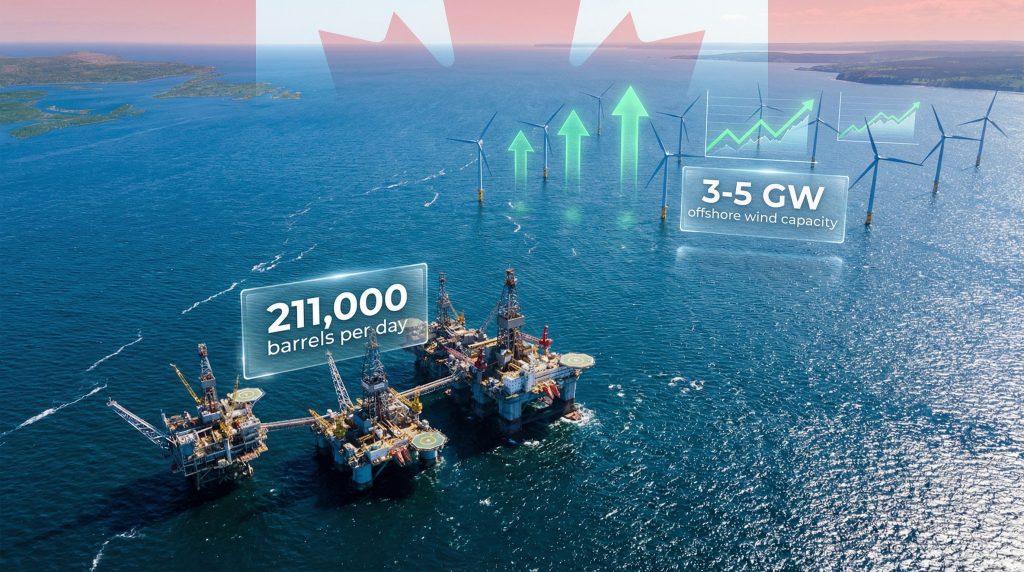
| Daily Output (2024) | 211,000 barrels | Baseline production | Current |
| Peak Capacity (2030) | 270,000 barrels | Maximum potential | Target |
| Decline Risk | Post-2025 | Significant without new projects | Critical |
Major Project Development Pipeline
West White Rose Extension (Cenovus):
- Investment scale: C$900 million to C$1 billion
- Commercial timeline: First oil H1 2026
- Production capacity: 45,000 barrels per day peak
- Strategic value: Infrastructure leveraging proven reserves
Terra Nova Life Extension (Suncor):
- Project status: Life extension completed 2025
- Sustained output: 30,000 barrels per day
- Strategic significance: Asset repurposing demonstration
Bay du Nord Development (Equinor):
- Current status: Business case optimisation
- Final investment decision: Post-2027 timeline
- Development approach: Deepwater frontier validation
Geological Foundation Analysis
The Jeanne d'Arc Basin represents Eastern Canada's most thoroughly understood petroleum system, characterised as a large asymmetric half-graben structure. The basin's primary source rock, the Kimmeridgian Egret Member of the Rankin Formation, correlates with prolific hydrocarbon-generating formations across conjugate basins.
Reservoir characteristics consist of coarse-grained, regionally persistent marine sandstones within turbidite sequences spanning Late Jurassic through Early Cretaceous periods. This geological continuity provides operators with predictable development parameters and reduced exploration risk compared to frontier basin alternatives.
Renewable Energy Integration Opportunities
Regulatory Framework Expansion
Bill C-49's October 2025 Royal Assent fundamentally expanded offshore energy regulatory mandates beyond traditional hydrocarbon oversight. The legislation enables both C-NLOER and the Canada-Nova Scotia Offshore Energy Regulator to oversee renewable energy development, creating integrated regulatory frameworks for multi-energy platform management.
In addition to addressing offshore regulatory challenges, this framework positions Eastern Canada for substantial renewable energy development. Furthermore, these changes align with broader industry evolution trends affecting resource sectors globally.
Nova Scotia Offshore Wind Initiative
The West Atlantic Energy call for bids, launched September 18, 2025, represents the region's most ambitious renewable energy expansion program:
Development Parameters:
- Initial capacity target: 3-5 GW offshore wind
- Expansion trajectory: Annual capacity additions
- Regulatory timeline: Public consultation through January 13, 2026
- Administrative support: Major Projects Office fast-tracking protocols
This initiative positions Eastern Canada within North America's expanding offshore wind development corridor, potentially serving both domestic electricity demand and emerging hydrogen export markets targeting New England and international buyers.
Economic Diversification Drivers
Resource Base Quantification
Eastern Canada's offshore region contains estimated recoverable resources exceeding 3.6 billion barrels of oil equivalent across sedimentary basins covering approximately 2.5 times the North Sea's total area. Currently, only 8% of this acreage operates under active licensing, indicating substantial untapped potential despite recent exploration setbacks.
Basin-Specific Resource Assessment:
| Basin System | Resource Classification | Development Status | Strategic Priority |
|---|---|---|---|
| Jeanne d'Arc | Proven reserves | Active production | High – existing infrastructure |
| Flemish Pass | Exploration potential | Mixed results | Medium – selective development |
| Orphan Basin | Frontier opportunity | Limited success | Lower – high risk/reward |
| Labrador Sea | Gas-rich system (4.89 tcf) | Early exploration | Medium – future gas markets |
Inter-Regional Energy Market Integration
New England's growing clean energy import requirements create strategic opportunities for Canadian offshore renewable development. The Eastern Energy Partnership's emphasis on electrical interconnection infrastructure and hydrogen export capabilities could establish the region as a renewable energy hub serving multiple North American markets.
Consequently, Australia faces similar energy exports challenges in balancing traditional resource exports with renewable energy development. This diversification approach reduces dependency on volatile hydrocarbon markets while leveraging existing offshore operational expertise and infrastructure for renewable energy applications.
Regulatory Adaptation Strategies for 2026
Land Tenure System Review
C-NLOER's commitment to reviewing existing land tenure frameworks reflects recognition that current licensing structures may inadequately incentivise investment under prevailing market conditions. The regulator's preparation for potential 2026 Jeanne d'Arc Basin licensing rounds suggests modified terms designed to enhance regional competitiveness.
Potential modifications may include adjusted royalty structures, extended exploration timelines, or enhanced cost recovery provisions to improve project economics in challenging market environments.
Multi-Energy Regulatory Integration
The expansion of offshore regulatory authority to encompass both traditional hydrocarbons and renewable energy requires new operational frameworks capable of managing portfolio diversification whilst maintaining safety and environmental standards. This integration challenge affects permit coordination, environmental assessment procedures, and infrastructure sharing arrangements.
However, the implementation of maritime strategy frameworks demonstrates successful multi-use oceanic platform development. Successful implementation will require harmonised regulatory processes that avoid duplicative oversight while ensuring appropriate technical standards across different energy development modalities.
The next major ASX story will hit our subscribers first
Strategic Positioning for Energy Transition
How Can Operators Navigate Current Market Challenges?
Risk Management Priorities:
- Maintain cash flow through proven basin development
- Evaluate renewable energy partnership opportunities
- Assess infrastructure repurposing potential for offshore wind support
- Balance frontier exploration exposure with development certainty
Government Policy Framework:
- Develop integrated energy policies balancing hydrocarbon revenue with renewable expansion
- Create regulatory certainty reducing investment timeline risks
- Establish clear energy transition milestones and support mechanisms
- Coordinate federal and provincial regulatory alignment
Investment Community Focus:
- Prioritise operators demonstrating portfolio diversification capabilities
- Evaluate infrastructure assets with renewable conversion potential
- Monitor regulatory developments affecting long-term asset valuations
- Assess regional energy market integration opportunities
What Market Psychology Factors Affect Investment Decisions?
The offshore energy sector's transition reflects broader shifts in capital allocation preferences, where investors increasingly demand clear pathways to energy transition participation alongside traditional energy security contributions. Frontier Failures Force Eastern Canada to Rethink Its Offshore Strategy requires operators to demonstrate how proven asset development can coexist with renewable energy platform expansion.
This psychological shift requires operators to articulate dual value propositions: immediate cash generation from proven reserves and strategic positioning for long-term renewable energy markets through infrastructure and operational expertise leverage. Additionally, Canadian industry tariff impacts create further complexity in investment decision-making processes.
Long-Term Strategic Implications
Eastern Canada's offshore energy transformation represents a critical test case for integrated energy platform development in mature petroleum provinces. The region's vast geological endowment, established operational infrastructure, and expanding regulatory mandate position it for continued strategic importance despite current exploration market challenges.
Success requires operators to navigate the balance between proven asset optimisation and strategic renewable energy positioning whilst regulators create frameworks incentivising both continued hydrocarbon production and renewable energy expansion. Moreover, global risk assessment frameworks highlight the importance of diversified energy strategies in managing transition uncertainties.
The 2025 licensing round failure signals market recalibration rather than resource abandonment, suggesting future opportunities will emerge through modified risk-return frameworks. Furthermore, Frontier Failures Force Eastern Canada to Rethink Its Offshore Strategy demonstrates how mature energy provinces can adapt to changing market conditions.
The region's evolution toward multi-energy platform operations could establish precedents for other mature offshore provinces facing similar energy transition pressures, making Eastern Canada's strategic choices influential beyond regional boundaries. Consequently, this transformation model may serve as a blueprint for balancing traditional energy production with renewable development across North America's offshore regions.
Looking to Capitalise on Energy Sector Transformation?
Discovery Alert's proprietary Discovery IQ model delivers real-time alerts on significant mineral discoveries across the ASX, helping investors identify actionable opportunities as energy companies diversify their portfolios and explore new resource frontiers. Understand why major mineral discoveries can lead to substantial market returns by exploring Discovery Alert's dedicated discoveries page, showcasing historic examples of exceptional outcomes, and begin your 30-day free trial today to position yourself ahead of the market.