
July 1, 2026
The Yield Trap Most Income Investors Fall Into Before Buying a Single Share
There is a persistent misconception among income-focused investors that dividend yield is a static, reliable number. It is not. For companies operating in cyclical commodity markets, yield is a moving target, shaped by earnings volatility, currency fluctuations, capital allocation decisions, and the unpredictable rhythms of global commodity demand. Understanding this dynamic is the starting point for any serious analysis of how many Rio Tinto shares for $10,000 a year in passive income you would actually need to hold.
Before running any calculation, it is worth appreciating the structural complexity sitting beneath what looks like a simple arithmetic problem. The number of shares required changes depending on which yield figure you use, what tax bracket you occupy, whether you account for franking credits, and how you interpret Rio Tinto’s dividend history relative to its commodity price cycle.
When big ASX news breaks, our subscribers know first
Rio Tinto’s Dividend Structure: What the Numbers Actually Show
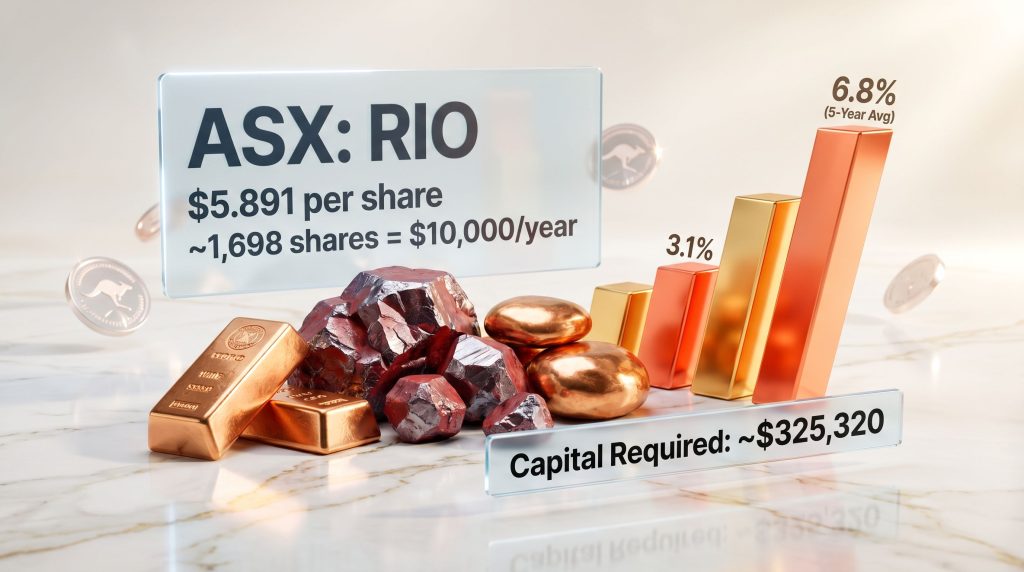
Rio Tinto (ASX: RIO) distributes dividends to shareholders twice per year. The most recent cycle produced a fully franked interim dividend of $2.22 per share, paid in September, followed by a fully franked final dividend of $3.671 per share, paid in April. Combined, the total cash dividend across the full year reached $5.891 per share.
Using Rio Tinto’s closing share price of approximately $191.59, the trailing cash dividend yield sits at roughly 3.1%. That sounds modest by income investing standards, but there is a critical layer beneath the headline number that most casual investors overlook.
Trailing Yield vs. Forecast Yield: Why Does the Distinction Matter?
A trailing yield looks backward, calculating the return based on dividends already paid divided by the current share price. A forecast yield looks forward, incorporating analyst projections about what the company might pay in future periods.
For resource sector companies, forecast yields carry considerably more uncertainty than those for banks or infrastructure businesses. The iron ore price trends, copper demand, Pilbara weather conditions, and Chinese macroeconomic policy can all shift dividend outcomes materially within a single reporting cycle.
Income investors should treat forecast yields on mining companies as directional estimates, not reliable income projections. The trailing yield is the only figure that reflects money actually distributed to shareholders.
The Hidden Yield Boost: How Franking Credits Change the Real Return
Rio Tinto’s dividends are fully franked, which carries significant implications for Australian resident investors that go beyond the stated cash return. Full franking means the company has already paid 30% corporate tax on the underlying profits before distributing dividends. Shareholders receive an attached franking credit representing that prepaid tax, which can be used to offset personal income tax obligations.
For eligible investors, the grossed-up yield exceeds the headline 3.1% cash figure considerably. The practical effect depends on the investor’s marginal tax rate:
| Investor Tax Rate | Cash Dividend (per share) | Franking Credit Value | Effective Outcome |
|---|---|---|---|
| 0% (retiree below threshold) | $5.891 | Full cash refund of credits | Highest total return |
| 19% marginal rate | $5.891 | Partial tax offset | Strong benefit |
| 32.5% marginal rate | $5.891 | Moderate offset | Some benefit |
| 45% + Medicare Levy | $5.891 | Reduces liability only | Least benefit |
For self-managed superannuation fund (SMSF) investors drawing a retirement pension, the franking credit refund mechanism can turn Rio Tinto’s modest cash yield into a meaningfully higher effective return. This is one of the more under-appreciated advantages of fully franked dividend investing within the Australian tax framework. According to Morningstar, generating substantial passive income through dividend stocks requires careful consideration of these tax-efficiency factors.
The Core Calculation: How Many Rio Tinto Shares for $10,000 a Year?
The arithmetic is straightforward once you have a firm dividend-per-share figure. Using the trailing total dividend of $5.891:
Shares Required = $10,000 ÷ $5.891 = approximately 1,698 shares
At the current share price of $191.59, acquiring 1,698 shares requires a total capital deployment of approximately $325,320.
That figure deserves some historical context. Rio Tinto’s share price has climbed more than 59% over the past twelve months. As the price rises without a proportional increase in dividends, the yield compresses, meaning the capital required to generate a fixed income target expands. Investors who built positions during periods of lower share prices benefited from significantly better entry yields.
| Scenario | Shares Required | Reference Share Price | Total Capital Required |
|---|---|---|---|
| Current trailing yield (~3.1%) | ~1,698 shares | ~$191.59 | ~$325,320 |
| 5-year average yield (~6.8%) | ~1,471 shares | ~$110.59 (historical) | ~$162,680 |
| Mid-range yield estimate (~3.81%) | ~2,375 shares | ~$110.59 | ~$262,700 |
The contrast between the current yield environment and the five-year average of approximately 6.8% illustrates just how much the capital requirement shifts across different market cycles. Investors buying at cycle peaks face compressed yields and elevated capital costs simultaneously. For further context on passive income projections from a $10,000 starting position, analyst commentary highlights how variable those returns can be year to year.
Why Rio Tinto’s Dividend Is So Difficult to Predict
One of the most important things an income investor can understand about Rio Tinto is that its dividends are structurally linked to commodity prices, particularly iron ore and, increasingly, copper. Unlike banks or utilities that generate predictable cash flows from contracted revenue streams, Rio Tinto’s earnings are largely a function of prevailing spot prices on global commodity markets.
Iron Ore: The Dominant Earnings Driver
Iron ore remains the foundation of Rio Tinto’s revenue base. The Pilbara region of Western Australia houses one of the world’s most productive iron ore mining complexes, and output from this region feeds directly into Chinese steel mills. When China steel demand is elevated, iron ore prices rise and Rio Tinto’s earnings expand. When Chinese demand contracts, the reverse occurs.
A decline in iron ore prices below approximately US$80 per tonne has historically placed meaningful downward pressure on free cash flow, which feeds directly into dividend capacity. This is not a theoretical risk. Iron ore has traded well below this threshold during previous commodity downturns, and investors relying on peak-cycle dividends for income planning have been disappointed accordingly.
Copper and the Energy Transition Factor
Rio Tinto’s growing copper exposure introduces a second earnings driver with a different demand profile. Copper is central to electrification infrastructure, including electric vehicles, grid upgrades, and renewable energy installations. Unlike iron ore, which is tied primarily to construction and traditional manufacturing, copper demand is increasingly linked to decarbonisation capital expenditure globally.
This creates an interesting dynamic for long-term dividend investors. If the energy transition continues accelerating, copper revenues could partially offset periods of iron ore weakness. However, understanding broader copper market trends reveals that supply responses to price signals are slow, adding a speculative dimension to copper’s long-term price trajectory.
Historical Dividend Variability: A Pattern Income Investors Must Accept
| Period | Dividend Trend | Primary Driver |
|---|---|---|
| FY2021 | Peak payouts | Iron ore super-cycle |
| FY2022 | Sharp decline | Commodity price correction |
| FY2023-2024 | Partial recovery | Stabilising iron ore, copper growth |
| FY2025 (Trailing) | $5.891 per share | Dual fully franked payments |
The swing from peak cycle payouts in FY2021 to materially lower distributions in FY2022 was a sharp reminder that resource sector dividends cannot be budgeted with the same confidence as bank dividends or infrastructure distributions. This variability is structural, not accidental.
The Concentration Risk Problem
Even if the income maths work, concentrating $325,000 in a single stock creates a risk profile that most financial planning frameworks would classify as inappropriate for income-dependent investors. Single-stock concentration means the investor’s entire passive income stream is subject to the fortunes of one company, one commodity complex, and one geographic operating environment.
A well-structured passive income portfolio typically spans 10 to 15 ASX dividend-paying companies across multiple sectors. Furthermore, a thoughtful approach to portfolio diversification serves two measurable functions:
- Income smoothing: When resources dividends fall in a commodity downturn, financial or infrastructure dividends may hold steady or grow, cushioning total income.
- Capital preservation: Sector-specific drawdowns, such as a sustained iron ore price decline, do not devastate the entire portfolio value.
| Sector | Role in Portfolio |
|---|---|
| Resources (e.g., RIO, BHP) | High yield, cyclical income generation |
| Major banks | Consistent franked dividend history |
| Infrastructure and utilities | Defensive, often inflation-linked income |
| Consumer staples | Recession-resistant cash flow profile |
| Healthcare | Defensive growth component with dividends |
Building Toward $10,000 a Year Without a $325,000 Lump Sum
For most investors, deploying $325,320 in a single transaction is neither practical nor advisable. Fortunately, the path to a $10,000 annual income target from Rio Tinto shares does not require it. A structured accumulation approach can achieve the same outcome over time:
- Define your target and time horizon before purchasing a single share. Knowing you want 1,698 shares gives the accumulation strategy a concrete endpoint.
- Apply dollar-cost averaging (DCA) by investing a fixed amount regularly, for example $2,000 per month, which reduces the risk of buying exclusively at high prices.
- Enrol in the Dividend Reinvestment Plan (DRP) to automatically convert cash dividends into additional shares. This compounds the shareholding without requiring fresh capital contributions.
- Monitor payout ratio trends at each reporting period. Rio Tinto’s board determines dividends based on earnings and capital requirements, so tracking payout ratios provides early signals about dividend sustainability.
- Review diversification annually to ensure Rio Tinto remains an appropriately sized position within a broader income portfolio rather than growing through compounding to become an outsized concentration risk.
The next major ASX story will hit our subscribers first
Rio Tinto vs. BHP: A Brief Comparative View
Australian income investors frequently compare Rio Tinto and BHP Group (ASX: BHP) given their similar market positioning. Both are large-cap, fully franked, twice-yearly dividend payers with iron ore and copper as primary revenue sources. It is also worth considering the Rio Tinto delisting impact on investor strategy, particularly for those building long-term income positions. The key distinctions worth noting:
| Metric | Rio Tinto (ASX: RIO) | BHP Group (ASX: BHP) |
|---|---|---|
| Dividend Franking | Fully franked | Fully franked |
| Dividend Frequency | Twice yearly | Twice yearly |
| Primary Revenue Driver | Iron ore + copper | Iron ore + copper + coal |
| Energy transition metal exposure | High (copper, lithium projects) | Moderate |
| Reporting currency | US dollars | US dollars |
Both companies convert dividends from USD to AUD for ASX shareholders, meaning the AUD/USD exchange rate at the time of conversion influences the final payment received. A stronger Australian dollar reduces the AUD equivalent of each dividend, which is an often-overlooked variable in passive income planning for resource sector stocks.
Macro Forces That Could Reshape the Dividend Outlook
Several macro variables beyond iron ore and copper prices deserve attention from investors targeting how many Rio Tinto shares for $10,000 a year in passive income they need:
- Chinese economic policy: Stimulus or contraction in China’s property and infrastructure sectors directly affects steel demand, iron ore prices, and ultimately Rio Tinto’s earnings capacity.
- Global interest rate cycles: As central banks adjust monetary policy, the relative attractiveness of dividend-paying equities shifts relative to fixed income alternatives. In declining rate environments, high-yield stocks typically attract capital inflows, which compresses yields further by lifting share prices.
- Pilbara operational risks: Cyclone activity and flooding in the Pilbara can disrupt shipments and affect quarterly production volumes. These events are unpredictable and can influence annual earnings.
- Large-scale capital allocation decisions: Projects of the scale of the Simandou iron ore development in Guinea represent significant capital commitments that could affect free cash flow available for dividends over multi-year periods.
- Currency risk: Rio Tinto reports in USD. AUD/USD movements create variability in dividend income for Australian shareholders that is entirely independent of the underlying business performance.
Disclaimer: This article contains general financial information only and does not constitute personal financial advice. Dividend yields, share prices, and franking credit benefits vary over time and depend on individual circumstances. Past dividend payments are not indicative of future distributions. Investors should seek independent financial advice tailored to their personal situation before making investment decisions.
Frequently Asked Questions
How Often Does Rio Tinto Pay Dividends?
Rio Tinto pays dividends twice per year. The interim dividend is typically paid in September and the final dividend in April. Both have historically been fully franked for ASX shareholders.
Are Rio Tinto’s Dividends Guaranteed?
No. The board determines dividend amounts based on earnings, free cash flow, and capital requirements each reporting period. Commodity price cycles can produce significant variation between years, including material reductions from peak levels.
What Is the Difference Between a Trailing and Forecast Yield?
A trailing yield uses dividends actually paid over the past twelve months divided by the current share price. A forecast yield uses analyst estimates of future distributions. For cyclical miners, forecast yields carry substantially higher uncertainty than trailing figures.
How Do Franking Credits Affect Rio Tinto Dividend Income?
Franking credits represent corporate tax already paid by Rio Tinto before distributing profits. Australian resident investors can apply these credits against personal tax liabilities, with eligible low-income investors or SMSF pension accounts potentially receiving a cash refund, increasing total income above the stated cash yield.
Does Rio Tinto Offer a Dividend Reinvestment Plan?
Yes. Rio Tinto operates a Dividend Reinvestment Plan that allows eligible shareholders to receive additional shares in lieu of cash dividends, supporting the compounding of shareholdings over time.
How Does the AUD/USD Exchange Rate Affect My Dividends?
Rio Tinto declares dividends in US dollars. When converted to Australian dollars for ASX-listed shareholders, the payment amount reflects the prevailing exchange rate at the time of conversion. Consequently, a stronger Australian dollar reduces the AUD value of each payment.
Want To Know Which ASX Mineral Discoveries Could Boost Your Investment Portfolio?
While building a passive income strategy around established miners like Rio Tinto offers stability, Discovery Alert’s proprietary Discovery IQ model scans ASX announcements in real time to identify significant mineral discoveries — the kind that have historically generated substantial returns, as showcased on Discovery Alert’s dedicated discoveries page — so begin your 14-day free trial today and position yourself ahead of the broader market.