
August 14, 2026
The Hidden Cost of Diesel Dependence: Why Australia's Mining Subsidy System Is Facing a Reckoning
Few policy debates reveal more about a nation's economic priorities than how it chooses to subsidise energy consumption. For decades, Australia's fuel tax credit system has operated as an invisible engine beneath the resources sector, quietly redistributing billions of dollars each year to the country's largest industrial operators. Now, an unlikely coalition of self-interest and strategic vision is pushing that arrangement into public view, and the implications stretch well beyond the mining gate.
When big ASX news breaks, our subscribers know first
How Australia's Fuel Tax Credit System Actually Works
The fuel tax credit scheme is a legislated rebate mechanism that returns a portion of the fuel excise levy to eligible businesses and individuals who use diesel and other qualifying fuels in non-road settings. Because the excise is designed primarily as a road-use charge, operators using fuel for off-road industrial, agricultural, or commercial purposes are entitled to reclaim that component.
Who Qualifies and What They Receive
The scheme is deliberately broad in its eligibility, covering a wide spectrum of Australian industries:
- Farmers and agricultural operators running irrigation and machinery
- Commercial fishing vessels
- Construction and earthmoving contractors
- Mining and resources companies using diesel in extraction operations
- Small and medium tradespeople relying on diesel-powered equipment
The standard rebate rate sits at 52.6 cents per litre, though this figure has been temporarily reduced to 26.3 cents per litre while a government excise halving measure remains in effect until 30 June. This reduction proportionally lowers the rebate value for every claimant in the country, regardless of their scale of operation.
The Scale of the Subsidy: Who Gets What
The aggregate numbers involved in the scheme are substantial, and the distribution pattern is striking:
| Metric | Figure |
|---|---|
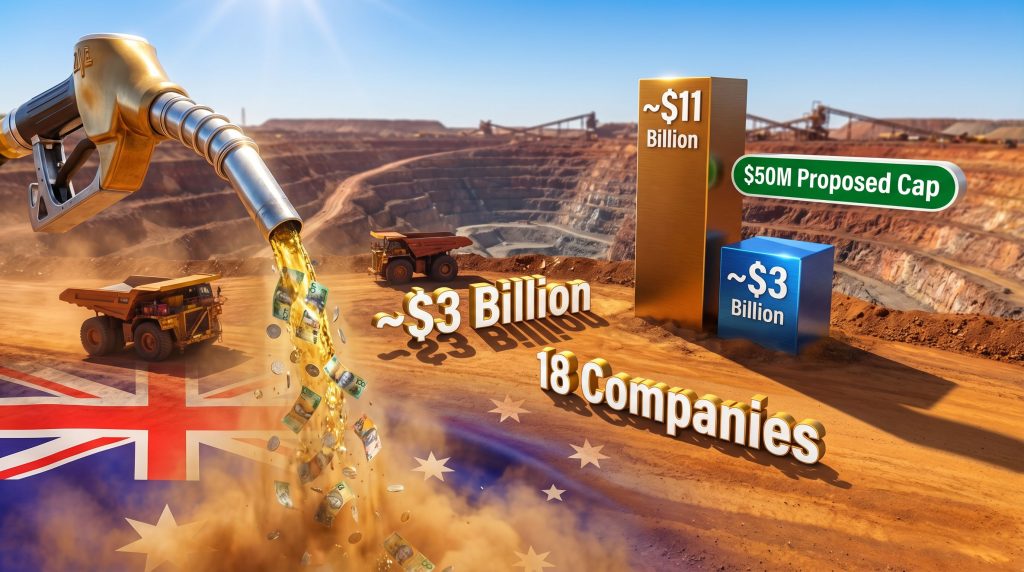
| Total annual fuel rebates distributed nationally | ~$11 billion |
| Share claimed by Australia's 18 largest miners | ~$3 billion |
| Diesel consumed by top 15 claimants (FY24) | ~6 billion litres |
| Top 15 claimants' combined FTC value (FY24) | ~$2.9 billion |
| Proposed annual cap per large mining company | $50 million |
What these figures reveal is a significant concentration effect. Roughly one-third of a nationally distributed rebate scheme flows to just 18 companies, all operating at the upper end of industrial-scale diesel consumption. For context, the 18 largest mining companies collectively claim approximately the same value in fuel tax credits as the entire remaining pool of farmers, tradespeople, fishers, and small contractors combined.
The concentration of fuel tax credits among a small cohort of major industrial operators has reignited a long-standing policy debate: whether open-ended diesel subsidies serve the national interest or entrench fossil fuel dependence at scale.
The Campaign Pushing for Change
Origins and Structure of the Fortescue Fuel Tax Credit Cap Campaign
The Fortescue fuel tax credit cap campaign launched publicly this week through national television and radio advertising, including a dedicated 30-second broadcast spot. The campaign's central proposition is disarmingly simple: impose a $50 million annual ceiling on fuel tax credit claims for any company currently exceeding that threshold, and redirect the resulting fiscal savings toward cost-of-living relief, cleaner energy investment, and support for everyday taxpayers.
What makes this campaign structurally unusual is that Fortescue itself ranks among the largest recipients of the credits it is now seeking to cap. Rather than avoiding this tension, the company's messaging engages with it directly. Chief Executive Dino Otranto has framed the campaign around the argument that the current system entrenches fossil fuel dependency at precisely the moment when global energy instability is exposing the strategic vulnerability of diesel-reliant industries.
The companies identified as falling above the proposed threshold include BHP, Rio Tinto, and Glencore, among 15 others. None of these organisations have publicly stated a position on the proposal at the time of writing.
What the Cap Would and Would Not Affect
A common misunderstanding in early public commentary has been the assumption that capping credits for large miners would affect smaller operators. The proposal is explicit on this point:
- The $50 million ceiling applies only to companies currently claiming above that level
- Farmers, fishers, tradespeople, and junior exploration companies would retain full and unaffected access to the scheme
- The 18 companies in scope represent a narrow cohort at the very top of the claim distribution
- All other participants in the FTC system would continue operating under existing rules
This design is intentional. By carving out the broad base of small and medium operators, the campaign avoids the political landmine of appearing to target rural communities or small business, while still directing reform pressure at the cohort where fiscal concentration is most pronounced.
Where Would the Redirected Capital Go?
Fortescue's campaign proposes channelling the savings generated by the cap into what it describes as a Transition Tax Incentive framework. The suggested uses include:
- Electrification of mine site operations and heavy equipment fleets
- Renewable energy infrastructure development in regional and remote areas
- Procurement incentives for low-emissions equipment and technology
- Broader household energy cost relief measures
The framing positions the cap not as a tax increase but as a subsidy rationalisation, redirecting existing government expenditure from large-scale fossil fuel consumption toward decarbonisation priorities. This aligns closely with the broader push towards mining electrification and decarbonisation that is reshaping the sector's long-term strategic planning.
Is This Reform or Reputation Management?
Fortescue's Credibility Paradox
The obvious question any observer raises is whether a company campaigning against its own subsidies is engaged in genuine policy reform or sophisticated brand positioning. The answer may be both, and the distinction matters less than the structural logic underpinning the argument.
Fortescue has committed US$6.2 billion to eliminating fossil fuel use entirely from its operations, targeting what it calls "real zero" emissions by 2030 through large-scale electrification and renewable energy deployment. If that transition timeline is credible, then the company's dependence on diesel-based rebates will progressively diminish regardless of whether the cap is implemented. Under this scenario, advocating for a cap carries limited financial self-harm for Fortescue while generating significant reputational capital.
The implicit argument embedded in the campaign is more pointed: if a major iron ore exporter operating some of the world's largest open-cut mines can credibly eliminate diesel dependency within this decade, the ongoing policy rationale for providing uncapped, open-ended diesel subsidies to competitors becomes increasingly difficult to defend.
The Rhetorical Strategy
The campaign's messaging architecture is carefully constructed:
- It uses cost-of-living language to broaden appeal beyond industry audiences
- It avoids naming competitors in negative terms, maintaining a systemic rather than adversarial tone
- It frames the $50 million cap as a simple fix that is non-partisan and fiscally neutral
- It anchors the argument in national interest and energy security rather than purely environmental grounds
If a cap were implemented at $50 million per company across all 18 qualifying miners, the theoretical annual fiscal saving could exceed $2.5 billion, funds that the campaign suggests could be redirected to household energy cost relief and low-emissions transition programs.
This is a speculative projection based on the campaign's proposed parameters, not a confirmed Treasury estimate, and actual fiscal outcomes would depend on implementation design, transition timelines, and ongoing diesel consumption patterns across the sector.
Fuel Security Pressures Reshaping Operational Decisions Across the Sector
Supply Disruptions and Government Response
The timing of the Fortescue fuel tax credit cap campaign cannot be separated from a broader fuel security context that has been intensifying across Australia. The federal government secured an additional 200 million litres of diesel this week in response to supply disruptions linked to Middle East conflict dynamics. Energy Minister Chris Bowen publicly acknowledged that extended conflict would have escalating consequences for Australian fuel availability.
At a retail level, the real-world effects are already visible. More than 400 petrol stations nationally experienced supply outages mid-week, representing approximately 2% of tracked outlets. While this proportion appears modest, the concentration of outages in specific regions and the timing sensitivity of diesel supply chains for remote mining operations amplifies the practical impact.
How Junior and Mid-Tier Miners Are Responding
Survey data collected by the Association of Mining and Exploration Companies (AMEC) from its Western Australia-focused membership reveals that more than 50% of member companies are actively implementing measures to reduce fuel consumption. The operational responses being adopted across the junior and mid-tier exploration sector include:
- Suspension or deferral of active drill programs
- Cancellation of night shifts for drilling rigs to reduce fuel burn
- Reduction in non-essential site travel and logistics movements
- Consolidation of supply runs and personnel rotations
Critically, AMEC's rolling survey identified the primary driver of these decisions as the 200% increase in fuel cost, not physical supply unavailability. This distinction is important for understanding the policy dimension. The crisis is primarily economic rather than logistical, and its effects on exploration activity are likely to compound over time if price pressure continues.
The Junior Explorer Financing Dimension
Against this backdrop of fuel cost pressure, the federal opposition reaffirmed a $100 million commitment to extending the Junior Minerals Exploration Incentive during opposition leader Angus Taylor's visit to Perth. The JMEI operates by providing tax credits to investors in early-stage exploration companies, lowering the effective cost of capital for pre-revenue explorers and stimulating flow-through financing structures.
AMEC has called on the federal government to match or exceed this commitment level, arguing that long-term certainty in exploration financing is particularly critical when operational cost pressures from fuel price increases are already forcing activity cutbacks. The intersection of fuel insecurity and exploration capital availability represents a compounding risk that could suppress new mineral discovery activity in Western Australia over the near term.
Policy Trade-Offs: The Case For and Against the Cap
Arguments Supporting Reform
The case for implementing a fuel tax credit cap for large miners rests on several distinct but interconnected arguments:
- Fiscal efficiency: Directing $3 billion annually to 18 companies through an uncapped rebate mechanism represents a structurally concentrated allocation of public resources
- Decarbonisation alignment: Continuing to financially subsidise large-scale diesel consumption creates a direct disincentive to invest in electrification and renewable alternatives
- Equity: Small operators, farmers, and tradespeople receive proportionally minor FTC benefits while bearing the same cost-of-living pressures that diesel price increases create
- Energy security: Reducing sector-wide diesel dependency could improve national fuel resilience over a multi-year horizon
Furthermore, the broader adoption of renewable energy in mining has demonstrated that technically viable alternatives to diesel-intensive operations are already commercially available at scale in multiple jurisdictions.
Arguments Complicating the Reform
The counterarguments are substantive and deserve serious consideration:
- A hard cap could significantly increase operating costs for large miners during a transition period before mine-scale electrification is commercially viable
- Changes to established tax concessions carry sovereign risk implications that may affect investor confidence in Australian resource development
- Fortescue's 2030 "real zero" target is ambitious, and sector-wide transition timelines may differ considerably depending on mine type, location, and capital structure
- Rapid cost increases in remote operations could affect workforce levels in communities with limited economic alternatives
Stakeholder Positions Compared
| Stakeholder Group | Position | Primary Concern |
|---|---|---|
| Fortescue | Strongly supportive | Accelerate decarbonisation; demonstrate sector leadership |
| BHP / Rio Tinto / Glencore | Not publicly stated | Cost exposure; transition feasibility |
| AMEC (junior explorers) | Neutral to cautious | Ensure small operators remain exempt |
| Federal Government | Under review | Fiscal, energy security, and electoral considerations |
| Federal Opposition | Not aligned | Committed to JMEI extension; FTC reform not endorsed |
| Farmers and Tradespeople | Supportive of exemption | Protect below-threshold claimants |
The next major ASX story will hit our subscribers first
What a $50 Million Cap Would Mean in Practice
Modelling the Financial Impact on Large Operators
The financial mathematics of a binding cap are straightforward to model, even if the behavioural responses are more complex. For a company currently claiming $200 million annually in fuel tax credits, a $50 million ceiling would translate to a $150 million increase in net operating costs. The impact is asymmetric: the more diesel-intensive the operation, the larger the financial exposure.
This cost increase would not be uniformly distributed. Open-cut iron ore operations running large haul truck fleets in remote locations face different electrification economics than underground gold mines or coastal processing facilities. A blanket cap without transition provisions could create significant operational disruption in specific asset classes before electric alternatives achieve commercial scale.
Accelerating the Business Case for Electrification
From an investment decision-making perspective, the cap's most significant effect may be on internal rate of return (IRR) calculations for electrification projects. Currently, the payback period for electric haul trucks, on-site battery storage systems, and integrated renewable energy generation at mine sites remains longer than conventional diesel configurations, partly because the rebate lowers the effective cost of diesel consumption.
A binding FTC cap would structurally alter those calculations, making electrification investments financially rational earlier in the capital planning cycle. This mechanism parallels policy tools used in other jurisdictions to accelerate industrial decarbonisation, including the carbon border adjustment frameworks in Europe and clean energy incentive structures in the United States, though the Australian proposal operates through subsidy reduction rather than direct carbon pricing.
Frequently Asked Questions: The Fuel Tax Credit Cap Debate
What exactly is Fortescue proposing with its fuel tax credit cap campaign?
Fortescue is advocating for a legislated ceiling of $50 million per year on fuel tax credit claims for large mining operations. The proposal targets only the 18 or so companies currently claiming above that threshold, leaving all small and medium operators entirely unaffected.
Why would Fortescue campaign against a subsidy it currently benefits from?
Fortescue's stated rationale connects to its broader decarbonisation strategy and its US$6.2 billion commitment to eliminating fossil fuel use by 2030. The company argues that an uncapped subsidy system creates a sector-wide financial barrier to electrification investment, and that reform would accelerate the energy transition across the industry.
Which companies would face the new ceiling?
The campaign identifies 18 large mining companies as the target cohort, with BHP, Rio Tinto, and Glencore specifically named. These companies collectively receive approximately $3 billion annually in fuel tax credits.
Would farmers or small businesses be affected?
No. The proposed cap is explicitly designed to protect operators below the $50 million threshold. Farmers, fishers, tradespeople, and junior exploration companies would retain full access to the existing scheme under its current terms.
How does the current excise reduction affect the rebate calculation?
The standard FTC rate of 52.6 cents per litre has been temporarily halved to 26.3 cents per litre as part of a government excise reduction measure. This proportionally reduces the current rebate value for all claimants until 30 June, when the standard rate is scheduled to resume.
What would happen to the fiscal savings generated by the cap?
Fortescue's proposal suggests channelling savings into a Transition Tax Incentive framework to fund mine electrification, regional renewable energy infrastructure, and low-emissions equipment procurement, alongside potential household energy cost relief measures.
The Bigger Picture: Diesel, Decarbonisation, and a Shifting Policy Landscape
A Coherence Problem at the Heart of Australian Energy Policy
The fuel tax credit debate surfaces a structural tension that runs through Australian energy policy more broadly. The country maintains national commitments to net zero emissions by 2050 while simultaneously operating an uncapped rebate mechanism that financially rewards large-scale diesel consumption with no transition conditions or sunset provisions.
This is not simply a matter of inconsistency. It represents a structural misalignment between fiscal settings and decarbonisation objectives, one that becomes more visible and harder to defend as electrification technology matures and the cost of renewable energy alternatives continues to fall across the resources sector. Consequently, Australia's resource and energy exports face growing scrutiny from international trading partners over the coherence of domestic energy subsidy settings relative to stated climate commitments.
What Policy Progress Would Actually Require
Translating campaign momentum into legislative change involves several distinct steps that extend well beyond advocacy:
- A formal government review of FTC eligibility thresholds and their alignment with national climate and energy security targets
- Industry-led modelling of electrification transition timelines and capital requirements across different mine types and locations
- Bipartisan policy dialogue separating the junior exploration support question (addressed through JMEI) from the large-miner subsidy rationalisation debate
- Development of a Transition Tax Incentive framework with clear eligibility criteria, accountability mechanisms, and funding certainty
In addition, Australia's critical minerals strategy will need to account for the intersection of fuel cost exposure and sovereign competitiveness as global demand for responsibly produced minerals continues to intensify.
The Fortescue fuel tax credit cap campaign has reframed what was previously a niche tax policy debate into a mainstream conversation about who bears the cost of Australia's energy transition, and whether the current subsidy architecture is fit for purpose in a decarbonising global economy.
Whether the campaign generates sufficient political pressure to force legislative action remains an open question. What it has already achieved is forcing a public reckoning with a $3 billion annual allocation that was largely invisible to most Australians before this week's television and radio campaign began.
This article contains forward-looking statements and modelled projections that are inherently subject to uncertainty. Readers should not treat fiscal impact estimates or electrification transition timelines as confirmed government or company guidance. Policy outcomes depend on legislative processes, political conditions, and commercial factors that cannot be predicted with certainty.
For ongoing coverage of ASX-listed resource sector developments and Australian mining policy, industry commentary from White Noise Communications is available at whitenoisecomms.com/insights.
Want to Stay Ahead of Significant ASX Mineral Discoveries Before the Broader Market?
Discovery Alert's proprietary Discovery IQ model delivers real-time alerts on major ASX mineral discoveries, instantly translating complex geological data into actionable investment insights for both short-term traders and long-term investors. Start your 14-day free trial today and explore Discovery Alert's dedicated discoveries page to understand how historic mineral discoveries have generated substantial market returns.