June 15, 2026
The convergence of digital transformation, clean energy transition, and geopolitical tensions has fundamentally altered how global markets approach critical mineral security. Modern economies depend on increasingly complex supply chains spanning multiple continents, making traditional commodity tracking insufficient for strategic planning. This reality has driven the development of sophisticated analytical frameworks designed to assess mineral value chains holistically, integrating everything from regulatory environments to technological capabilities.
The emergence of comprehensive supply chain intelligence tools represents a shift from reactive commodity monitoring toward predictive risk assessment. These frameworks address the growing disconnect between resource availability and capital allocation, particularly as demand projections for critical minerals reach unprecedented levels. Furthermore, understanding these dynamics becomes essential as industries face supply constraints that could reshape global economic competitiveness through data-driven operations.
The Future Minerals Forum Global Index Framework
The Future Minerals Forum global index launched in January 2026 as a comprehensive market intelligence tool developed through collaboration between McKinsey & Company, S&P Global Market Intelligence, Global AI, and GlobeScan. This partnership brings together 47 experts across multilateral organizations, non-profits, and private companies to create what officials describe as an intellectual tool highlighting key trends in the mining and minerals sector.
The index serves as more than a traditional commodity tracker. According to Khalid Al-Mudaifer, Vice Minister of Industry and Mineral Resources for Mining Affairs, the tool establishes a comprehensive baseline to measure progress of governments, companies, and investors in enhancing resilient and responsible mineral supply chains. The framework specifically addresses how global critical mineral markets are shaped by capital, risk, and trust dynamics, identifying the widening gap between resource availability and capital allocation.
When big ASX news breaks, our subscribers know first
Institutional Credibility Through Multi-Stakeholder Collaboration
The credibility of the Future Minerals Forum global index stems from its institutional partnership structure. McKinsey & Company provides the primary analytical framework, leveraging their management consulting expertise in supply chain optimisation and risk assessment. S&P Global Market Intelligence contributes commodity price data, trading volumes, and market structure analysis, while Global AI handles pattern recognition, predictive modelling, and trend analysis capabilities.
GlobeScan's involvement adds stakeholder sentiment analysis, capturing qualitative perception data from industry leaders, policymakers, and civil society organisations. This multi-disciplinary approach creates what Jeffrey Lorsch, Partner at McKinsey & Company, describes as a strategic roadmap helping companies navigate volatility and unlock long-term growth opportunities by integrating market data, stakeholder perspectives, and value chain standards.
The framework development process began at the 2025 International Ministerial Meeting, suggesting an 18-month consultation cycle prior to public launch. This extended timeline allowed for multi-stakeholder input and validation across different geographic regions and industry segments, enhancing the framework's legitimacy across diverse stakeholder communities while addressing industry innovation trends.
Comprehensive Value Chain Assessment Through Seven Strategic Pillars
The Future Minerals Forum global index employs a seven-pillar framework designed to evaluate end-to-end value chain resilience across producing, exporting, and consuming countries. Each pillar addresses institutional, infrastructure, or capability requirements that influence project viability and investment flows throughout the mineral supply chain.
Policy and Regulatory Environment
This pillar evaluates government support mechanisms and regulatory clarity that enable mineral development. The framework recognises that supportive policies and regulations form the foundation for supply chain development, with regulatory clarity identified as a key differentiator in attracting responsible investment. Countries with streamlined permitting processes insights, transparent mining codes, and consistent policy implementation typically score higher on this dimension.
Financing Infrastructure
Capital allocation patterns and investment risk assessment form the core of this pillar. The framework acknowledges that innovative financing solutions are critical for securing and managing the substantial investments required for mineral projects. This includes access to project finance, capital market development, and risk mitigation instruments that can bridge the gap between resource availability and capital deployment.
Physical Infrastructure
Multimodal transport networks and logistics optimisation capabilities determine how effectively minerals can reach global markets. The framework evaluates roads, railways, ports, and other infrastructure elements that reduce costs and increase project viability. Countries with well-developed logistics networks typically demonstrate lower transportation costs and higher supply chain reliability.
Sustainability Governance
Environmental and social compliance frameworks have become integral to supply chain viability rather than supplementary considerations. The framework mandates strong environmental and social governance mechanisms, recognising that ESG compliance affects project financing, market access, and long-term operational sustainability. This includes carbon footprint tracking, community impact assessment, and water usage optimisation protocols.
Human Capital Development
Skills training, research and development capabilities, and knowledge transfer mechanisms address what industry leaders identify as the primary constraint facing mineral development. According to Ma'aden CEO Bob Wilt, the sector faces significant talent shortages, with human capital representing a greater challenge than equipment, capital, or technology constraints.
The pillar evaluates:
- Technical education programmes aligned with mining industry requirements
- Research and development infrastructure supporting geological and metallurgical innovation
- Knowledge transfer mechanisms between international companies and local workforces
- Professional development pathways for mining engineers, geologists, and technical specialists
Technological Modernisation
Updated geological data systems and global expertise partnerships reduce exploration risk and improve project economics. The framework evaluates countries' capabilities in geological surveying, data management, and technology adoption across the mining value chain. This includes satellite imagery integration, artificial intelligence applications in resource estimation, and digital transformation initiatives.
Geological Resource Base
Reliable, accessible geological data in producing, exporting, and consuming countries serves as a critical factor in attracting investment. The framework recognises that data transparency and standardisation enhance investment confidence by reducing exploration risk and enabling more accurate resource assessments. Countries with comprehensive geological surveys and publicly available data typically demonstrate higher investment attractiveness.
Supply Chain Resilience Metrics and Quantitative Analysis
The Future Minerals Forum global index integrates quantitative metrics with qualitative assessments to provide comprehensive supply chain resilience scores. The framework addresses market volatility indicators alongside operational resilience measures, creating a multi-dimensional view of mineral supply chain stability.
Critical Mineral Demand Projections and Supply Constraints
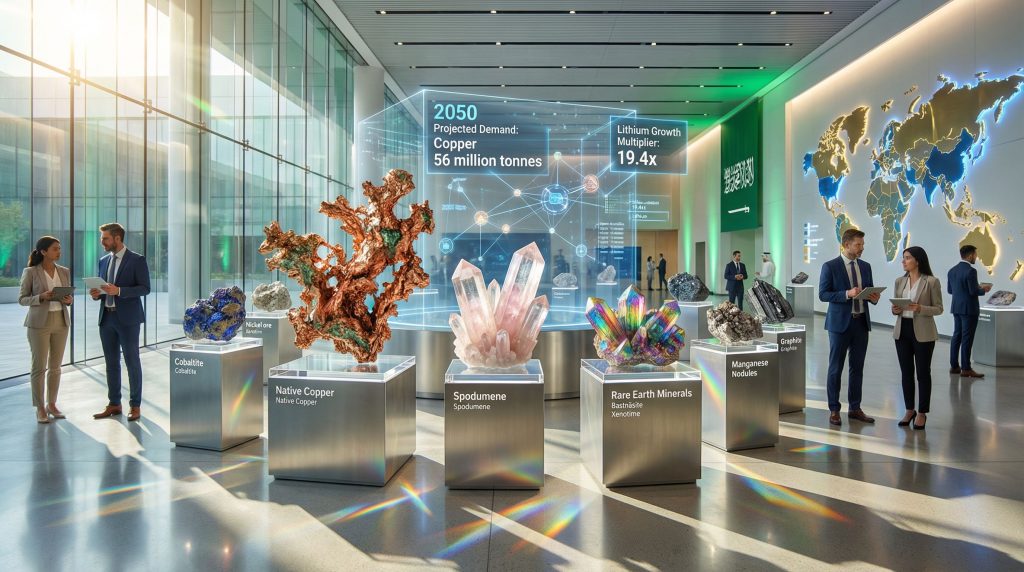
Global copper demand exemplifies the scale of supply chain challenges facing critical minerals, particularly within the context of the critical minerals transition. According to Anglo American CEO Duncan Wanblad, copper demand is expected to grow 75% to reach 56 million tonnes annually by 2050. Meeting this demand requires opening approximately 60 new mines the size of Quellaveco within the next decade to offset declines from aging mines and satisfy increased consumption.
| Supply Chain Challenge | Current Status | 2050 Projection | Key Constraints |
|---|---|---|---|
| Copper Mine Development | 25 million tonnes annual production | 56 million tonnes required | Development timeline averaging 15-20 years |
| Processing Capacity | Regional concentration in established facilities | Geographic diversification needed | Technology transfer and capital intensity |
| Infrastructure Requirements | Existing logistics networks near capacity | Multimodal expansion required | Financing and regulatory coordination |
Investment Flow Analysis and Capital Allocation Patterns
The index reveals significant disparities between resource availability and capital allocation across different jurisdictions. Investment flows demonstrate risk-adjusted return preferences, with capital gravitating toward regions offering regulatory stability, infrastructure development, and skilled labour availability. The framework tracks these patterns to identify emerging opportunities and potential supply bottlenecks.
Geographic distribution analysis shows concentrated investment in established mining jurisdictions, while resource-rich regions with infrastructure constraints receive proportionally less capital. This creates supply chain vulnerabilities that the index aims to highlight for strategic planning purposes.
Risk Assessment and Market Intelligence Integration
The framework combines traditional geological and economic risk factors with emerging considerations including climate change impacts, social licence requirements, and geopolitical stability. Real-time market data integration allows for dynamic risk assessment that adapts to changing conditions across global mineral markets.
Early warning indicators include:
- Regulatory environment changes affecting permit approval timelines
- Infrastructure capacity constraints limiting production scaling
- Human capital shortages in critical technical roles
- Financing availability shifts affecting project development pipelines
Regional Competitiveness and Jurisdictional Analysis
The Future Minerals Forum global index provides comparative scoring across different geographic regions, highlighting competitive advantages and development opportunities in critical mineral supply chains. Regional analysis reveals distinct patterns in infrastructure development, policy frameworks, and investment attractiveness.
Africa: Mineral Wealth Versus Infrastructure Development
African countries demonstrate substantial mineral resource endowments but face infrastructure development gaps that limit supply chain effectiveness. The continent hosts significant reserves of critical minerals including cobalt, lithium, and rare earth elements, yet transportation networks and processing capabilities often require substantial investment to reach international markets efficiently.
Countries like the Democratic Republic of Congo possess world-class cobalt resources but struggle with logistics infrastructure and regulatory complexity. The index framework helps identify specific intervention points where targeted infrastructure investment could unlock mineral potential while addressing sustainability governance requirements.
Asia-Pacific: Technology Adoption and Processing Leadership
The Asia-Pacific region demonstrates comparative advantages in technology adoption and processing capability development. Countries in this region have invested heavily in downstream processing infrastructure, creating integrated supply chains from raw material extraction through refined product manufacturing.
China's dominance in rare earth element processing exemplifies this regional strength, though it also highlights supply chain concentration risks for consuming countries. The index framework evaluates how other Asia-Pacific nations can develop complementary processing capabilities to enhance supply chain resilience.
Middle East: Strategic Positioning and Sovereign Investment
Middle Eastern countries, particularly Saudi Arabia, leverage strategic positioning and sovereign wealth fund involvement to develop mineral supply chain capabilities. Saudi Arabia's Vision 2030 economic diversification goals integrate mineral development with broader industrial transformation objectives.
Ma'aden's role as a regional mining champion demonstrates how sovereign-backed companies can accelerate mineral development through access to patient capital and strategic government support. The Future Minerals Forum serves as both a diplomatic platform and commercial marketplace, positioning Saudi Arabia as a hub for international mineral industry cooperation.
Latin America: Political Stability and Investment Climate
Latin American countries balance substantial mineral resources with varying degrees of political stability and regulatory consistency. Countries like Chile have established stable mining investment climates through consistent policy frameworks and developed infrastructure, while others face challenges in maintaining investor confidence through political transitions.
The region's copper production capabilities make it strategically important for global supply chains, particularly as demand growth accelerates. However, water availability, community relations, and environmental compliance present ongoing challenges that the index framework helps quantify and compare across different jurisdictions.
Industry Leadership Perspectives and Strategic Applications
The Future Minerals Forum global index incorporates insights from mining industry executives who highlight critical challenges and opportunities shaping global mineral supply chains. These perspectives provide context for how the framework addresses real-world operational and strategic decision-making requirements.
Human Capital as the Primary Constraint
Industry leaders consistently identify talent shortages as the most significant constraint facing mineral development globally. Ma'aden CEO Bob Wilt emphasises that the sector lacks sufficient qualified personnel, stating that their biggest challenges are not equipment, capital, or technology, but people. This insight drives the framework's emphasis on human capital development as a core pillar for supply chain resilience.
The talent shortage spans multiple skill categories:
- Geological and mining engineers with expertise in complex ore body development
- Metallurgical specialists capable of optimising processing efficiency
- Environmental and social specialists ensuring compliance with evolving standards
- Project management professionals with experience in large-scale infrastructure development
Technology Convergence Driving Demand
Ivanhoe Mines founder Robert Friedland identifies three converging megatrends reshaping mineral demand: electrification of energy systems, digitalisation of the economy, and rapid artificial intelligence growth. His observation that sustainable development cannot proceed without mining underscores the fundamental importance of mineral supply chains for global economic transformation.
This convergence creates unprecedented demand growth rates for specific minerals:
- Lithium demand driven by battery manufacturing for electric vehicles and energy storage
- Copper requirements increasing from electrification infrastructure and renewable energy systems
- Rare earth element needs expanding through advanced manufacturing and defence applications
Mining as Essential Infrastructure
Vale CEO Gustavo Pimenta positions mining as fundamental to sustainable development, describing it as essential to balancing economic development with environmental protection and social responsibility. This perspective reflects the industry's evolution from resource extraction toward integrated sustainability frameworks that address climate change mitigation and social development objectives.
The strategic implication involves reframing mining operations as critical infrastructure comparable to transportation networks or energy systems, requiring long-term planning and sustained investment to maintain global economic functionality. Consequently, this approach aligns with broader market considerations including trade war market impact.
The next major ASX story will hit our subscribers first
Practical Applications Across Stakeholder Categories
The Future Minerals Forum global index serves distinct operational and strategic requirements for different stakeholder groups throughout the mineral supply chain ecosystem. Understanding these applications helps clarify how the framework creates value for diverse user communities.
Mining Companies: Site Selection and Risk Assessment
Mining companies utilise the index for jurisdiction evaluation and project prioritisation decisions. The seven-pillar framework provides standardised criteria for comparing investment opportunities across different countries and regions, enabling more systematic capital allocation processes.
Operational applications include:
- Site selection criteria incorporating infrastructure availability, regulatory clarity, and human capital access
- Risk assessment frameworks integrating political stability, environmental compliance requirements, and community relations factors
- Stakeholder engagement optimisation based on local governance structures and social development priorities
- Supply chain logistics planning considering transportation infrastructure and processing facility access
Companies can benchmark potential projects against established operations to identify capability gaps and investment requirements needed for successful development.
Government Policy Development and International Cooperation
Government agencies use the index for benchmarking national competitiveness in critical mineral sectors and identifying infrastructure investment priorities. The framework helps policymakers understand how regulatory environments, infrastructure development, and human capital initiatives affect their country's attractiveness for responsible mining investment.
Policy applications encompass:
- Regulatory framework design that balances environmental protection with investment attraction
- Infrastructure investment prioritisation focusing on transportation networks and utilities that enable mineral development
- International cooperation agreements facilitating technology transfer and capacity building initiatives
- Economic diversification planning leveraging mineral resources for broader industrial development
The index supports evidence-based policy development by providing comparative data on successful jurisdictions and identifying best practices for mineral sector governance.
Investment Due Diligence and Portfolio Construction
Institutional investors and fund managers employ the index for country risk assessment and ESG compliance verification across mineral-focused investment portfolios. The framework provides standardised metrics for evaluating long-term supply security and operational sustainability across different geographic regions and commodity categories.
Investment applications include:
- Country risk assessment methodologies integrating political, regulatory, and operational factors
- ESG compliance verification ensuring portfolio companies meet environmental and social standards
- Supply chain resilience evaluation for downstream industries dependent on critical mineral inputs
- Portfolio diversification strategies balancing exposure across different jurisdictions and commodity categories
The framework helps investors identify emerging opportunities while managing risks associated with resource nationalism, regulatory changes, and environmental compliance requirements.
Sustainability Integration and Responsible Mining Standards
The Future Minerals Forum global index incorporates comprehensive sustainability governance as a core component of supply chain resilience assessment. This integration reflects the evolution of mining operations from traditional resource extraction toward integrated sustainability frameworks addressing environmental protection and social development objectives.
Environmental Performance and Carbon Management
The framework evaluates carbon footprint tracking across mineral value chains, recognising that climate change mitigation requirements increasingly influence mining project viability and market access. Companies demonstrating lower carbon intensity and renewable energy adoption typically achieve higher sustainability scores within the index methodology.
Environmental assessment components include:
- Energy efficiency optimisation in extraction, processing, and transportation operations
- Water usage management addressing both consumption levels and quality protection
- Waste minimisation strategies including tailings management and circular economy principles
- Biodiversity protection measures ensuring ecosystem preservation in and around mining operations
Social Development and Community Engagement
Community impact assessment and benefit-sharing mechanisms form critical components of the sustainability pillar. The framework recognises that social licence to operate has become essential for project development and long-term operational success, particularly in regions with indigenous communities or vulnerable populations.
Effective community engagement strategies demonstrate measurable benefits including:
- Local employment creation with skills development and career advancement opportunities
- Infrastructure development benefiting broader regional economic development
- Education and healthcare investments supporting long-term community sustainability
- Cultural preservation initiatives respecting indigenous rights and traditional practices
Supply Chain Transparency and Traceability
The index evaluates capabilities for mineral provenance tracking throughout global supply chains. Blockchain integration and other digital technologies enable more comprehensive traceability systems that verify responsible sourcing practices and avoid conflict mineral exposure.
Traceability requirements address:
- Origin verification ensuring minerals are sourced from operations meeting environmental and social standards
- Chain of custody documentation maintaining accountability through processing and manufacturing stages
- Conflict mineral avoidance preventing financing of armed conflicts or human rights abuses
- Circular economy integration tracking recycled content and end-of-life material flows
Future Development and Technology Integration
The Future Minerals Forum global index framework continues evolving through annual reporting cycles and continuous improvement initiatives. Future development plans emphasise real-time data integration, expanded mineral coverage, and enhanced predictive analytics capabilities.
Annual Reporting and Continuous Improvement
The index employs annual reporting cycles that incorporate feedback from stakeholder communities and lessons learned from global mineral market developments. This iterative approach enables framework refinement based on changing market conditions, regulatory environments, and technology capabilities.
Improvement initiatives focus on:
- Real-time market data integration providing more current supply chain resilience assessments
- Expanded mineral coverage beyond current critical materials to include emerging strategic commodities
- Enhanced predictive analytics for supply chain disruption forecasting and early warning systems
- User interface development improving data accessibility and visualisation for different stakeholder groups
Digital Innovation and Technology Integration
Artificial intelligence applications in pattern recognition and forecasting represent key technology integration opportunities. Machine learning algorithms can identify complex relationships between different framework pillars and predict how changes in one area might affect overall supply chain resilience.
Technology integration includes:
- Satellite imagery analysis for real-time mine monitoring and production estimation
- Mobile applications enabling stakeholder access to index data and analysis tools
- Blockchain implementation supporting mineral traceability and provenance verification
- Digital twin modelling simulating supply chain scenarios and optimisation strategies
Global Expansion and Institutional Partnerships
Framework expansion involves deeper integration with multilateral development bank systems and international mining association networks. Standardisation efforts with other global commodity tracking systems could enhance data compatibility and reduce reporting burdens for companies operating across multiple frameworks.
Partnership development encompasses:
- Multilateral development bank integration aligning with World Bank and regional development bank project assessment criteria
- International mining association collaboration leveraging industry expertise and best practice sharing
- Academic research partnerships supporting continuous methodology improvement and validation studies
- Technology company alliances accelerating digital tool development and implementation
Strategic Implications for Global Mining Transformation
The Future Minerals Forum global index represents broader transformation trends affecting global mining sector development. These changes extend beyond traditional resource extraction toward integrated supply chain management that addresses geopolitical risks, sustainability requirements, and technological innovation simultaneously.
Market Transformation and Investment Patterns
The shift from resource nationalism toward collaborative supply chain development reflects recognition that mineral security requires international cooperation rather than unilateral control strategies. Countries increasingly compete on creating enabling environments that attract responsible investment rather than simply controlling resource access.
This transformation creates opportunities for:
- Infrastructure development partnerships between resource-rich and capital-abundant countries
- Technology transfer agreements supporting capacity building in developing mining jurisdictions
- Regional supply chain integration reducing dependence on single-country sourcing strategies
- Sustainability standard harmonisation creating consistent frameworks across different jurisdictions
Geopolitical Risk Integration
Integration of geopolitical risk assessment with traditional mining economics acknowledges that mineral supply chains now operate within complex international relations environments. Trade tensions, sanctions regimes, and strategic competition between major powers affect mineral market dynamics in unprecedented ways.
Risk assessment evolution includes:
- Supply chain diversification strategies reducing dependence on single-country sources
- Strategic stockpiling programmes maintaining supply security during geopolitical disruptions
- Alternative sourcing development supporting mineral production in allied countries
- Diplomatic engagement mechanisms addressing mineral supply security through international cooperation
Long-term Investment and Policy Recommendations
The framework's insights suggest prioritising infrastructure development in high-potential jurisdictions while enhancing international cooperation on critical mineral supply security. Successful implementation requires integrating sustainability metrics with traditional financial returns, recognising that environmental and social performance increasingly determine long-term project viability.
Strategic recommendations emphasise:
- Patient capital deployment supporting long-term mineral development projects with extended payback periods
- Multi-stakeholder governance involving governments, companies, and civil society in supply chain development planning
- Technology innovation investment accelerating development of more efficient and sustainable mining practices
- Capacity building programmes addressing human capital shortages across different skill categories
The emergence of mineral diplomacy as a key component of international relations reflects the strategic importance of critical mineral supply chains for national economic security and global sustainable development objectives. Countries that successfully implement comprehensive frameworks addressing all seven pillars of supply chain resilience will likely capture disproportionate shares of global mineral investment flows and strategic partnerships. Moreover, according to the Barometer Report 2025, these developments will continue shaping investment patterns across the global mining sector.
This analysis is based on publicly available information and industry expert perspectives. Mining investments involve significant risks including regulatory changes, commodity price volatility, and operational challenges that can affect project outcomes. Investors should conduct thorough due diligence and consider professional advice before making investment decisions.
Looking to Capitalise on Critical Mineral Investment Opportunities?
The global shift towards strategic mineral supply chains creates unprecedented opportunities for informed investors to capitalise on significant ASX discoveries before broader market recognition. Discovery Alert's proprietary Discovery IQ model delivers instant notifications on major mineral discoveries, transforming complex geological data into actionable investment insights that help subscribers identify potential winners in Australia's critical minerals sector. Begin your 30-day free trial today to position yourself ahead of market movements in this rapidly evolving landscape.