June 13, 2026
The Subsea Architecture Behind Egypt's Next Gas Discovery Cycle
Sedimentary basins rarely surrender their secrets willingly. The geological layers beneath the Mediterranean seafloor off Egypt's northern coast represent decades of accumulated exploration intelligence, seismic campaigns, and hard-won drilling data. What has emerged from this sustained effort is a picture of genuinely world-class gas prospectivity, concentrated within Miocene-era sandstone sequences that extend across some of the most commercially viable acreage in the eastern Mediterranean. Understanding why the KPC Egypt gas project West Mena represents a structurally significant upstream commitment requires moving beyond the headline numbers and examining the subsurface mechanics, partnership architecture, and technology stack that make this development work.
When big ASX news breaks, our subscribers know first
The Nile Delta Basin: Scale, Geology, and Why It Attracts Gulf Capital
The Nile Delta Basin holds an estimated 200 trillion cubic feet (tcf) of natural gas reserves, placing it among the most resource-endowed sedimentary systems in the MENA region. For context, Egypt's Zohr field, discovered in 2015 and widely regarded as a transformational find, holds approximately 30 tcf on its own. The arithmetic suggests that the broader basin contains multiples of Zohr's resource volume across dozens of unexplored or partially appraised structural closures.
The primary exploration targets across the basin are Miocene-age sandstone and carbonate sequences, deposited during a period when the Mediterranean experienced significant sea-level fluctuations. These cycles created stacked reservoir intervals separated by sealing shales, producing the kind of stratigraphic complexity that rewards sophisticated seismic interpretation but can confound conventional processing workflows.
This geological complexity is precisely why Gulf national oil companies, particularly Kuwait Petroleum Corporation (KPC) and its international exploration arm KUFPEC, have accelerated their upstream positioning in North Africa. Furthermore, the Nile Delta offers a compelling combination of factors:
- Proven commercial gas accumulations with established export pathways
- Relatively shallow water depths that keep development costs competitive
- Proximity to European LNG markets through Egypt's existing liquefaction infrastructure at Idku and Damietta
- A mature regulatory framework with established fiscal terms for international operators
These dynamics are increasingly relevant to the global LNG market, where eastern Mediterranean supply is becoming a more prominent feature of long-term supply planning.
The Nile Delta Basin's layered Miocene sequences present some of the most reservoir-heterogeneous geology in the eastern Mediterranean, where subtle stratigraphic traps and compartmentalized fluid systems require high-resolution seismic interpretation to de-risk effectively.
West Mena Field: Location, Structure, and the Naming Question
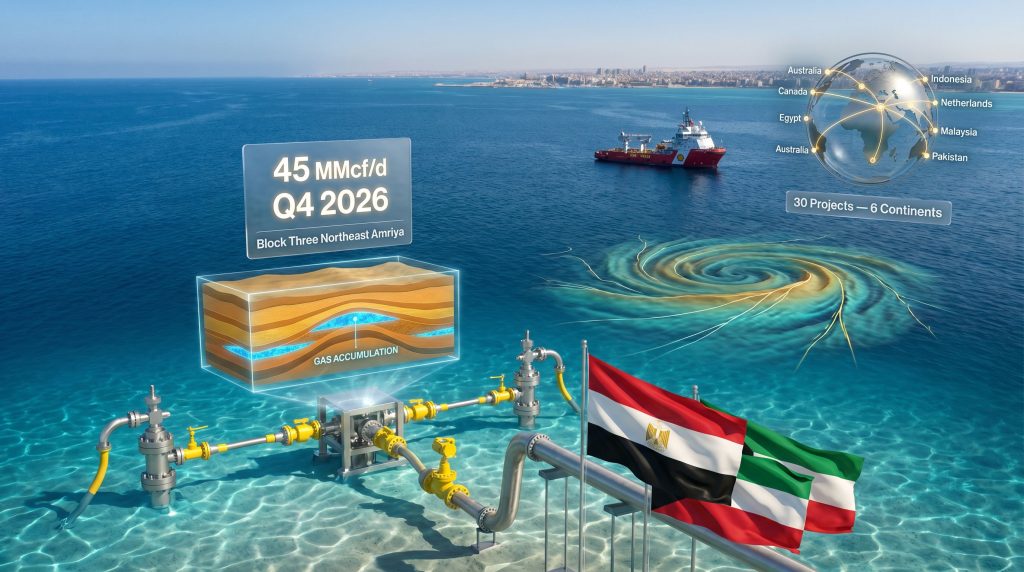
The West Mena gas development, also referenced in some industry documentation as Mina West, sits within the Northeast El Amriya concession in the Mediterranean Sea offshore Alexandria. The shallow-water setting of this block is commercially meaningful: development costs in water depths below 200 metres are substantially lower than deepwater campaigns, and the existing infrastructure along Egypt's northern coastline provides accessible tie-in points for subsea production systems.
Block Three Northeast Amriya functions as one of KPC's flagship international natural gas assets. The joint venture structure governing the concession distributes both operational responsibility and financial exposure as follows:
| Party | Equity Stake | Designated Role |
|---|---|---|
| Shell | 60% | Operator |
| KUFPEC (KPC subsidiary) | 40% | Non-operating partner |
Shell's decision to invest in the West Mena development signals strong operator confidence in the concession's commercial potential. KUFPEC contributes capital, technical review capacity, and strategic input as a non-operating partner with meaningful equity exposure. This 60/40 structure is a well-established model in international upstream development, distributing risk while preserving operational clarity within a single-operator framework.
Two Discovery Wells and What They Revealed Geologically
West Mina 1X: Confirming the Miocene Play
The West Mina 1X well established the commercial foundation of the entire West Mena development program. Targeting Miocene-era gas and condensate accumulations within shallow-water sedimentary formations, the well confirmed the presence of hydrocarbons at commercially meaningful flow rates. The well is currently progressing through active development, with its subsea infrastructure forming the first phase of the field's production system.
Khufu R1: Extending the Resource Envelope Downward
The Khufu R1 well tells a geologically distinct story. Classified as a deep, high-pressure well, it penetrated into lower Miocene sandstone reservoirs at significantly greater depths than the West Mina 1X target interval. The successful identification of gas within these deeper sequences matters beyond the immediate resource increment it provides: it demonstrates that the prospective section within Block Three Northeast Amriya extends vertically across multiple Miocene intervals, each representing a separate exploration and appraisal opportunity.
High-pressure, high-temperature (HPHT) well environments like Khufu R1 are technically demanding and carry elevated drilling risk, but their success materially expands the addressable resource base of a concession. Consequently, the well's results effectively de-risk deeper Miocene targets across the broader block acreage.
How AI and Machine Learning Are Changing Subsurface Interpretation
One of the less widely understood dimensions of the West Mena program is the integration of artificial intelligence and machine learning algorithms into the seismic data processing workflow. KUFPEC applied these technologies to the processing of three-dimensional (3D) seismic data across the southern portion of Block Three, with results described as strongly favourable. Indeed, AI in exploration is rapidly reshaping how operators de-risk complex plays across the world's most contested basins.
The specific operational benefits achieved through this integration include:
- Enhanced imaging resolution beneath complex geological structures, where conventional processing approaches produce noise-contaminated results that obscure fault geometries and reservoir boundaries
- Accelerated data processing timelines, compressing the period between field data acquisition and interpretable subsurface models
- Improved reliability of geological interpretations, reducing the uncertainty embedded in structural maps used to design future well locations
Technical Note: Machine learning applied to seismic attribute analysis enables geoscientists to detect subtle stratigraphic traps and fluid contact anomalies that deterministic processing methods frequently miss. In the Nile Delta's layered Miocene sequences, where reservoir heterogeneity is pronounced, this capability translates directly into more accurate resource estimates and lower exploration risk per well drilled.
In addition, 3D geological modelling is playing an increasingly central role in how operators communicate subsurface complexity to joint venture partners and government stakeholders. KUFPEC's adoption of this methodology signals a broader shift in how international E&P companies are approaching complex basin exploration.
From FID to First Gas: The Development Timeline
The West Mena project reached its Final Investment Decision (FID) in July 2025, formally transitioning from the appraisal and pre-FEED phase into committed capital deployment. FID is the critical inflection point in any upstream project lifecycle, triggering contractor agreements, procurement schedules, and the subsea installation campaign. Understanding what underpins a definitive feasibility study and the associated investment threshold analysis provides useful context for how projects like West Mena move from appraisal to sanction.
The chosen development mechanism is a subsea tie-back, connecting the West Mena wellhead infrastructure to existing offshore processing facilities rather than constructing a standalone production platform. This approach carries significant economic advantages:
- Capital expenditure reductions of 30 to 50% compared to standalone greenfield platform developments
- Compressed construction timelines by eliminating the need for topside fabrication and platform installation
- Lower operating cost structures through shared processing infrastructure
- Reduced environmental footprint relative to standalone developments
First gas production from the West Mena field is targeted for Q4 2026, with initial output expected at approximately 45 million cubic feet per day (MMcf/d) from the West Mena-1 well. The roughly 12-to-18-month window between FID and first gas reflects the engineering complexity of subsea installation campaigns in Mediterranean operating conditions, including pipeline laying, wellhead connection, and commissioning sequences.
KPC's board approval of the West Mena investment formalised the corporation's commitment to the project and confirmed KUFPEC's 40% participation in the capital program.
The next major ASX story will hit our subscribers first
The Kuwait-Egypt Upstream Dialogue: Bilateral Depth Beyond the Project
The strategic relationship between KPC and Egypt's petroleum sector extends well beyond a single concession. Senior-level discussions between KPC's chief executive and Egypt's Minister of Petroleum and Mineral Resources, held during meetings in the United States, addressed a considerably broader investment agenda.
Egypt's petroleum ministry outlined upstream investment opportunities spanning three geologically distinct basin types:
- Mediterranean Sea: Miocene gas and condensate plays, represented by Block Three Northeast Amriya and similar acreage
- Red Sea: A geologically younger rift basin with different hydrocarbon chemistry and development characteristics, including potential oil plays alongside gas
- Western Desert: A mature producing province with established infrastructure and ongoing production enhancement opportunities
The discussions also encompassed technology transfer in reservoir management, production enhancement methodologies, and advanced analytics capabilities. Egypt's petroleum sector stands to gain technical knowledge in AI-assisted exploration and subsurface data analytics, capabilities that can be integrated into the operational frameworks of Egyptian state petroleum entities over time.
For KPC and KUFPEC, the Egyptian upstream relationship offers portfolio diversification across multiple basin types within a single country relationship, reducing the overhead associated with operating in multiple jurisdictions while expanding the addressable resource base. However, these bilateral engagements also reflect shifting dynamics across global energy markets, where national oil companies are increasingly seeking direct upstream positions beyond their home regions.
KUFPEC's Global Portfolio: Where West Mena Fits
The KPC Egypt gas project West Mena represents one component of a substantially diversified international upstream portfolio managed by KUFPEC across 30 active projects on six continents, coordinated through seven overseas offices in Australia, Canada, Egypt, Indonesia, Malaysia, the Netherlands, and Pakistan.
| Portfolio Metric | Detail |
|---|---|
| Active projects globally | 30 |
| Continental coverage | 6 |
| Overseas office locations | 7 |
| West Mena equity stake | 40% |
| FID date | July 2025 |
| Target first production | Q4 2026 |
| Initial production rate | ~45 MMcf/d |
A parallel development within KUFPEC's portfolio is the Anambas project in Indonesia, which has received Indonesian government approval and advanced into its third phase, known as the project definition stage. This phase precedes the final investment decision and involves detailed engineering, contractor selection, and cost estimation. The Anambas progression mirrors the structured development pathway applied to West Mena, reflecting KUFPEC's consistent project governance methodology across different regulatory environments.
KUFPEC's growth framework is constructed around criteria-based geographic selection, meaning asset addition is governed by technical, fiscal, and risk-adjusted return thresholds rather than regional preferences. This philosophy produces a portfolio that is deliberately diversified across geological settings, hydrocarbon types, development stages, and political risk profiles.
Egypt's Energy Infrastructure: The Demand-Side Context
The West Mena development does not exist in isolation from Egypt's broader energy system. Egypt's domestic gas consumption has grown significantly alongside industrial expansion and power generation demand, creating a widening gap between production capacity and consumption requirements that new offshore developments are essential to bridging.
Egypt's allocation of $1.16 billion toward power grid upgrades signals a coordinated approach to managing both supply-side gas production and the transmission infrastructure required to deliver energy to end consumers. The timing of West Mena's Q4 2026 production target aligns with a period of heightened demand as grid capacity expands.
The broader Mediterranean offshore acreage surrounding Block Three Northeast Amriya continues to attract international capital, with Egypt's petroleum ministry actively marketing exploration blocks across its three major basin types. The KPC Egypt gas project West Mena functions as both a near-term production catalyst and a potential gateway to expanded investment across this broader opportunity set.
Frequently Asked Questions: KPC Egypt Gas Project West Mena
What is the West Mena gas project?
West Mena is an offshore natural gas development located within the Northeast El Amriya concession in the Mediterranean Sea, positioned near Alexandria, Egypt. Shell operates the project with a 60% interest, while KUFPEC holds the remaining 40%.
When will West Mena begin producing gas?
Initial production is targeted for the fourth quarter of 2026, following the project's FID reached in July 2025. Early output is expected at approximately 45 MMcf/d through a subsea tie-back configuration.
What geological formations does the project target?
The program targets Miocene-era gas and condensate accumulations confirmed by the West Mina 1X discovery well, alongside deeper lower Miocene sandstone reservoirs identified by the high-pressure Khufu R1 well.
How is artificial intelligence being applied to the exploration program?
KUFPEC has embedded AI and machine learning tools within its 3D seismic processing workflow across Block Three, improving imaging quality beneath complex geological structures, accelerating processing timelines, and enhancing the reliability of interpretations used to plan future drilling.
What other basins did Egypt present to KPC as investment opportunities?
Egypt's petroleum ministry outlined upstream opportunities across the Red Sea, Mediterranean Sea, and Western Desert, each representing geologically distinct basins with different hydrocarbon profiles and development risk characteristics.
Readers seeking ongoing coverage of Egypt's upstream gas sector and broader MENA energy developments can access project tracking and industry reporting through Zawya's Energy section at zawya.com.
Disclaimer: This article contains forward-looking statements including production timelines, reserve estimates, and investment projections. These represent current expectations and are subject to material risks, geological uncertainties, operational variables, and market conditions that could cause actual outcomes to differ. Nothing in this article constitutes financial or investment advice.
Want to Track the Next Major ASX Mineral Discovery Before the Market Does?
Discovery Alert's proprietary Discovery IQ model delivers real-time alerts on significant ASX mineral discoveries, transforming complex geological data into actionable investment insights for both short-term traders and long-term investors — explore the historic returns major discoveries have generated and begin your 14-day free trial at Discovery Alert to position yourself ahead of the broader market.