August 6, 2026
The Governance Gap That Critical Minerals Policy Cannot Afford to Ignore
Multilateral institutions rarely emerge from moments of inspiration. They emerge from the accumulating weight of structural failures that unilateral action can no longer absorb. The global critical minerals landscape has reached precisely that threshold. Across lithium, cobalt, and rare earth elements, the supply chain architecture underpinning electric vehicles, advanced defence systems, and renewable energy infrastructure remains disproportionately concentrated in a single jurisdiction. The response from the world's largest democratic economies has been substantive, but fragmented. Summit declarations have multiplied. Bilateral agreements have deepened. Yet the machinery capable of executing coordinated strategy across annual leadership rotations has, until now, remained absent. That institutional gap is what the proposed G7 critical minerals secretariat is designed to close.
When big ASX news breaks, our subscribers know first
Why Annual Presidencies Are Structurally Incompatible With Long-Term Mineral Strategy
Understanding the case for a permanent secretariat requires understanding what rotating presidencies fundamentally cannot do. Each incoming G7 presidency inherits the diplomatic commitments of its predecessor but has no obligation to prioritise the same thematic agenda. A nation that elevated critical minerals and energy security to the top of its G7 programme may be followed by a presidency with competing domestic priorities, shifting the bloc's collective attention before implementation mechanisms have matured.
This creates what analysts describe as a momentum discontinuity problem. Major mining projects operate on development timelines of ten to fifteen years from exploration to production. Coordinated policy frameworks require sustained institutional attention across multiple presidential cycles to influence those timelines meaningfully. When each presidency must rebuild momentum from scratch, the policy signal to miners, processors, and investors becomes unreliable. Capital allocation decisions in extractive industries respond to long-horizon certainty, not summit-cycle sentiment.
Five sources familiar with the discussions, speaking on condition of anonymity to Reuters, confirmed that ensuring critical mineral initiatives survive beyond the bloc's rotating presidencies is the explicit rationale behind the secretariat proposal. This is not a diplomatic gesture. It is a structural correction to a known institutional deficiency.
The compounding risk extends beyond policy continuity. Without a standing executive body, there is no permanent mechanism to monitor implementation gaps, track stockpile adequacy, or coordinate emergency responses across member nations when supply disruptions occur. The G7's strategic petroleum reserve framework under the IEA provides an instructive contrast: it functions precisely because a permanent institution maintains technical capacity, trigger protocols, and coordinated release mechanisms between crises, not just during them.
Three Presidencies, One Trajectory: How the G7 Built Toward This Moment
The proposed secretariat did not emerge in isolation. It represents the institutional conclusion of a deliberate, three-year policy architecture constructed across consecutive G7 presidencies.
Japan's 2023 presidency established the conceptual foundation, articulating a Five-Point Framework that identified supply chain diversification as a bloc-wide strategic imperative. Japan brought particular institutional credibility to this agenda. Its manufacturing economy, concentrated in automotive and precision electronics, had experienced firsthand the consequences of mineral supply concentration when China imposed rare earth export restrictions in 2010. That historical episode informed the urgency and specificity of Japan's 2023 framework.
Italy's 2024 presidency translated strategic architecture into operational experimentation. The most significant development of that cycle was the launch of the European Union's pilot stockpile project, led jointly by Italy, France, and Germany. Rather than proposing a single EU-wide reserve, the three-nation structure tested whether coordinated mineral stockpiling was technically and diplomatically feasible while preserving national sovereignty over individual holdings. This design choice, limiting the pilot to Europe's three largest economies, reflected pragmatic acknowledgment that political consensus around pooled reserves was not yet achievable at scale. Furthermore, questions around European critical raw materials supply were already shaping how member states approached this collaboration.
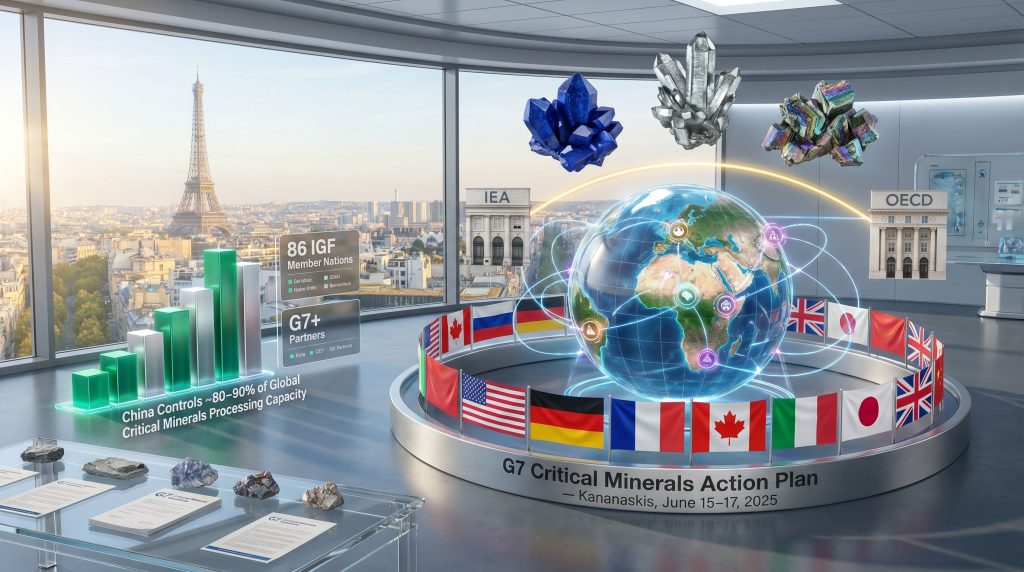
Canada's June 2025 Kananaskis Summit then produced the most comprehensive programmatic framework to date: the G7 Critical Minerals Action Plan. Its four core pillars are worth examining in structural terms.
| Strategic Pillar | Core Objective | Principal Partners |
|---|---|---|
| Supply Chain Diversification | Onshore mining, processing, and recycling capacity | Industry, IGF (86 member nations) |
| Investment Mobilisation | Capital deployment via MSP and World Bank RISE | G7 finance ministers, Australia, India, Korea |
| Responsible Mining Standards | Sustainable practices across source countries | IGF, Chicago Conference (September 2025) |
| Standards-Based Market Development | Transparent mineral market roadmap by end-2025 | G7 trade and industry ministries |
Each pillar designates specific partner institutions and target timelines, moving the conversation from aspirational to operational. The Kananaskis Action Plan created accountability structures that now require institutional homes for execution. The secretariat proposal is the logical response to that implementation requirement.
Parallel to the G7 process, the Minerals Security Partnership (MSP) has functioned as a complementary but distinct coordination framework. The MSP operates primarily through bilateral agreements and project-level financing rather than broad multilateral governance. The US-EU agreement to deepen coordination on lithium, cobalt, and rare earth elements represents a recent strengthening of that bilateral foundation. However, bilateral architecture cannot substitute for G7-wide execution capacity. What bilateral agreements cannot do is coordinate stockpiling triggers, align production incentives, or set unified market standards across seven major economies simultaneously. That is the specific function the secretariat would provide.
What a Permanent G7 Minerals Body Would Actually Do
Clarity about the secretariat's institutional mandate requires equal clarity about what it would not be. Both of these dimensions are contested in current discussions.
On the operational side, the secretariat's core functions would include maintaining continuity of execution across rotating G7 presidencies, coordinating stockpiling strategy development and review, monitoring supply chain adequacy across member states, and providing the administrative backbone for decisions reached at leaders' summits. It would act as the execution layer between summits rather than as a policy-making body in its own right. The distinction matters because it positions the secretariat as a servant of member governments rather than as an independent multilateral authority.
On the boundary conditions, the picture is equally important. European governments have explicitly rejected the concept of a single shared mineral stockpile, according to Reuters sources familiar with the discussions. Each nation would retain sovereign control over its own reserves. The secretariat would not hold, purchase, or manage mineral inventories directly. It would coordinate strategy, not control supply.
The geopolitical dimension of this design is notable. Reuters reporting indicates that European partners have expressed specific concern about US-led control of any shared reserve, citing the risk of access restrictions during a supply crisis. This concern reflects a broader transatlantic trust dynamic in which European governments seek genuine multilateral governance rather than a framework that could functionally operate as a US supply chain instrument. The secretariat design, as currently conceptualised, accommodates this concern by positioning the body as an execution coordinator rather than a stockpile authority.
A permanent secretariat is best understood not as a diplomatic gesture, but as a structural response to a documented supply chain vulnerability that no single nation, or bilateral agreement, can resolve independently.
Paris as the Institutional Anchor: IEA vs. OECD
Location and host institution discussions have coalesced around Paris, a choice that reflects both practical and geopolitical logic. Both primary candidate institutions, the International Energy Agency and the Organisation for Economic Co-operation and Development, are based in the French capital. France currently holds the G7's rotating presidency, making Paris a natural anchor for early-stage discussions. French Finance Minister Roland Lescure confirmed the country's proactive engagement when he announced an online G7 meeting to address China's dominance in critical materials, framing it as preparatory work for the mid-June Evian leaders' summit.
The choice between the IEA and the OECD as host institutions carries meaningful institutional consequences.
| Institution | Existing Mineral Mandate | Membership Scope | Key Operational Advantage |
|---|---|---|---|
| IEA | Active stockpiling and production alignment programs | 31 member countries, energy-focused | Already convening government and industry on mineral stockpile design |
| OECD | Responsible business conduct and policy standards | 38 members, broader economic mandate | Stronger reach into developing-nation policy frameworks |
The IEA has already demonstrated operational engagement. Its April 2025 Brussels workshop brought together government delegations from the United States, Germany, France, Canada, Italy, and Spain alongside the European Commission. Industry participants included representatives from General Motors, Glencore, Leonardo, and Umicore. The workshop's explicit purpose was to examine technical aspects of effective stockpiling system design and gather industry perspectives on implementation. This level of operational activity ahead of a formal establishment decision gives the IEA a practical head start as a candidate host.
The OECD's advantage lies in its established relationships with resource-rich developing nations and its existing responsible business conduct frameworks. Given that the IGF's 86 member nations represent the primary source countries for minerals G7 economies require, an OECD-hosted secretariat might more naturally bridge the gap between consumer and producer nation governance expectations.
The IEA declined to comment on the G7 talks. The OECD did not respond to a request for comment from Reuters by publication time. The silence from both institutions reflects the sensitivity of host selection negotiations at this stage.
China's Processing Dominance: The Number That Drives Everything
No analysis of the G7 critical minerals secretariat is complete without a precise understanding of the supply concentration problem it exists to address. China controls approximately 80 to 90 percent of global critical minerals processing capacity across the battery and defence input categories that matter most to G7 economies. This figure is not a projection or an estimate based on one data point. It is a structural feature of the global mineral processing industry that has developed over decades of deliberate industrial policy investment.
The asymmetry at the heart of the problem is geographic: the minerals themselves are distributed across multiple continents, with significant deposits in Africa, South America, Australia, and Central Asia. However, the refining and processing infrastructure that transforms raw ore into battery-grade lithium carbonate, cobalt sulphate, or separated rare earth oxides is overwhelmingly concentrated in China. G7 nations can mine; they currently cannot process at scale.
This creates a structural dependency that affects three distinct strategic priority areas simultaneously.
- Defence manufacturing: Advanced weapons systems, guidance systems, and electronic warfare capabilities depend on rare earth elements for which there is no short-term substitute sourcing alternative.
- Energy transition infrastructure: Electric vehicle batteries, wind turbine generators, and grid-scale storage systems require lithium, cobalt, and neodymium at volumes that current non-Chinese processing capacity cannot supply.
- Advanced manufacturing competitiveness: Semiconductor fabrication, precision optics, and industrial robotics all incorporate critical mineral inputs at points in the supply chain that are difficult to substitute or reshore rapidly.
The US-EU agreement to deepen bilateral coordination on lithium, cobalt, and rare earths reflects recognition that the problem requires coordinated action. In addition, the surging critical minerals demand across G7 economies is making that coordination ever more urgent. Bilateral agreements address pieces of the processing dependency problem without providing the unified market signal, coordinated stockpile trigger, or shared standards infrastructure that a G7-wide secretariat would deliver.
It is worth noting one dynamic that receives less attention in mainstream policy discussions: China's dominance in processing is not simply a function of lower labour costs or industrial scale. It reflects decades of investment in the technical expertise, workforce training, and proprietary process chemistry required to achieve battery-grade mineral purity at commercial volumes. Recreating that technical infrastructure in G7 economies requires not just capital but time, and that time horizon amplifies the urgency of coordinated stockpile strategies while domestic processing capacity develops.
The next major ASX story will hit our subscribers first
The Stockpile Debate: Where G7 Nations Disagree
The most substantive area of internal G7 disagreement concerns the architecture of mineral reserves: whether to pool resources into a shared stockpile or maintain individually controlled national reserves with coordinated governance.
| Model | Control Structure | Access Mechanism | Primary Risk |
|---|---|---|---|
| Centralised Shared Reserve | Single multilateral authority | Consensus-based coordinated release | Political gridlock during acute supply crises |
| National Sovereign Reserves | Individual government control | Bilateral or emergency protocols | Fragmentation and coordination lag |
| EU Pilot Model (current) | Three-nation coordination | Aligned but independently held reserves | Scale limitations and intra-EU divergence |
The case for centralised reserves rests on procurement efficiency and speed of response. Pooled purchasing reduces per-unit acquisition costs and enables faster release during supply disruptions, mirroring the logic of the IEA's strategic petroleum reserve framework.
The case against, and the position European governments have adopted, centres on sovereignty and access risk. Reuters sources confirmed that European nations have explicitly raised concerns about scenarios where access to a US-controlled or jointly controlled reserve could be restricted during a geopolitical crisis. Given that energy security has already demonstrated how multilateral energy commitments can fracture under extreme political pressure, this caution is institutionally rational rather than merely protectionist.
The EU pilot project, led by Italy, France, and Germany, represents the middle-ground solution currently being tested. Each nation maintains independent control of its reserves while coordinating acquisition strategy, strategic composition, and release protocols with the other two participants. This preserves sovereign decision-making authority while capturing some of the coordination benefits of a shared framework. Whether this model scales to seven G7 nations with divergent industrial structures and geopolitical alignments remains an open question that the proposed secretariat would need to operationalise.
The IGF Partnership: Why Resource-Rich Nations Are Central to the Strategy
One dimension of the G7 critical minerals agenda that receives insufficient analytical attention is the role of the Intergovernmental Forum on Mining, Minerals, Metals and Sustainable Development. With 86 member nations representing the world's primary mineral-producing jurisdictions, the IGF is not a peripheral stakeholder in the secretariat's design. It is a central partner in supply chain diversification strategy.
The Kananaskis Action Plan's formal recognition of the IGF signals a strategic shift from a purely extraction-oriented relationship between G7 consumer economies and developing-nation mineral producers toward a partnership governance model. This distinction matters for long-term supply reliability. Supply disruptions driven by political instability, resource nationalism, or governance failures in producer nations represent a material risk to G7 mineral security that stockpiles can buffer but not eliminate.
The September 2025 US-chaired Conference in Chicago serves as a key implementation milestone for responsible mining standards frameworks. By establishing minimum governance, environmental, and community engagement standards in source countries, G7 nations are making a strategic investment in the institutional stability of the jurisdictions they depend upon for mineral supply. This is not purely altruistic. It is a risk management strategy applied to the upstream end of supply chains that G7 economies need to diversify.
There is also a soft-power dimension worth acknowledging. China's Belt and Road Initiative has deployed significant capital into mineral-rich developing nations, often with limited environmental or governance conditionality. A G7 secretariat that actively supports responsible mining standards, and channels investment through frameworks like the World Bank's RISE programme, offers an institutional alternative to Chinese infrastructure financing that serves both development and supply chain objectives simultaneously. The broader shift in metals and mining geopolitics is, consequently, reshaping how G7 nations frame these partnerships.
Three Scenarios for What Comes Next
The outcome of the Evian summit and subsequent G7 ministerial processes will determine which institutional pathway the secretariat proposal follows. Three plausible scenarios deserve consideration.
Scenario One: Formal Establishment by Late 2026
France's active presidential engagement, the IEA's existing Brussels workshop programme, and the Kananaskis Action Plan's implementation requirements collectively create conditions under which formal secretariat establishment by late 2026 is achievable. This scenario requires G7 Leaders' Communiqué language that authorises an institutional mandate, a host-country agreement from France or a relevant organisation, and sufficient budgetary commitment from member states to staff initial operations.
Scenario Two: Delayed or Structurally Diluted Implementation
If the Evian summit produces aspirational language without an operational mandate, the secretariat concept enters a holding pattern. In this scenario, G7 nations continue relying on bilateral agreements and ministerial-level coordination without unified execution capacity. The risk is that China exploits the coordination gap through long-term offtake agreements with resource-rich nations, progressively deepening G7 supply chain dependencies while the secretariat remains theoretical.
Scenario Three: Parallel Institutional Architecture
A third pathway involves the IEA and OECD independently expanding their mineral mandates without a formal G7 endorsement of a unified secretariat. The IEA's existing Brussels workshop programme could evolve into a de facto coordination mechanism without formal institutional designation. This would provide functional secretariat-like capacity but without the political authority, formal membership structure, or cross-ministry coordination power that a formally designated G7 body would carry.
The G7+ expansion dynamic adds further complexity. Australia, India, Korea, and Mexico have participated in G7+ mineral meetings and could potentially be incorporated into a broader secretariat membership structure. While expanded membership would strengthen the body's legitimacy and mineral sourcing reach, it would also introduce additional governance complexity into an institution that has not yet resolved its internal membership's structural disagreements. The evolving critical minerals strategy shift across G7 nations will, furthermore, determine how quickly these disagreements can be resolved.
Key Data Points at a Glance
| Metric | Detail |
|---|---|
| China's processing market share | Approximately 80-90% across key critical minerals |
| G7 Critical Minerals Action Plan launch | June 15-17, 2025 (Kananaskis, Canada) |
| Proposed secretariat host city | Paris (IEA or OECD as candidate institutions) |
| G7+ partner nations involved | Australia, India, Korea, Mexico |
| IGF member nations represented | 86 resource-rich countries |
| IEA Brussels workshop registered governments | US, Germany, France, Canada, Italy, Spain, EU Commission |
| IEA Brussels workshop industry participants | General Motors, Glencore, Leonardo, Umicore |
| EU pilot stockpile project leaders | Italy, France, Germany |
Frequently Asked Questions: G7 Critical Minerals Secretariat
What is the G7 critical minerals secretariat?
The G7 critical minerals secretariat is a proposed permanent institutional body designed to maintain execution continuity for G7 minerals policy across the bloc's annual rotating presidencies. Its function would be to coordinate stockpiling strategy, supply chain diversification, and standards development on behalf of member nations, rather than directly managing mineral inventories.
When could the secretariat be established?
As of the Reuters reporting that confirmed the discussions, the timeline remained unresolved. Government sources indicated that 2026 was a plausible establishment window, with key decisions expected at the June G7 Leaders' Summit in Evian, France. No formal establishment date has been confirmed.
Where would the secretariat be based?
Paris has emerged as the most likely host city. Both the International Energy Agency and the OECD have been identified as potential institutional homes, and both are headquartered in Paris. France's active G7 presidency further reinforces the French capital's positioning as the natural discussion hub.
Why do G7 nations need a permanent body rather than summit commitments?
Summit commitments are implemented through member states' domestic administrative systems, without a standing body to monitor progress or coordinate between meetings. Given that major mining and processing projects operate on decade-long development timelines, policy consistency across multiple G7 presidencies is essential to send reliable signals to investors and industry.
Which minerals are the primary focus?
Lithium, cobalt, and rare earth elements represent the highest strategic priority, given China's approximately 80 to 90 percent share of global processing capacity for these inputs and their centrality to electric vehicle batteries, renewable energy systems, and defence manufacturing.
Will the secretariat control a shared mineral stockpile?
No. European governments have explicitly rejected the shared stockpile model, citing sovereignty concerns and risk of access restrictions under US-led control. The G7 critical minerals secretariat would coordinate strategy between nationally held reserves rather than owning or managing any mineral inventory directly.
This article is intended for informational purposes only and does not constitute financial or investment advice. Statements regarding proposed institutional frameworks, timelines, and policy outcomes reflect reporting and analysis based on available information as of the publication date. Readers should conduct independent research before making any investment decisions related to the critical minerals sector.
Want to Position Yourself Ahead of the Next Major Critical Minerals Discovery?
Discovery Alert's proprietary Discovery IQ model delivers real-time alerts on significant ASX mineral discoveries — cutting through complex data to surface actionable opportunities in lithium, cobalt, rare earths, and beyond — the very commodities at the centre of the global supply chain realignment described above. Explore how historic mineral discoveries have generated substantial returns and begin your 14-day free trial today to gain an immediate market-leading edge.