June 18, 2026
The Structural Trap Beneath the Clean Energy Boom
Every electric vehicle sold, every offshore wind turbine installed, and every guided missile launched depends on a group of 17 metallic elements that most people have never heard of. Rare earth elements sit at the intersection of the green economy, consumer technology, and national security, yet the global supply chain that delivers them is arguably the most concentrated of any industrial input on Earth. This is not a geological accident. It is the result of deliberate, decades-long industrial policy that has left the world's wealthiest democracies in a position of deep structural vulnerability.
Understanding why the G7 rare earth imports rule matters requires stepping back from the policy announcement itself and examining the underlying architecture of a supply chain that was never designed with resilience in mind.
When big ASX news breaks, our subscribers know first
Why Rare Earth Concentration Risk Has Become a G7-Level Crisis
The 17 Elements Holding the Global Economy Hostage
Rare earth elements are not particularly rare in the geological sense. They are found in the Earth's crust in concentrations that exceed many commercially mined metals. The challenge is that they rarely occur in economically viable concentrations, and processing them into usable forms is technically demanding, environmentally complex, and capital intensive.
Their applications, however, are irreplaceable across the most strategically important sectors of the modern economy:
| Application | Key Rare Earth Elements Used |
|---|---|
| EV traction motors | Neodymium, Praseodymium, Dysprosium |
| Wind turbine generators | Neodymium, Terbium, Dysprosium |
| Smartphones and consumer electronics | Lanthanum, Cerium, Neodymium |
| Precision-guided weapons and radar | Samarium, Dysprosium, Terbium |
| Semiconductors and display technology | Europium, Yttrium, Cerium |
| AI server cooling and components | Yttrium, Lanthanum |
The scarcity that matters here is not geological. It is structural and geopolitical, built into the architecture of who controls the processing infrastructure, not just the ground beneath their feet. Rare earth supply chains, furthermore, are shaped as much by policy decisions as by geology.
How One Country Came to Control the Entire Value Chain
China's dominance in rare earths was not achieved overnight. It unfolded across three decades through a combination of state-backed investment, tolerance for environmental externalities that Western regulators would not permit, and a willingness to operate processing facilities at prices that made competition from other nations commercially unviable.
According to the International Energy Agency, China currently accounts for approximately 60% of global magnet rare earth mining output. Moving further down the value chain, that share climbs dramatically: China controls more than 90% of global rare earth refining capacity and nearly 95% of permanent magnet manufacturing. Two decades ago, China produced roughly half of the world's permanent magnets. That share has since roughly doubled, consolidating control at every downstream stage.
"China's dominance extends far beyond extraction. It encompasses every processing stage between raw ore and finished magnet, meaning that simply opening new mines in other countries addresses only the first link in a much longer chain."
This is the core analytical insight that the G7 rare earth imports rule is designed to confront. A mine in Australia or Canada produces ore concentrate. Without refining infrastructure to process that concentrate into separated rare earth oxides, and without magnet manufacturing capacity to convert those oxides into functional components, the ore itself has limited strategic value. Understanding the rare earth processing challenges involved at each stage is, consequently, essential to appreciating why political commitments alone are insufficient.
What Is the G7 Rare Earth Imports Rule?
The 60% Import Cap Explained
At the G7 summit held in France, the United States, Canada, France, Germany, Italy, Japan, and the United Kingdom collectively committed to a diversification benchmark: no single country should supply more than 60% of any G7 member's rare earth imports by 2030. The group also established a secondary aspiration to reduce that threshold further to 50% as quickly as practicable.
Critically, the rule covers both rare earth elements and permanent magnets, addressing the two most strategically exposed segments of the supply chain simultaneously. Several points deserve emphasis:
- The rule is a concentration limit, not a trade ban or import restriction on Chinese materials
- G7 nations can continue sourcing from China but must develop diversified alternatives to reduce single-supplier dependency
- The benchmark applies to imports as a whole, meaning that reaching the target requires building viable alternative suppliers at scale, not merely reducing Chinese purchases
According to reporting on the G7's rare earth ambitions, the commitment represents the most explicit quantified target the group has yet attached to supply chain diversification in this sector.
Is the G7 Rare Earth Rule Legally Binding?
One of the most consequential distinctions surrounding the G7 rare earth imports rule is the gap between political commitment and binding regulation. The G7 declaration is a non-binding pledge that requires translation into national legislation and procurement policy by each member state individually.
| Policy Instrument | Binding Force | Implementation Mechanism | Target Timeline |
|---|---|---|---|
| G7 60% Import Cap | Non-binding pledge | Member-state discretion | By 2030 |
| EU Critical Raw Materials Act | Binding (EU members) | Regulatory benchmarks | 2030 |
| U.S. Defense Production Act Orders | Binding (domestic) | Federal procurement rules | Active |
| Canada Critical Minerals Strategy | Non-binding framework | Public investment programs | Ongoing |
The EU critical raw materials framework represents the most legally enforceable parallel instrument among G7 members, establishing domestic processing benchmarks with regulatory teeth. The gap between political declaration and enforceable policy is where many previous G7 supply-chain commitments have stalled, and rare earths will be no different unless member states follow through with domestic legislation.
What Triggered the G7's Rare Earth Diversification Push?
China's Export Control Escalation: A Timeline of Pressure
The catalyst for the G7's formal commitment was a visible, measurable disruption rather than an abstract strategic concern. China's export restrictions on specific rare earth elements and advanced processing technologies in 2025 caused production slowdowns and inventory shortfalls at manufacturers across multiple industries outside China.
According to United Nations reporting, China has introduced 16 separate trade restrictions on critical energy transition materials since 2020, a cadence that reflects a deliberate, escalating policy posture rather than isolated responses to trade disputes. The pressure is set to intensify further: Beijing plans to reinstate export controls on several defence-related rare earth categories in November 2026, following the expiration of a temporary U.S.-China trade truce.
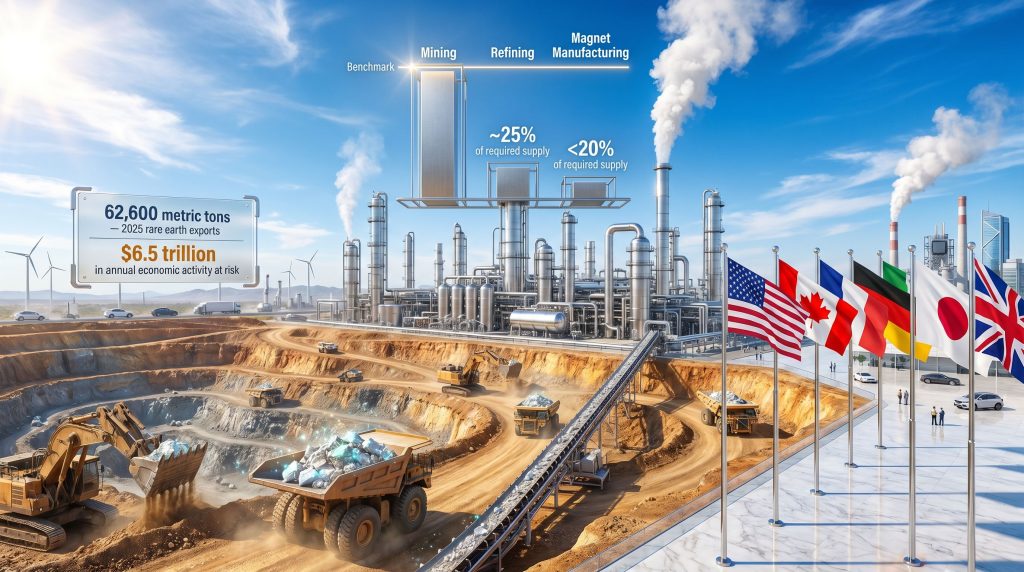
The IEA has estimated that full implementation of Chinese export restrictions could affect up to $6.5 trillion in annual economic activity outside China.
"This figure does not represent a single catastrophic disruption event. It reflects the annualised value of global industrial output that depends on uninterrupted access to Chinese rare earth inputs across automotive, electronics, clean energy, and defence sectors simultaneously."
Analysis from the Center for Strategic and International Studies highlights that these restrictions pose particular risks to U.S. defence supply chains, where rare earth dependency is both deep and difficult to substitute quickly.
Why Export Volumes Rose Even as Controls Tightened
An important nuance often missed in coverage of rare earth export controls is that China's overall export volumes have actually risen despite the restrictions. According to Statista, citing data from China's General Administration of Customs and Reuters, Chinese rare earth exports reached 62,600 metric tons in 2025, up from 55,400 metric tons in 2024, representing the highest annual export volume in over a decade.
This apparent contradiction is explained by the targeted nature of the controls. Beijing's restrictions focus on specific heavy rare earth elements and advanced processing technologies, particularly those with the most direct defence and high-tech applications, rather than restricting total export volumes. International manufacturers, aware of the strategic direction of Chinese policy, responded by aggressively building inventory buffers and diversifying procurement wherever partial alternatives existed.
How Far Behind Is the Rest of the World? A Supply Chain Gap Analysis
The Three-Stage Bottleneck: Mining, Refining, and Magnets
The IEA's projections for non-China supply capacity by 2035 reveal a progressively widening gap as one moves downstream through the value chain:
| Supply Chain Stage | Projected Coverage of Non-China Demand by 2035 |
|---|---|
| Mining output | ~50% of required supply |
| Refining capacity | ~25% of required supply |
| Magnet manufacturing | Less than 20% of required supply |
The pattern is unmistakable. Mining investment, which attracts the most visible capital flows and government announcements, closes the gap least at the stage where it matters most commercially. Refining and magnet manufacturing, which are the actual bottlenecks, remain severely underdeveloped outside China.
Why Refining and Magnet Manufacturing Are the Real Bottlenecks
Building a rare earth separation facility is not comparable to constructing a standard mineral processing plant. Rare earth separation uses solvent extraction processes that involve hundreds of sequential chemical stages, require highly specialised technical expertise, and generate significant chemical waste streams that trigger stringent environmental permitting requirements in most Western jurisdictions.
Several factors compound this challenge:
- Knowledge concentration: The workforce with direct experience in rare earth separation chemistry is largely concentrated in China, creating a human capital barrier alongside the physical infrastructure gap
- Environmental permitting: Processing facilities face complex regulatory approvals in the EU, U.S., Canada, and Australia that can extend development timelines by years
- Economics of scale: Chinese processing facilities operate at scales that make Western equivalents commercially uncompetitive without policy support or price floor mechanisms
- Magnet manufacturing complexity: Producing sintered neodymium-iron-boron (NdFeB) permanent magnets requires grain boundary diffusion technologies and microstructural control that represent proprietary industrial knowledge accumulated over decades
A mining project announced today in Canada or Australia will not deliver processed rare earth oxides into supply chains for a minimum of five to seven years under optimistic permitting scenarios, and will not contribute to magnet manufacturing capacity at all without entirely separate downstream investment.
The $60 Billion Investment Requirement
The IEA estimates that approximately $60 billion in investment will be required over the next decade to build genuinely diversified rare earth supply chains outside China. While substantial in absolute terms, this figure is modest relative to the trillions of dollars in annual industrial output that depend on supply chain security.
Governments are exploring several financing mechanisms to mobilise this capital:
- Development bank lending and public financing for processing infrastructure with long payback timelines
- Tax incentives for domestic rare earth refining and magnet manufacturing facilities
- Price floor or offtake guarantee mechanisms to reduce the commercial risk of investing in capacity that may not be competitive on spot market terms
- Trade architecture tools including procurement preferences for allied-nation rare earth inputs
Can Recycling and Alternative Technologies Close the Gap?
Rare Earth Recycling: The Underutilised Supply Lever
The IEA projects that recycling could reduce demand for newly mined rare earth materials by up to 35% by 2050, representing a significant long-term contribution to supply diversification. Current global recycling rates for rare earths remain extremely low, with most end-of-life rare earth materials going unrecovered.
The most valuable recycling feedstock streams include:
- End-of-life EV traction motors
- Decommissioned wind turbine generators
- Consumer electronics and hard disk drives
- Industrial motors and generators
A critical but underappreciated dynamic is timing. The volume of recyclable rare earth material available in the waste stream is largely a function of how many rare-earth-intensive products were manufactured 10 to 15 years earlier. As EV adoption has accelerated only recently, the volume of end-of-life EV motors available for recycling will not reach meaningful scale until the mid-2030s at the earliest.
Material Substitution and the Limits of Near-Term Relief
Research into reducing rare earth intensity per unit of industrial output represents a legitimate long-term strategy, but the timelines are unforgiving. Motor designs that reduce or eliminate neodymium and dysprosium requirements, ferrite-based magnet alternatives, and rare-earth-lean configurations are all active research areas, but none are positioned to provide material supply relief before 2030.
The two heavy rare earths facing the most acute concentration risk are dysprosium and terbium, both used to enhance the high-temperature performance of NdFeB magnets. These elements are produced almost exclusively from ionic clay deposits in southern China, with almost no commercial production elsewhere. Even within the rare earth supply challenge, these two elements represent a particularly acute vulnerability.
The next major ASX story will hit our subscribers first
How Are G7 Nations Responding Beyond the 60% Pledge?
National and Multilateral Initiatives Already Underway
G7 member states have not waited for the formal declaration to begin building supply-chain resilience frameworks. Key actions already underway include:
- Canada has committed $6.4 billion toward critical minerals supply chain development, making it one of the most capital-committed G7 members in absolute terms
- United States Department of Defense has committed $500 million in direct capital support to Phoenix Tailings to rebuild domestic rare earth processing capacity
- European Union has enacted the Critical Raw Materials Act, establishing binding benchmarks requiring that at least 10% of annual rare earth consumption come from EU domestic extraction and 40% from EU processing by 2030
- Japan has maintained long-standing bilateral minerals agreements with Australia, Canada, and several African nations, built in part on its experience with a 2010 Chinese rare earth export restriction that disrupted its manufacturing sector severely
The Minerals Security Partnership (MSP), which brings together the U.S., EU, Japan, Canada, Australia, the UK, and other allied nations, provides a multilateral framework for coordinating investment in critical mineral supply chains across the full value chain.
The Role of Allied-Nation Producers in Filling the Gap
Countries with the geological endowment to meaningfully contribute to non-Chinese rare earth supply include Australia, Canada, Brazil, South Africa, India, and Greenland. However, resource endowment and production capacity remain vastly different things. The Greenland minerals race illustrates precisely how geopolitical complexity can slow the conversion of geological potential into operational supply.
"Australia holds some of the world's largest rare earth reserves outside China, yet its contribution to global refined rare earth supply remains a fraction of its geological potential. This gap between what lies in the ground and what reaches industrial supply chains illustrates precisely why the G7's focus must extend well beyond encouraging new mining projects."
What Does the G7 Rare Earth Rule Mean for Industry and Investors?
Sector-Level Exposure Under the Current Supply Structure
| Sector | Rare Earth Dependency | Diversification Urgency |
|---|---|---|
| Electric vehicles | High (permanent magnets in traction motors) | Critical |
| Wind energy (direct-drive turbines) | High (large-format NdFeB magnets) | Critical |
| Defence and aerospace | Very high (guidance systems, actuators) | Extreme |
| Consumer electronics | Moderate (speakers, vibration motors) | High |
| Industrial motors and HVAC | Moderate | Moderate |
| AI infrastructure (cooling, sensors) | Emerging and growing | High |
Investment Themes Emerging from the G7 Policy Shift
For investors tracking the structural implications of the G7 rare earth imports rule, several themes warrant attention:
- Rare earth processing and refining represents the highest-value investment opportunity in the sector, precisely because it is the most underdeveloped stage of non-Chinese supply chains
- Magnet manufacturing capacity in the U.S., EU, and Japan is receiving unprecedented government and private attention as the final output stage closest to end-market demand
- Recycling technology companies targeting rare earth recovery from EV motors and wind turbines are positioned for long-term policy tailwinds as waste stream volumes build through the 2030s
- Allied-nation miners with integrated processing strategies are fundamentally more investable than pure-play exploration companies, given that ore concentrate without downstream processing capacity has limited strategic value to buyers under supply-security mandates
This article does not constitute financial advice. Investors should conduct their own due diligence before making investment decisions in the rare earth or critical minerals sector.
Frequently Asked Questions: G7 Rare Earth Imports Rule
What exactly is the G7 rare earth imports rule?
The G7 agreement establishes a diversification benchmark stating that no single country should supply more than 60% of any G7 member nation's rare earth imports by 2030, with a further aspiration to reduce that share to 50% as quickly as possible. The rule covers both rare earth elements and permanent magnets.
Is China banned from supplying rare earths to G7 countries?
No. The rule is a concentration limit, not a trade prohibition. G7 nations can continue importing from China but are committing to develop sufficient alternative supply sources to ensure no single supplier accounts for more than 60% of their total rare earth imports.
Which rare earth elements represent the greatest supply security risk?
The four elements of greatest strategic concern for permanent magnet production are neodymium, praseodymium, dysprosium, and terbium. Of these, dysprosium and terbium face the most acute concentration risk because commercial production is almost entirely confined to ionic clay deposits in southern China, with negligible production elsewhere.
What happens if G7 countries cannot meet the 60% target by 2030?
Because the commitment is a non-binding political pledge rather than a regulatory requirement, there is no formal enforcement mechanism. Accountability rests on political credibility and the degree to which member states translate the pledge into domestic legislation. Given that IEA projections suggest non-China refining capacity will cover only around 25% of required supply by 2035, meeting the 60% target by 2030 through diversification alone will require a significant acceleration of current investment trajectories.
The Road to Rare Earth Resilience: Key Takeaways
Three Conditions Required for the G7 Target to Succeed
Achieving genuine rare earth supply chain diversification by 2030 depends on more than political will. Three structural conditions must be met simultaneously:
- Capital deployment across the full value chain, with particular urgency at the refining and magnet manufacturing stages that receive the least commercial investment relative to their strategic importance
- Accelerated permitting and regulatory reform in allied nations to reduce the development timeline from mineral discovery to processing output, which currently stretches well beyond the 2030 target window under standard procedures
- Coordinated trade architecture that makes non-Chinese rare earth supply economically competitive through procurement preferences, price floor mechanisms, and allied-nation offtake agreements
What Remains Genuinely Uncertain
- Whether G7 political declarations translate into the binding national legislation and funding commitments required for commercial-scale investment decisions
- How China calibrates its export control policy in response to accelerated Western diversification, including the potential reinstatement of defence-related controls in November 2026
- Whether recycling infrastructure and substitution technologies can reach material scale before 2030, or whether primary supply diversification bears the full burden of meeting the target
The G7 rare earth imports rule represents the most coordinated multilateral response yet to a supply chain vulnerability that has been documented for more than a decade. Whether it marks the beginning of structural change or becomes another unfulfilled declaration depends entirely on what happens in the years between the summit announcement and the 2030 deadline. The broader architecture of rare earth supply chains will, consequently, determine whether political ambition translates into genuine industrial resilience.
For ongoing coverage of rare earth markets, critical minerals policy, and energy transition investment themes, visit CarbonCredits.com.
Want to Track the Next Major Critical Minerals Discovery Before the Market Does?
Discovery Alert's proprietary Discovery IQ model delivers real-time alerts on significant ASX mineral discoveries — including rare earths and other critical minerals driving the energy transition — instantly converting complex geological data into actionable investment insights. Explore how historic discoveries have generated substantial returns on Discovery Alert's dedicated discoveries page, and begin your 14-day free trial today to position yourself ahead of the market.