July 27, 2026
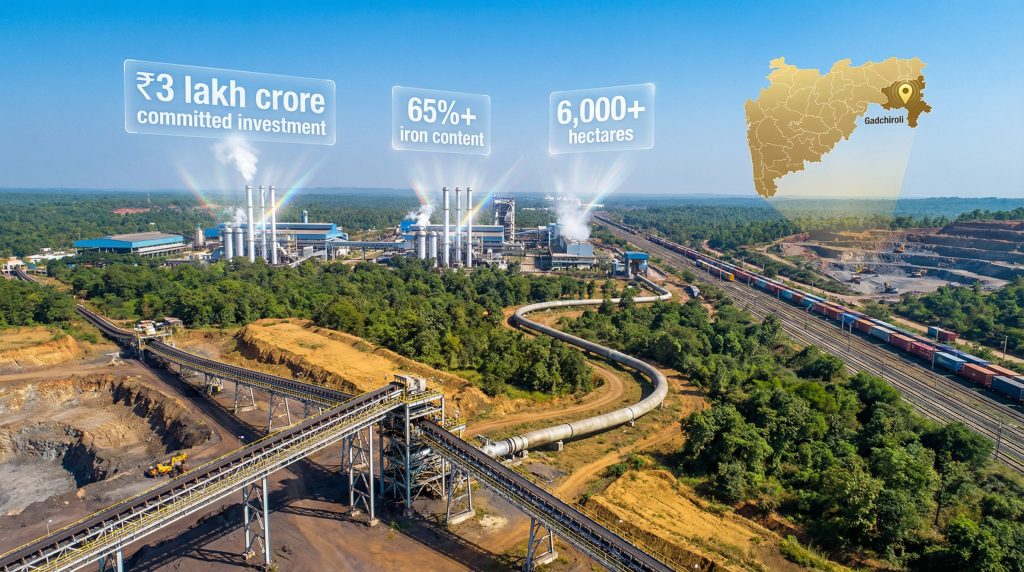
The Gadchiroli industrial potential represents a compelling case study in regional transformation, where abundant mineral resources are converging with strategic policy support to create India's next major steel manufacturing hub. This Maharashtra district, long recognised for its high-grade iron ore deposits, is experiencing unprecedented investment momentum as major steel producers commit billions to integrated production facilities.
The convergence of high-grade mineral deposits, strategic geographic positioning, and targeted government support creates unique conditions for accelerated industrial development. Understanding these transformation mechanisms provides insights into how resource-rich regions can overcome historical development constraints to achieve rapid industrialisation.
Strategic Resource Assessment: Understanding Gadchiroli's Geological Advantages
Maharashtra's Gadchiroli district contains some of India's highest-quality iron ore deposits, with ore grades exceeding 65% iron content across more than 6,000 hectares of mineral-bearing terrain. This superior ore quality significantly reduces beneficiation requirements and energy consumption in steel production processes compared to lower-grade deposits requiring extensive processing.
The district's geological profile extends beyond iron ore to include substantial coal reserves, limestone deposits, and manganese resources. This mineral diversity enables integrated steel production chains where multiple raw materials can be sourced within proximity, reducing transportation costs and supply chain dependencies that typically constrain steel manufacturing economics.
High-grade ore quality delivers multiple operational advantages:
• Reduced pelletisation requirements lower capital investment in beneficiation infrastructure
• Improved blast furnace efficiency reduces coke consumption and energy intensity
• Superior metallurgical properties enable premium steel grade production
• Lower processing costs improve overall project economics and competitiveness
The geographic positioning within central India provides strategic access to major consumption markets across Maharashtra, Gujarat, Karnataka, and northern states. This central location reduces distribution costs for finished steel products while enabling efficient raw material assembly from regional suppliers.
Railway connectivity expansion projects currently under development will support 10 million tonnes per annum ore transportation capacity, creating the logistics infrastructure necessary for large-scale mining and steel production operations. The planned 90-kilometer slurry pipeline system will enable continuous ore movement from mining zones to processing facilities, operating independently of weather conditions and traffic constraints affecting traditional transportation modes.
Port access through Maharashtra's western coast creates export opportunities for value-added steel products, particularly important as India seeks to increase steel exports and reduce trade deficits in manufactured goods. This export potential becomes increasingly valuable as global steel markets shift toward higher environmental standards favoring low-carbon production methods.
When big ASX news breaks, our subscribers know first
Investment Momentum Analysis: Corporate Commitment Patterns
Major steel companies are committing unprecedented investment levels to Gadchiroli development, with total committed investments approaching ₹3 lakh crore across multiple integrated steel facilities and supporting infrastructure projects. This investment scale reflects institutional confidence in the district's long-term development potential and resource base sustainability.
Key Corporate Investment Commitments:
| Company Partnership | Project Scope | Investment Range | Production Capacity | Employment Generation |
|---|---|---|---|---|
| Tata Steel – Lloyds Metals | Integrated Steel Complex | ₹10,000-45,000 crore | 5-15 million tonnes | 7,000-15,000 direct jobs |
| Jayaswal Neco Group | Steel Manufacturing Plant | ₹8,000-12,000 crore | 2 million tonnes | 3,000-5,000 direct jobs |
| Sarda Energy & Minerals | Mining & Processing Operations | ₹400-2,700 crore | Processing capacity | 600-2,000 direct jobs |
| Greta Energy | Green Steel Facility | ₹3,000-5,000 crore | 1.2 million tonnes | 1,500-2,500 direct jobs |
The Tata Steel partnership with Lloyds Metals and Energy represents particularly significant validation of Gadchiroli's commercial viability. As one of India's most established steel producers, Tata Steel's commitment indicates thorough due diligence on resource quality, infrastructure development potential, and regulatory environment stability.
DB Sundara Ramam, Vice President of Corporate Affairs at Tata Steel, emphasises that India's target of 300 million tonnes annual steel capacity will require high-grade ore deposits like those found in Gadchiroli. The company's historical connection to the region dates back over a century, when Dorabji Tata identified both coal and iron ore potential during geological surveys conducted with American specialists.
Strategic partnership models emerging in Gadchiroli demonstrate diverse approaches:
• Integrated steel complexes combining mining, beneficiation, and steel production
• Specialised ore processing facilities serving multiple steel producers regionally
• Green steel initiatives incorporating carbon reduction technologies
• Infrastructure development partnerships creating shared logistics and utilities
Prabhakaran, Chairman and Managing Director of Lloyds Metals and Energy, describes their 350-hectare operational lease as representing broader potential across more than 6,000 hectares of prospective mineral terrain. The company's community engagement approach includes converting skilled workers into company shareholders, creating aligned economic interests between operations and local communities.
Infrastructure Development Framework: Enabling Industrial Growth
Transportation infrastructure represents the critical foundation enabling Gadchiroli's industrial transformation. The 90-kilometer slurry pipeline network connecting mining areas to processing facilities will support continuous ore movement independent of weather conditions and traffic constraints affecting road-based transportation.
Railway capacity expansion projects target 10 million tonnes per annum transportation capability through dedicated freight corridors and siding infrastructure. These railway improvements reduce transportation costs by 15-20% compared to current logistics arrangements while providing reliable capacity for sustained high-volume operations.
Power generation infrastructure integrates captive power plants with steel production facilities, incorporating waste heat recovery systems generating 4MW+ additional electricity capacity. This integrated approach improves overall energy efficiency while reducing grid dependency during peak industrial operations.
Advanced power generation technologies being implemented include:
• Coal gasification systems enabling reduced carbon emissions
• Waste heat recovery converting thermal energy to electrical power
• Grid interconnection providing backup power and export capability
• Renewable energy integration for auxiliary power requirements
Anup Goyal of Greta Energy indicates their 1.2 million tonne green steel facility will achieve 0.3% carbon emissions through coal gasification technology combined with high-grade ore utilisation. This performance profile places the facility among the lowest-emission steel production operations globally, supporting India's industrial decarbonisation objectives.
Water management infrastructure supports both industrial operations and community needs through integrated treatment and distribution systems. Industrial water recycling achieves 85%+ reuse rates while community water supply improvements benefit local populations affected by mining activities.
Logistics hub development creates consolidated storage and distribution facilities serving multiple steel producers and reducing individual company infrastructure requirements. These shared facilities improve economies of scale while providing flexibility for smaller producers to access advanced logistics capabilities.
Environmental and Social Integration Strategies
Environmental compliance frameworks exceed standard regulatory requirements through forest conservation protocols maintaining 70% green cover across development areas. These conservation measures address biodiversity concerns while demonstrating sustainable mining practices increasingly required for international market access.
Community integration models prioritise local workforce development through 80-90% local hiring mandates across major projects. Skills development partnerships with Gondwana University create structured training programmes enabling local residents to transition into skilled industrial employment.
Lloyds Metals and Energy's community engagement approach demonstrates innovative social integration through workforce transformation programmes. The company has successfully integrated former Maoist-affiliated individuals into productive employment, with skilled workers subsequently receiving equity shareholding opportunities.
Notable community integration outcomes include:
• Female workforce participation in traditionally male-dominated roles
• Skills-based equity conversion programmes for local workers
• Educational infrastructure development supporting community advancement
• Healthcare facility improvements benefiting regional populations
Prabhakaran emphasises that early tribal community engagement remains central to operational success rather than ancillary to project execution. This stakeholder integration approach extends beyond typical corporate social responsibility compliance to create genuine economic participation opportunities.
Environmental technology implementation focuses on carbon emissions reduction through advanced production processes. Greta Energy's coal gasification technology enables steel production with carbon emissions of 0.3%, positioning the facility within global benchmarks for clean steel manufacturing.
Water conservation protocols achieve industrial water recycling rates exceeding 85% while maintaining community water access through separate distribution systems. These dual-purpose water management approaches address both industrial requirements and local community development needs.
Tribal shareholding arrangements create long-term economic participation beyond employment relationships. This ownership participation model aligns community interests with operational performance while providing sustainable income streams independent of individual employment status.
Government Policy Architecture: Institutional Support Mechanisms
Administrative support from Maharashtra state government provides direct Chief Minister's office facilitation for major project clearances and coordination. This high-level institutional engagement accelerates typical approval processes while ensuring coordinated development across multiple departments and agencies.
Gadchiroli Mineral Corporation, established under Chief Minister oversight, reserves 150 million tonnes of iron ore specifically for Maharashtra industries. This resource allocation mechanism ensures local industrial development benefits from regional mineral wealth rather than primarily serving external markets.
Regulatory advantages supporting industrial development include:
• Streamlined environmental clearance processes with state-level coordination
• Fast-track mining lease approvals reducing typical approval timelines
• Industrial park development with plug-and-play infrastructure availability
• Export promotion schemes supporting value-added steel product development
MIDC (Maharashtra Industrial Development Corporation) land acquisition support utilises pass-through mechanisms facilitating large-scale land assembly for industrial projects. This institutional framework addresses one of the most significant constraints typically affecting major industrial development in mineral-rich regions.
Tax incentive structures provide capital investment incentives and operational cost reductions during initial years of production. These fiscal advantages improve project economics while encouraging rapid capacity expansion and employment generation.
Environmental clearance acceleration through state-level follow-up enables reduced approval timelines compared to typical regulatory processes. Multiple executives credit this administrative coordination with enabling project advancement despite complex regulatory requirements.
Policy continuity assurance through cross-party political support reduces regulatory risk for long-term investment commitments. This institutional stability becomes particularly important for steel projects requiring 3-5 year development periods and 15-20 year operational horizons.
Industrial infrastructure development receives coordinated support across multiple departments including transportation, power, water resources, and environmental agencies. This whole-of-government approach addresses the complex institutional coordination required for successful industrial hub development.
National Steel Sector Impact: Strategic Significance Assessment
The Gadchiroli industrial potential contributes directly to India's national steel capacity target of 300 million tonnes annually by 2030. High-grade ore availability reduces import dependency while enabling cost-competitive production supporting domestic consumption growth.
Integrated steel production chains being established in Gadchiroli create backward and forward linkages supporting downstream manufacturing industries across automotive, construction, and machinery sectors. These industrial linkages multiply economic impact beyond direct steel production employment and revenue.
Furthermore, the region's development aligns with broader iron ore trends affecting global commodity markets. The export potential through value-added steel products positions India for increased participation in global steel trade whilst improving trade balance performance in manufactured goods categories.
Technology transfer opportunities emerge through partnerships between established steel producers and specialised technology providers. Green steel production methods being implemented create demonstration effects potentially applicable across India's broader steel industry.
Raw material security achieved through domestic high-grade ore access reduces India's vulnerability to international commodity price fluctuations and supply chain disruptions. This strategic resource security becomes increasingly important as global steel markets experience greater volatility.
Market positioning advantages include:
• Cost competitiveness through integrated ore-to-steel production
• Quality advantages enabling premium product development
• Export market access through western coast port connectivity
• Technology leadership in green steel production methods
Domestic steel consumption growth of 7-8% annually supports sustained demand for additional production capacity. Gadchiroli's strategic location provides efficient access to major consumption markets while enabling competitive transportation costs compared to imported steel.
Strategic reserves development ensures national industrial security through domestic resource base expansion. This resource security reduces dependence on imported raw materials whilst providing flexibility for industrial policy implementation during international economic uncertainty.
The next major ASX story will hit our subscribers first
Long-term Economic Development Projections
Phase 1 development (2025-2027) encompasses initial steel plant commissioning and basic infrastructure completion. This foundation-building period targets 10,000+ direct employment creation with ₹50,000 crore investment realisation across early-stage projects.
The development timeline reflects broader mining industry evolution trends toward integrated production systems. Phase 2 expansion (2028-2030) involves full-scale production across multiple facilities and downstream manufacturing development. Employment expansion reaches 25,000+ total positions with ₹1.5 lakh crore cumulative investment supporting regional economic transformation.
Phase 3 consolidation (2031-2035) integrates technology manufacturing and export-oriented production scaling. Mature industrial ecosystem development creates 50,000+ jobs with ₹3+ lakh crore total economic impact across direct and indirect activities.
Economic multiplier effects extend beyond direct steel production through:
• Transportation and logistics service development
• Equipment manufacturing and maintenance industries
• Financial services and industrial banking expansion
• Educational and healthcare infrastructure improvement
Regional economic transformation indicators include per capita income increases, infrastructure development, and diversified employment opportunities extending across skill levels and educational backgrounds. These broad-based economic improvements create sustainable development outcomes beyond single-industry dependence.
Technology cluster development potential emerges through specialised manufacturing requirements supporting steel production equipment, automation systems, and environmental control technologies. These technology clusters create higher-skilled employment whilst establishing innovation capabilities.
Export market development through value-added steel products creates foreign exchange earnings whilst establishing Maharashtra as a significant player in global steel markets. Export orientation provides market diversification reducing dependence on domestic demand cycles.
Risk Assessment and Mitigation Framework
Land acquisition complexities in tribal areas require comprehensive stakeholder engagement and transparent compensation mechanisms. Success depends on genuine community participation rather than standard land acquisition procedures typically employed in non-tribal regions.
Environmental compliance requirements demand sustained investment in pollution control and habitat conservation. Regulatory compliance costs represent 8-12% of total project investment but provide essential social licence for long-term operations.
Infrastructure development coordination across multiple agencies and projects creates execution complexity requiring sustained management attention. Delays in critical infrastructure can cascade across multiple industrial projects creating significant economic losses.
Market demand fluctuations affecting steel prices and consumption patterns pose commercial risks for integrated steel projects. Diversified product portfolios and flexible production capabilities provide partial mitigation against market volatility.
Mitigation strategies addressing these challenges include:
• Phased development approaches reducing execution risk and capital exposure
• Comprehensive stakeholder engagement protocols ensuring community support
• Diversified product development balancing market exposure across applications
• Government partnership agreements ensuring policy continuity and support
Financial risk management through staged investment and performance milestones enables course correction during development phases. This approach reduces total capital at risk whilst maintaining project advancement flexibility.
Technical risk mitigation involves proven technology deployment rather than experimental approaches during initial development phases. Technology innovation occurs through incremental improvements rather than unproven system implementation.
Regulatory risk management requires sustained engagement with multiple approval agencies and transparent compliance documentation. Early regulatory engagement reduces approval delays whilst ensuring environmental and social standards compliance.
Competitive Analysis: Benchmarking Against Alternative Industrial Hubs
Resource quality advantages position Gadchiroli favourably compared to established steel-producing regions across Odisha, Chhattisgarh, and Jharkhand. Superior ore grades reduce production costs whilst enabling premium steel product development supporting export market participation.
Government support levels exceed typical industrial promotion efforts through direct Chief Minister engagement and coordinated department support. This institutional commitment provides implementation advantages compared to standard industrial development procedures.
Infrastructure development comprehensiveness addresses transportation, power, water, and community needs through integrated planning. This holistic approach contrasts with piecemeal infrastructure development characterising many historical industrial regions.
Environmental standards implementation from project inception provides competitive advantages in markets increasingly requiring sustainability compliance. Legacy industrial regions often struggle with retrofitting environmental controls creating competitive disadvantages.
Benchmarking metrics demonstrate the Gadchiroli industrial potential competitive positioning:
| Comparison Factor | Gadchiroli | Legacy Industrial Regions | Competitive Advantage |
|---|---|---|---|
| Ore Grade Quality | 65%+ iron content | 55-62% iron content | Lower processing costs |
| Infrastructure Investment | Integrated development | Piecemeal upgrades | Coordinated efficiency |
| Environmental Standards | Designed-in compliance | Retrofitted controls | Lower compliance costs |
| Community Integration | Stakeholder participation | Traditional approaches | Social licence security |
Development timeline acceleration compared to historical industrial hub creation reflects improved planning methodologies and institutional coordination. Gadchiroli's development trajectory targets 7-10 years for full industrial ecosystem maturity compared to 15-20 years for legacy regions.
Technology integration from initial development phases provides competitive advantages over regions requiring modernisation of existing facilities. New facility design enables optimal technology deployment without legacy system constraints.
Investment Opportunity Assessment: Stakeholder Participation Options
Large-scale steel production opportunities target major industrial groups seeking integrated mining-to-manufacturing operations. Investment requirements range ₹10,000-45,000 crore for world-class facilities supporting 5-15 million tonnes annual capacity.
Super Smelters has committed ₹10,000 crore investment for their Gadchiroli steel plant, demonstrating the scale of commitment from major industry players. Specialised mining equipment and services create opportunities for local and regional companies supporting multiple steel producers. Equipment manufacturing, maintenance services, and specialised contracting represent ₹2,000-5,000 crore market opportunity across the industrial cluster.
Transportation and logistics infrastructure investment opportunities include railway development, slurry pipeline construction, and logistics hub development. These infrastructure investments require ₹3,000-8,000 crore whilst providing essential services across multiple steel producers.
Technology solutions for automation, environmental control, and process optimisation create opportunities for specialised technology companies. Industrial automation and digitalisation represent ₹1,000-3,000 crore market opportunity supporting operational efficiency improvements.
Supporting industry development opportunities:
• Power generation and distribution systems for industrial consumption
• Industrial housing and commercial development for workforce accommodation
• Educational institutions providing technical training and skill development
• Healthcare facilities serving industrial workforce and local communities
Infrastructure investment scenarios provide stable returns through long-term service contracts with steel producers. Power generation, transportation, and utilities infrastructure typically generate 8-12% internal rates of return through regulated or contracted pricing mechanisms.
Financial services and industrial banking opportunities emerge through specialised financing requirements for industrial development, trade finance for steel exports, and working capital facilities for supporting industries.
In addition, the development mirrors BHP's strategic pivot toward high-grade ore operations globally. Export facilitation services including port handling, freight forwarding, and international trade services support value-added steel product development. Export services represent growing market opportunity as the Gadchiroli industrial potential scales toward international markets.
Moreover, industry professionals can stay informed about similar developments through the global mining innovation expo, which showcases technological advances supporting modern steel production.
Disclaimer: This analysis is based on publicly available information and industry reports. Investment decisions should be made after thorough due diligence and professional consultation. Projections and forecasts involve inherent uncertainties and actual results may vary significantly from estimates provided. Regulatory changes, market conditions, and other factors may affect project development and financial outcomes.
Ready to Invest in the Next Major Mineral Discovery?
Discovery Alert instantly alerts investors to significant ASX mineral discoveries using its proprietary Discovery IQ model, turning complex mineral data into actionable insights. Understand why historic discoveries can generate substantial returns by exploring Discovery Alert's dedicated discoveries page, and begin your 14-day free trial today to position yourself ahead of the market.