June 4, 2026
Idaho's Silver Valley and the Geology Behind Bonanza-Grade Discoveries
Narrow, high-grade vein systems have defined the economics of underground silver mining for over a century. Unlike bulk-tonnage open-pit operations where grade dilution is managed through volume, bonanza-style vein deposits concentrate extraordinary silver values into structures measured in centimetres to metres. The Idaho Silver Valley, one of North America's most prolific silver-producing corridors, has built its legacy on exactly this geological model. When a new vein cluster emerges within arm's reach of active mine infrastructure, the economic calculus shifts dramatically compared to a greenfield find requiring years of development before first ore. That precise scenario is now unfolding through the Americas Gold & Silver Galena Complex new high-grade silver veins program.
When big ASX news breaks, our subscribers know first
Understanding the Galena Complex: Idaho's Premier High-Grade Silver-Antimony System
The Galena Complex, operated by Americas Gold & Silver Corporation (TSX: USA / NYSE American: USAS), produces silver, copper, lead, and antimony from a well-developed underground mine network in Idaho's historic Silver Valley. The operation holds a distinction that makes it strategically relevant beyond the silver price alone: it is the United States' largest antimony critical mineral producer, a position that takes on heightened significance as domestic critical mineral supply chains attract increasing attention.
The geological foundation underpinning Galena's grade profile is tetrahedrite, a copper-antimony sulphosalt mineral that naturally concentrates silver, copper, and antimony into tightly structured vein systems. Unlike disseminated silver deposits where the metal is spread across large rock volumes at lower grades, tetrahedrite-hosted systems deliver polymetallic high-grade intercepts that generate substantial revenue per tonne mined. This mineralogical characteristic explains why Galena's vein discoveries consistently report multiple payable metals within the same drill intercept.
The corporate structure has undergone meaningful transformation in recent years:
- December 2024: Full consolidation of the Galena Complex to 100% ownership, with Eric Sprott becoming the company's largest shareholder
- December 2025: Acquisition of the Crescent Silver Mine, located nine miles from Galena
- February 2026: Formation of a 51/49 joint venture with US Antimony to construct an on-site antimony processing hub at Galena
"The Galena Complex operates within one of North America's longest continuously producing silver mining districts. Its tetrahedrite-dominant ore system naturally concentrates silver, copper, and antimony into high-grade vein structures, a geological characteristic that directly underpins the discovery rate now being reported across multiple vein targets."
How the 43L-TJ Vein Complex Fits Into Galena's Broader Geology
Vein System Architecture and Structural Position
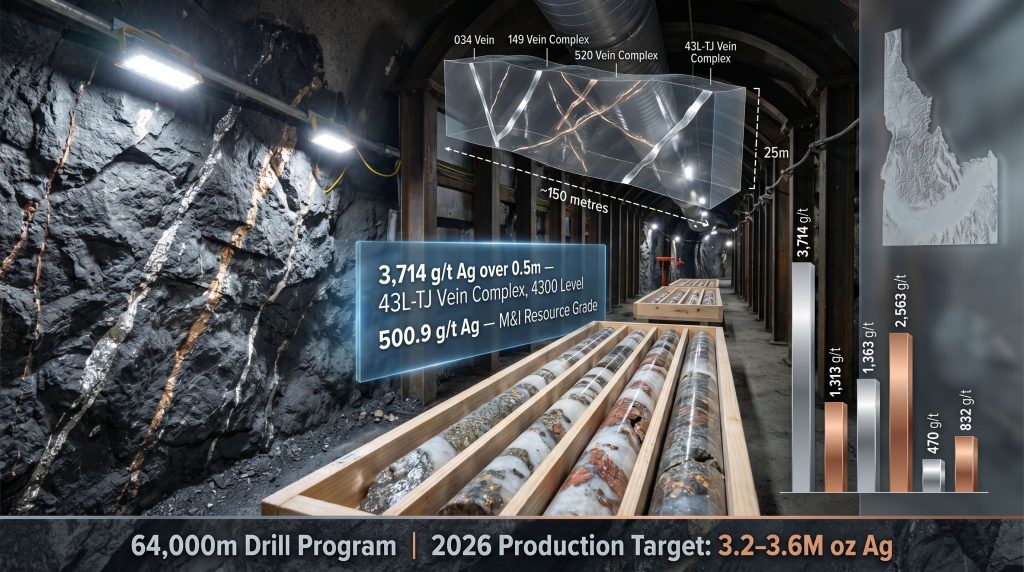
The 43L-TJ Vein Complex was identified during Q1 2026 infill and step-out drilling targeting the 149 Vein Complex, a program announced in August 2025. The new discovery sits approximately 150 metres southwest of the 149 Vein and consists of multiple parallel silver-copper-antimony and lead vein splays. Six core holes have intersected the vein complex to date, all from the 4300 Level.
The structural relationship between the 43L-TJ Vein Complex and the adjacent 149 Vein Complex raises an important geological question: are these discrete systems or components of a broader mineralising corridor? In classic Idaho Silver Valley geology, multiple parallel veins can share a common structural control, often a regional fault or shear zone, that channelled hydrothermal fluids through the same network over time. If structural mapping confirms corridor-scale continuity between the two complexes, the mineralised envelope could be substantially larger than either system suggests individually.
The 4300 Level: Why Underground Elevation Matters
The 4300 Level designation refers to the underground working elevation from which drilling was conducted, a standard convention in Idaho hard-rock mines where levels are numbered by approximate depth in feet below surface. Crucially, this level is an active working horizon with established haulage, ventilation, and power infrastructure already in place.
This operational context transforms the significance of the discovery. The six veins comprising the 43L-TJ complex were intersected within 25 metres of current mine infrastructure, a proximity that allows access via a single exploration drift rather than requiring new shaft sinking, decline development, or ventilation raises. In underground hard-rock mining, that distinction can represent the difference between months and years on a development timeline.
"In underground mining, discovering a new vein system within 25 metres of active development can typically be accessed via a short exploration drift, often a matter of weeks rather than the months or years required to develop access to more remote discoveries. This proximity substantially reduces both the capital requirement and the time between discovery and first ore extraction."
What the Drill Results Actually Tell Us: Breaking Down the 43L-TJ Intercepts
Full Drill Result Summary: Six Holes, Six Intercepts
All reported widths are estimated true widths — a critical distinction when interpreting drill results in vein mining, where core recovery angles can overstate apparent thickness if not geometrically corrected.
| Intercept | Silver (g/t) | Lead (%) | Copper (%) | Antimony (%) | True Width (m) | Ag x Width (g/t·m) |
|---|---|---|---|---|---|---|
| 1 | 1,392 | 1.9 | 1.5 | 1.5 | 1.9 | 2,644.8 |
| 2 | 1,313 | 2.6 | 1.4 | 1.1 | 1.0 | 1,313.0 |
| 3 | 2,563 | 0.3 | 1.8 | 1.4 | 0.7 | 1,794.1 |
| 4 | 832 | — | — | — | 1.7 | 1,414.4 |
| 5 | 470 | — | — | — | 0.9 | 423.0 |
| 6 | 3,714 | — | — | — | 0.5 | 1,857.0 |
Interpreting Grade-Width Relationships in Narrow High-Grade Vein Systems
The grade-thickness product, expressed in gram-metres (g/t·m), is the most operationally meaningful metric for narrow vein deposits. Understanding true vs apparent widths is essential here: a 0.5-metre intercept at 3,714 g/t silver yields 1,857 g/t·m, comparable in value terms to a 1.9-metre intercept at 978 g/t. Viewed through this lens, five of the six intercepts deliver grade-thickness products exceeding 1,300 g/t·m, a remarkably consistent performance across multiple vein structures within the same complex.
Widths between 0.5 and 1.9 metres are entirely typical for bonanza-style silver vein deposits in the Idaho Silver Valley. These are not bulk-mining widths, but the grade intensity more than compensates when processing infrastructure is already in place and underground haulage distances are short.
How These Grades Compare to Galena's Existing Resource Base
The Galena Complex's current Measured and Indicated resource carries a grade of 500.9 g/t silver, itself a figure that would rank among the higher-grade silver operations globally. The 43L-TJ intercepts tell a more concentrated story:
- The peak intercept of 3,714 g/t silver exceeds the resource average by approximately 7.4 times
- Three of the six intercepts surpass 1,300 g/t silver
- The prior high-grade benchmark from the 149 Vein program returned 4,896 g/t silver and 3.95% copper over 1.3 metres
- The 2025 resource update reflected a 21% year-over-year increase in Measured and Indicated ounces, reaching 87.9 million ounces
"At 3,714 g/t silver, the highest 43L-TJ intercept grades more than seven times above the Complex's current Measured and Indicated resource average. While narrow widths limit bulk tonnage potential, such intercepts are characteristic of the tetrahedrite vein systems that have historically defined Galena's highest-value ore shoots and demonstrate the fluid channelling intensity typical of world-class silver vein deposits."
Why Infrastructure Proximity Changes the Economics of This Discovery
The 25-Metre Threshold: From Discovery to Development Drift
The economic significance of discovering high-grade mineralisation within 25 metres of active workings is difficult to overstate. In standard underground hard-rock mining practice, advancing an exploration drift through competent rock typically proceeds at a rate of several metres per day with modern mechanised equipment. At that pace, a 25-metre drift to provide direct physical access to a new vein target can be completed within weeks.
Compare this to the alternative scenario: a new vein discovery located 500 metres below existing workings, or 300 metres laterally beyond the current development footprint, requires new ventilation infrastructure, additional haulage raises, and potentially ramp extensions before a single tonne of ore can be extracted. Capital requirements and timelines scale accordingly.
The planned exploration drift into the 43L-TJ Vein area from the 4300 Level serves a dual purpose:
- Structural mapping to understand the orientation, continuity, and geometry of the vein splays
- Definition drilling platforms at closer spacing to support future resource category upgrades from Inferred to Indicated
Antimony's Strategic Overlay: Amplifying Economic Value
Galena's designation as the United States' largest antimony producer adds a dimension to the 43L-TJ discovery that extends well beyond silver pricing. Furthermore, antimony supply risks are escalating globally, as antimony is classified as a critical mineral under US policy frameworks due to its applications in flame retardants, lead-acid batteries, and increasingly in military and defence-related alloys. Domestic production of antimony is extremely limited, making Galena's tetrahedrite ore system a rare source of US-origin supply.
The February 2026 joint venture with US Antimony to establish an on-site processing hub at Galena positions the Complex to capture value from antimony concentrates that might otherwise be processed offshore. The 43L-TJ intercepts carry antimony grades of up to 1.5% Sb, consistent with the broader tetrahedrite mineralogy that characterises Galena's highest-value ore shoots.
Four Discoveries in Twelve Months: What the Track Record Signals
Chronological Progression of Vein System Discoveries at Galena
The rate of new vein system identification at the Galena Complex within a single drilling campaign is a notable data point for understanding the Complex's geological endowment. Indeed, the fourth major discovery at the Galena Complex reinforces the view that this is a district-scale system with meaningful exploration upside remaining.
| Discovery | Announcement Period | Current Status |
|---|---|---|
| 034 Vein | Mid-2025 | Incorporated into 2025 resource update; in development |
| 149 Vein Complex | August 2025 | Active drilling; infill and step-out program continuing |
| 520 Vein Complex | Late 2025 / Early 2026 | Open down-dip; significant depth potential identified |
| 43L-TJ Vein Complex | Q1 2026 (announced April 2026) | Follow-up drilling and exploration drift planned |
What a Four-Discovery Sequence Tells Geologists
The 034 Vein's progression from discovery to resource incorporation and active development preparation within approximately twelve months establishes a meaningful precedent. It demonstrates that Galena's existing underground infrastructure allows the company to compress the typical exploration-to-development cycle significantly.
Each of the four discoveries emerged from a drill campaign guided by a dense network of existing underground access points. Rather than drilling from surface into unknown geology, the team operates from known positions within an established mine grid, testing geologically informed targets at relatively low incremental cost per hole. This methodology helps explain a four-discovery hit rate that would be difficult to replicate from surface drilling programs on greenfield properties.
The 520 Vein Complex adds another layer of interest. Its reported connection to the adjacent Coeur Mine and the potential for cross-property vein continuity raises the possibility that the overall mineralised system at Galena extends across a larger footprint than the current resource boundary captures.
The 2026 Drilling Program Scale
Americas Gold & Silver has committed to a 64,000-metre drilling program across its Idaho and Cosalá Operations for 2026, representing the company's largest exploration investment to date. Consequently, details of how new veins convert to near-term mining fronts at Galena will be closely watched by investors assessing the pace of development.
The production framework supporting this investment is substantive. The company's 2026 silver production guidance of 3.2 to 3.6 million ounces represents approximately 30% growth over 2025 output levels, with the 4300 Level and connected workings central to achieving that target.
"A 64,000-metre annual drill program represents a substantial commitment for a mid-tier silver producer. At Galena specifically, the combination of existing underground access points and a high density of known vein structures means each drill hole is testing a geologically informed target, a factor that helps explain the four-discovery rate achieved in twelve months."
The next major ASX story will hit our subscribers first
Americas Gold & Silver Galena Complex New High-Grade Silver Veins: Resource and Production Outlook
Near-Term Resource Implications
Converting drill intercepts into formal resource inventory follows a defined sequence under NI 43-101 reporting standards:
- Initial intercepts establish the presence of mineralisation at reportable grades
- Follow-up drilling at closer spacing reduces geological uncertainty to the threshold required for Inferred classification
- Definition drilling from underground positions, including channel sampling from the planned exploration drift, provides the data density needed for Indicated classification
- Resource estimate integration incorporates the new inventory into the overall Galena resource model
Based on the 034 Vein precedent, where discovery-to-resource-incorporation was achieved within approximately twelve months, a similar timeline for 43L-TJ integration into a future resource update is plausible if drift development proceeds through the second half of 2026.
Production Growth Trajectory
The Crescent Mine acquisition in December 2025, situated nine miles from the Galena Complex, adds further strategic optionality. While the Crescent Mine's integration timeline and its relationship to 43L-TJ processing logistics remain subject to operational planning, the proximity of both assets to Galena's existing mill and the planned antimony processing hub creates a cluster of Idaho silver assets with shared infrastructure potential.
The near-term production contribution from 43L-TJ ore will depend on the pace of exploration drift development and the density of definition drilling completed through 2026. However, the infrastructure proximity that defines this discovery as operationally distinctive also means that the pathway from current intercepts to ore in a mine plan is shorter than almost any greenfield equivalent.
Benchmarking Galena Against the Global High-Grade Silver Landscape
What 500.9 g/t Silver Means in a Global Context
A Measured and Indicated resource averaging 500.9 g/t silver places the Galena Complex at the upper end of the global primary silver mine grade distribution. Most primary silver operations worldwide process ore at grades considerably below this level, relying on large throughput volumes to generate economic returns. Galena's grade intensity reflects the specific advantages of tetrahedrite-hosted vein mineralisation in a mature underground mine where decades of development have created access to the highest-value structural zones.
The Polymetallic Advantage
Silver's dual role as both a precious and industrial metal means silver-only operations price their ore against a single commodity with dual demand drivers. In contrast, Galena's tetrahedrite mineralogy generates revenue from four payable metals simultaneously — silver, copper, lead, and antimony — within the same ore parcel. This polymetallic characteristic provides a natural hedge against single-commodity price volatility and generates a net smelter return per tonne that is materially higher than the silver grade alone would suggest.
The antimony component deserves particular attention. As a mineral with constrained domestic US supply and growing demand in both industrial and defence applications, antimony grades of up to 1.5% within the same vein structures that carry 1,000-plus g/t silver create a compound value proposition that is structurally difficult for mono-metallic silver producers to replicate.
Disclaimer: This article contains forward-looking statements and projections based on publicly available company announcements and exploration results. Mineral exploration involves inherent uncertainty, and drill intercepts do not guarantee the definition of economic mineral resources. Production guidance and resource estimates are subject to revision. This article does not constitute investment advice. Readers should conduct their own due diligence and consult a qualified financial adviser before making investment decisions.
Frequently Asked Questions: Americas Gold & Silver Galena Complex New High-Grade Silver Veins
What is the 43L-TJ Vein Complex at the Galena Complex?
The 43L-TJ Vein Complex is a newly identified cluster of six high-grade silver-copper-antimony and lead veins discovered during Q1 2026 diamond drilling conducted from the 4300 Level at the Galena Complex in Idaho. It is positioned approximately 150 metres southwest of the previously announced 149 Vein Complex.
What Silver Grades Were Returned From the 43L-TJ Drilling Program?
Six drill holes intersected the 43L-TJ Vein Complex, returning silver grades ranging from 470 g/t over 0.9 metres to 3,714 g/t over 0.5 metres. Three of the six intercepts exceeded 1,300 g/t silver and carried meaningful copper and antimony credits alongside the silver values.
Why Is the 25-Metre Proximity to Existing Infrastructure Significant?
Discovering a new vein system within 25 metres of active underground development means that access can typically be established via a single short exploration drift, compressing the timeline between discovery and potential ore extraction from years to months compared to more remotely located finds.
How Does This Discovery Fit Into the Broader Galena Exploration Campaign?
The Americas Gold & Silver Galena Complex new high-grade silver veins program has now yielded four major discoveries within a twelve-month drilling campaign. The 034 Vein, 149 Vein Complex, and 520 Vein Complex preceded the 43L-TJ find, with the 034 Vein already incorporated into the 2025 resource update and advancing toward production.
What Are the Next Steps for the 43L-TJ Vein Complex?
The company has outlined two parallel workstreams: additional diamond drilling to expand the known mineralised envelope and test for further parallel vein structures, and the development of an exploration drift from the 4300 Level to enable structural mapping and closer-spaced definition drilling.
What Is Americas Gold & Silver's 2026 Silver Production Target?
The company has guided for 3.2 to 3.6 million ounces of silver production in 2026, representing approximately 30% growth over 2025 output levels, supported by the integration of multiple new vein discoveries into active mine plans at the Galena Complex.
What Is the Significance of Galena's Antimony Production?
The Galena Complex is the largest antimony producer in the United States. The 43L-TJ Vein Complex carries antimony grades of up to 1.5% Sb, and the February 2026 joint venture with US Antimony to build an on-site processing hub positions Galena as a meaningful domestic supplier of this critical mineral.
Want to Stay Ahead of the Next Major Silver or Critical Mineral Discovery?
Discovery Alert's proprietary Discovery IQ model delivers real-time alerts on significant ASX mineral discoveries, instantly translating complex exploration data into actionable investment insights for both short-term traders and long-term investors — explore historic discoveries and their remarkable returns, then begin your 14-day free trial at Discovery Alert to position yourself ahead of the broader market.