
August 24, 2026
Understanding Gallium's Critical Role in Modern Defense Systems
The emergence of gallium arsenide (GaAs) and gallium nitride (GaN) technologies represents a fundamental shift in semiconductor physics that underpins contemporary military capabilities. These compound semiconductors operate at frequencies exceeding 10 GHz and withstand operating temperatures up to 200°C, far surpassing silicon's limitations of approximately 5 GHz and 150°C respectively.
Performance Characteristics of Gallium-Based Semiconductors:
• Frequency Response: GaN devices demonstrate operational capability at frequencies ranging from 2-18 GHz, essential for electronic warfare applications
• Power Efficiency: Energy efficiency improvements of 40-50% over silicon alternatives in radio frequency applications
• Thermal Management: Superior heat dissipation enabling compact form factors in military hardware
• Voltage Handling: Single GaN devices can manage voltages exceeding 1,000V through High Electron Mobility Transistor (HEMT) architecture
The gallium supply chain and national security intersection becomes evident when examining specific military applications. Advanced radar systems, including the AN/FPS-117 long-range surveillance platforms operated by the U.S. Air Force, increasingly integrate GaN components for enhanced detection capabilities. Similarly, U.S. Navy AEGIS Combat System modernization programs incorporate GaN-based RF power amplifiers to improve phased array radar performance.
Electronic warfare systems represent perhaps the most critical application area. GaN technology enables jamming equipment to operate across broad frequency spectrums (2-18 GHz) while maintaining power efficiency crucial for airborne platforms. The superior thermal characteristics allow these systems to operate in harsh environments without performance degradation.
Unlike traditional silicon semiconductors, gallium compounds provide irreplaceable performance characteristics for high-frequency military applications, creating technological dependencies that extend beyond simple material substitution.
Critical Defense Applications:
• Patriot air defense systems utilising GaN-based signal processing
• Satellite communication transponders for secure military networks
• Missile guidance seeker electronics requiring precise frequency control
• Night vision and thermal imaging systems dependent on gallium arsenide photodetectors
• 5G infrastructure supporting military command-and-control networks
The technical superiority of gallium-based semiconductors stems from their heterojunction design, typically utilising GaN/AlGaN structures that enable both high-frequency operation and substantial voltage handling capacity. This combination proves essential for modern radar transmitters operating in S-band (2-4 GHz) and X-band (8-12 GHz) frequencies.
When big ASX news breaks, our subscribers know first
China's Strategic Monopolisation of Global Gallium Production
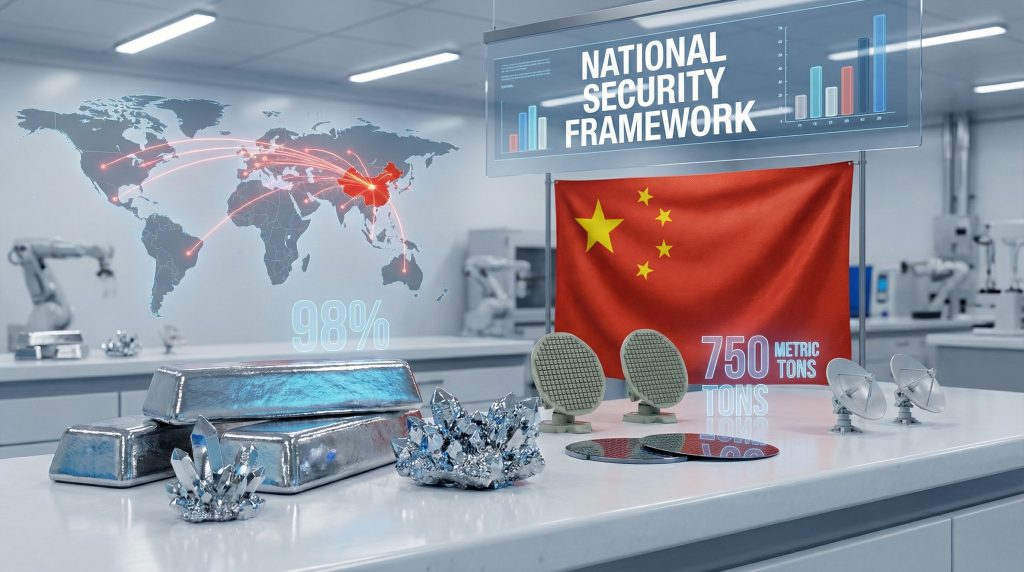
China's dominance over global gallium production emerges from its control of aluminium refining infrastructure rather than natural resource endowment. The country produces approximately 95-98% of world gallium output, totalling roughly 540-600 metric tons annually of refined gallium, according to U.S. Geological Survey data.
This market position results from gallium's unique extraction process, which occurs as a byproduct of aluminium refining during the Bayer process. Bauxite ore contains gallium in concentrations of 0.005-0.1% by weight, requiring massive aluminium production capacity to generate commercially viable gallium quantities. Furthermore, this creates critical minerals energy security challenges for nations lacking domestic processing capabilities.
| Global Gallium Production Metrics | 2024 Data |
|---|---|
| China's Market Share | 95-98% |
| Annual Global Refined Output | 540-600 metric tons |
| Chinese Annual Production | ~520-590 metric tons |
| Global Aluminium Capacity Controlled by China | ~60% |
China's Strategic Advantages in Gallium Production:
• Vertical Integration: Control spanning bauxite mining through aluminium smelting to gallium extraction
• Energy Subsidies: Government-subsidised electricity costs reduced 30-40% below market rates in western provinces
• Infrastructure Scale: Integrated aluminium refineries in Guangxi and Yunnan provinces co-locating extraction with primary production
• Cost Structure: Integrated operations reducing gallium separation costs by 25-35% versus standalone facilities
The gallium supply chain and national security implications became acute following China's implementation of export licensing requirements in August 2023. This policy shift triggered immediate market volatility, with high-purity gallium (99.9999%) prices increasing from $130-160 per kilogram to $180-220 per kilogram, representing a 35-45% price surge within weeks.
China's aluminium refining capacity provides the foundation for gallium extraction monopolisation. The country operates approximately 40 million tons of annual aluminium smelting capacity, representing 60% of global production. This industrial base enables gallium recovery at scales unmatched elsewhere globally.
Historical Context of U.S. Aluminium Industry Decline:
The United States experienced catastrophic aluminium production capacity loss over three decades. Domestic primary aluminium production declined from approximately 4 million tons in the 1990s to merely 0.7 million tons by 2023, representing an 82% capacity reduction. This deindustrialisation eliminated the foundation necessary for domestic gallium extraction.
Rebuilding equivalent aluminium refining infrastructure would require estimated investments of $15-20 billion and implementation timelines of 8-12 years, according to industry analyses. These barriers create structural advantages for existing Chinese facilities that prove difficult to replicate through market mechanisms alone.
Export Control Timeline and Market Impact:
• August 16, 2023: China's Ministry of Commerce implements gallium and germanium export licensing requirements
• September 2023: Spot gallium prices peak at $220/kg, representing 40% increase from pre-control levels
• December 2024: Enhanced restrictions targeting unspecified entities, affecting gallium supply chain and national security calculations globally
• Ongoing: Potential expansion to tungsten and other critical minerals under consideration
The technical barriers to gallium substitution compound China's market position. Unlike rare earth elements, which can theoretically be processed in alternative facilities with sufficient capital investment, gallium extraction requires active aluminium refining operations. This creates a fundamental constraint that cannot be easily circumvented through financial resources alone.
Economic Impact Assessment: Quantifying National Vulnerability
Economic modelling of gallium supply disruptions reveals cascading effects across multiple industrial sectors, with particular concentration in defence, telecommunications, and aerospace manufacturing. The interdependent nature of gallium applications creates multiplier effects that extend beyond direct semiconductor production.
Supply Disruption Scenario Analysis:
Supply chain economists distinguish between direct manufacturing impacts and economy-wide multiplier effects when assessing critical material shortages. A complete gallium supply interruption would create immediate constraints in semiconductor fabrication, followed by secondary effects in systems integration and final equipment production.
Primary Sector Impacts:
- Semiconductor manufacturers unable to produce GaN devices for military applications
- Defence contractors facing component shortages for radar and electronic warfare systems
- Telecommunications infrastructure deployment delays affecting 5G military networks
Secondary Economic Effects:
- Defence spending reallocation away from affected programmes
- Research and development delays in next-generation weapons systems
- Industrial base consolidation as smaller suppliers exit constrained markets
Department of Defense Supply Chain Vulnerability:
Current Department of Defense inventory management practices maintain minimal stockpiles of processed gallium, relying instead on just-in-time procurement from commercial suppliers. This approach, while cost-efficient during stable supply conditions, creates vulnerability during geopolitical tensions.
The absence of publicly disclosed strategic gallium reserves contrasts with established stockpiles for petroleum and other critical materials. Government Accountability Office assessments of critical materials stockpiling identify this gap as a systemic vulnerability in defence industrial planning.
The gallium supply chain and national security nexus represents a unique constraint where material dependencies create hard limits on technological capabilities, unlike price-driven supply disruptions that markets can eventually resolve through substitution or higher costs.
Historical Precedent: Rare Earth Supply Crisis (2010-2011)
China's rare earth export restrictions during 2010-2011 provide instructive precedent for gallium vulnerability assessment:
• Price Impacts: Dysprosium increased 300-400%, neodymium rose 200%
• Timeline Effects: Defence contractors reported 6-18 month delays obtaining qualified magnetic materials
• Supply Chain Adaptation: Limited substitution achieved through alternative suppliers and recycling programmes
• Critical Difference: Rare earth processing could theoretically be relocated; gallium extraction requires aluminium infrastructure unavailable outside China at scale
Defence Industrial Base Assessment:
Military systems utilising gallium-based semiconductors span thousands of applications across service branches. Verifiable applications include AN/FPS-117 radar installations (100+ facilities), AEGIS Combat System variants (90+ naval vessels), and Patriot air defence batteries (600+ global deployments).
The aggregated count of military subsystems incorporating gallium components likely exceeds several thousand applications when including classified programmes, electronic warfare equipment, and satellite communications systems.
Economic Multiplier Framework:
Input-output economic modelling suggests gallium supply disruptions generate disproportionate economic effects due to the material's role in high-value defence and technology applications. Unlike commodity materials where substitution provides relief valves, gallium's technical irreplaceability creates rigid constraints on affected industries. However, nations implementing australia critical minerals reserve strategies may better position themselves to weather such disruptions.
Policy Response Framework: Legislative and Executive Actions
Congressional recognition of critical mineral vulnerabilities has generated bipartisan legislative initiatives addressing gallium supply chain and national security challenges. The National Defense Authorization Act includes provisions for domestic critical mineral capacity development, while executive agencies implement targeted procurement and research programmes.
Legislative Framework Development:
The Defense Production Act provides executive authorities with tools for accelerating domestic gallium production capacity through federal investment and procurement guarantees. Recent invocations focus on establishing gallium recovery systems integrated with existing industrial operations rather than standalone extraction facilities.
Federal Investment Programmes:
| Initiative | Funding Level | Timeline | Strategic Objective |
|---|---|---|---|
| Department of Energy Gallium Research | $6 million | 2024-2026 | Extraction technology development |
| Metallium Inc. Defense Contract | Classified amount | 2025-2027 | Gallium recovery system implementation |
| Critical Materials Security Program | $50 million total | Multi-year | Comprehensive supply chain resilience |
Interagency Coordination Mechanisms:
The Committee on Foreign Investment in the United States (CFIUS) now examines gallium-related acquisitions under expanded national security review criteria. This represents a shift from reactive to preventive policy approaches in critical mineral supply chain protection.
Executive Branch Actions:
• Department of Defense: Enhanced supplier qualification requirements for gallium-containing components
• Department of Commerce: Export control coordination with allied nations to prevent gallium re-export to restricted entities
• Department of Energy: Research partnerships with university programmes developing alternative extraction technologies
• Department of State: G7 coordination on collective supply chain resilience strategies
Allied Nation Coordination:
International cooperation frameworks address gallium supply chain and national security concerns through technology sharing and joint procurement initiatives. The G7 Critical Materials Partnership facilitates information exchange on supply chain vulnerabilities and coordinated response strategies.
NATO's Critical Materials Working Group examines gallium dependencies across alliance military systems, identifying shared vulnerabilities and potential pooled procurement approaches. This multilateral framework aims to reduce individual nation dependency on Chinese gallium supplies.
Recent Executive Developments
Following the pattern of recent us critical minerals order initiatives, agencies are implementing enhanced oversight mechanisms for gallium supply chain monitoring.
Regulatory Environment Evolution:
The Committee on Foreign Investment in the United States expanded review criteria to include gallium processing capabilities in corporate acquisition assessments. This regulatory evolution reflects recognition that technological dependencies create national security vulnerabilities equivalent to traditional defence industrial base concerns.
Strategic Policy Integration:
Recent National Security Strategy documents explicitly acknowledge critical mineral dependencies as constraints on U.S. strategic options. This represents a departure from purely ideological foreign policy frameworks toward resource-constrained strategic planning.
The emergence of "resource realism" in policy circles suggests that material dependencies increasingly influence diplomatic and military decision-making processes, with gallium serving as a primary example of these constraints.
Alternative Supply Chain Development: Progress and Limitations
Non-Chinese gallium production capacity development faces substantial technical and economic barriers, though several initiatives demonstrate potential for reducing dependency levels over medium-term timeframes. Current projects target 15-20% of global demand through alternative sourcing by 2030.
North American Production Initiatives:
| Project | Annual Capacity | Timeline | Strategic Significance |
|---|---|---|---|
| Indium Corp + Rio Tinto (Canada) | 40 tons | 2026-2027 | 6-7% of global demand |
| Neo Performance Materials Recycling | Variable capacity | Operational | Secondary supply source |
| Quebec Pilot Facility | 3.5 tons | 2025-2026 | Technology demonstration |
| U.S. Defense Production Act Projects | Classified capacity | 2025-2028 | Military supply priority |
European Recovery Programmes:
European Union critical materials strategy emphasises domestic processing capacity restoration rather than primary production development. Key initiatives include:
• Metlen Energy (Greece): 50-ton annual capacity targeting 2027 operational status
• Germany's Stade Refinery: Potential 40-ton capacity restart contingent on aluminium smelting economics
• EU Critical Raw Materials Act: Regulatory framework supporting alternative supply chain development
• France's Strategic Autonomy Programme: Research partnerships for gallium extraction technology advancement
Technical Constraints on Capacity Development:
The gallium supply chain and national security challenge extends beyond simple production scaling due to several structural limitations:
Raw Material Access: Alternative gallium sources require either bauxite processing infrastructure or recycling systems for GaN/GaAs scrap recovery. Limited bauxite processing outside China constrains primary production options.
Extraction Technology: China controls approximately 90% of gallium extraction resins and specialised equipment necessary for commercial-scale recovery operations. This creates dependency even when alternative aluminium sources exist.
Economic Competitiveness: Non-Chinese production faces cost disadvantages of 30-50% due to higher electricity costs, environmental compliance requirements, and lack of vertical integration economies.
Recycling and Secondary Supply Development:
Gallium recycling from end-of-life electronics and manufacturing scrap represents the most technically feasible near-term alternative to Chinese primary production. Current recycling operations recover gallium from:
• Semiconductor manufacturing waste streams
• Decommissioned military radar systems
• Solar photovoltaic panel recycling
• LED manufacturing byproducts
Neo Performance Materials and other recycling specialists demonstrate technology capable of recovering gallium at purities sufficient for semiconductor applications. However, total recycling capacity remains limited to 5-15% of global demand due to collection and processing constraints.
Alternative Technology Development:
Research programmes investigate silicon-based alternatives to GaN technology for specific military applications. While silicon cannot match GaN performance characteristics, hybrid approaches might reduce gallium requirements for non-critical systems.
Advanced materials research explores gallium-free compound semiconductors, though current alternatives sacrifice performance parameters essential for defence applications. These research programmes require 5-10 year development timelines before potential implementation.
Investment and Financial Barriers
Private capital markets demonstrate limited willingness to finance gallium production alternatives due to Chinese market manipulation risks and uncertain demand projections. Government guarantees and strategic investments appear necessary to motivate private sector participation in capacity development. Similarly, bauxite project benefits must be carefully evaluated when considering domestic gallium extraction capabilities.
Geopolitical Strategy Implications: Resource Realism vs. Alliance Politics
The recognition of gallium supply constraints as strategic limitations represents a fundamental shift toward "resource realism" in foreign policy formulation, where material dependencies constrain diplomatic and military options independently of ideological considerations.
This analytical framework suggests that traditional alliance politics must accommodate physical constraints imposed by critical mineral supply chains, potentially limiting policy options that assume unlimited technological capabilities.
Strategic Doctrine Evolution:
Contemporary strategic planning increasingly acknowledges that material dependencies create hard constraints on military capabilities and diplomatic leverage. The gallium supply chain and national security intersection exemplifies how technological dependencies can limit strategic options regardless of military spending or alliance strength.
Resource Constraint Framework:
Military planners now incorporate supply chain vulnerability assessments into strategic planning processes, recognising that material shortages can degrade capabilities more rapidly than traditional threat scenarios. This represents a departure from purely capabilities-based planning toward resource-constrained strategic assessment.
Alliance Coordination Challenges:
NATO and Pacific alliance frameworks face coordination challenges when individual nations maintain different levels of Chinese supply chain dependency. Gallium vulnerabilities vary significantly across alliance members, creating potential for asymmetric economic leverage and strategic decoupling.
Diplomatic Leverage Asymmetries:
China's gallium monopoly creates potential for selective economic pressure against specific nations or companies without broader escalation. This capability enables targeted influence campaigns that exploit supply chain dependencies while maintaining plausible deniability.
Technology Competition Implications:
The semiconductor technology competition between democratic allies and authoritarian competitors operates within constraints imposed by Chinese material supply control. Advanced military systems development requires accommodation of these dependencies or substantial alternative supply chain investments.
The emergence of resource realism suggests that strategic planning must increasingly balance ideological preferences against material constraints, with gallium representing a primary example of how supply chain physics can override political ambitions.
External Analysis and Insights
According to the Center for Strategic and International Studies analysis on gallium supply chains, the national security implications of Chinese gallium dominance extend beyond immediate supply disruption risks. The report emphasises that dependency creates strategic vulnerabilities even during periods of stable supply, as the threat of disruption influences policy decisions.
Investment Strategy Implications:
Institutional investors increasingly recognise critical minerals as strategic constraints rather than industrial inputs, affecting portfolio allocation toward supply chain resilience investments. This shift reflects understanding that material dependencies influence geopolitical stability and long-term investment returns.
Defence contractors face strategic decisions regarding Chinese supply chain integration versus alternative sourcing investments, with implications for competitive positioning and government contract eligibility under enhanced security requirements.
Policy Coordination Frameworks:
The G7 Critical Materials Partnership and similar multilateral initiatives attempt to coordinate alternative supply chain development while maintaining technology sharing capabilities among democratic allies. These frameworks acknowledge that individual nation responses prove insufficient for addressing Chinese monopolisation strategies.
The next major ASX story will hit our subscribers first
Risk Mitigation Strategies: Building Resilient Supply Networks
Comprehensive approaches to gallium supply chain resilience require coordinated investments across multiple timeframes, combining immediate vulnerability reduction with long-term capacity development. Effective strategies address both supply diversification and demand reduction through technological alternatives.
Immediate Risk Reduction Measures:
Strategic stockpile establishment represents the most direct approach to short-term vulnerability reduction. Unlike petroleum reserves, gallium stockpiles require minimal infrastructure investment while providing immediate supply security during disruption periods.
Stockpile Specifications:
- Target inventory: 6-12 months of critical defence application requirements
- Purity standards: 99.9999% gallium for semiconductor applications
- Rotation protocols: Periodic inventory refresh to maintain material quality
- Strategic location: Distributed storage reducing single-point-of-failure risks
Allied Cooperation Framework:
Multilateral supply chain resilience requires coordinated investment and technology sharing among democratic allies. The G7 and NATO frameworks provide institutional structures for collaborative capacity development.
Key Cooperation Areas:
• Technology Transfer: Gallium extraction and purification technology sharing between allied nations
• Joint Procurement: Coordinated purchasing reducing individual nation dependency
• Research Partnerships: Collaborative development of gallium alternatives and recycling technologies
• Supply Chain Mapping: Comprehensive assessment of gallium dependencies across alliance military systems
Medium-Term Capacity Development:
Alternative production capacity development requires sustained investment over 5-8 year timeframes, targeting specific percentage reductions in Chinese dependency rather than complete substitution.
| Strategy Component | Timeline | Dependency Reduction Target | Investment Requirement |
|---|---|---|---|
| Allied Production Capacity | 5-7 years | 25-30% of defence demand | $2-3 billion |
| Recycling Infrastructure | 3-5 years | 10-15% of total supply | $500 million – $1 billion |
| Alternative Technologies | 8-12 years | 20-40% of applications | $5-8 billion |
| Strategic Stockpiles | 1-2 years | 6-month supply buffer | $200-400 million |
Critical Raw Materials Transition Considerations
The complexity of supply chain resilience extends beyond gallium to encompass broader critical raw materials transition challenges, requiring integrated planning across multiple material dependencies.
Recycling Infrastructure Enhancement:
Gallium recycling provides the most economically viable near-term alternative to Chinese primary production, requiring coordinated collection and processing system development.
Recycling System Components:
- Collection networks for defence electronics and commercial semiconductors
- Processing facilities capable of achieving semiconductor-grade purity
- Quality certification systems ensuring military specification compliance
- Economic incentives encouraging recycling participation
Long-Term Strategic Independence:
Complete reduction of Chinese gallium dependency requires fundamental changes to aluminium refining capacity and semiconductor technology development. These objectives necessitate sustained political commitment across multiple electoral cycles.
Industrial Policy Integration:
Comprehensive gallium supply chain resilience requires coordination between defence policy, trade policy, and domestic industrial development. Current policy frameworks operate independently, reducing overall effectiveness.
Research and Development Priorities:
Advanced materials research targeting gallium substitutes for non-critical applications could reduce overall demand while maintaining performance for essential defence systems. These programmes require sustained funding over decade-plus timeframes.
Economic Incentive Structures:
Market-based approaches to supply chain diversification require government intervention to overcome Chinese cost advantages and market manipulation capabilities. Tax incentives, procurement guarantees, and direct subsidies appear necessary for motivating private investment.
Future Outlook: Gallium Supply Chain Evolution Through 2030
Demand projections for gallium through 2030 reflect expanding applications across defence, telecommunications, and electric vehicle sectors, while supply responses remain constrained by technical and economic barriers to alternative production capacity.
Demand Growth Drivers:
Multiple technology trends converge to increase gallium consumption requirements over the next decade:
• 5G Infrastructure Expansion: Civilian and military networks requiring GaN-based power amplifiers
• Electric Vehicle Adoption: Onboard charging systems and power management utilising gallium semiconductors
• Defence Modernisation Programmes: Next-generation radar, electronic warfare, and missile guidance systems
• Satellite Technology: Commercial and military satellite communications driving GaN demand
• Renewable Energy Systems: Solar inverters and wind turbine power electronics incorporating gallium components
Supply Chain Evolution Scenarios:
Scenario 1: Gradual Diversification (Most Likely)
- Non-Chinese production reaches 15-20% of global supply by 2030
- Recycling provides additional 10-15% of total gallium availability
- Chinese market share declines to 65-75% from current 95-98%
- Prices remain elevated 50-100% above historical levels
Scenario 2: Accelerated Alternative Development (Optimistic)
- Coordinated allied investment achieves 30-35% alternative supply capacity
- Breakthrough recycling technologies capture 20% of demand
- Chinese leverage reduced to 45-50% market share
- Competitive pricing restored through alternative capacity
Scenario 3: Continued Chinese Dominance (Pessimistic)
- Alternative capacity development faces technical and economic barriers
- Chinese production increases to meet growing demand
- Market share remains above 90% through 2030
- Geopolitical leverage increases with demand growth
External Military Perspective
According to the Atlantic Council's analysis of military gallium requirements, defence systems increasingly depend on gallium compounds for critical capabilities that cannot be easily substituted with alternative materials, highlighting the strategic importance of supply chain security.
Technology Development Trajectories:
Semiconductor research programmes investigate gallium alternatives and efficiency improvements that could moderate demand growth:
Near-term (2025-2027):
- Improved GaN device efficiency reducing gallium content per application
- Hybrid silicon-GaN architectures for non-critical systems
- Enhanced recycling technologies increasing recovery rates
Medium-term (2027-2030):
- Alternative compound semiconductors for specific applications
- Manufacturing process optimisation reducing gallium waste
- System-level design changes accommodating reduced gallium availability
Policy Environment Evolution:
The gallium supply chain and national security intersection will likely drive enhanced government intervention in critical mineral markets:
Legislative Developments:
- Expanded Defense Production Act authority for critical mineral security
- Tax incentives for domestic gallium production and recycling
- Procurement preferences for alternative supply chain sources
- Enhanced oversight of Chinese technology transfer and acquisition
Regulatory Framework Enhancement:
- CFIUS review expansion to include gallium processing capabilities
- Export control coordination with allied nations
- Supply chain disclosure requirements for defence contractors
- Strategic stockpile mandate for critical defence applications
Investment Implications Through 2030:
The transition toward resource realism in strategic planning creates investment opportunities in alternative supply chain development:
High-Probability Investment Themes:
- Gallium recycling technology and infrastructure
- Alternative compound semiconductor research
- Defence contractor supply chain resilience investments
- Allied nation production capacity development
Risk Factors:
- Chinese market manipulation and price volatility
- Technical barriers to alternative technology adoption
- Political sustainability of long-term investment commitments
- Coordination challenges among allied nations
Market Structure Evolution:
The gallium market will likely evolve from Chinese monopoly toward oligopoly structure, with 3-5 significant alternative suppliers achieving meaningful market share by 2030. This transition requires sustained investment and coordinated policy support across multiple jurisdictions.
Price volatility will remain elevated during the transition period, reflecting ongoing uncertainty about supply security and alternative capacity development timelines. Strategic buyers, particularly defence contractors, will increasingly prioritise supply security over cost minimisation in procurement decisions.
Interested in Small-Cap Commodity Investment Opportunities?
Discovery Alert's proprietary Discovery IQ model delivers real-time alerts on significant ASX mineral discoveries, instantly empowering subscribers to identify actionable opportunities ahead of the broader market. Explore Discovery Alert's dedicated discoveries page to understand why historic discoveries can generate substantial returns, then begin your 30-day free trial today to position yourself ahead of the market.