August 24, 2026
The Hidden Architecture of Allied Industrial Strategy
The global semiconductor industry runs on materials most people have never heard of. Gallium is one of them. Measured in tonnes rather than millions of tonnes, it occupies a position in modern manufacturing that is wildly disproportionate to its physical volume. Without it, the radio frequency chips inside defence radar systems go dark. The power electronics converting renewable energy into usable current become less efficient. The high-frequency semiconductors underpinning 5G infrastructure slow to a crawl. Yet for decades, the economics of primary gallium production were so unattractive that the world effectively outsourced its supply to a single country.
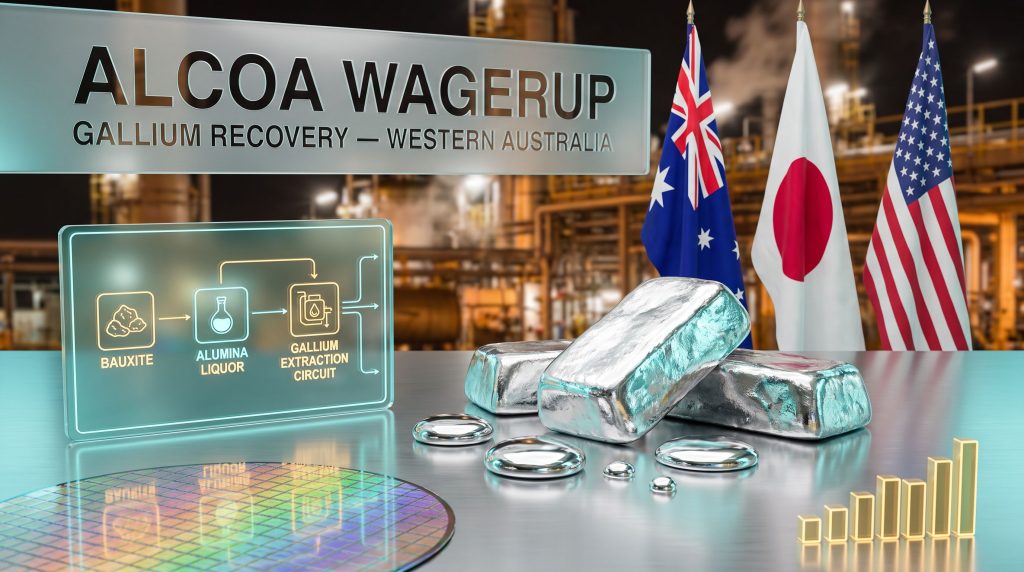
That structural vulnerability is now driving a new category of industrial investment, one where the strategic calculus matters more than the margin. The Alcoa Wagerup refinery gallium project is one of the most tangible expressions of this shift currently under construction anywhere in the world.
When big ASX news breaks, our subscribers know first
Why Gallium Became a Strategic Flashpoint
The Unique Industrial Footprint of a Specialty Metal
Gallium does not behave like copper, iron, or even lithium. Its significance is not measured in bulk but in function. Furthermore, within semiconductor manufacturing, gallium arsenide (GaAs) and gallium nitride (GaN) are materials with properties that silicon simply cannot replicate in certain applications. The importance of gallium in semiconductors and renewable energy cannot be overstated.
Key end-use sectors include:
- Defence electronics: GaAs chips are foundational to radar, electronic warfare systems, and guided munitions.
- Radio frequency semiconductors: GaN-based RF devices are essential for 5G base stations and satellite communications.
- Power electronics: GaN power devices offer superior switching efficiency at high voltages, supporting EV charging and grid infrastructure.
- Solar photovoltaics: High-efficiency multijunction solar cells used in space applications depend on gallium-based compounds.
- Optoelectronics: LEDs and laser diodes across industrial and consumer applications consume gallium in compound form.
What makes shortages particularly dangerous is that gallium is not easily substituted in these applications. A disruption does not produce a price spike that passes. It produces a manufacturing bottleneck that cascades into downstream production lines for some of the most strategically sensitive goods in modern industry.
How Concentrated Supply Became a Geopolitical Lever
According to data from the United States Geological Survey, China has historically accounted for roughly 80 to 90 percent of global primary gallium production, with output largely derived as a by-product of aluminium refining. This concentration is not the result of geological luck alone. It reflects decades of vertically integrated industrial policy combined with the willingness to accept low margins that Western producers historically were not.
In August 2023, China introduced export controls on gallium and germanium, framing them as national security measures. The bismuth export controls that followed demonstrated a similar pattern, and the market response in both cases was immediate and instructive. Prices for gallium spiked sharply in the months following the announcement, demonstrating precisely how sensitive specialty metal markets are to policy rather than purely physical supply and demand.
Key market insight: Gallium does not trade on a public exchange. Prices are negotiated bilaterally, which means price discovery is opaque and supply disruptions can produce large moves before market participants can adjust sourcing strategies.
This policy event fundamentally changed the economics of non-Chinese gallium projects. What previously looked commercially marginal now carries strategic premium that private markets alone may not fully price.
| Factor | Bulk Commodity Project | Gallium Recovery Project |
|---|---|---|
| Market size | Large | Small |
| Strategic importance | Moderate to high | Very high |
| Price sensitivity | Cyclical | Can spike sharply under policy stress |
| Buyer base | Broad industrial | Specialised industrial and offtake specific |
| Government interest | Variable | Often elevated |
How Gallium Is Actually Recovered at an Alumina Refinery
Where Gallium Sits in the Bayer Process
This is the technical detail that most coverage misses entirely. Gallium does not exist in bauxite in economically mineable concentrations on its own. It is a trace impurity that co-occurs with aluminium-bearing minerals and reports into process streams during the Bayer process, the dominant global method for refining bauxite into alumina.
In the Bayer process:
- Bauxite ore is digested in hot caustic soda (sodium hydroxide) under pressure, dissolving aluminium compounds into a sodium aluminate solution known as Bayer liquor.
- Gallium, which shares chemical similarities with aluminium, dissolves into this liquor alongside the aluminium.
- As the liquor is cooled and seeded to precipitate aluminium hydroxide, gallium remains in solution at progressively higher concentrations.
- A dedicated gallium recovery circuit can intercept a sidestream of this enriched liquor and extract gallium through solvent extraction, ion exchange, or electrochemical precipitation techniques.
- Further purification stages then produce a saleable gallium-bearing intermediate or refined gallium metal, depending on the process configuration.
The critical advantage of this approach is that gallium recovery does not require building a new mine. The feedstock is already being processed. The infrastructure, utilities, workforce, and permitting baseline of an operating refinery are already in place. In addition, flash Joule heating technology is emerging as a complementary innovation for critical minerals processing more broadly.
Technical Risks That Investors Must Not Ignore
Recovery from process streams is not without complexity. Several technical questions are relevant for any rigorous assessment:
- Ore variability: Gallium content in bauxite is not uniform. Changes in ore blend affect gallium concentration in the liquor, creating variability in recovery rates across operating periods.
- Alumina throughput interaction: Any sidestream extraction must be designed to avoid disrupting the primary alumina production circuit, which is the economic engine of the refinery.
- Reagent and energy requirements: Solvent extraction and ion exchange circuits consume reagents and energy. Operating cost per unit of gallium recovered must be competitive across a range of gallium price scenarios.
- Product specification: Downstream buyers in semiconductor fabrication require high-purity gallium, typically 6N (99.9999%) for some applications. Whether Wagerup targets gallium metal, gallium oxide, or an intermediate product has direct implications for marketability.
- Scale-up from demonstration to commercial operation: Bench-scale or pilot results do not always translate linearly to commercial-scale circuits. The step from pilot to full operation carries its own technical and capital risk.
The Strategic Logic of Wagerup as a Production Site
Why Brownfield Integration Can Outperform Greenfield Development
Building a standalone gallium processing facility from scratch would require land acquisition, environmental approvals, utility connections, workforce recruitment, and significant infrastructure capital. At Wagerup, however, much of this already exists.
The brownfield integration advantages are substantial:
- Established workforce with existing refinery operating experience
- Industrial utilities including steam, power, and water already connected
- Export pathways through established Western Australian port infrastructure
- Permitting familiarity with regulatory frameworks already navigated for the base refinery
- Known feed chemistry from years of operating data on Wagerup's bauxite inputs
These factors do not eliminate technical risk, but they compress the development timeline and reduce the capital intensity of reaching first production.
Western Australia's Position in Allied Critical Minerals Networks
Western Australia is the world's largest bauxite producer and a leading alumina exporter. This existing industrial base gives the state a natural starting point for critical minerals processing that other jurisdictions lack. The Wagerup refinery itself processes bauxite from Alcoa's Darling Range operations, one of the largest integrated bauxite-to-alumina systems operating anywhere.
For allied governments seeking to build non-Chinese gallium supply chains, WA's combination of geological endowment, existing refinery infrastructure, and established export relationships with Japan, South Korea, and other technology manufacturing nations makes it a logical anchor point. Consequently, critical minerals in semiconductors have become a central focus of allied industrial policy discussions across the 2025 coalition framework.
The Policy Economics of Public Funding
Why Private Markets Alone Underinvest in Strategic Minerals
The question of why taxpayer money should support a project undertaken by a large multinational like Alcoa deserves a direct answer, because it is not straightforward.
The core problem is a strategic externalities gap. The national security value of having a reliable, non-Chinese source of gallium within an allied supply chain is real and large. But this value does not accrue fully to the private investor. Alcoa's shareholders capture the commercial returns. The defence contractors, semiconductor fabricators, and governments who benefit from supply-chain resilience capture a different category of value entirely. Because these benefits are diffuse and non-appropriable, private markets systematically underinvest in strategic supply-chain diversification compared to the socially optimal level.
Additionally, first-of-kind processing projects face demonstration risk that subsequent projects do not. The second gallium recovery circuit built on an Australian alumina refinery will be de-risked by the existence of Wagerup. The first one carries the full burden of proving the concept at commercial scale.
Policy test: The critical distinction is whether public funding is supporting a commercially unviable project indefinitely, or catalysing a strategically important investment that private returns alone cannot justify at the required timing. These are very different situations with very different policy implications.
The Trilateral Interest Signal
The involvement of Australia, Japan, and the United States in supporting this project is not a coincidence of administrative timing. It reflects a deliberate effort by allied governments to build redundancy into critical mineral supply chains that underpin shared defence and technology industrial bases. The final investment decision announced by Alcoa, Australia, Japan, and the United States marked a pivotal milestone for the project.
Japan is one of the world's largest consumers of gallium-based semiconductors through its electronics and automotive manufacturing sectors. The United States has identified gallium on its critical minerals list and has invested significantly through programmes targeting domestic and allied processing capability. Australia, furthermore, through its strategic reserve initiatives, has positioned itself as the processing jurisdiction of choice within this network.
This trilateral structure signals that Wagerup is being evaluated not just as a commercial project but as proof-of-concept infrastructure for a broader allied industrial model.
What Critics Will Legitimately Question
A balanced assessment must acknowledge the scrutiny this model attracts:
- Is public funding enabling Alcoa to socialise costs while privatising returns?
- What performance milestones are attached to government support, and are they verifiable?
- Does the subsidy crowd out private investment that might otherwise have occurred?
- Is there a credible pathway to commercial self-sufficiency, or does the project require ongoing support?
- What are the measurable public benefits, and over what timeframe are they expected to materialise?
These are legitimate questions, and their answers will determine whether the Wagerup model is replicable at other alumina refineries or whether it remains a one-off policy experiment.
Evaluating Project Quality: A Due-Diligence Framework
What Metrics Carry the Most Analytical Weight
Headline announcements about gallium projects frequently obscure the variables that actually determine success. Sophisticated readers should prioritise:
- Recovery volume: How many tonnes of gallium equivalent per year does the facility target, and how does this relate to global demand?
- Capital intensity: What is the capital cost per annual kilogram of gallium produced?
- Operating cost per unit: Can the project remain economic if gallium prices retreat from elevated levels?
- Offtake structure: Are there binding long-term purchase agreements with qualified semiconductor buyers?
- Product purity targets: What purity specifications are being pursued, and have they been validated against buyer requirements?
- Integration risk: What contractual or operational protections exist to prevent gallium recovery from disrupting primary alumina output?
Project Due-Diligence Checklist
| Due-Diligence Item | Why It Matters | What to Look For |
|---|---|---|
| Recovery technology | Determines technical success | Pilot data, process route, scale-up evidence |
| Feedstream consistency | Affects output reliability | Discussion of ore and liquor variability |
| Product specification | Drives marketability | Purity thresholds, buyer qualification status |
| Funding mix | Indicates risk sharing | Grants, loans, equity, milestone-linked support |
| Offtake security | Supports commercial case | Long-term buyers, strategic partnerships |
| Timeline | Tracks execution risk | Construction, commissioning, ramp-up phases |
| Integration safeguards | Protects base business | Operational separation, throughput protection |
The next major ASX story will hit our subscribers first
Scenario Analysis: Three Futures for the Wagerup Project
| Scenario | Operating Outcome | Market Outcome | Policy Outcome |
|---|---|---|---|
| Bull case | Smooth ramp-up, target recovery rates achieved | Tight gallium market, strong allied offtake demand | Wagerup becomes model for allied refinery-based recovery |
| Base case | Moderate operational success with some integration learning | Stable niche demand, competitive but not exceptional pricing | Justified targeted public support, project reaches self-sufficiency |
| Bear case | Technical setbacks, purity or consistency challenges | Gallium price weakness or limited offtake conversion | Public funding scrutinised, replication at other sites delayed |
What Success Looks Like Beyond Tonnes Produced
The Broader Policy Transformation This Project Represents
For Australia, the Alcoa Wagerup refinery gallium project is one data point in a larger argument about what kind of minerals economy the country wants to operate. Historically, Australia has been extraordinarily good at extracting raw materials and exporting them upstream for processing elsewhere. The gallium recovery model inverts this by extracting additional strategic value from an industrial process that already exists.
If the project succeeds, the implications extend well beyond Wagerup itself:
- It demonstrates that by-product recovery from existing alumina refineries can be integrated without disrupting primary operations
- It creates processing know-how that can be transferred to other Australian refineries with similar feedstreams
- It establishes customer qualification pathways with allied semiconductor buyers that strengthen Australia's position in technology supply chains
- It provides a replicable model for other jurisdictions seeking to leverage existing industrial infrastructure for critical minerals diversification
Furthermore, government-backed export finance has played a meaningful role in supporting the project's viability.
Open Questions That Remain
Several material uncertainties persist and should be tracked by anyone following this project closely:
- What is the targeted annual production volume of gallium, and how does this compare to allied demand requirements?
- Will the output be gallium metal, gallium oxide, or a less refined intermediate, and what does this imply for buyer qualification timelines?
- How sensitive is the recovery circuit to variability in the Darling Range bauxite feed chemistry?
- What proportion of total project funding is public versus private, and what milestone structure governs disbursement?
- Is there a downstream strategy to support Australian or allied semiconductor fabrication, or does the project exclusively target export supply diversification?
The answers to these questions will determine whether the Alcoa Wagerup refinery gallium project becomes the foundation of an allied industrial capability or remains a symbolically important but commercially limited demonstration exercise.
FAQ: Alcoa Wagerup Refinery Gallium Project
What is the Alcoa Wagerup refinery gallium project?
It is a gallium recovery initiative integrated into Alcoa's existing Wagerup alumina refinery in Western Australia. Rather than mining gallium independently, the project extracts gallium from the process streams generated during alumina production, creating a secondary output stream from existing industrial infrastructure.
Why is gallium strategically important?
Gallium is a critical input for gallium arsenide and gallium nitride semiconductors used in defence electronics, 5G radio frequency systems, power conversion devices, and high-efficiency solar cells. Its strategic importance is amplified by the fact that primary production has historically been heavily concentrated in China.
Why does the project have interest from multiple governments?
Allied governments in Australia, Japan, and the United States share a common interest in reducing dependence on Chinese-sourced gallium for defence and semiconductor supply chains. The project represents a concrete effort to build non-Chinese processing capability within an allied industrial framework.
Why might public funding be involved in a project at an existing major refinery?
The strategic benefits of allied gallium supply chains extend well beyond what private investors alone can capture commercially. First-of-kind processing projects also carry demonstration risk that subsequent facilities do not, creating a rationale for public co-investment to catalyse projects that may be strategically essential but privately sub-optimal in timing.
Is Wagerup mining gallium independently?
No. The more accurate framing is that gallium recovery is being integrated into an existing alumina refining operation as a co-product or by-product stream, leveraging the Bayer process chemistry already operating at the site.
Disclaimer: This article contains forward-looking analysis and scenario projections based on publicly available information. It does not constitute financial advice. Readers considering investment decisions related to companies or projects mentioned should conduct independent due diligence and seek professional financial guidance. All production estimates, project timelines, and financial assumptions referenced in this article are subject to change based on operational, regulatory, and market conditions.
Further Exploration: Readers interested in related industry coverage can explore public reporting from Mining Magazine on the Wagerup development and broader critical minerals processing trends.
Want to Catch the Next Major ASX Critical Minerals Discovery Before the Market Does?
Discovery Alert's proprietary Discovery IQ model delivers real-time alerts on significant ASX mineral discoveries — including critical minerals tied to defence, semiconductors, and allied supply chains — instantly translating complex data into actionable insights for investors at every level. Explore historic discoveries and the returns they generated, then start your 14-day free trial to position yourself ahead of the market.