August 25, 2026
The Governance Gap at the Heart of America's Nuclear Fuel Strategy
The enriched uranium supply chain is one of the most technically complex and strategically consequential industrial systems in the world. Unlike oil or natural gas, nuclear fuel does not simply flow from a well to a refinery to a consumer. It moves through a series of interdependent, capital-intensive processes, each with decade-long lead times and significant geopolitical exposure. When any link in that chain weakens, the consequences ripple outward across both national defence programmes and civilian energy infrastructure simultaneously. Understanding where those weaknesses currently lie, and what Congress is being asked to do about them, is the central purpose of the GAO nuclear fuel report released in August 2026.
When big ASX news breaks, our subscribers know first
What the GAO Was Actually Asked to Examine
The Government Accountability Office's congressional mandate in this context was substantive and multi-dimensional. The resulting report, formally titled Nuclear Fuel: Actions Needed to Enhance Cost Reporting and Economic Analysis for Federal Uranium Supply Efforts, was not a routine audit. It was a structured investigation into whether the United States federal government has adequate visibility into its own enriched uranium programmes, whether existing planning frameworks are fit for purpose, and whether the structural risks threatening future supply goals are being properly tracked and communicated to lawmakers.
The report examined three distinct investigative pillars:
- The National Nuclear Security Administration's current estimates of enriched uranium supply and demand through the 2040s
- The NNSA's plans and internal frameworks for meeting those projected fuel requirements
- Specific structural challenges that could compromise the achievement of supply goals across both defence and commercial sectors
The scope deliberately spans two worlds that rarely appear in the same policy document: the classified world of defence fuel management and the increasingly urgent commercial landscape of advanced reactor deployment.
How the NNSA Is Managing Enriched Uranium Supply Through the 2040s
LEU and HEU Stockpile Adequacy
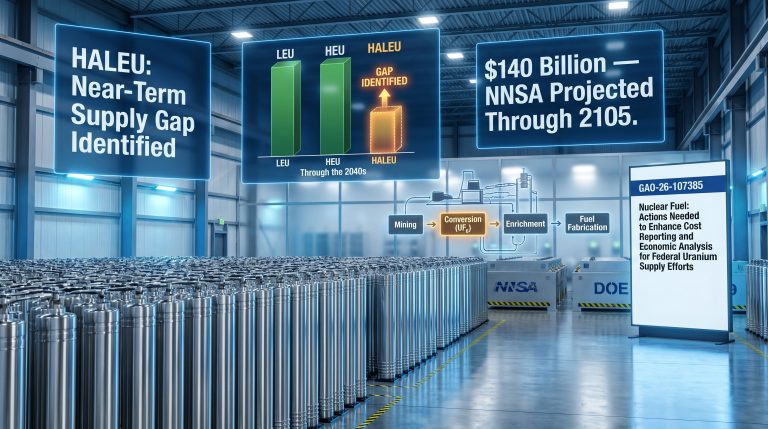
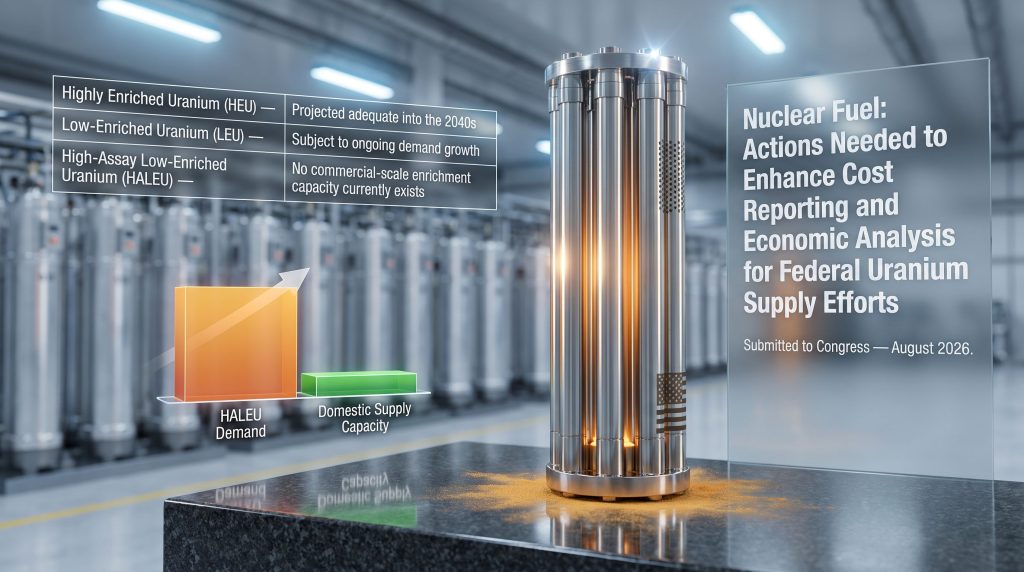
The GAO's findings on current stockpile levels offer a degree of reassurance at the national security end of the spectrum. Both highly enriched uranium and low-enriched uranium inventories managed by the NNSA are projected to remain sufficient for defence and national security requirements into the 2040s. This reflects decades of careful stockpile management inherited from Cold War-era weapons programmes, where production volumes were measured in quantities that dwarfed anything contemplated for civilian use.
| Uranium Category | Primary Application | GAO-Assessed Supply Horizon |
|---|---|---|
| Highly Enriched Uranium (HEU) | Defence and national security programmes | Adequate into the 2040s |
| Low-Enriched Uranium (LEU) | Commercial light water reactors | Subject to growing demand pressure |
| High-Assay Low-Enriched Uranium (HALEU) | Advanced and next-generation reactors | No domestic commercial-scale enrichment capacity |
The Enriched Uranium Management Plan and Its Blind Spots
The NNSA operates an internal governing document known as the Enriched Uranium Management Plan, which guides how the agency estimates, allocates, and oversees its uranium inventories across near-term and long-range planning horizons. The GAO found that while this plan demonstrates genuine institutional competence in tracking physical inventories, it contains a material weakness: the cost accounting and economic analysis frameworks embedded within it are insufficiently rigorous to support the level of congressional oversight that programmes of this scale and strategic importance require.
Existing NNSA stockpiles of both LEU and HEU appear sufficient to meet national security requirements into the 2040s, but the absence of rigorous cost reporting frameworks and structured economic analysis creates long-term governance risks that Congress cannot adequately oversee without corrective action.
This distinction matters enormously from a fiscal governance perspective. Knowing that a stockpile is physically adequate is not the same as knowing what it costs to maintain, replenish, or supplement that stockpile under different demand scenarios. Without transparent cost reporting, Congress is essentially flying blind on the economics of programmes that could run into tens of billions of dollars over multi-decade timeframes.
Furthermore, understanding uranium supply and demand pressures across both the defence and commercial sectors is increasingly critical as domestic enrichment capacity struggles to keep pace with projected requirements.
What Is HALEU and Why It Represents the Most Urgent Vulnerability
Defining the Fuel That Advanced Reactors Require
High-Assay Low-Enriched Uranium, universally abbreviated as HALEU in the industry, occupies a unique and technically precise niche in the nuclear fuel cycle. It is enriched to a U-235 concentration between 5% and 20%, placing it above the threshold used in conventional light water reactor fuel (typically around 3% to 5%) but below the weapons-grade threshold of 90% or more that defines HEU. This enrichment level is not arbitrary. It is dictated by the physics of advanced reactor designs, many of which require higher neutron flux or operate with different moderator configurations than conventional reactors.
Most advanced reactor concepts currently under development in the United States require HALEU as their fuel. This includes many small modular reactor designs as well as microreactor concepts intended for remote or mobile applications. The critical problem identified in the GAO nuclear fuel report is straightforward: no domestic facility currently exists that can produce HALEU at commercial scale.
The Commercial-Scale Enrichment Capacity Problem
Centrus Energy's American Centrifuge Plant in Piketon, Ohio, has demonstrated the ability to produce HALEU at a pilot level. As of the time of the GAO report, this facility represented the only operational HALEU production capability on U.S. soil. However, a demonstration capability and a commercial-scale supply chain are categorically different things. Scaling from a research-and-demonstration output to the volumes that a fleet of deployed advanced reactors would require involves significant capital investment, licensing work, and operational build-out that has not yet occurred.
BWXT, which has longstanding involvement in defence fuel manufacturing, holds potential relevance to HALEU supply through its existing technical capabilities, though the pathway from defence fuel manufacturing to commercial HALEU enrichment involves regulatory and operational complexities of its own. In this context, the U.S. uranium production rebound at the mining and milling level provides some encouragement, but it does not directly resolve the enrichment capacity gap further downstream.
Supply Risk Scenarios for Next-Generation Reactor Deployment
The timing problem here is particularly acute because advanced reactor developers are already securing construction commitments and commercial agreements. TerraPower's Natrium reactor, X-energy's Xe-100, and several other advanced designs are moving through licensing processes that assume a HALEU supply chain will exist when they need it. If commercial enrichment capacity is not established well in advance of those reactors coming online, the consequences extend beyond cost overruns to outright deployment delays that could set back the U.S. advanced nuclear programme by years.
Consider the compounding nature of this risk:
- Advanced reactor licensing timelines run 5 to 10 years from initial application to operational status
- Commercial HALEU enrichment facilities would require substantial capital, regulatory approval, and construction timelines of their own
- The overlap between reactor readiness and fuel availability is not guaranteed under current planning assumptions
- Any delay in HALEU availability affects multiple reactor programmes simultaneously, since the supply gap is systemic rather than project-specific
How the GAO Evaluates DOE's Role in Commercial Fuel Cycle Development
The Department of Energy's responsibilities in this space are distinct from, though complementary to, the NNSA's national security mission. The GAO examined DOE's efforts to support the front-end fuel cycle for the commercial nuclear industry, which encompasses uranium mining, conversion, enrichment, and fuel fabrication before a fuel assembly ever enters a reactor.
| Policy Approach | Mechanism | Intended Outcome |
|---|---|---|
| Direct federal uranium supply | NNSA stockpile management | Guaranteed national security fuel availability |
| Market facilitation | DOE commercial fuel cycle support programmes | Stimulating private sector enrichment investment |
| HALEU production incentives | Centrus and DOE partnership programmes | Bridging the advanced reactor fuel gap |
The GAO's analysis suggests that DOE's market facilitation approach, while structurally sound in theory, is operating without the economic analysis infrastructure needed to evaluate whether federal investments are producing the intended outcomes. This connects directly to the report's core recommendations. In addition, the broader uranium market dynamics at play in 2025 and beyond are placing further pressure on domestic planning frameworks.
The GAO's Core Recommendations and What They Mean in Practice
Recommendation 1: Strengthening Cost Reporting Mechanisms
The first and most foundational recommendation calls for the NNSA and related agencies to establish cost reporting practices that give Congress a clear, consistent, and comparable view of expenditures across uranium supply programmes. Currently, the absence of standardised cost reporting means that different programmes may be accounting for costs in different ways, making it impossible to accurately compare programme efficiency or identify where resources are being misallocated.
Recommendation 2: Establishing Rigorous Economic Analysis Standards
The second recommendation goes further, calling for the development of formal economic analysis methodologies that can evaluate the true costs and risks of federal uranium supply efforts under different demand scenarios. This type of analysis is standard practice in large infrastructure programmes elsewhere in government but has not been consistently applied to enriched uranium supply management.
In GAO methodology, the designation of actions needed signals that existing agency practices fall materially short of what is required for effective congressional oversight, and that without corrective action, cost overruns, misallocated resources, or supply shortfalls could emerge without adequate warning.
Alignment with Broader Nuclear Energy Strategy
These recommendations do not exist in isolation. They arrive at a moment when nuclear energy has been repositioned as a central pillar of U.S. energy and industrial strategy. The Working Group on U.S. Nuclear Energy Dominance published its own action plan in August 2025, calling for accelerated reactor deployment, domestic supply chain development, workforce expansion, and regulatory reform.
The GAO's cost reporting and economic analysis recommendations function as a necessary governance foundation beneath those ambitions. You cannot credibly claim to be pursuing nuclear energy dominance while lacking the fiscal visibility to know what your own fuel programmes actually cost. Consequently, the critical minerals demand context underscores just how interconnected these supply chain governance challenges have become across the broader energy transition.
The next major ASX story will hit our subscribers first
Four Structural Challenges That Could Derail U.S. Enriched Uranium Goals
Challenge 1: No Domestic HALEU Enrichment at Commercial Scale
As described above, this is the most immediate and technically specific constraint facing the advanced reactor sector. It is not a problem that additional policy ambition alone can solve. It requires capital deployment, regulatory coordination, and construction activity that takes years to complete.
Challenge 2: Geopolitical Dependence on Foreign Enrichment
Russia's state-owned enrichment enterprise, Rosatom's TENEX subsidiary, has historically supplied a meaningful share of enriched uranium to U.S. commercial reactors. The Russian uranium import ban introduced restrictions on that supply through the Prohibiting Russian Uranium Imports Act signed in 2024, however the underlying enrichment capacity gap that made Russian imports attractive in the first place has not been fully resolved domestically. The GAO's findings on improved domestic supply planning speak directly to this exposure.
Challenge 3: Cost Transparency Failures
Without consistent cost reporting, federal decision-makers and Congress cannot determine whether uranium supply programmes are operating efficiently, whether cost trajectories are sustainable, or where contingency resources should be pre-positioned. This is not a hypothetical governance concern; it is the kind of information gap that historically precedes significant cost overruns in complex federal programmes.
Challenge 4: Coordinating Defence and Commercial Fuel Priorities
The NNSA's primary mandate is national security. The DOE's commercial support programmes operate within a different institutional culture and incentive structure. Coordinating these two tracks under a single coherent supply framework, particularly as HALEU demand begins to create competition for enrichment capacity, represents a governance challenge that existing planning documents have not fully addressed.
How the 2026 GAO Nuclear Fuel Report Fits Within a Broader Assessment Landscape
The GAO has produced several significant nuclear-related reports in recent years, each targeting a different dimension of the federal nuclear enterprise.
| Report Title | Focus Area | Core Action Required |
|---|---|---|
| Nuclear Fuel: Actions Needed to Enhance Cost Reporting and Economic Analysis | Enriched uranium supply, NNSA planning, HALEU gap | Enhanced cost reporting and economic analysis frameworks |
| Commercial Spent Nuclear Fuel: Congressional Action Needed | Permanent disposal solution for spent fuel | Legislative action to break the disposal impasse |
| Nuclear Waste Cleanup: Closer Alignment with Leading Practices Needed | DOE cleanup programme management | Alignment with project management best practices |
What distinguishes the 2026 GAO nuclear fuel report from earlier assessments is its simultaneous engagement with both the national security and commercial dimensions of the fuel cycle. Furthermore, its explicit focus on the HALEU supply gap as a forward-looking structural risk, rather than merely a current operational concern, sets it apart from previous reviews.
What This Means for Advanced Reactor Deployment and the Path Ahead
The Fuel-Reactor Deployment Feedback Loop
There is a feedback dynamic embedded in the advanced reactor landscape that deserves careful attention. Reactor developers need confidence that fuel will be available before they commit to full commercial deployment. Enrichment facility investors need confidence that reactor deployments will create sustained demand before they commit capital to commercial-scale HALEU production.
This circular dependency means that without a deliberate intervention, neither side of the market moves first, and the entire advanced nuclear programme stalls. For instance, key facts about spent nuclear fuel management illustrate how long-term planning failures upstream create compounding challenges throughout the entire fuel cycle.
Policy Levers and Private Capital
Resolving this coordination problem requires a combination of:
- Congressional appropriations to fund HALEU enrichment capacity development as a bridge measure
- Long-term fuel supply agreements between DOE and reactor developers that provide demand certainty to enrichment investors
- Public-private partnership structures that allow private capital to co-invest in enrichment infrastructure with appropriate risk allocation
- Improved regulatory coordination between the Nuclear Regulatory Commission and enrichment facility developers to shorten licensing timelines
The GAO's recommendations on cost reporting and economic analysis are prerequisites for all of the above. Congress cannot make sound appropriations decisions, evaluate partnership terms, or benchmark programme performance without the fiscal transparency the GAO is calling for.
FAQ: GAO Nuclear Fuel Report, Key Questions Answered
What is the full title of the GAO nuclear fuel report?
The report is formally titled Nuclear Fuel: Actions Needed to Enhance Cost Reporting and Economic Analysis for Federal Uranium Supply Efforts and was submitted to Congress in August 2026.
What does the GAO say about current U.S. enriched uranium stockpiles?
The GAO found that the NNSA is maintaining sufficient quantities of both LEU and HEU to satisfy national security requirements projected out to the 2040s, though cost reporting deficiencies limit full transparency into programme economics.
Why is HALEU considered a critical supply risk?
Because the majority of advanced reactor designs under development in the United States require HALEU as their fuel, and no domestic commercial-scale enrichment facility currently exists to produce it at the volumes those reactors will eventually need.
What is the NNSA's Enriched Uranium Management Plan?
It is the NNSA's internal planning document that governs how the agency estimates, allocates, and manages enriched uranium inventories to meet both near-term and long-range national security fuel requirements.
What two sectors does the GAO report address?
The report addresses both the national security sector, primarily through the NNSA's defence fuel programmes, and the commercial nuclear sector, through the DOE's efforts to support front-end fuel cycle development for civilian reactors.
What specific improvements does the GAO recommend?
The GAO calls for enhanced cost reporting practices and the development of more structured economic analysis methodologies to give Congress clearer visibility into the true costs and risks associated with federal uranium supply programmes.
Cost Transparency as the Foundation of Sustainable Nuclear Fuel Strategy
The GAO nuclear fuel report is ultimately a document about institutional accountability, delivered at a moment when the stakes of getting nuclear fuel policy right have rarely been higher. The HALEU supply gap is real, technically specific, and not going to resolve itself through policy statements alone. The cost reporting deficiencies the GAO identified are not minor bookkeeping issues; they represent a structural weakness in the governance architecture that underpins multi-decade, multi-billion-dollar federal commitments.
For policymakers, the immediate priority should be acting on the GAO's recommendations before the advanced reactor deployment timeline makes the HALEU gap acute rather than merely theoretical. For investors and industry stakeholders, the report signals that the regulatory and planning environment around enriched uranium supply is likely to become more structured and better resourced as congressional oversight mechanisms improve. For the broader public, it is a reminder that the nuclear renaissance being discussed in energy policy circles depends on solving supply chain problems that are far less visible than reactor designs or electricity prices, but every bit as consequential.
This article is intended for informational purposes only and does not constitute financial or investment advice. Readers should conduct their own due diligence before making decisions based on forward-looking statements or projections related to the nuclear energy sector. For ongoing coverage of U.S. nuclear fuel policy, visit the American Nuclear Society's Nuclear Newswire at ans.org/news.
Want to Stay Ahead of Significant Mineral Discoveries Tied to the Energy Transition?
As uranium and critical minerals continue to reshape global energy strategy, Discovery Alert's proprietary Discovery IQ model delivers real-time ASX mineral discovery alerts, transforming complex data across 30+ commodities into clear, actionable insights for both traders and long-term investors. Explore how historic discoveries have generated substantial returns on Discovery Alert's dedicated discoveries page, and begin your 14-day free trial today to position yourself ahead of the market.