June 21, 2026
Regional energy markets across South America are undergoing fundamental shifts as unconventional resource development reshapes traditional supply-demand dynamics. The integration of cross-border pipeline infrastructure, combined with advances in shale extraction technologies, creates new opportunities for energy security diversification and cost optimization strategies across neighboring nations. Furthermore, the gas exportación Vaca Muerta Uruguay corridor exemplifies how bilateral cooperation can unlock immediate economic benefits while supporting renewable energy solutions across the region.
¿Cómo está transformando Vaca Muerta el panorama energético regional sudamericano?
The Neuquén Basin's unconventional resources have fundamentally altered South America's energy landscape through technological advancement and production scaling. Vaca Muerta's geological characteristics require sophisticated extraction methodologies, including multi-stage hydraulic fracturing and horizontal drilling techniques that differ significantly from conventional extraction approaches.
Moreover, these developments are part of broader industry evolution trends that are reshaping how energy companies approach resource extraction and market positioning across Latin America.
Capacidad productiva actual y proyecciones de crecimiento
Argentina's Vaca Muerta formation currently generates approximately 48 million cubic meters per day (MMm³/d) of natural gas, establishing the country as a major regional supplier. This production level represents the culmination of sustained investment in unconventional extraction infrastructure across the Neuquén Basin.
The formation's geological structure presents unique technical challenges that distinguish it from conventional reservoirs. Tight shale formations require sustained capital expenditure for horizontal well development, with production profiles exhibiting higher initial decline rates compared to conventional wells. This necessitates continuous drilling programs to maintain production levels.
The Neuquén Basin accounts for approximately 65% of Argentina's total natural gas production, according to Argentina's Energy Secretariat data. This concentration reflects the strategic importance of unconventional resources in the country's energy matrix transformation.
Posicionamiento estratégico de Argentina en el mercado gasífero continental
Pan American Energy has positioned itself as one of Argentina's principal natural gas producers, leveraging Vaca Muerta's output to serve both domestic demand and regional export opportunities. The company's strategy recognizes that Argentina's domestic market has reached sufficient supply levels, creating conditions for international market expansion.
Regional export contracts represent a strategic stepping stone toward more ambitious international market insertion, particularly as Argentina develops capabilities for liquefied natural gas (LNG) exports. This approach allows producers to test export logistics and contract mechanisms while building relationships with neighboring utilities.
The reactivation of cross-border pipeline infrastructure reflects normalization and renewed impetus for bilateral energy trade. Previously underutilized assets now find economic justification through increased production availability and improved regulatory predictability for export permits.
Impacto en la balanza comercial y generación de divisas
Uruguay's state utility UTE reported savings of approximately USD 1 million within four days of commencing Argentine gas imports, highlighting the immediate economic benefits of regional energy integration. This translates to potential annual savings in the range of USD 91-100 million assuming consistent seasonal demand patterns.
The cost advantages stem from natural gas providing approximately 50% reduction in electricity production costs compared to alternative thermal fuel sources available to Uruguay. These alternatives typically include fuel oil, diesel, or liquefied petroleum gas, all of which carry higher per-unit energy costs.
Pan American Energy has delivered over 7 million cubic meters of gas to Uruguay through the reactivated Gasoducto Cruz del Sur, with volumes expected to increase during summer peak electricity demand periods. This export activity generates foreign exchange earnings for Argentina while providing cost-effective thermal generation fuel for Uruguay.
When big ASX news breaks, our subscribers know first
¿Qué factores impulsan la demanda uruguaya de gas natural argentino?
Uruguay's energy matrix historically demonstrates heavy reliance on hydroelectric generation, contributing 50-60% of electricity production in favorable hydrological years. However, seasonal variability and drought conditions create requirements for thermal generation capacity to ensure grid reliability and supply security.
Additionally, current gas price trends make Argentine gas particularly attractive for Uruguay's energy planners seeking cost-effective thermal generation options.
Análisis de la matriz energética uruguaya actual
The Uruguayan electrical system operates with a diversified generation portfolio designed to balance renewable resource variability with thermal backup capacity. Combined-cycle thermal plants like Punta del Tigre serve critical roles in meeting peak demand and providing grid stability services.
Uruguay's summer electricity demand (December-February) peaks due to increased air conditioning loads and tourism-driven consumption patterns. This seasonal pattern creates predictable requirements for thermal generation capacity, making natural gas imports particularly valuable during these periods.
Winter demand periods (June-August) typically show lower consumption levels but can present challenges when hydroelectric reservoirs experience drought conditions. Natural gas availability provides operational flexibility for utilities managing these seasonal variations.
Costos comparativos entre combustibles alternativos
| Fuel Type | Approximate Cost Impact | Operational Characteristics |
|---|---|---|
| Natural Gas (Argentine) | 50% cost reduction vs alternatives | Lower emissions, efficient combustion |
| Fuel Oil | Higher cost baseline | Higher particulate and sulfur emissions |
| Diesel | Premium pricing | Typically reserved for peak/emergency use |
| LPG | Variable pricing | Limited availability for large-scale generation |
Natural gas combustion in combined-cycle facilities achieves approximately 50-60% thermodynamic efficiency, significantly higher than conventional coal or fuel oil plants. This efficiency advantage translates directly into lower fuel consumption per megawatt-hour generated.
The USD 250,000 daily savings achieved through Argentine gas imports demonstrates the substantial economic impact of fuel source optimization. These savings accumulate particularly during high-demand periods when thermal generation operates at elevated capacity factors.
Objetivos de diversificación y seguridad energética nacional
Uruguay's energy security strategy emphasises supply source diversification within a transition energy scheme combining efficiency, sustainability, and cost stability. This approach recognises the importance of maintaining flexible fuel options while pursuing long-term decarbonisation objectives.
UTE's role as the national utility involves guaranteeing accessible energy access through regional agreements that provide predictability and operational efficiency. The Argentine gas supply contract exemplifies this strategic approach to bilateral energy cooperation.
Natural gas imports represent a pragmatic bridge technology that provides immediate cost benefits while supporting grid reliability during renewable resource variability periods.
Regulatory frameworks in Uruguay support fuel diversification initiatives that enhance system flexibility without compromising environmental objectives. Natural gas exhibits lower greenhouse gas emissions intensity compared to fuel oil or coal alternatives.
¿Cuáles son las rutas de infraestructura disponibles para las exportaciones gasíferas?
Cross-border pipeline infrastructure represents the foundation of regional energy integration, requiring sophisticated engineering solutions for pressure management, flow measurement, and bilateral regulatory coordination. The technical complexity of international gas transmission involves multiple stakeholder coordination and standardised operational protocols.
Evaluación técnica del Gasoducto Cruz del Sur
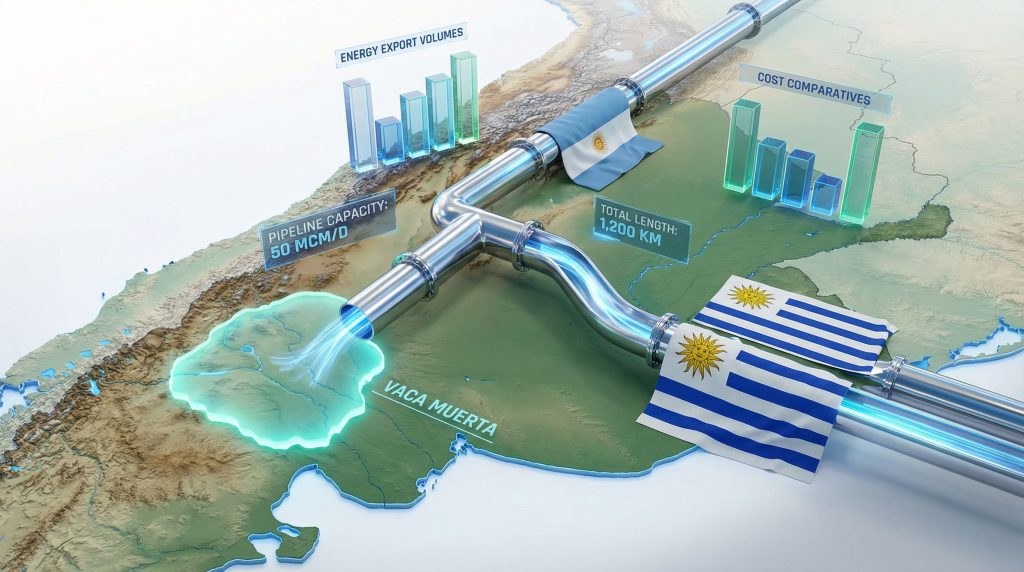
Gasoducto Cruz del Sur connects Punta Lara (Buenos Aires Province) with Colonia and Montevideo, establishing a direct transmission pathway for Argentine gas exports. The pipeline represents binational infrastructure of great relevance that returns to occupy a central role in regional energy integration.
The infrastructure was previously underutilised for years due to limited gas availability and export regulatory constraints. Reactivation became feasible through increased gas availability in Argentina, driven by sustained Vaca Muerta development and expansion of transport capacity within Argentina's trunk pipeline network.
Pipeline ownership structure includes Pan American Energy, ANCAP, Harbour Energy, and Shell as stakeholders, reflecting international cooperation in cross-border energy infrastructure development. This ownership model demonstrates private-public partnership approaches to strategic infrastructure financing.
Capacidades de transporte y limitaciones operativas
Technical specifications for Gasoducto Cruz del Sur require consultation of original engineering documentation, as specific capacity figures, operating pressures, and design parameters are not readily available through public sources. Infrastructure capacity utilisation has improved significantly following reactivation.
Flow measurement and custody transfer systems at international border points ensure accurate accounting of gas volumes for commercial and regulatory purposes. These systems require calibration and maintenance protocols coordinated between Argentine and Uruguayan authorities.
Compressor station operations along the pipeline route maintain necessary pressure levels for gas transmission across distances and elevation changes. Maintenance scheduling requires coordination to minimise service interruptions while ensuring operational safety.
Proyectos de expansión de red troncal en desarrollo
Argentina's trunk pipeline network has undergone expansion of transport capacity that enables increased export availability. These infrastructure investments create redundancy and capacity margins necessary for reliable international supply commitments.
Regional pipeline network expansion includes both Argentina's domestic transmission system and interconnection points with neighbouring countries. This integrated approach maximises infrastructure utilisation efficiency while supporting multiple export routes.
- Lateral pipeline connections enhance system flexibility
- Pressure management systems optimise flow distribution
- Border measurement facilities ensure commercial accuracy
- Emergency isolation capabilities protect system integrity
¿Qué papel juegan los actores corporativos en esta integración energética?
Corporate strategies in regional energy integration involve complex assessments of production capacity, infrastructure access, regulatory frameworks, and market development opportunities. Companies must balance domestic supply obligations with export growth potential while managing technical and commercial risks.
Furthermore, these developments occur within the context of broader energy transition challenges that companies must navigate while pursuing regional integration opportunities.
Estrategia comercial de Pan American Energy en mercados externos
Pan American Energy has positioned gas exports as a critical growth vector, recognising Argentina's domestic market reaches adequate supply levels. The company views regional contracts as a first step toward more ambitious international market insertion, particularly as Argentina develops LNG export capabilities.
The company's dual-track approach involves simultaneous development of pipeline exports to regional markets and preparation for participation in global LNG trade. Beginning in 2027, PAE plans participation in the Southern Energy consortium for LNG exports, complementing pipeline exports with maritime shipments of greater geographic reach.
PAE's production capacity from Vaca Muerta operations provides the foundation for sustained export commitments. The company emphasises that exports occur within a context of ample domestic market supply, ensuring national energy security while pursuing international opportunities.
Rol de UTE y ANCAP en la planificación energética uruguaya
UTE operates as Uruguay's integrated utility, responsible for generation, transmission, distribution, and commercialisation of electrical energy. The company emphasises its central role in the national energy system and commitment to guaranteeing accessible energy access.
ANCAP's participation in Gasoducto Cruz del Sur reflects the state oil company's involvement in strategic energy infrastructure. The company's role includes pipeline ownership, operational oversight, and coordination with international partners for cross-border energy trade.
Bilateral coordination mechanisms between UTE and Argentine suppliers ensure operational reliability and commercial predictability. These relationships support regional agreements that provide predictability and efficiency in energy supply management.
Participación de empresas internacionales en infraestructura binacional
International energy companies including Harbour Energy and Shell participate in Gasoducto Cruz del Sur ownership, bringing technical expertise and financing capabilities to binational infrastructure projects. This international participation demonstrates confidence in regional energy integration prospects.
Private-public partnership models in cross-border energy infrastructure enable risk sharing and technical capability combination. Companies contribute specialised expertise in pipeline operations, commercial optimisation, and regulatory compliance.
Technical service providers support pipeline maintenance, measurement accuracy, and operational safety protocols. These specialised capabilities ensure infrastructure reliability and regulatory compliance across jurisdictions.
¿Cómo se compara esta iniciativa con otros proyectos de exportación gasífera regionales?
Regional gas export projects across South America exhibit varying technical configurations, market structures, and commercial arrangements that reflect specific geographic, regulatory, and economic conditions. Comparative analysis reveals optimisation strategies and lessons learned from different integration approaches.
Análisis del memorando Argentina-Brasil y sus implicaciones
Argentina's broader regional export strategy includes memoranda of understanding with Brazil for expanded gas trade relationships. Brazilian market access represents significantly larger volume potential compared to Uruguay, reflecting Brazil's industrial demand base and thermal generation requirements.
Infrastructure development timelines for Brazil-directed exports may require substantial additional investment in cross-border pipeline capacity and compression facilities. These projects involve longer development lead times but offer greater volume scaling opportunities.
Regulatory coordination complexity increases with larger neighbouring markets due to more complex approval processes and integration requirements with existing pipeline networks. Brazil's regulatory framework involves federal and state-level coordination mechanisms.
Competencia entre rutas de exportación hacia diferentes mercados
Export route optimisation involves assessment of transportation costs, market pricing, and infrastructure availability across potential destination markets. Companies must evaluate whether pipeline exports or LNG development provides superior economic returns.
| Export Route | Market Size | Infrastructure Requirements | Development Timeline |
|---|---|---|---|
| Uruguay (Pipeline) | Limited volume, immediate | Existing infrastructure reactivation | Operational |
| Brazil (Pipeline) | Large volume potential | Major infrastructure investment | 3-5 years |
| Global LNG | Unlimited market access | LNG facility development | 2027+ |
Pipeline route competition focuses on transportation cost optimisation and reliable supply commitments. Companies evaluate multiple export pathways to diversify market risk and maximise revenue potential.
Ventajas competitivas del corredor argentino-uruguayo
The Uruguay export corridor provides immediate market access through existing infrastructure, enabling rapid commercialisation of increased Argentine production. This speed-to-market advantage allows companies to generate export revenue while developing longer-term projects.
Operational simplicity characterises the Argentina-Uruguay trade relationship due to existing infrastructure, established commercial relationships, and simplified regulatory coordination. These factors reduce project development risk and timeline uncertainty.
Market scale alignment between Argentine surplus production and Uruguayan thermal demand creates natural supply-demand balance without requiring massive infrastructure investment. This proportional matching reduces commercial risk for both suppliers and consumers.
¿Qué desafíos regulatorios y financieros enfrenta la expansión del sector?
Energy export development involves complex regulatory frameworks spanning production permitting, transportation approvals, and international trade authorisations. Financial structuring requires long-term revenue visibility, infrastructure investment recovery, and risk management across multiple jurisdictions.
Consequently, these challenges are compounded by broader global market impacts that affect energy commodity pricing and investment flows.
Marco normativo para permisos de exportación energética
Export permit frameworks in Argentina have evolved toward greater predictability, supporting producer confidence in international market commitments. Improved regulatory clarity enables companies to develop export strategies with reduced administrative uncertainty.
Bilateral regulatory coordination between Argentina and Uruguay involves customs procedures, quality specifications, and measurement standards for cross-border gas trade. These protocols ensure commercial accuracy and dispute resolution mechanisms.
Environmental impact assessments may apply to infrastructure modifications or capacity expansions supporting increased export volumes. Regulatory agencies coordinate environmental compliance across transmission routes and generation facilities.
Requerimientos de inversión en infraestructura de transporte
Transportation infrastructure investment requirements vary significantly based on export volume targets and destination market characteristics. Existing pipeline reactivation involves lower capital requirements compared to greenfield infrastructure development.
Compression facility investments may become necessary to maintain adequate pipeline pressures for increased export volumes. These facilities require specialised equipment and maintenance capabilities.
- Measurement station upgrades for enhanced commercial accuracy
- Pipeline integrity assessments for sustained higher utilisation
- Border facility enhancements for customs and regulatory compliance
- Emergency response capabilities for operational safety
Coordinación intergubernamental para proyectos transfronterizos
Intergovernmental coordination mechanisms facilitate policy alignment, regulatory harmonisation, and dispute resolution for cross-border energy projects. These relationships require sustained diplomatic engagement and technical cooperation.
Energy ministry coordination between Argentina and Uruguay supports strategic planning, infrastructure prioritisation, and regulatory framework development. Regular ministerial meetings address policy coordination and project facilitation.
Technical working groups address operational protocols, safety standards, and commercial procedures for cross-border energy trade. These specialist groups develop implementation guidelines and troubleshoot operational issues.
The next major ASX story will hit our subscribers first
¿Cuáles son las perspectivas de mediano y largo plazo para este mercado?
Long-term energy market evolution involves assessment of demand growth trajectories, infrastructure development timelines, technology advancement impacts, and regional integration deepening. Forecasting requires consideration of policy changes, economic development patterns, and energy transition strategies.
Proyecciones de demanda energética en Uruguay hasta 2030
Uruguay's electricity demand projections through 2030 reflect economic growth expectations, population development, and energy efficiency implementation. Thermal generation requirements depend significantly on hydroelectric resource availability and renewable energy capacity additions.
Seasonal demand variability creates predictable patterns for thermal generation utilisation, with summer periods consistently requiring higher thermal capacity deployment. Argentine gas availability provides supply security during these peak demand periods.
Industrial demand growth in Uruguay may create additional natural gas consumption opportunities beyond electricity generation. Direct industrial applications could expand total import volume requirements and justify infrastructure capacity investments.
Potencial de Uruguay como hub de tránsito hacia Brasil
Uruguay's geographic position creates potential for serving as a transit corridor for Argentine gas exports to Brazilian markets. This development would require substantial infrastructure expansion and trilateral regulatory coordination.
Transit facility development would necessitate major pipeline capacity additions and interconnection infrastructure with Brazil's domestic gas network. These projects involve complex financing and regulatory approval processes across multiple jurisdictions.
Commercial arrangements for transit services would require coordination between Argentine producers, Uruguayan infrastructure operators, and Brazilian consumers. Such arrangements involve sophisticated pricing and allocation mechanisms.
Integración con proyectos de GNL y exportación marítima
LNG export development represents a complementary pathway to pipeline exports, enabling Argentine gas access to global markets beyond regional neighbours. PAE's planned participation in Southern Energy consortium beginning 2027 illustrates this strategic integration.
Pipeline and LNG export coordination allows companies to optimise production allocation based on market pricing and contract terms. This flexibility maximises revenue potential while maintaining supply reliability for different market segments.
Infrastructure synergies between pipeline exports and LNG development include shared gas gathering systems, processing facilities, and transportation networks. These synergies reduce overall development costs and improve project economics.
| Development Phase | Timeline | Key Milestones |
|---|---|---|
| 2025-2026 | Pipeline Export Scaling | Uruguay volume increases, Brazil agreements |
| 2027-2029 | LNG Export Launch | Southern Energy operations, global market access |
| 2030+ | Integrated Export Portfolio | Pipeline-LNG optimisation, market diversification |
¿Qué lecciones ofrece este caso para la integración energética sudamericana?
Regional energy integration success factors include infrastructure utilisation optimisation, regulatory framework harmonisation, commercial relationship development, and strategic patience in market development. The Argentina-Uruguay gas exportación Vaca Muerta Uruguay initiative demonstrates practical approaches to cross-border energy cooperation.
Modelos de cooperación bilateral en el sector energético
Bilateral energy cooperation requires sustained commitment from both governmental and corporate stakeholders across political cycles and market conditions. The reactivation of previously underutilised infrastructure demonstrates the importance of maintaining strategic assets during low-utilisation periods.
Public-private partnership models in international energy infrastructure enable risk sharing, technical expertise combination, and financing capability leveraging. Multiple stakeholder participation in Gasoducto Cruz del Sur exemplifies this approach.
Regulatory framework evolution toward greater export permit predictability supports producer confidence in international market development. This regulatory improvement creates conditions for sustained commercial relationship development.
Factores críticos de éxito en proyectos de infraestructura compartida
Technical compatibility between systems requires standardised measurement protocols, quality specifications, and operational procedures. These technical harmonisation requirements necessitate engineering coordination and equipment standardisation.
Commercial framework development involves pricing mechanisms, contract terms, and dispute resolution procedures that provide predictability for all stakeholders. Long-term contractual commitments enable infrastructure investment recovery and operational planning.
Political risk management through bilateral treaty frameworks, diplomatic engagement, and regulatory coordination reduces uncertainty for private sector investment in cross-border infrastructure. Moreover, Argentina's government has recently expanded the RIGI (Regime for Large Investments) to include all incremental production from Vaca Muerta, providing additional regulatory certainty for investors.
Implicaciones para la transición energética regional
Natural gas serves as a bridge fuel in regional energy transition strategies, providing cleaner thermal generation compared to coal or fuel oil while supporting renewable energy integration through grid flexibility services.
Regional energy security enhancement through diversified supply sources reduces dependence on single fuel types or supply routes. Cross-border gas trade contributes to this diversification while optimising regional resource allocation.
The Argentina-Uruguay gas exportación Vaca Muerta Uruguay corridor demonstrates that pragmatic bilateral cooperation can achieve immediate economic benefits while building foundations for deeper regional energy integration.
Infrastructure development patience enables long-term strategic positioning despite short-term utilisation challenges. The Cruz del Sur reactivation illustrates how strategic infrastructure maintains value potential across market cycles.
Technology advancement integration in regional energy cooperation includes both extraction technologies (unconventional resource development) and transmission technologies (pipeline efficiency improvements). This technological foundation supports sustainable expansion of cross-border energy trade.
Environmental performance improvements through fuel switching from higher-emission alternatives to natural gas provide immediate greenhouse gas reduction benefits while maintaining energy security and economic competitiveness. This approach balances environmental objectives with practical energy system requirements.
What role could regional energy integration play in your investment strategy?
Discover how Argentina's expanding gas exportación Vaca Muerta Uruguay corridor, along with broader South American energy infrastructure developments, creates actionable investment opportunities in the mining and energy sectors. Discovery Alert's proprietary Discovery IQ model provides real-time alerts on significant mineral and energy discoveries across the ASX, helping investors identify companies positioned to benefit from regional resource integration trends before the broader market recognises these opportunities. Begin your 30-day free trial today to gain market-leading insights into how energy infrastructure developments translate into discoverable investment opportunities.