
August 25, 2026
Regional Production Powerhouse Faces Critical Supply Chain Vulnerabilities
Energy-intensive industries worldwide depend on stable supply chains to maintain operational continuity and cost efficiency. In the aluminium sector, production concentration in specific geographic regions creates both opportunities and vulnerabilities that extend far beyond regional boundaries. The Gulf Cooperation Council (GCC) states have emerged as critical nodes in global aluminium supply networks, leveraging natural resource advantages to build substantial smelting capacity that serves markets across continents. However, the current GCC aluminium supply disruption threatens to reshape global market dynamics and expose deep structural dependencies.
Modern aluminium production requires consistent access to both energy inputs and raw materials, creating complex interdependencies that can amplify regional disruptions into global market events. When supply chain vulnerabilities intersect with geopolitical uncertainties, the resulting dynamics reshape pricing mechanisms, trade flows, and strategic planning across the entire value chain. Understanding these interconnected risks becomes essential for stakeholders navigating an increasingly complex global aluminium landscape.
When big ASX news breaks, our subscribers know first
Energy-Driven Competitive Advantages Transform Middle Eastern Smelting Operations
The GCC region's emergence as an aluminium production powerhouse stems from fundamental energy economics that create sustained competitive advantages. Natural gas availability from regional reserves provides smelting operations with energy costs approximately 30-40% below facilities dependent on imported fuel sources or higher-cost electricity markets. This energy advantage translates directly into operational cost savings, as electricity represents the largest single input cost in primary aluminium production.
Modern smelter facilities across the Gulf states utilize the Hall-Héroult electrolytic process, consuming approximately 12,000-15,500 kilowatt-hours per tonne of aluminium produced. Furthermore, the availability of piped natural gas from domestic reserves enables GCC operators to achieve energy procurement costs that maintain competitiveness even during periods of global energy price volatility.
This structural advantage has supported steady capacity expansion and production growth over multiple economic cycles. Regional smelting operations demonstrate operational efficiency metrics comparable to international standards, reflecting substantial capital investments in contemporary technology and infrastructure. These efficiency gains compound the natural resource advantages, creating a dual competitive benefit that strengthens the region's market position.
Regional Production Capacity Distribution Across Gulf States
Production capacity distribution across GCC countries creates concentrated nodes of aluminium output, with individual facilities operating at substantial scale. Qatar maintains smelter capacity in the range of 585,000-636,000 tonnes annually, representing a significant single-facility concentration. Meanwhile, Bahrain operates smelting capacity reported at 1.62 million tonnes, constituting one of the largest individual production complexes in the region.
The United Arab Emirates contributes additional smelting operations to the overall GCC production profile, though specific facility capacities vary by location and operational configuration. This multi-country distribution provides some geographic diversification within the regional complex whilst maintaining the concentrated supply vulnerability that characterises production hubs.
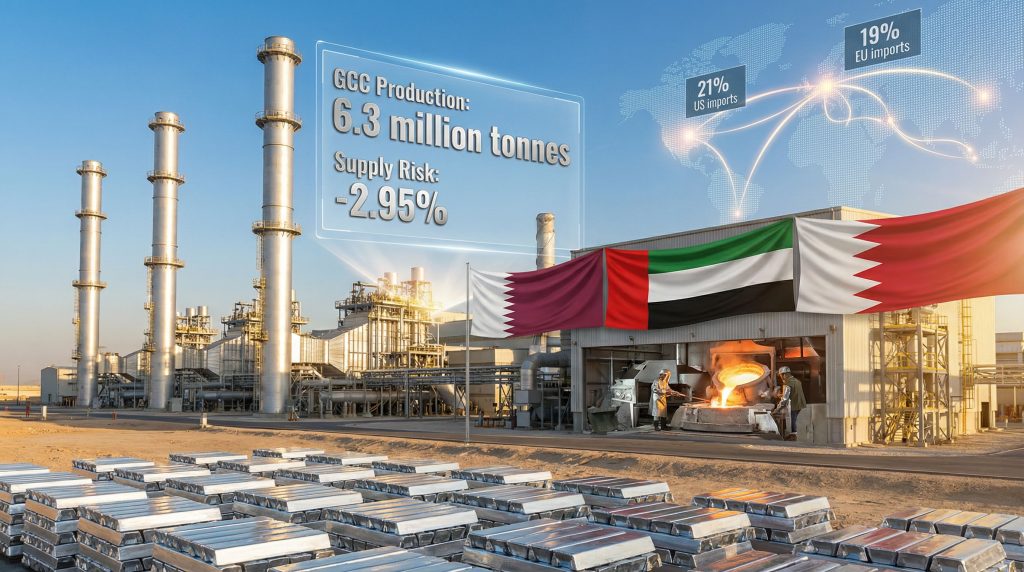
Total regional output demonstrates consistent growth trajectories over recent years. Primary aluminium production increased from 5.8 million tonnes in 2021 to 6.3 million tonnes in 2024, representing steady annual expansion despite global economic uncertainties. Year-on-year growth rates of 3.14% (2021-2022), 2.35% (2022-2023), and 2.07% (2023-2024) illustrate the region's expanding role in global supply networks.
However, production momentum shifted in 2025, when output declined to 6.15 million tonnes, marking a -2.95% decrease from the previous year. This reduction totalling approximately 150,000 tonnes annually signals the impact of supply chain constraints that continue to affect regional operations.
Strategic Geographic Position for Raw Material Imports
The GCC's strategic location provides advantageous access to global shipping routes whilst creating dependencies on international raw material supplies. Maritime transport corridors from Australia, Brazil, and Guinea facilitate bauxite and alumina imports required for sustained smelting operations. Transit times from major supplier countries range from 15-30 days, depending on specific origin and destination combinations.
Port infrastructure across GCC states accommodates the large-volume bulk commodity shipments required for aluminium production. Specialised handling facilities for bauxite and alumina unloading, storage, and transport to smelter sites enable efficient supply chain logistics during normal operating conditions. However, this infrastructure dependency creates potential chokepoints during periods of supply disruption or logistics constraints.
Regional smelters maintain inventory buffers to manage normal supply chain variability, typically holding 30-45 days of alumina feedstock. These inventory levels provide operational flexibility during minor supply disruptions but prove insufficient during extended supply chain interruptions exceeding 6-8 weeks duration.
Critical Raw Material Dependencies Create Structural Vulnerabilities
The GCC aluminium supply disruption operates with extreme dependency on imported raw materials that creates fundamental supply chain vulnerabilities. Regional production generates only approximately 3% of global alumina capacity whilst contributing merely 1% of global bauxite mining output. This dramatic imbalance means that 97% of alumina requirements and 99% of bauxite requirements must be sourced externally.
| Raw Material | GCC Production Share | Import Dependency | Primary Suppliers |
|---|---|---|---|
| Bauxite | 1% | 99% | Australia, Guinea, Brazil |
| Alumina | 3% | 97% | China, Australia, India |
| Primary Aluminium | 8-9% | N/A | Regional production |
This raw material import structure creates sequential vulnerability where disruptions at any upstream stage cascade through the production chain. For instance, bauxite mining disruptions in Australia or Guinea directly impact alumina refinery operations, which subsequently constrain aluminium smelter feedstock availability in the GCC region. The bauxite project benefits demonstrate the critical importance of maintaining stable raw material supply chains.
Raw Material Import Dependency Analysis
Bauxite sourcing concentrates in a limited number of supplier countries, with Australia controlling approximately 45-50% of global reserves, Guinea holding 15-20% of reserves, and Brazil maintaining 10-15% of reserves. This geographic concentration amplifies supply risk, as disruptions in any major supplier region create immediate availability constraints for GCC smelters.
Alumina refining capacity demonstrates even greater concentration, with China, Australia, and India collectively controlling approximately 65-70% of global alumina production. The refining process requires specialised facilities capable of calcining bauxite ore at 900-1,100°C to produce the high-purity alumina (99.5%+ Al₂O₃ content) required for smelting operations.
Supply chain logistics involve complex coordination across multiple stages. Furthermore, each stage introduces potential failure points that can disrupt downstream operations. The approximately 20-25 day transit time from Australian suppliers to GCC destinations prevents rapid supply substitution when primary sources experience disruptions.
Critical Infrastructure Chokepoints
Maritime shipping routes essential for raw material imports pass through critical chokepoints that concentrate supply vulnerability. The Strait of Hormuz, Suez Canal, and Strait of Malacca represent essential transit corridors for alumina shipments to GCC smelters. Any significant disruption to these shipping lanes creates immediate supply constraints for regional producers.
Port capacity limitations at major supplier locations can create bottlenecks during periods of high demand or operational constraints. Specialised bulk handling equipment for bauxite and alumina loading requires regular maintenance and periodic upgrades, creating potential service interruptions that affect supply continuity.
Regional storage and distribution infrastructure within GCC countries represents another potential constraint point. Smelter-specific alumina storage facilities, conveyor systems, and processing equipment require continuous operation to maintain production schedules. Equipment failures or maintenance requirements can force temporary production curtailments even when raw material supplies remain available.
Energy Security Risks in Smelting Operations
Despite the GCC's natural gas advantages, energy security risks exist that could constrain smelter operations. Regional geopolitical tensions, infrastructure maintenance requirements, or domestic energy demand growth could potentially limit gas availability for industrial applications. In addition, the natural gas price trends indicate potential volatility that could affect operational costs.
Smelting operations require continuous energy supply, as production interruptions damage equipment and reduce operational efficiency. Power grid stability represents another critical requirement for aluminium production. Smelter facilities typically operate 24/7 and require consistent electrical supply to maintain electrolytic cell operations.
Alternative energy sourcing options remain limited for large-scale smelting operations. Whilst renewable energy projects expand across the GCC region, the scale and consistency requirements of aluminium production currently limit substitution possibilities for conventional energy sources.
Production Impact Scenarios Reveal Substantial Market Exposure
Current supply chain disruptions threaten to generate significant production shortfalls that could reshape global aluminium availability. Analysis of regional production constraints suggests that a 3-month raw material disruption scenario could create a 1-1.25 million tonne shortage in primary aluminium output from GCC facilities.
This projected shortage magnitude reflects the concentrated nature of regional production and the limited inventory buffers available to absorb extended supply interruptions. Monthly production impact calculations indicate potential reductions of 333,000-417,000 tonnes per month during disruption periods, representing 63-79% production curtailment relative to normal operating levels.
Quantifying the Production Shortfall Impact
The baseline production capacity provides context for understanding disruption magnitude. With 2024 production at 6.3 million tonnes and normal monthly output approximately 525,000 tonnes, any substantial production curtailment creates measurable impacts on global supply availability.
Key Production Statistics
- 2024 baseline: 6.3 million tonnes annual production
- 2025 decline: 6.15 million tonnes (-2.95% year-over-year)
- Monthly baseline: ~525,000 tonnes under normal operations
- Projected disruption: 1-1.25 million tonnes over 3 months
- Disruption severity: 63-79% production curtailment during affected period
The projected shortage timeframe aligns with typical alumina inventory depletion cycles. Most smelter facilities maintain 30-45 days of alumina inventory to buffer normal supply variability. When supply disruptions extend beyond 6-8 weeks, inventory depletion forces production curtailment as facilities cannot operate without adequate feedstock supplies.
Production curtailment mechanics operate through discrete cell shutdown rather than proportional throughput reduction. Modern smelter technology cannot efficiently operate individual electrolytic cells below 60-70% design capacity without significantly reducing energy efficiency and increasing per-unit production costs.
Facility-Specific Shutdown Analysis
Individual facility exposure varies based on specific operational configurations, inventory levels, and supply contract structures. Larger facilities with greater storage capacity may maintain operations longer during supply disruptions, whilst smaller facilities with limited inventory buffers face earlier production constraints.
| Facility Location | Annual Capacity | Monthly Output | Disruption Impact |
|---|---|---|---|
| Bahrain | 1.62 million tonnes | ~135,000 tonnes | High exposure |
| Qatar | 585,000-636,000 tonnes | ~50,000 tonnes | Moderate exposure |
| UAE | Variable by facility | Variable | Facility-dependent |
The concentration of capacity in individual facilities amplifies the impact of facility-specific disruptions. Bahrain's 1.62 million-tonne capacity represents approximately 25% of total regional production, meaning disruptions at this single facility create substantial supply shortages.
Force majeure declarations become likely when supply disruptions prevent normal contract fulfillment. Such declarations formally acknowledge that extraordinary circumstances prevent contract performance, shifting risk allocation between suppliers and customers according to specific contract terms.
Force Majeure Declarations and Contract Implications
Supply disruption severity sufficient to trigger force majeure events creates cascading effects throughout the supply chain. Aluminium smelters unable to secure adequate raw materials may declare force majeure on customer contracts, shifting delivery obligations and price risk to purchasers.
Contract terms typically specify force majeure conditions and remedies, including suspension of delivery obligations during disruption periods, price adjustment mechanisms for partial deliveries, alternative sourcing requirements and cost allocation, and contract termination rights under extended disruption scenarios.
The legal and commercial implications extend beyond immediate supply constraints. Long-term supply agreements may require renegotiation if disruption patterns suggest structural changes in supply reliability. Customer relationships and market positioning could shift based on suppliers' ability to maintain deliveries during challenging operating conditions.
Global Import Dependencies Create Regional Vulnerability Asymmetries
The distribution of GCC aluminium supply disruption across global consuming regions creates uneven exposure to potential disruptions. Major economic zones demonstrate varying levels of import dependency that determine their vulnerability to Middle Eastern production constraints.
United States imports approximately 21% of primary aluminium from GCC and related Middle Eastern sources, creating substantial exposure to regional supply variations. European Union sourcing reaches approximately 19% of primary aluminium imports from the region, though this figure increases to approximately 30% when including value-added products such as semi-finished and finished aluminium goods.
Japan demonstrates the highest dependency levels, sourcing approximately 25% of primary aluminium imports from Middle Eastern suppliers. This concentration reflects deliberate supply chain optimisation by Japanese industrial consumers seeking cost-competitive primary aluminium for domestic manufacturing operations. However, trade war market impact considerations also influence these sourcing decisions.
Regional Import Dependency Analysis
Import dependency percentages translate into substantial volume exposures when applied to total consumption levels in major economies. The persistence of these import ratios despite historical price volatility and geopolitical risks indicates that GCC cost advantages outweigh supply security concerns for many consuming regions.
| Region | Primary Al Import Share | Including Value-Added | Supply Vulnerability |
|---|---|---|---|
| United States | 21% | Not specified | High |
| European Union | 19% | 30% | Very High |
| Japan | 25% | Not specified | Extreme |
| Asia-Pacific | Variable | Variable | Region-dependent |
The volume implications become significant when considering total consumption patterns. Global primary aluminium production totals approximately 68-72 million tonnes annually, with the GCC's 6.3 million tonnes representing approximately 8.7% of global output. However, the concentrated distribution to specific importing regions amplifies the impact beyond global production share percentages.
Regional substitution capabilities vary significantly based on alternative supplier relationships and domestic production capacity. Consuming regions with diversified sourcing portfolios face lower adjustment costs during GCC supply disruptions, whilst regions with concentrated Middle Eastern sourcing encounter more severe price and availability impacts.
Supply Chain Rerouting Challenges and Costs
Alternative sourcing during GCC supply disruptions requires rapid identification and contracting with substitute suppliers. This substitution process involves several practical challenges that increase costs and extend procurement timelines. Quality specification matching requires alternative suppliers to meet the same purity and technical standards as original GCC suppliers.
Transportation logistics require new shipping routes and handling procedures that necessitate coordination and potentially different infrastructure. Contract negotiation typically occurs at premium pricing compared to long-term supply agreements, whilst delivery timeline extensions result from alternative suppliers potentially lacking immediate availability.
The global aluminium market operates with relatively tight supply-demand balances during normal conditions. When major supply sources face disruptions, the available spare capacity from alternative suppliers may prove insufficient to fully offset lost production, creating upward pressure on pricing and delivery timelines.
Aluminium Price Dynamics Respond to Supply Disruption Scenarios
Global aluminium pricing mechanisms demonstrate sensitivity to supply disruption risks from concentrated production regions. London Metal Exchange (LME) price movements reflect market perception of supply availability and disruption probability, with recent price increases of 3.8% following supply disruption announcements indicating immediate market responsiveness.
Price trajectory projections under extended disruption scenarios suggest potential ceiling levels approaching $3,700 per tonne during prolonged supply constraints. Current market dynamics indicate consolidation risk near $3,200 per tonne as traders evaluate supply disruption duration and severity.
LME Price Volatility and Market Response Analysis
Aluminium price volatility during supply disruption periods reflects the interaction between immediate availability concerns and longer-term supply substitution expectations. The 3.8% initial price surge demonstrates market sensitivity to supply constraint announcements, though sustained price levels depend on actual production impact magnitude and duration.
Historical precedents indicate that aluminium prices can sustain elevated levels during extended supply disruptions, particularly when alternative sourcing options remain limited. The market's four-year price highs suggest that current supply concerns exceed recent historical experience in severity and scope.
Price discovery mechanisms incorporate both physical supply constraints and financial market dynamics. Spot market pricing reflects immediate availability and short-term supply concerns, whilst forward curve pricing considers expected supply recovery timelines and long-term availability. Regional premium adjustments account for transportation costs and local supply-demand balances, and inventory financing costs include storage and carrying costs during supply uncertainty periods.
Regional Premium Adjustments
Regional pricing premiums above LME base prices adjust to reflect local supply-demand imbalances and transportation cost differentials. During GCC aluminium supply disruption, consuming regions dependent on Middle Eastern aluminium typically experience premium expansion as alternative sourcing requires higher transportation costs and procurement premiums.
European regional premiums may increase by $100-200 per tonne during extended Middle Eastern supply disruptions, reflecting both alternative sourcing costs and supply scarcity. Asian market premiums demonstrate similar adjustment patterns, though specific magnitude depends on alternative supplier availability in the Pacific region.
United States Midwest premiums show responsiveness to supply disruption in supplier regions, though domestic production provides some buffer against international supply constraints. The premium adjustment magnitude typically reflects the proportion of total supply sourced from affected regions.
Forward Curve Implications for Industrial Buyers
Aluminium forward pricing curves provide market expectations for supply recovery timelines and long-term price trajectories. During supply disruption periods, forward curves typically demonstrate backwardation (higher near-term prices than future delivery prices) as markets expect eventual supply recovery and price normalisation.
Industrial buyers utilising forward contracts face several strategic considerations during supply disruption periods. Contract timing decisions involve whether to secure near-term supply at elevated prices or wait for potential price recovery. Volume allocation requires balancing immediate production requirements against inventory build strategies.
The shape and slope of forward curves provide insight into market expectations for disruption duration. Steep backwardation suggests expectations for relatively rapid supply recovery, whilst flatter curves indicate market pessimism about quick resolution of supply constraints.
The next major ASX story will hit our subscribers first
Strategic Response Options for Managing Supply Shortfalls
Global aluminium supply shortfalls from GCC disruptions require coordinated responses across multiple dimensions to minimise market impact and maintain supply chain continuity. Strategic alternatives involve optimising existing capacity utilisation, deploying strategic inventories, and developing alternative trade route economics.
The magnitude of potential shortfalls (1-1.25 million tonnes over 3 months) exceeds the immediate adjustment capacity of alternative suppliers, necessitating multi-faceted response strategies that combine production optimisation, inventory management, and demand-side adjustments.
Global Capacity Utilisation Optimisation
Existing aluminium production capacity outside the GCC region operates with varying utilisation rates that provide some flexibility for increased output during supply emergencies. Chinese facilities typically operate at 85-90% utilisation, potentially providing 2-4 million tonnes of additional annual capacity if environmental and policy constraints permit increased production.
European smelters maintain approximately 75-85% utilisation on average, reflecting both economic constraints and environmental policy limitations. Capacity increases in this region face higher energy costs and carbon pricing mechanisms that limit economic viability compared to lower-cost producer regions.
North American facilities demonstrate utilisation rates of 80-90%, with potential for modest production increases constrained primarily by energy costs and environmental permit limitations. Restart options for idled capacity require 3-6 month timelines and substantial capital investment for equipment rehabilitation.
Strategic Inventory Deployment Scenarios
Global strategic aluminium inventories maintained by governments, trading companies, and major industrial consumers provide buffer capacity during supply disruptions. London Metal Exchange warehouse stocks typically range between 800,000-1,500,000 tonnes, though these levels vary significantly based on market conditions and seasonal demand patterns.
Shanghai Futures Exchange inventories contribute additional buffer capacity, though access for international markets depends on Chinese export policy and domestic demand priorities. Regional strategic reserves maintained by major consuming countries provide emergency supply options during acute shortages.
Strategic inventory release coordination among major consuming regions can help stabilise prices and ensure adequate supply distribution during crisis periods. However, inventory depletion during extended disruptions may create subsequent supply vulnerabilities once emergency stocks are exhausted.
Alternative Trade Route Economics
Supply disruption scenarios necessitate evaluation of alternative transportation routes and supply source combinations that may involve higher costs but maintain supply continuity. Maritime shipping route alternatives include longer voyages from distant supplier regions, potentially increasing per-tonne transportation costs by $150-300.
Rail transportation options from continental suppliers (such as Russian or Canadian producers) provide alternative logistics paths, though capacity constraints and geopolitical considerations may limit availability. Regional trade agreement utilisation can reduce tariff costs for emergency sourcing from alternative supplier countries.
The total cost impact of alternative sourcing typically ranges $200-500 per tonne above normal GCC sourcing costs, depending on specific route selections and market conditions during procurement. Moreover, the analysis of supply disruption risks indicates that these cost premiums may persist throughout extended disruption periods.
Long-Term Market Structure Transformation Implications
Extended supply disruptions from the GCC region catalyse structural changes in global aluminium supply chains that persist beyond immediate crisis resolution. These transformations include accelerated supplier diversification strategies, investment reallocation toward non-GCC production capacity, and revised strategic stockpiling policies across consuming regions.
The experience of supply vulnerability prompts industrial consumers and policymakers to reassess supply chain resilience priorities, potentially shifting long-term sourcing patterns away from concentrated regional dependencies. Furthermore, these structural adjustments reshape competitive dynamics and investment flows across the global aluminium industry, particularly as energy transition security becomes increasingly important.
Accelerated Diversification Away from GCC Dependence
Major consuming regions demonstrate increasing emphasis on supply source diversification to reduce exposure to regional production concentrations. European Union strategic autonomy initiatives include targets for reducing Middle Eastern aluminium import dependency from current 30% levels to below 20% over 5-year timelines.
Japanese industrial policy developments prioritise alternative supplier relationship building in Australia, Canada, and potentially African emerging producers. United States supply chain resilience programmes emphasise domestic production capacity expansion and nearshoring from Allied countries in North and South America.
Diversification strategies involve multi-supplier contract structures that spread supply requirements across multiple geographic regions. Regional production investment supports capacity expansion in alternative producer countries, whilst long-term supply agreements secure guaranteed allocation from non-GCC suppliers.
Investment Implications for Non-GCC Smelting Capacity
Supply disruption risks from concentrated production regions drive investment interest in alternative smelting capacity development. Australian smelter expansion projects receive increased investor attention as consuming regions seek supply security from Allied producer countries.
African aluminium development initiatives in Guinea, Ghana, and other resource-rich countries attract strategic investment from consuming region stakeholders seeking vertically integrated supply chains. These projects combine bauxite mining, alumina refining, and smelting capacity to reduce dependency on multi-stage supply chains.
Renewable energy-powered smelting projects gain investment priority as both supply diversification and environmental sustainability objectives align. Canadian hydroelectric-powered facilities and Nordic renewable energy projects represent preferred investment destinations for European and North American strategic investors.
Strategic Stockpiling Policy Reconsiderations
Government and corporate strategic reserve policies undergo revision to address supply security vulnerabilities revealed by regional production disruptions. Strategic petroleum reserve models provide precedent for critical materials stockpiling, with aluminium qualifying as strategic material for defence and infrastructure applications.
National security considerations drive expanded government involvement in strategic materials reserves, particularly in countries with substantial defence manufacturing or critical infrastructure requirements. Corporate strategic inventory policies increase target inventory levels to buffer extended supply disruptions.
The cost of enhanced strategic stockpiling includes both inventory carrying costs and opportunity costs of capital allocation, though these expenses may prove justified by supply security benefits during future disruption events.
Recovery Timeline Scenarios and Market Implications
Market recovery from GCC aluminium supply disruption depends on both the resolution of underlying supply chain constraints and the time required to rebuild normal production and inventory levels. Different recovery timeline scenarios create varying implications for pricing dynamics, customer relationships, and long-term market structure.
Best-case recovery scenarios assuming 3-month resolution enable relatively rapid market normalisation, though elevated price levels may persist for 6-12 months as inventory buffers rebuild. Extended disruption scenarios lasting 6-12 months create more fundamental market structure changes and permanent shifts in supplier relationships.
Best-Case Scenario: 3-Month Resolution Framework
Rapid resolution of supply chain constraints enables GCC production restoration within 3-4 months of initial disruption, though full production ramp-up requires additional time for facility restart procedures and inventory rebuilding. LME price normalisation typically occurs within 6 months of production restoration as market confidence returns.
Customer contract restoration follows production recovery, though some industrial consumers may maintain diversified sourcing strategies implemented during the crisis period. Regional premium normalisation occurs more rapidly than base price recovery, as transportation cost differentials quickly adjust to restored supply availability.
Recovery sequence typically follows this pattern: raw material supply restoration (Month 1-2), production facility restart (Month 2-3), output ramp-up to normal levels (Month 3-4), inventory rebuilding phase (Month 4-8), and price and premium normalisation (Month 6-12).
Extended Disruption: 6-12 Month Impact Modelling
Prolonged supply disruptions exceeding 6 months duration create structural market changes that persist beyond crisis resolution. Alternative supplier relationships developed during extended outages become permanent, reducing GCC market share recovery potential.
Investment in alternative capacity accelerates during extended disruptions as consuming regions prioritise supply security over short-term cost optimisation. Government intervention in supply chain security becomes more likely during prolonged shortages affecting strategic industries.
Recovery from extended disruptions requires 18-24 months for complete market normalisation, with price levels potentially remaining elevated above historical baselines to support expanded global production capacity.
Strategic Recommendations for Industry Stakeholders
The potential for significant GCC aluminium supply disruption requires comprehensive risk management frameworks that address both immediate operational continuity and long-term strategic positioning. Stakeholders across the aluminium value chain must develop resilient approaches that balance cost optimisation with supply security objectives.
Industrial consumers should prioritise supplier diversification whilst maintaining cost competitiveness. Financial market participants must develop sophisticated models for pricing disruption risk and volatility. Policy makers require frameworks that support supply chain resilience without creating market inefficiencies.
Risk Management Framework Recommendations
Effective risk management for GCC aluminium supply disruption incorporates multiple layers of protection against various disruption scenarios. Portfolio diversification approaches spread supply sourcing across multiple geographic regions and supplier relationships to reduce concentrated exposure.
Financial hedging strategies utilise derivative instruments to manage price volatility exposure during disruption periods. Inventory management optimisation balances carrying costs against supply security benefits through enhanced buffer inventory levels.
Supply contract structuring should include force majeure provisions, alternative sourcing mechanisms, and price adjustment formulas that allocate disruption risks appropriately between suppliers and customers. Regular scenario planning exercises help organisations prepare response strategies for different disruption severities and durations.
Supply Chain Resilience Building Strategies
Multi-tier supplier relationship development creates backup sourcing options that can activate during primary supplier disruptions. Regional supplier development programmes support alternative capacity expansion in preferred geographic regions aligned with supply security objectives.
Technology investment in recycling capacity reduces dependency on primary aluminium imports whilst supporting environmental sustainability goals. Vertical integration evaluation may justify investment in upstream capacity for large-volume consumers seeking supply chain control.
Collaborative industry approaches include information sharing on supply chain risks, joint strategic inventory programmes, and coordinated alternative sourcing development among industry participants facing similar exposure profiles.
Market Positioning for Post-Disruption Recovery
Strategic positioning during disruption periods influences long-term market relationships and competitive advantages. Companies maintaining reliable supply to customers during crisis periods strengthen customer loyalty and potentially gain market share from competitors unable to maintain service levels.
Investment in alternative supply relationships during normal market conditions provides competitive advantages when disruptions occur. Geographic diversification strategies reduce exposure to concentrated regional risks whilst potentially accessing lower-cost supply sources in emerging producer regions.
Policy engagement activities help shape government responses to supply security challenges, potentially creating favourable conditions for alternative sourcing development and strategic inventory programmes that benefit industry participants.
Could GCC Aluminium Supply Disruptions Create New Investment Opportunities?
Whilst supply chain vulnerabilities expose significant risks to global aluminium markets, they also highlight emerging opportunities in alternative production regions and strategic materials. Discovery Alert's proprietary Discovery IQ model delivers real-time alerts on significant mineral discoveries, including critical materials that could reshape global supply chains away from vulnerable regions. Begin your 14-day free trial today to position yourself ahead of these transformative market shifts.