
June 14, 2026
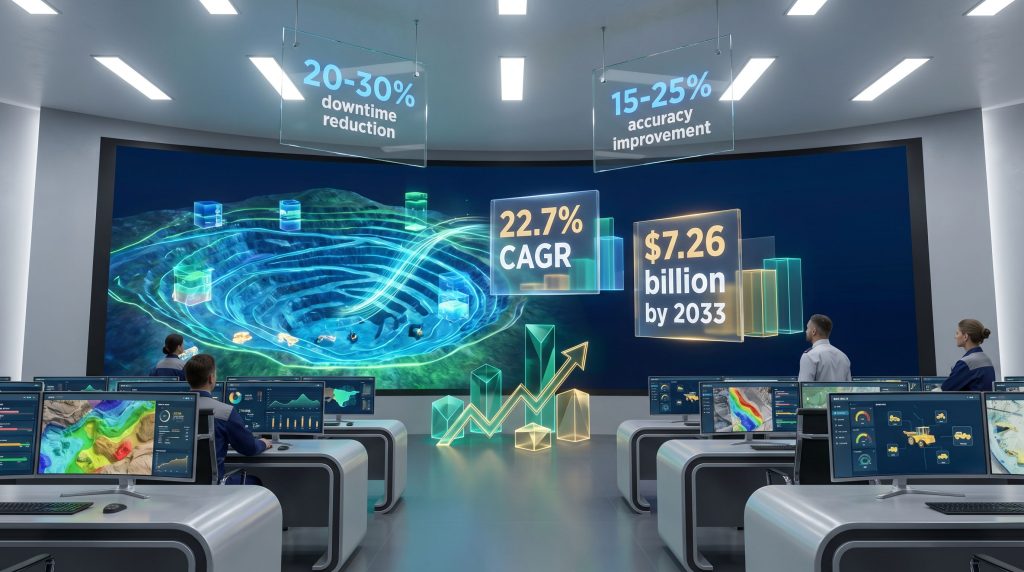
The global mining sector faces an unprecedented transformation as generative AI in mining operations reshapes operational paradigms across every stage of resource extraction. Unlike previous technological advances that simply mechanized existing processes, GenAI introduces cognitive capabilities that fundamentally alter how mining companies approach decision-making, risk assessment, and resource optimization. This shift represents more than automation enhancement; it signals the emergence of intelligent mining ecosystems capable of autonomous learning and adaptive optimization across complex geological and market conditions.
Traditional mining operations have long relied on historical data analysis and rule-based systems to guide extraction decisions. However, the speculative nature of mineral exploration, combined with volatile commodity markets and increasingly stringent environmental regulations, demands more sophisticated analytical capabilities. GenAI addresses these challenges through real-time contextual analysis, enabling mining operators to process vast datasets from geological surveys, market conditions, and operational parameters simultaneously.
The transformation extends beyond operational efficiency improvements to encompass strategic value creation across the entire mining value chain. From initial geological assessment through final product delivery, GenAI systems generate actionable insights that reduce uncertainty, optimize resource allocation, and enhance environmental compliance. This technological evolution positions early adopters to capture significant competitive advantages in an industry where marginal improvements in efficiency translate to substantial financial returns.
Understanding the Strategic Value Framework of AI in Resource Extraction
Mining enterprises operate within complex systems where geological uncertainty, operational variability, and market volatility create cascading effects across project economics. Traditional approaches to managing this complexity rely heavily on compartmentalized decision-making, where individual departments optimize their specific functions without comprehensive system-wide integration. GenAI transforms this paradigm by enabling holistic optimization across interconnected operational domains.
The strategic value framework emerges through GenAI's ability to process multi-dimensional datasets simultaneously. Geological data from seismic surveys, core samples, and satellite imagery combines with real-time operational metrics, equipment performance indicators, and market price fluctuations to create comprehensive decision support systems. This integration enables mining companies to shift from reactive operational management to predictive strategic planning.
Key value creation mechanisms include:
- Risk-adjusted resource modeling that incorporates geological uncertainty into financial projections
- Dynamic operational optimization based on real-time equipment performance and market conditions
- Integrated supply chain coordination linking extraction rates to processing capacity and market demand
- Environmental compliance automation ensuring regulatory adherence across all operational phases
The framework's effectiveness depends on establishing data integration standards that connect previously isolated information systems. Mining operations generate enormous volumes of heterogeneous data, from geological survey results to equipment telemetry, yet traditional systems lack the analytical sophistication to extract actionable insights from these combined datasets. GenAI bridges this gap through advanced pattern recognition and predictive modeling capabilities that identify optimization opportunities invisible to conventional analytical approaches.
Strategic implementation requires careful consideration of organizational readiness factors including data infrastructure maturity, workforce capabilities, and change management processes. Companies achieving the greatest value from GenAI implementation invest significantly in cross-functional integration, breaking down traditional silos between geology, engineering, operations, and finance departments to enable collaborative optimization.
When big ASX news breaks, our subscribers know first
What Makes Generative AI Different from Traditional Mining Technologies?
The fundamental distinction between generative AI and conventional mining technologies lies in their approach to decision-making architecture. Traditional systems operate through predetermined rule sets and historical pattern matching, limiting their effectiveness in novel or complex scenarios. GenAI systems demonstrate contextual awareness and adaptive learning capabilities that enable sophisticated responses to previously unseen conditions.
Architectural Differentiators:
| Traditional Mining Systems | Generative AI Systems |
|---|---|
| Static rule-based programming | Dynamic contextual reasoning |
| Historical data dependence | Predictive scenario modeling |
| Single-variable optimization | Multi-dimensional optimization |
| Reactive maintenance protocols | Proactive intervention strategies |
| Department-specific solutions | Ecosystem-wide coordination |
Cognitive Processing Capabilities represent perhaps the most significant advancement. Traditional mining software excels at processing structured datasets according to predefined algorithms, but struggles with unstructured information integration and complex variable interactions. Furthermore, GenAI systems demonstrate sophisticated natural language processing abilities that enable them to incorporate geological reports, maintenance logs, regulatory documentation, and market analysis into unified decision frameworks.
The learning architecture of GenAI systems enables continuous improvement through operational experience. Unlike traditional software that requires manual updates and rule modifications, GenAI platforms automatically refine their analytical models based on outcome feedback. This adaptive capability proves particularly valuable in mining environments where geological conditions, equipment performance, and market dynamics change continuously.
Real-time synthesis capabilities distinguish GenAI from previous automation technologies. Mining operations generate continuous streams of sensor data, equipment telemetry, and environmental monitoring information. In contrast, traditional systems process this information sequentially through separate analytical pipelines, creating temporal delays and integration gaps. GenAI platforms perform simultaneous multi-source analysis, enabling immediate optimization responses to changing conditions.
Autonomous decision-making represents the most transformative capability difference. Traditional mining systems require human oversight for complex decisions, particularly those involving risk assessment and strategic trade-offs. However, GenAI systems demonstrate sophisticated decision synthesis abilities, weighing multiple competing objectives and constraints to recommend optimal operational strategies. This capability proves essential for managing the increasing complexity of modern mining operations.
Where Does GenAI Create the Highest ROI in Mining Operations?
Resource assessment and geological modeling emerge as primary areas for substantial return on investment through GenAI implementation. The speculative nature of mineral exploration traditionally requires extensive drilling programs and geological surveys to reduce uncertainty around ore body characteristics. GenAI systems process multi-source geological data including seismic surveys, magnetic measurements, satellite imagery, and historical drilling results to create sophisticated probabilistic resource models.
These enhanced modeling capabilities address one of mining's most significant financial challenges: reserve estimation accuracy. Traditional geological modeling relies heavily on interpolation between limited data points, creating substantial uncertainty around ore grade distribution and extraction feasibility. GenAI platforms incorporate machine learning algorithms that identify subtle geological patterns invisible to conventional analysis, improving resource estimation precision and reducing exploration costs.
Predictive maintenance optimization generates significant operational value through equipment performance enhancement. Mining operations depend on complex machinery operating in harsh environments where unexpected failures create cascading production delays and safety risks. Traditional maintenance approaches rely on scheduled intervals or reactive responses to equipment failures, both of which prove suboptimal for cost management and operational continuity.
GenAI systems analyze real-time equipment telemetry including vibration patterns, temperature fluctuations, hydraulic pressure variations, and power consumption metrics to identify early failure indicators. This analytical capability enables condition-based maintenance that addresses potential issues before they impact production. The financial impact proves substantial, as unplanned equipment downtime typically costs mining operations significantly more than scheduled maintenance interventions.
Process optimization across extraction operations represents another high-impact application area. Mining involves complex multi-stage processes where optimization decisions in one area affect performance throughout the operational chain. Traditional approaches optimize individual process stages independently, often creating sub-optimal system-wide performance. In addition, GenAI enables holistic process optimization that considers interactions between drilling, blasting, hauling, crushing, and processing operations.
Key ROI generation areas include:
- Geological uncertainty reduction through enhanced pattern recognition in exploration data
- Equipment reliability improvement via predictive failure analysis and optimized maintenance scheduling
- Processing efficiency enhancement through real-time ore quality assessment and plant parameter optimization
- Energy consumption optimization across all operational phases through intelligent load management
- Supply chain coordination linking production rates to market demand and transportation capacity
Quality control automation creates additional value through real-time ore characterization and automated sorting systems. Traditional approaches rely on periodic sampling and laboratory analysis, creating temporal delays between extraction and quality assessment. GenAI-powered sensor fusion systems provide immediate ore quality analysis, enabling real-time decisions about processing parameters, blending strategies, and product specifications.
How Are Leading Mining Companies Implementing GenAI Strategies?
Phased implementation approaches characterize successful GenAI adoption across major mining operations. Leading companies avoid wholesale system replacement in favor of strategic pilot programs that demonstrate value before expanding to full-scale deployment. This methodology addresses the inherent risks associated with implementing complex AI systems in critical operational environments.
Phase 1: Foundation Development focuses on establishing the data infrastructure and organizational capabilities necessary for AI implementation. This involves upgrading sensor networks, implementing data integration platforms, and developing cross-functional teams with combined mining and AI expertise. Companies investing adequate time in foundation development achieve significantly higher success rates in subsequent implementation phases.
Phase 2: Operational Integration expands AI capabilities into specific operational processes where value generation potential justifies implementation risks. Common starting points include geological modeling enhancement, predictive maintenance systems, and process optimization algorithms. Companies maintain human oversight during this phase while gradually increasing autonomous decision-making authority as systems demonstrate reliability.
Phase 3: Strategic Transformation represents full-scale AI integration across entire operational ecosystems. Advanced implementations include autonomous equipment operation, integrated supply chain optimization, and real-time market response systems. Companies reaching this phase demonstrate competitive advantages through superior operational efficiency and strategic agility.
Implementation Success Factors:
- Executive leadership commitment ensuring adequate resource allocation and organizational support
- Technical expertise development through partnership with AI specialists and internal capability building
- Data quality standardization across all operational systems and information sources
- Change management programs addressing workforce adaptation to AI-augmented operations
- Performance measurement systems tracking AI implementation value creation and optimization opportunities
Partnership strategies prove critical for successful implementation, particularly for mining companies lacking internal AI development capabilities. Leading operators establish strategic relationships with technology providers specializing in mining applications rather than attempting to develop generic AI solutions internally. These partnerships provide access to domain-specific expertise and proven implementation methodologies.
Risk management frameworks guide implementation decisions throughout all phases. Mining operations face significant safety, environmental, and financial risks that require careful consideration when implementing autonomous systems. Successful companies develop comprehensive testing protocols, backup systems, and manual override capabilities to ensure operational continuity during AI system deployment and optimization.
What Are the Critical Success Factors for GenAI Implementation?
Data infrastructure quality emerges as the fundamental determinant of GenAI implementation success. Mining operations generate enormous volumes of heterogeneous data, but much of this information exists in incompatible formats across isolated systems. Successful AI implementation requires establishing unified data architectures that enable seamless information flow between geological databases, equipment monitoring systems, environmental sensors, and market information sources.
Critical infrastructure requirements include:
- High-speed data transmission networks connecting remote mining sites to processing centers
- Cloud-based storage and computing platforms providing scalable analytical capabilities
- Real-time data processing systems enabling immediate response to operational changes
- Data quality assurance protocols ensuring accuracy and consistency across all information sources
- Cybersecurity frameworks protecting operational data from unauthorized access and manipulation
Organizational readiness factors prove equally important for successful implementation. GenAI systems require cross-functional collaboration between traditionally separate departments including geology, engineering, operations, information technology, and finance. Companies achieving implementation success invest significantly in organizational restructuring that breaks down departmental silos and enables integrated decision-making.
Workforce development programs address the skills gap between traditional mining expertise and AI system operation. Successful companies implement comprehensive training initiatives that combine mining domain knowledge with AI system capabilities. These programs focus on developing AI-augmented decision-making skills rather than replacing human expertise with automated systems.
Technical competency requirements include:
- Data interpretation skills for understanding AI system outputs and recommendations
- System monitoring capabilities for identifying performance anomalies and optimization opportunities
- Integration expertise for connecting AI systems with existing operational processes
- Problem-solving abilities for addressing implementation challenges and system optimization
Governance frameworks establish accountability structures and decision-making protocols for AI-augmented operations. Mining operations involve significant safety and environmental risks that require clear responsibility allocation between human operators and automated systems. Effective governance frameworks specify decision authority levels, override procedures, and performance accountability standards.
Change management strategies prove critical for overcoming organizational resistance to AI implementation. Mining workforces often demonstrate skepticism toward automation technologies based on concerns about job displacement and operational reliability. Successful companies address these concerns through transparent communication, participatory implementation processes, and clear demonstration of AI systems as capability enhancers rather than workforce replacements.
Which Mining Processes Show the Greatest AI Transformation Potential?
Geological exploration and resource modeling demonstrate exceptional transformation potential through AI enhancement. Traditional exploration relies on limited sampling data and geological interpretation to estimate ore body characteristics, creating substantial uncertainty around resource quantity, grade distribution, and extraction feasibility. AI systems process comprehensive geological datasets including seismic surveys, magnetic measurements, satellite imagery, and geochemical analysis to create sophisticated probabilistic models of subsurface conditions.
Advanced pattern recognition capabilities enable AI systems to identify subtle geological indicators that traditional analysis methods overlook. These capabilities prove particularly valuable in complex geological environments where ore bodies exhibit irregular distribution patterns or occur within challenging geological formations. For instance, 3D geological modelling enhances target identification accuracy and substantially reduces exploration costs and timeframes.
Safety and risk management systems represent another high-potential transformation area. Mining operations involve inherent safety risks from unstable geological conditions, equipment failures, and hazardous material handling. Traditional safety approaches rely on scheduled inspections, historical risk assessment, and reactive incident response. AI systems enable continuous risk monitoring through real-time sensor analysis and predictive threat identification.
AI-powered safety applications include:
- Geological stability monitoring using continuous seismic and deformation measurements
- Equipment failure prediction through vibration analysis and performance trending
- Environmental hazard detection including gas accumulation and structural instability
- Emergency response optimization through automated evacuation planning and resource allocation
- Personal protective equipment monitoring ensuring worker compliance and system effectiveness
Processing and metallurgical optimization show significant transformation potential through real-time quality control and dynamic parameter adjustment. Traditional processing approaches rely on batch sampling and laboratory analysis to determine ore characteristics and adjust processing parameters. This creates temporal delays between ore quality changes and processing optimization, reducing recovery efficiency and product quality consistency.
AI systems enable continuous ore characterization through sensor technology advancement that combines X-ray fluorescence, near-infrared spectroscopy, and machine vision systems. This real-time quality assessment enables immediate processing optimization including flotation chemistry adjustment, grinding parameter modification, and separation process enhancement.
Environmental compliance and sustainability management demonstrate substantial AI transformation potential. Mining operations face increasingly stringent environmental regulations requiring continuous monitoring of water quality, air emissions, waste management, and ecosystem impact. Traditional compliance approaches involve periodic reporting and reactive corrective actions that often fail to prevent environmental incidents.
Supply chain and logistics optimization represent significant transformation opportunities through integrated planning systems that coordinate extraction rates, processing capacity, transportation scheduling, and market delivery. Traditional approaches optimize these functions independently, creating inefficiencies and missed opportunities for value creation through system-wide coordination.
The next major ASX story will hit our subscribers first
What Challenges Must Mining Companies Overcome for Successful AI Integration?
Data quality and availability constraints represent fundamental challenges for AI implementation in mining operations. Mining data often exhibits high variability, incomplete coverage, and measurement uncertainty that complicates AI model training and validation. Geological data particularly suffers from spatial sampling limitations where drilling and survey data provide only partial coverage of ore body characteristics.
Specific data challenges include:
- Inconsistent measurement protocols across different sites and time periods
- Legacy data integration from systems using incompatible formats and standards
- Real-time data transmission from remote locations with limited connectivity infrastructure
- Data validation difficulties in environments where ground truth verification proves expensive or impractical
- Privacy and security concerns around sharing operational data with AI system providers
Technical integration complexities arise from the need to connect AI systems with legacy mining equipment and established operational processes. Many mining operations rely on equipment and control systems installed over decades, creating compatibility challenges for modern AI platform integration. Retrofitting existing infrastructure often requires substantial capital investment and operational disruption.
Regulatory compliance uncertainties create implementation challenges as regulatory frameworks lag behind AI technology development. Mining operations must comply with safety regulations, environmental standards, and reporting requirements that may not address AI system decision-making authority and accountability. This regulatory uncertainty creates legal risks and compliance complexities for companies implementing autonomous systems.
Workforce adaptation challenges emerge from the need to transition traditional mining expertise to AI-augmented operational models. Mining workforces possess deep domain knowledge and operational experience that prove essential for effective AI implementation, but often lack technical backgrounds necessary for AI system operation and optimization.
Critical workforce challenges include:
- Skills gap between traditional mining expertise and AI system requirements
- Resistance to change based on concerns about job security and operational reliability
- Training program development that effectively combines mining knowledge with AI capabilities
- Performance measurement systems that account for AI-human collaboration effectiveness
Return on investment uncertainty complicates implementation decisions due to long payback periods and measurement difficulties associated with AI system benefits. Mining operations often require multi-year implementation timelines before achieving full AI capability, creating challenges for capital allocation decisions and performance evaluation.
Competitive positioning concerns arise from the need to balance AI capability development with proprietary information protection. Mining companies face pressure to implement AI systems for competitive advantage while protecting geological data, operational knowledge, and strategic information that provides market differentiation.
How Will GenAI Transform Mining Economics Over the Next Decade?
Operational cost structure transformation will fundamentally alter mining economics through autonomous system deployment and predictive optimization capabilities. Traditional mining operations allocate substantial resources to reactive maintenance, manual monitoring, and suboptimal process control. AI systems enable proactive intervention strategies that reduce these cost centers while improving operational reliability and production consistency.
Economic transformation drivers include:
- Labor cost optimization through automated monitoring and control systems
- Energy efficiency improvements via intelligent load management and process optimization
- Equipment utilization enhancement through predictive maintenance and optimal scheduling
- Material waste reduction via real-time quality control and process adjustment
- Capital efficiency gains from improved project planning and resource allocation
Market responsiveness capabilities will enable mining companies to capture price volatility opportunities through flexible production strategies. Traditional mining operations struggle to adjust production rates quickly in response to commodity price fluctuations due to operational constraints and planning limitations. For example, data-driven mining operations enable dynamic production optimization that responds to market conditions while maintaining operational safety and environmental compliance.
Competitive landscape restructuring will favor companies achieving early AI implementation success. First-movers in AI adoption will establish operational advantages that prove difficult for competitors to replicate due to learning curve effects and data accumulation benefits. Furthermore, these advantages include superior geological modeling, enhanced process optimization, and improved market timing capabilities.
Technology partnership ecosystems will become critical success factors as mining companies collaborate with specialized AI providers rather than developing internal capabilities. According to AI mining transformation trends, this will create platform-based competition where mining companies differentiate through AI system integration effectiveness rather than proprietary technology development.
Regulatory framework evolution will establish standardized protocols for AI system deployment, decision accountability, and safety assurance in mining operations. These frameworks will reduce implementation uncertainty and enable industry-wide adoption of proven AI applications while maintaining operational safety and environmental protection standards.
Investment pattern shifts will redirect capital allocation from traditional expansion projects toward technology integration initiatives and data infrastructure development. Mining companies will increasingly evaluate projects based on AI implementation potential and digital transformation readiness rather than solely on geological resources and traditional operational factors.
Sustainability integration will position AI systems as essential tools for achieving environmental compliance and carbon reduction targets. AI-enabled optimization systems will minimize energy consumption, reduce waste generation, and enhance environmental monitoring capabilities, making sustainable mining practices more economically viable.
What Does the Future Hold for AI-Driven Mining Operations?
Autonomous mining ecosystems will emerge as fully integrated systems where AI agents manage complex operational decisions without human intervention. These systems will coordinate extraction planning, equipment deployment, processing optimization, and logistics management through sophisticated decision networks that optimize system-wide performance rather than individual process components.
Advanced AI architectures will incorporate agentic AI capabilities that enable autonomous problem-solving and strategic adaptation to changing operational conditions. These systems will demonstrate creative problem-solving abilities that identify novel optimization opportunities and develop innovative operational strategies beyond human conceptualization.
The development of digital twins will create comprehensive virtual replicas of mining operations that enable risk-free experimentation with operational strategies, equipment configurations, and process modifications. These virtual environments will support scenario planning, optimization testing, and training programs that improve real-world operational performance.
Internet of Things integration will establish ubiquitous monitoring networks that provide comprehensive operational visibility across geological conditions, equipment performance, environmental parameters, and workforce activities. This sensor density will enable unprecedented operational insight and real-time optimization capabilities.
Predictive market integration will connect AI mining systems directly to commodity markets, supply chain networks, and customer demand patterns. This integration will enable proactive production planning that optimizes extraction schedules, processing priorities, and delivery timing based on market forecasting and price prediction models.
Future implementation priorities include:
- Comprehensive data strategy development ensuring high-quality information flows across all operational systems
- Strategic technology partnerships providing access to specialized AI capabilities and domain expertise
- Organizational capability building through workforce development and change management programs
- Robust governance frameworks establishing decision accountability and risk management protocols
- Continuous monitoring systems tracking AI performance and optimization opportunities
Regulatory adaptation will establish industry standards for AI system deployment, safety assurance, and environmental protection in mining operations. These standards will provide implementation guidance and compliance frameworks that enable responsible AI adoption across the mining industry.
Sustainable mining integration will position AI systems as fundamental enablers of environmental stewardship and social responsibility in resource extraction. AI-powered systems will optimize energy usage, minimize environmental impact, and enhance community engagement through transparent operational monitoring and predictive impact assessment.
Conclusion: Maximizing Value Through Strategic AI Implementation
The transformation of mining operations through generative AI in mining operations represents a fundamental shift from reactive operational management to predictive strategic optimization. Successful implementation requires comprehensive understanding of value creation mechanisms, technical requirements, and organizational readiness factors that enable effective AI integration across complex mining systems.
Strategic success factors emphasize the importance of phased implementation approaches that build foundational capabilities before expanding to full-scale autonomous operations. Companies achieving the greatest value from AI implementation invest significantly in data infrastructure, workforce development, and cross-functional collaboration that enables system-wide optimization rather than departmental efficiency gains.
The competitive advantages generated through effective AI implementation extend beyond operational cost reduction to encompass enhanced decision-making capabilities, improved risk management, and superior market responsiveness. These advantages prove sustainable due to learning curve effects and data accumulation benefits that compound over time, creating difficult-to-replicate competitive positions.
The evolution of mining industry innovation continues to accelerate as AI technologies mature and integration methodologies improve. Companies investing in AI transformation frameworks position themselves to capture significant value creation opportunities while maintaining operational safety and environmental responsibility.
Future success in AI-driven mining operations will depend on strategic vision, technical execution, and organizational adaptation capabilities that enable companies to capture the full value potential of these transformative technologies. The mining industry stands at the threshold of a technological revolution that will reshape operational practices, competitive dynamics, and economic structures across the global resource sector.
Disclaimer: This analysis contains forward-looking statements about AI technology adoption and mining industry trends. Actual results may differ materially from projections due to technological, regulatory, and market factors. Readers should conduct independent research and consult qualified professionals before making investment or operational decisions based on this information.
Ready to Capitalise on AI-Driven Mining Innovations?
Discover how Discovery Alert's proprietary Discovery IQ model transforms complex mining industry insights into immediate investment opportunities across the Australian market. As AI revolutionises mining operations and creates new value propositions for forward-thinking companies, our real-time alert system ensures you never miss significant mineral discoveries that could benefit from these technological advances. Begin your 14-day free trial today to position yourself ahead of the market in this rapidly evolving sector.