
July 14, 2026
When Scale Becomes Survival: The Logic Behind Australia's Biggest Gold Merger
The global gold mining industry has always rewarded those willing to think beyond individual deposits. Historically, the most enduring producers have not been those sitting on the richest single orebody, but those capable of assembling portfolios of assets large enough to absorb capital cycles, sustain processing throughput, and attract the kind of institutional investment that provides long-term financial resilience. That structural truth is now reshaping the ASX gold sector with particular intensity, as sustained high gold prices transform the economics of consolidation from aspirational to urgent.
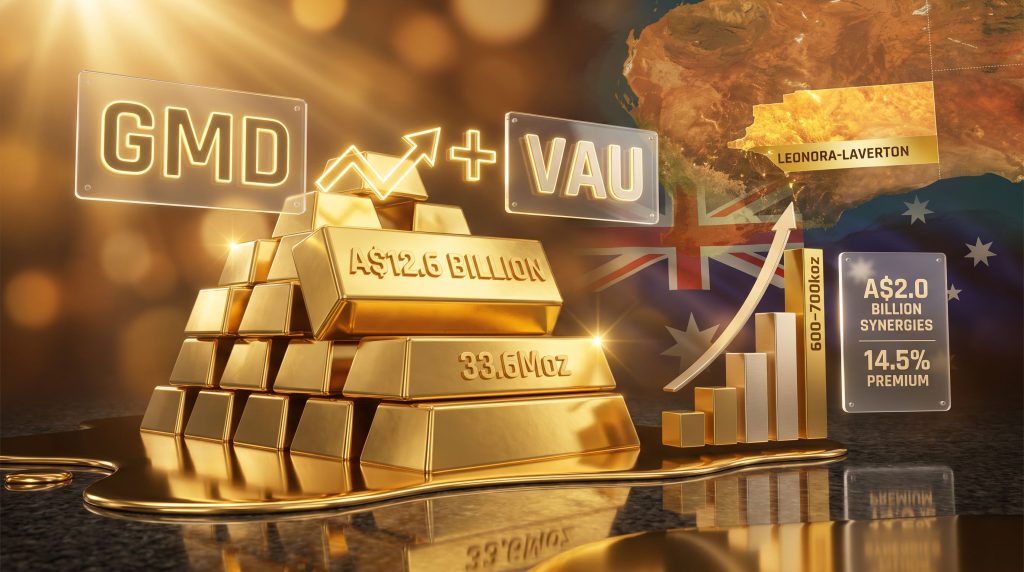
The Genesis Minerals and Vault Minerals merger represents the most significant expression of this trend in Australia in recent years. At A$12.6 billion in combined market capitalisation and targeting 600,000 to 700,000 ounces of annual gold production from five wholly Western Australian mines, the proposed combination would vault the merged entity into the top three gold producers on the ASX by output, fundamentally altering the competitive hierarchy of Australian gold.
When big ASX news breaks, our subscribers know first
The Macro Forces Driving ASX Gold Consolidation
Understanding why this deal is happening now requires stepping back from the transaction itself and examining the broader structural pressures reshaping mid-tier gold mining globally. The current gold price outlook has remained persistently elevated through 2025 and into 2026, providing a powerful amplifier for M&A economics.
When gold trades at high levels, the dollar value of cost synergies grows proportionally, making adjacent asset combinations far more financially compelling than they would be at subdued price levels. For producers operating in the same geological district, the case for combining becomes almost self-evident.
Institutional capital markets have also been quietly demanding scale from ASX-listed gold producers. Larger, more liquid equities attract index inclusion, fund flow, and analyst coverage in ways that smaller independent companies simply cannot match. Consequently, for mid-tier producers, the pressure to grow or be acquired has become a defining feature of the current market environment.
Western Australia's Goldfields region, and the Leonora-Laverton district in particular, has emerged as one of the world's most active zones for gold sector M&A. The concentration of overlapping mineralised systems and shared infrastructure corridors in this area makes regional consolidation not just financially logical but operationally necessary for producers seeking to maximise throughput efficiency across multiple processing facilities. Furthermore, Australian gold M&A activity in this district continues to intensify as high prices sustain competitive deal-making dynamics.
Transaction Structure: What Vault Shareholders Actually Receive
The Genesis Minerals and Vault Minerals merger is structured as a scheme of arrangement, the mechanism most commonly used for large Australian corporate combinations requiring court and shareholder approval.
Deal Terms at a Glance
| Component | Details |
|---|---|
| Transaction Type | Scheme of Arrangement |
| Offer per Vault Share | 0.7629 Genesis shares + A$0.475 cash |
| Implied Value per Vault Share | A$5.274 |
| Combined Market Capitalisation | A$12.6 billion |
| Genesis Shareholder Ownership | ~59.8% |
| Vault Shareholder Ownership | ~40.2% |
| Net Cash Position (Pro-Forma) | A$611 million |
| Post-Merger Liquidity | A$1.3 billion |
| Expected Implementation | November 2026 |
The cash-and-scrip structure deserves particular attention from investors evaluating the deal's fairness. The A$0.475 cash component per share delivers immediate, certain liquidity to Vault shareholders, reducing their exposure to execution risk during the integration period. The scrip component, representing 0.7629 new Genesis shares, then provides ongoing participation in the combined entity's growth pipeline, including the A$2.0 billion synergy programme.
Genesis secured revolving credit facilities to fund the approximately A$500 million cash component of the transaction without imposing financing conditions on the deal, a significant structural advantage that removes a common source of deal uncertainty for target shareholders.
How the Genesis Offer Displaced the Regis Resources Proposal
The Genesis Minerals and Vault Minerals merger did not emerge in a vacuum. It was the outcome of a contested takeover process that illustrates how elevated gold prices are intensifying competitive dynamics across the ASX resources sector.
The Contested Timeline
- May 2026: Vault Minerals and Regis Resources execute an initial all-scrip merger agreement
- July 2026: Genesis Minerals lodges a binding counter-proposal valued at approximately A$5.6 billion
- July 10, 2026: Regis Resources' five-day matching right window expires without a matching offer
- Post-July 10: Vault's board formally designates the Genesis offer as a Superior Proposal under Australian takeover law
- November 2026 (target): Full scheme implementation pending all required approvals
Genesis vs. Regis: A Structural Comparison
| Feature | Genesis Minerals Proposal | Regis Resources Proposal |
|---|---|---|
| Offer Type | Cash + Scrip | All-Scrip |
| Implied Premium | 14.5% above Regis offer | Baseline |
| Cash Component | A$0.475 per share | None |
| Combined Market Cap | A$12.6 billion | Smaller combined entity |
| Board Recommendation | Unanimously supported | Initially supported |
| Vault Board Assessment | Superior Proposal | Superseded |
The 14.5% premium over the prior Regis proposal is a meaningful figure, but the structural advantage of the Genesis offer runs deeper than headline premium alone. An all-scrip merger like the Regis proposal forces target shareholders to accept 100% of their consideration in a form whose value fluctuates with market conditions up until implementation. By contrast, the Genesis cash-and-scrip structure crystallises a defined portion of value immediately, a distinction that typically carries significant weight with institutional shareholders evaluating competing proposals.
The Vault board's formal designation of the Genesis offer as a Superior Proposal is a procedurally significant milestone under Australian takeover law, triggering the matching rights mechanism and placing Regis in the position of either escalating its offer or stepping aside.
Upon withdrawing from the Vault bid, Regis Resources secured an A$50.7 million break fee, capital it has indicated will be redirected toward organic growth. The competitive dynamics of the Genesis-Regis contest for Vault offer a window into how vigorously M&A competition is playing out across the ASX gold sector while gold prices remain elevated.
The Combined Resource and Production Profile
For investors, the most critical question is what the merged entity actually looks like on a consolidated operational basis.
Combined Metrics at Implementation
| Metric | Combined Figure |
|---|---|
| Mineral Resources | 33.6 million ounces |
| Ore Reserves | 9.4 million ounces |
| Annual Gold Production Target | 600,000 to 700,000 ounces |
| Number of Operating Mines | Five (all in Western Australia) |
| Pro-Forma Market Cap | A$12.6 billion |
| Pro-Forma Net Cash | A$611 million |
| Total Liquidity | A$1.3 billion |
A production profile of 600,000 to 700,000 ounces annually positions the merged group as Australia's third-largest gold producer by output. To contextualise that scale, it places the combined entity in a peer group previously occupied by international mid-tier producers competing for global capital allocation, not just ASX-focused investor pools.
What is particularly notable from a risk perspective is that all five mines sit within Western Australia, a jurisdiction consistently ranked among the world's most stable and mining-friendly by industry bodies tracking sovereign risk. Concentrated exposure to a single, low-risk jurisdiction eliminates the geopolitical and logistics complexity that burdens many international gold producers of comparable scale.
The Leonora-Laverton Corridor: More Than Geographic Proximity
The strategic value of combining Genesis and Vault assets extends well beyond simply adding ounces. The geographic concentration of both companies' core assets within the Leonora-Laverton district creates an integrated operational corridor that forms the primary foundation for synergy capture.
In gold mining, the relationship between mine sites and processing infrastructure is fundamental to cost structure. Processing gold ore requires milling capacity, and milling facilities represent some of the most capital-intensive assets in the industry. When two companies operate adjacent mines with separate but proximate milling circuits, the potential to optimise feed allocation across those circuits, reduce duplicated overhead, and eliminate capital expenditure on redundant infrastructure can generate savings that simply are not available to producers operating in isolation.
Vault's King of the Hills mine and Genesis's Ulysses operation serve as anchor assets within this combined corridor. Furthermore, the Gruyere production forecast provides useful context for understanding how Western Australian processing assets underpin regional output targets. The ability to strategically allocate ore between processing facilities based on grade, mineralogy, and throughput efficiency represents a meaningful operational lever that the merged entity will gain access to upon integration.
Unpacking the A$2.0 Billion Synergy Estimate
The A$2.0 billion post-tax synergy and capital savings figure projected over a 10-year horizon is the headline number that will attract most investor attention. However, the more analytically significant figure is the A$1.5 billion attributed to synergies unique to this specific combination.
In mining M&A, synergy estimates are frequently grouped into categories that obscure which savings are genuinely deal-specific and which could theoretically be achieved through alternative combinations or standalone initiatives. The A$1.5 billion figure represents the strategic premium Genesis places on this particular pairing of assets, including savings that would not be replicable if either company had instead combined with a different partner.
The primary synergy drivers identified by management include:
- Optimisation of milling and processing capacity across co-located regional assets
- Elimination of duplicated capital expenditure on processing infrastructure
- Mining fleet and logistics consolidation across the Leonora-Laverton corridor
- Reduction of corporate overhead and duplicated administrative functions
- Shared exploration and development infrastructure across the combined tenement package
Investment Consideration: Synergy estimates in mining M&A transactions are frequently subject to revision once integration begins. Investors should treat the A$2.0 billion figure as a directional target rather than a guaranteed outcome, with the A$1.5 billion deal-specific component representing the key differentiating factor in the strategic rationale for this particular combination.
Management has committed to providing a consolidated production and growth outlook in the second half of 2027, which will serve as the first substantive checkpoint for assessing synergy realisation progress.
The next major ASX story will hit our subscribers first
Genesis Minerals' Financial Position Entering the Merger
One dimension of the Genesis Minerals and Vault Minerals merger that deserves closer examination is the financial strength Genesis brings to the transaction. The company's shares appreciated approximately 43% over the 12 months preceding the merger announcement, compared to approximately 3% for the S&P/ASX 200 Index over the same period.
That differential of roughly 40 percentage points is not merely a share price statistic; it reflects Genesis's demonstrated operational execution and the market's confidence in its management team. In addition, understanding the relationship between gold price and mining equities helps explain why Genesis has been so well-positioned to make this move.
Strong Genesis share price performance carries a direct structural benefit for Vault shareholders accepting the scrip component of the offer. The higher the acquirer's share price, the greater the implied value of the scrip consideration. It also means Genesis enters the merger with currency that enhances the attractiveness of its offer relative to what an all-scrip acquirer with weaker price momentum could deliver.
The pro-forma A$611 million net cash position and total liquidity of A$1.3 billion provide the merged entity with substantial financial capacity to fund integration costs, pursue exploration, and accelerate development of high-potential assets across the combined portfolio without immediately returning to equity markets.
Regulatory and Shareholder Approval Pathway
Key Milestones Before Implementation
- Regis Resources matching right period expires (July 10, 2026)
- Binding merger agreement formalised between Genesis and Vault
- Court approval of the scheme of arrangement sought from the Federal Court
- Regulatory clearances obtained from relevant Australian authorities
- Shareholder votes conducted at both Genesis and Vault scheme meetings
- Final court orders issued and ASX implementation confirmed
- Target completion date of November 2026
Under Australian law, a scheme of arrangement requires approval from a majority of shareholders by headcount and at least 75% by value at the scheme meeting, alongside Federal Court approval. This dual threshold places shareholder engagement at the centre of execution risk between now and November 2026.
The requirement for both headcount and value thresholds means that even if a small number of large institutional holders vote in favour, concentrated opposition from a larger group of smaller shareholders could theoretically defeat the scheme. In practice, schemes supported unanimously by both boards and offering a material premium above a prior proposal tend to achieve strong approval rates, but the pathway remains subject to customary regulatory and market risks.
What the Merger Signals for Remaining ASX Gold Producers
The 2025 gold market outlook makes clear that the Genesis Minerals and Vault Minerals merger does not exist in isolation. Its completion would meaningfully reduce the number of independently viable mid-tier gold producers on the ASX and raise the competitive bar for those that remain.
Several structural implications flow from a transaction of this scale:
- Index inclusion dynamics shift: A combined A$12.6 billion market cap entity attracts greater weighting in ASX indices, drawing passive fund flows and increasing institutional coverage
- Standalone producers face increased pressure: Remaining mid-tier Western Australian gold producers will face growing pressure from investors and boards to demonstrate compelling standalone value creation or pursue their own consolidation strategies
- Elevated gold prices sustain competitive bidding: As demonstrated by the Genesis-Regis contest for Vault, high gold prices will likely continue to incentivise competitive M&A processes, potentially compressing the window for target companies to attract superior proposals
- Processing infrastructure becomes a strategic moat: The synergy thesis underpinning this merger highlights the growing importance of co-located processing capacity as a source of competitive advantage that cannot easily be replicated by greenfield development
The Leonora-Laverton district, in particular, will look materially different once the merged entity begins consolidating operations. What was previously a landscape of complementary but independently managed assets becomes a single, coordinated operational system, raising the effective barriers to entry for any new participant seeking to establish meaningful scale in the same corridor.
Frequently Asked Questions: Genesis Minerals and Vault Minerals Merger
What is the Genesis Minerals and Vault Minerals merger?
Genesis Minerals (ASX: GMD) and Vault Minerals (ASX: VAU) have agreed to combine via a scheme of arrangement, creating one of Australia's top three gold producers by output. The combined entity would hold a pro-forma market capitalisation of A$12.6 billion, combined mineral resources of 33.6 million ounces, and target annual production of 600,000 to 700,000 ounces from five Western Australian mines.
How much will Vault shareholders receive per share?
Each Vault shareholder will receive 0.7629 new Genesis shares plus A$0.475 in cash for every Vault share held, implying total consideration of approximately A$5.274 per Vault share.
Why did Vault's board prefer Genesis over Regis Resources?
The Genesis proposal delivered a 14.5% premium over the existing all-scrip Regis Resources merger agreement, included a cash component providing immediate liquidity, and was unanimously assessed by the Vault board as a Superior Proposal under Australian takeover law. The cash-and-scrip structure was a key differentiator from the all-scrip Regis offer.
What synergies are expected from the merger?
The combined group has identified approximately A$2.0 billion in post-tax synergies and capital savings over 10 years, with A$1.5 billion attributed to efficiencies uniquely available through this specific asset combination. The primary drivers are optimisation of shared processing infrastructure within the Leonora-Laverton region.
When is the merger expected to be completed?
Subject to court, regulatory, and shareholder approvals, the merger is targeted for implementation by November 2026.
What happens to Regis Resources after withdrawing?
Regis Resources secured an A$50.7 million break fee upon withdrawing from its competing proposal and has indicated it will focus on organic growth as its primary strategic priority.
Where will the merged company's operations be located?
All five mines in the combined portfolio are located in Western Australia, with a dominant operational concentration in the Leonora-Laverton gold district.
This article contains general information only and does not constitute financial advice. Investments in ASX-listed securities involve risk, including the potential loss of capital. Past performance is not indicative of future returns. Readers should consider seeking independent financial advice before making investment decisions. Synergy estimates, production targets, and transaction timelines referenced in this article are forward-looking statements subject to material risks, uncertainties, and assumptions that may cause actual outcomes to differ materially from those projected.
Want to Identify the Next Major ASX Gold Discovery Before the Market Moves?
The Genesis-Vault merger demonstrates how transformative scale and timing can be in the gold sector — but the greatest returns often come from catching significant discoveries at the earliest stage. Discovery Alert's proprietary Discovery IQ model instantly scans ASX announcements across 30-plus commodities, delivering real-time alerts on high-potential mineral discoveries so subscribers can act ahead of the broader market — explore historic discovery returns on Discovery Alert's dedicated discoveries page and begin a 14-day free trial to position yourself at the forefront of the next major find.