
July 14, 2026
The Cultural Engine Behind Gold: Why Billions of People Buy Yellow Metal Before They Check the Price
Most financial frameworks treat gold demand as a reaction function. Something breaks in the monetary system, investors panic, and gold goes up. This narrative dominates Western financial media and creates a persistent blind spot: it ignores the far larger, far more durable force that has underpinned gold prices across centuries of economic history. Understanding the gold love trade is essential to grasping why gold behaves so differently from every other asset class.
That force is not driven by fear of central banks or inflation expectations. It is driven by weddings, harvests, goddesses, and the accumulated memory of empires that tried to replace physical metal with paper promises and failed every single time.
For investors, commodity analysts, and anyone tracking long-term price dynamics, the gold love trade represents the foundational demand architecture that makes gold structurally unique. Furthermore, it is a force that no short-term macro model can adequately capture.
When big ASX news breaks, our subscribers know first
Two Demand Forces, One Market: How Gold Pricing Actually Works
The Fear Trade: Loud, Visible, and Temporary
Western financial commentary gives disproportionate attention to what market strategist Frank Holmes of U.S. Global Investors has termed the Fear Trade. This encompasses gold buying driven by monetary instability, negative real interest rates, government deficit expansion, currency debasement risk, and geopolitical crisis. Fear Trade demand is real, often dramatic, and commands headlines.
The problem is that it is fundamentally episodic. It surges during moments of systemic anxiety and retreats when conditions stabilise. An investor who only monitors Fear Trade signals misses roughly two-thirds of the structural demand picture entirely.
The Love Trade: Quiet, Consistent, and Civilizational in Scale
The gold love trade, by contrast, requires no trigger event. It operates on the rhythm of harvests, lunar calendars, wedding seasons, and religious observance. It is embedded in legal traditions, family obligations, and spiritual belief systems that predate modern financial markets by thousands of years.
| Demand Type | Primary Driver | Key Regions | Trigger Events |
|---|---|---|---|
| Love Trade | Cultural affinity, rising prosperity, tradition | India, China, Middle East, Turkey | Weddings, Diwali, Lunar New Year, Ramadan |
| Fear Trade | Monetary instability, negative real rates, deficit spending | Western markets, global institutions | Recessions, currency crises, inflation spikes |
Estimates consistently place the gold love trade at 60 to 70 percent of total global gold demand across a full economic cycle. That ratio fundamentally repositions gold from a crisis hedge to something far more consequential: a permanent consumption category woven into the social fabric of the world's two most populous nations.
The Chindia Effect: Understanding India and China's Structural Gold Appetite
Together, India and China represent approximately 35 percent of global population. Their combined physical gold consumption is not correlated to Western sentiment cycles, Federal Reserve policy, or Bitcoin's quarterly volatility. It is correlated to the arrival of monsoon seasons, the scheduling of auspicious wedding dates, and centuries-old convictions about what constitutes real, transferable, enduring wealth.
India's Record-Breaking Import Numbers
India's gold import data for FY 2025-26 tells a story that no financial model built entirely on Western assumptions could easily generate:
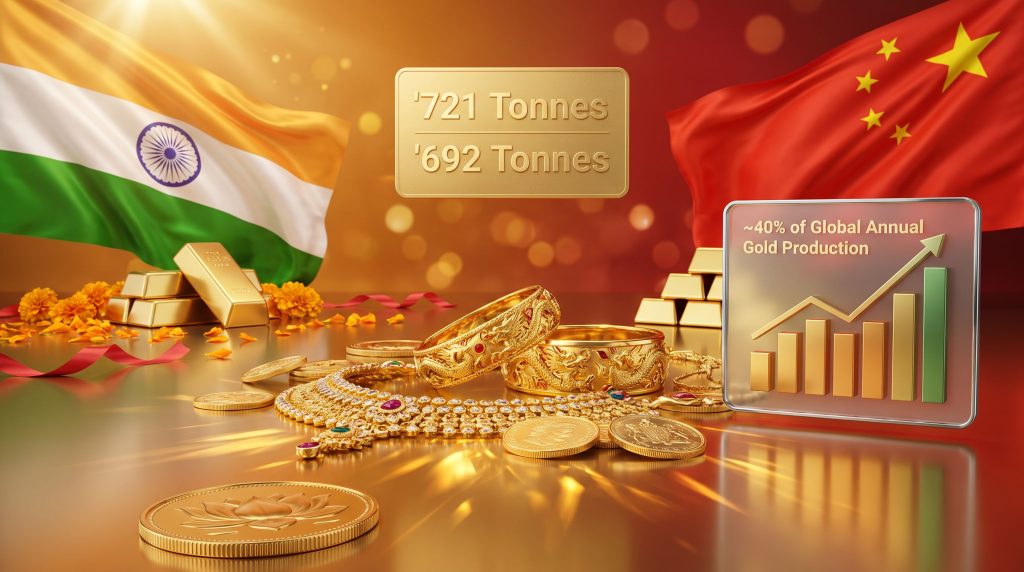
- India imported 721 tonnes of gold in FY 2025-26, the highest value on record at $71.98 billion
- This represented a 24 percent increase in value year-over-year, even as physical volumes declined marginally
- The divergence between volume and value is significant: households chose to spend more total money on gold despite higher per-unit prices, demonstrating demand inelasticity that is rarely seen in conventional investment categories
This behaviour pattern is not a response to gold's price performance. It is a response to the approach of Akshaya Tritiya, Dhanteras, and the winter wedding season. Price is largely a secondary consideration when the cultural imperative to purchase is strong enough. To understand how these figures fit into broader trends, the gold market outlook for 2025 provides important context.
China's Accelerating Physical Accumulation
China's import trajectory has been even more striking in recent data:
- In the first five months of 2026, China imported 692 tonnes, a 76 percent increase over the same period in 2025
- May 2026 alone accounted for 163 tonnes, the highest single-month figure in over two years
- Combined with India, the two nations consumed approximately 40 percent of total global annual gold production in the prior year
These figures are not the product of speculative frenzies or momentum-driven buying. They reflect demand patterns that have been structurally embedded across multiple generations and are therefore far more resistant to short-term price signals than Western institutional flows.
Furthermore, China's gold market dominance has been reinforced by deliberate policy choices that actively encourage physical ownership over synthetic alternatives.
Historical Gold Import Milestones: A Statistical Summary
| Year / Period | Country | Volume | Value / Notes |
|---|---|---|---|
| FY 2025-26 | India | 721 tonnes | Record $71.98 billion; +24% YoY value |
| Jan-May 2026 | China | 692 tonnes | +76% vs. same period 2025 |
| May 2026 | China | 163 tonnes | Highest single month in 2+ years |
| Prior year combined | India + China | ~40% of global output | Structural consumption benchmark |
The Cultural Architecture of Indian Gold Demand
Lakshmi, Purity, and the Metaphysics of Incorruptibility
Gold's deep integration into Indian life is inseparable from its association with Lakshmi, the Hindu goddess of wealth, prosperity, and abundance. The metal's physical property of resisting tarnish and corrosion is not merely a metallurgical fact in Indian cultural interpretation. It is a direct symbolic mirror of the qualities associated with the divine: permanence, purity, and enduring value. This connection transforms gold from a financial instrument into a spiritually meaningful object, a distinction that no digital asset has yet come close to replicating.
Streedhan: Gold as a Legally and Spiritually Protected Feminine Asset
One of the most important and least understood dimensions of Indian gold demand is the institution of Streedhan, literally translated as a woman's wealth. Under this tradition, gold gifted to a bride at the time of her marriage becomes her exclusive, legally recognised personal property. It does not belong to her husband. It cannot be claimed by his family. It functions as a portable financial reserve entirely independent of marital circumstances or economic conditions affecting the broader household.
This institutional role does several things simultaneously:
- It transforms gold into a form of personal financial sovereignty for women in contexts where other wealth transfer mechanisms may be less accessible
- It creates persistent, non-discretionary purchasing demand tied to the marriage market rather than the investment market
- It generates a category of gold ownership that is emotionally and legally resistant to liquidation, contributing to the enormous private gold stock estimated at 25,000 to 35,000 tonnes held in Indian households, temples, and private vaults
The Auspicious Calendar and Its Market Consequences
India's gold buying cycle is synchronised to religious and astrological calendars rather than financial news cycles:
- Akshaya Tritiya (spring) and Dhanteras (pre-Diwali, October-November) are the two dominant gold purchasing events
- Buying gold on these dates is considered to attract prosperity throughout the coming year
- Importers and wholesalers build inventory weeks in advance of these dates, creating measurable pre-positioning effects in import data that sophisticated commodity analysts track as forward-looking demand indicators
Why India's Gold Monetisation Scheme Has Been Unable to Redirect Household Holdings
India's government has made repeated attempts to mobilise the extraordinary private gold stock sitting in household storage. The Gold Monetisation Scheme, designed to incentivise families to deposit gold with banks in exchange for interest income, has gathered approximately 39 tonnes over more than a decade of operation.
Against an estimated household stock of 25,000 to 35,000 tonnes, this represents a conversion rate that rounds to near zero. The explanation offered by financial engineers, that the interest rate is too low or the process too cumbersome, misses the more fundamental reality: Indian families do not perceive their gold as idle financial capital available for institutional intermediation. They perceive it as family security, ancestral inheritance, and in many cases sacred property. The scheme's persistent failure confirms that top-down financial incentives cannot easily displace cultural conviction at scale.
China's Monetary Memory and Its Role in Modern Gold Accumulation
A History That Makes Paper Money Suspect
China's relationship with gold cannot be understood without reference to its long experience with monetary experimentation. The Song Dynasty introduced Jiaozi in the 11th century, one of the world's earliest government-issued paper currencies. The system initially functioned effectively but collapsed as successive administrations increased issuance beyond what the physical economy could support. Later Chinese dynasties repeated variations of this experiment with consistent results: the paper money eventually failed, and physical metal reasserted its primacy. By the mid-1400s, silver and physical metal had largely reclaimed their role as primary stores of value in Chinese commerce.
This accumulated institutional memory of monetary failure is not merely a historical footnote. It informs present-day household behaviour and shapes how gold in the monetary system is viewed at both the household and state level in China.
Beijing's Regulatory Stance: Encouraging Physical Ownership While Suppressing Synthetic Exposure
Chinese regulatory authorities have moved deliberately to reduce leveraged, paper-based gold trading through domestic banking channels. The policy logic operates on two levels simultaneously:
- Systemic stability: Synthetic gold products create volatility and systemic risk that physical ownership does not. Restricting leverage in gold markets reduces the transmission channels for financial contagion.
- Pricing sovereignty: Western gold markets have historically exercised significant influence over global gold pricing through derivatives, futures contracts, and leveraged positions. By encouraging physical accumulation and discouraging synthetic exposure, Chinese authorities are effectively working to reduce the degree to which Western paper markets can dictate the price of a commodity that Chinese consumers and the Chinese state hold in vast quantities.
This is a strategically sophisticated position that is frequently underappreciated in Western financial analysis. China's 15-year trajectory of physical gold accumulation, both at the household level and through official channels, appears consistent with a long-term objective of building genuine physical reserves while simultaneously reducing dependence on Western-controlled pricing mechanisms.
Seasonal Patterns and What They Signal for Gold Prices
The Annual Demand Cycle
| Period | Event | Primary Market | Demand Impact |
|---|---|---|---|
| January-February | Lunar New Year | China | High: jewellery and gold gifts |
| March-April | Akshaya Tritiya | India | High: auspicious buying season |
| October-November | Diwali and Indian Wedding Season | India | Peak: highest annual demand window |
| December | Year-End Gifting | Global | Moderate: secondary demand lift |
The Late July Signal That Sophisticated Investors Watch
One of the more practically useful insights from gold love trade analysis is the restocking cycle that precedes the October-November Indian demand peak. Wholesale buyers, retailers, and importers begin building inventory in late July and August in anticipation of Diwali and the wedding season. This pre-positioning phase creates measurable upward pressure on physical gold premiums in Mumbai and on import volumes that show up in Indian customs data.
Investors who monitor these leading indicators, specifically monthly Indian import data, Shanghai Gold Exchange physical delivery volumes, and the divergence between paper gold prices and physical premiums in key Asian markets, gain a data-driven view of demand momentum that purely futures-focused analysis cannot provide. For those tracking live gold price movements, this physical demand context is invaluable for interpreting short-term price signals.
When Love Trade and Fear Trade Converge: The Amplification Effect
The most significant gold price events in modern history have tended to occur when both demand forces operate simultaneously. The 2011 period offers an instructive case study: Fear Trade anxiety generated by the Eurozone sovereign debt crisis overlapped with Ramadan-driven Love Trade demand across Middle Eastern markets. The convergence of emotionally distinct but directionally aligned buying forces contributed to gold reaching historic highs during that period.
Identifying conditions where both forces are likely to activate simultaneously is arguably one of the highest-value analytical exercises available to gold market participants. In addition, gold safe-haven demand has also been reinforced by ongoing geopolitical uncertainty, further amplifying these convergence events.
The next major ASX story will hit our subscribers first
Why Bitcoin Cannot Fulfil the Gold Love Trade's Function
The Comparison That Keeps Getting Made and Why It Keeps Failing
Western financial media periodically cycles through arguments that Bitcoin or other digital assets will eventually displace gold's monetary and store-of-value functions. These arguments consistently underweight the structural reality of gold love trade demand.
A direct comparison reveals the depth of the gap:
| Criterion | Physical Gold | Bitcoin |
|---|---|---|
| Wearable at ceremonies | Yes | No |
| Transferable as Streedhan | Yes | No |
| 5,000+ year track record | Yes | No |
| Functions without internet or electricity | Yes | No |
| Culturally embedded in rituals | Yes | No |
| Tax treatment in India | Established framework | 30% gains tax |
| Volatility profile | Moderate, long-term stable | High, cyclically extreme |
The Scale Problem Is Not Marginal
Estimated Indian household gold holdings of 25,000 to 35,000 tonnes represent a stock worth multiple trillions of dollars at current prices. The total Bitcoin held across India and China combined represents a small fraction of this figure by any credible measure. The comparison is not between two competing asset classes of similar scale. It is between a deeply institutionalised form of wealth storage that has survived thousands of years and a volatile digital instrument that has yet to complete a single full economic cycle without triggering significant regulatory or market structure challenges.
Bitcoin's proponents frequently underestimate the degree to which gold's dominance in these markets is not a function of ignorance or conservatism. It is a function of gold having already passed the test that these societies apply to any form of wealth storage: does it work across generations, does it survive monetary regime changes, and does it carry social meaning that extends beyond its financial function? Gold has passed all three tests repeatedly. Bitcoin is still being evaluated on the first.
How Investors Can Apply Love Trade Analysis Practically
Key Data Points to Monitor
Investors seeking to integrate gold love trade dynamics into their analytical framework should focus on the following leading indicators:
- Monthly gold import volumes published by India's Ministry of Commerce
- China's customs service data on precious metal imports, released monthly
- Shanghai Gold Exchange physical delivery volumes, which reflect actual physical demand rather than paper positioning
- Physical gold premiums in Mumbai and Shanghai relative to London spot prices, a measure of physical scarcity and demand intensity
- Seasonal divergence between futures open interest and reported import volumes, which can indicate whether paper positioning is running ahead of or behind physical fundamentals
Those interested in gold trading strategies should consider how Love Trade seasonal patterns can serve as practical timing signals alongside conventional technical and macro analysis.
The Structural Price Floor Argument
Unlike Fear Trade demand, which can reverse sharply when crisis conditions ease, Love Trade demand provides a persistent consumption baseline across market cycles. This baseline creates a structural floor beneath gold prices that limits downside risk in ways that macro models focused exclusively on real interest rates and dollar strength tend to underestimate.
Consequently, central bank gold demand has reinforced this structural floor further, adding an institutional layer of buying that operates in parallel with culturally motivated household consumption.
The critical investor insight is this: culturally anchored demand that has persisted across multiple millennia and multiple monetary systems is not going to be redirected by a marginal change in interest rates or a new digital asset narrative. It will still be there when the current hype cycle has moved on.
The investor who understands that 35 percent of the world's population has a non-discretionary, culturally mandated relationship with physical gold is working from a fundamentally more complete picture of the gold market than one who focuses exclusively on ETF flows and Fed policy signals.
Frequently Asked Questions: Gold Love Trade
What Is the Gold Love Trade in Simple Terms?
The gold love trade describes the consistent, culturally motivated demand for physical gold in countries like India and China, where gold is purchased for weddings, religious festivals, and family wealth traditions rather than purely as a financial investment.
Who Coined the Term Love Trade?
The term was developed by Frank Holmes of U.S. Global Investors to distinguish emotionally and culturally motivated gold buying from fear-driven or macroeconomic investment demand.
When Is the Love Trade Most Active?
Demand peaks during India's Diwali and wedding season in October and November, China's Lunar New Year in January and February, and Akshaya Tritiya in India during March and April. The wholesale restocking cycle that precedes the Indian peak typically begins in late July.
How Much Gold Do India and China Buy Each Year?
Together, India and China account for approximately 40 percent of total global annual gold production in physical consumption terms. India imported 721 tonnes in FY 2025-26. China imported 692 tonnes in just the first five months of 2026.
Does the Love Trade Affect Gold Prices?
Yes. Retailer pre-positioning ahead of major festivals creates measurable upward pressure in the months leading into peak demand windows. When Love Trade demand coincides with Fear Trade conditions, price appreciation tends to be amplified significantly.
Can Bitcoin Replace Gold in the Love Trade?
No credible mechanism exists for Bitcoin to fulfil the cultural, ceremonial, and legal functions that gold serves in Indian and Chinese society. Bitcoin cannot be worn, gifted as Streedhan, or exchanged in the context of millennium-old traditions. It also faces a 30 percent capital gains tax in India, adding a structural financial disadvantage on top of the cultural one.
Core Takeaways: What the Love Trade Tells Us About Gold's Long-Term Trajectory
The gold love trade is not a niche observation. It is the dominant structural force in physical gold markets, accounting for the majority of demand in the world's two most populous nations and persisting across every economic cycle, monetary regime, and technological disruption of the past several thousand years.
Key structural arguments that investors and analysts should internalise:
- Cultural demand is not cyclical. Indian and Chinese gold buying is generational and self-reinforcing. It does not require a crisis to activate.
- Policy interventions have repeatedly failed. India's Gold Monetisation Scheme demonstrates that financial engineering cannot overcome cultural conviction at scale.
- China's regulatory posture actively reinforces physical ownership. Beijing's suppression of synthetic gold products is a deliberate, long-term policy choice with strategic pricing implications.
- Seasonal patterns are investable. The late July restocking cycle, Diwali pre-positioning, and Lunar New Year demand provide repeatable, data-driven entry signals for investors who monitor import data.
- The Love Trade creates a structural price floor. Unlike episodic Fear Trade demand, culturally anchored buying provides persistent baseline consumption that limits gold's downside across market cycles.
- Bitcoin cannot compete on cultural terms. The comparison is not between two investment assets of similar institutional depth. It is between a millennia-old institution and a volatile digital instrument that has yet to demonstrate it can survive a full economic cycle without significant disruption.
The deeper implication is straightforward: any model of gold's long-term price trajectory that does not give primary weight to the sustained, culturally embedded consumption patterns of 35 percent of the global population is working from an incomplete foundation. The gold love trade is not background noise. It is the signal.
This article is intended for informational and educational purposes only and does not constitute financial or investment advice. All forecasts, projections, and analytical perspectives represent opinion and are subject to change. Past performance and historical demand patterns are not guarantees of future outcomes. Readers should conduct their own due diligence before making any investment decisions.
Want to Know Which ASX Gold Stocks Could Benefit From Surging Cultural Demand?
Discovery Alert's proprietary Discovery IQ model scans ASX announcements in real time, instantly alerting subscribers to significant mineral discoveries — including gold — so they can act ahead of the broader market. Explore historic discovery returns that demonstrate what early positioning in major finds can deliver, and begin a 14-day free trial at Discovery Alert to gain a genuine market-leading edge.