
July 14, 2026
The Structural Forces Driving Gold Sector Consolidation in 2026
Mining M&A cycles rarely emerge from a single catalyst. More often, they reflect the convergence of strengthened producer balance sheets, compressed organic growth pipelines, and a commodity price environment that simultaneously inflates asset values and lowers the real cost of scrip-based offers. In 2026, all three conditions are present in the Australian gold sector simultaneously, and the Genesis takeover of Vault Minerals is the most significant expression of that convergence yet seen on the ASX.
Understanding why this deal happened, why Regis Resources walked away, and what the combined entity will look like requires more than a summary of headline figures. It demands an appreciation of the operational geography, the financial mechanics of competing offer structures, and the subtle signals embedded in how markets priced each party's shares on announcement day.
When big ASX news breaks, our subscribers know first
Why Geographic Adjacency Is the Most Underappreciated Variable in Australian Gold M&A
In gold mining, the concept of contiguous tenement packages carries enormous financial weight that rarely surfaces in mainstream analysis. When two producers operate mineralised systems within the same structural corridor, the integration case shifts fundamentally from a financial engineering exercise to an operational optimisation opportunity.
Genesis Minerals and Vault Minerals are not simply two gold companies occupying the same state. Their respective operations in Western Australia's Leonora district share geological heritage, road and power infrastructure, and critically, processing capacity that neither company can fully utilise independently at optimal throughput rates.
This is the foundational logic behind the A$2 billion in estimated post-tax synergies the combined entity is projected to realise. When processing plants can be fed from multiple ore sources across a consolidated tenement package, fixed costs per ounce decline substantially. Haulage routes shorten. Blending flexibility improves mill performance. The capital that would otherwise be spent duplicating shared infrastructure becomes available for resource extension drilling or debt reduction.
Furthermore, the broader gold M&A activity across the Australian market demonstrates that this geographic logic is increasingly driving deal selection, rather than purely financial metrics.
When neighbouring operations share processing infrastructure, the synergy capture timeline compresses significantly, making geographic adjacency one of the most undervalued variables in mining M&A due diligence.
This principle explains why Genesis was willing to outbid Regis by a meaningful margin. The synergy pool available to Genesis was structurally larger than what Regis could credibly access, given that Regis's operational footprint sits at greater geographic distance from Vault's assets.
Breaking Down the Genesis Offer: Structure, Valuation, and Financial Logic
How the Bid Is Structured
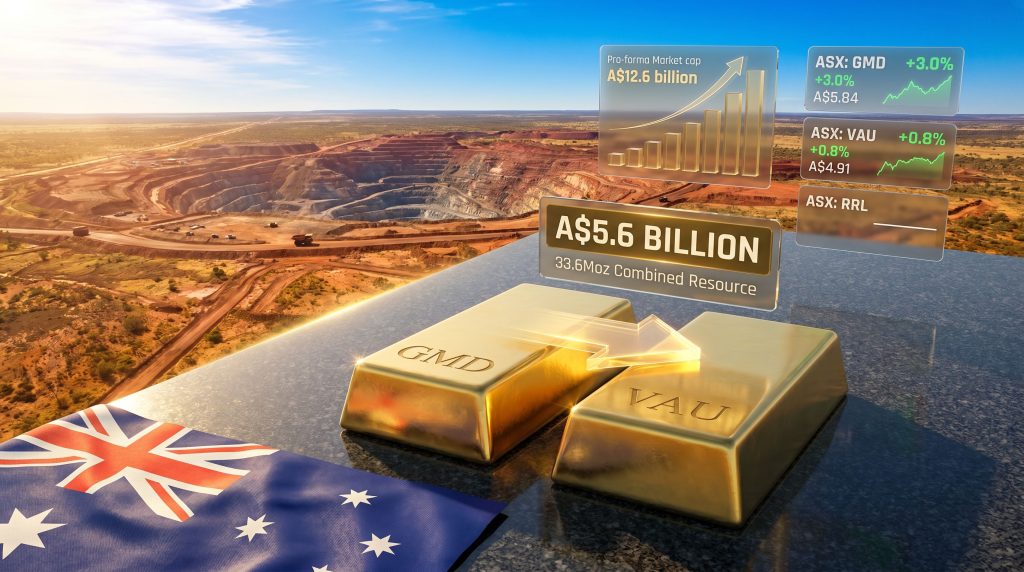
The Genesis proposal combines a scrip-and-cash mechanism, offering 0.7629 Genesis shares plus A$0.475 cash for every Vault Minerals share held. This values each Vault share at approximately A$5.274, implying a total transaction value of A$5.6 billion (approximately US$3.9 billion).
| Deal Component | Detail |
|---|---|
| Total Implied Valuation | A$5.6 billion (US$3.9 billion) |
| Per-Share Offer Price | A$5.274 per Vault share |
| Offer Mechanism | 0.7629 Genesis shares + A$0.475 cash |
| Premium to Regis Bid | ~14.5% |
| Premium to Vault's Last Close | ~15.7% |
| Post-Merger Ownership Split | Genesis ~60% / Vault ~40% |
| Pro-Forma Market Capitalisation | A$12.6 billion |
| Combined Gold Resource Base | 33.6 million ounces |
| Projected Annual Production | Up to 700,000 oz/year |
| Estimated Post-Tax Synergies | A$2 billion |
Why the Cash Component Changes the Risk Calculus
Vault's board formally declared the Genesis proposal superior to the existing Regis agreement, and the reasoning goes beyond the headline premium. Regis had structured its original bid as an all-scrip arrangement, which concentrates shareholder risk entirely in the acquirer's future equity performance. Genesis's inclusion of A$0.475 cash per share fundamentally alters that risk profile.
For Vault shareholders, particularly institutional holders with liquidity requirements or valuation mandates, the cash tranche provides:
- Immediate, guaranteed value at closing that is not subject to share price fluctuation
- A partial liquidity event without requiring market sales of the scrip component
- A floor on total consideration that protects against Genesis share price weakness between signing and settlement
Perhaps equally important is the absence of a financing condition on the cash component. Genesis secured its revolving credit facility to fund the approximately A$500 million cash tranche, meaning the transaction carries no completion risk linked to debt markets. In a deal of this size, financing certainty is not a minor technical point. It is a decisive competitive advantage when Vault's board is evaluating two otherwise comparable proposals.
How the Regis Bidding Contest Unfolded
The Chronology of a Three-Way Corporate Contest
The competitive dynamic preceding the Genesis takeover of Vault Minerals unfolded across several distinct phases:
- May 4, 2026: Vault Minerals and Regis Resources sign a Scheme Implementation Agreement, proposing an all-scrip merger that would have created a combined entity valued at approximately A$7.7 billion at prevailing prices.
- Genesis enters the contest: Genesis Minerals tables a competing proposal structured as a scrip-and-cash offer, carrying a roughly 14.5% premium to the Regis bid and a 15.7% premium to Vault's last traded price prior to the announcement.
- The matching right window: Under the terms of the existing Regis-Vault agreement, Regis held a contractual right to match or improve upon any superior proposal within a defined period. This is a standard protective mechanism in scheme of arrangement structures under Australian corporate law.
- Regis declines to exercise its matching right: On July 13, 2026, Regis publicly confirmed it would not match the Genesis proposal and would instead accept the termination of its agreement with Vault.
Why Regis Resources Walked Away
Regis's withdrawal was not a strategic miscalculation. It was a disciplined application of capital allocation principles that institutional investors increasingly expect from mid-tier mining boards.
The Regis board determined that the financial terms required to match or improve upon the Genesis proposal fell outside the return thresholds it applies uniformly to all capital deployment decisions. Rather than escalate into a potentially value-destructive bidding contest, Regis elected to collect the A$50.7 million break fee triggered upon termination of its agreement with Vault.
This outcome reveals something important about how sophisticated mining companies evaluate M&A optionality. Winning a contested takeover at any price is not inherently value-accretive. The synergy assumptions that justified Genesis's premium are rooted in its specific operational adjacency to Vault's assets, and those same synergies were simply not available to Regis at equivalent scale.
A hypothetical scenario analysis illustrates the alternatives Regis faced:
| Scenario | Outcome |
|---|---|
| Regis matches Genesis at A$5.274/share | Significant balance sheet stress; likely equity raise required |
| Regis improves offer beyond Genesis | Probable counter-bid; full auction dynamic emerges |
| Regis walks away (actual outcome) | Collects A$50.7M break fee; preserves capital for alternative growth |
The chosen path preserves Regis's financial flexibility for organic growth or alternative acquisitions where its specific asset base generates a more compelling synergy profile. This outcome is consistent with the pattern observed when Gold Road Resources faced a rejected takeover bid, demonstrating that Australian gold boards are increasingly willing to walk away from deals that do not meet disciplined valuation thresholds.
What the Combined Genesis-Vault Entity Looks Like
Scale Metrics of the Merged Producer
| Metric | Combined Entity |
|---|---|
| Pro-Forma Market Cap | A$12.6 billion |
| Total Gold Resource Base | 33.6 million ounces |
| Projected Annual Production | Up to 700,000 oz/year |
| Estimated Post-Tax Synergies | A$2 billion |
| Ownership Split | Genesis ~60% / Vault ~40% |
At 700,000 ounces of annual production, the merged company enters the conversation with Australia's largest gold producers. Northern Star Resources currently produces in excess of 1.6 million ounces annually, and Evolution Mining operates in the 700,000 to 800,000 ounce range, making the Genesis-Vault combination a genuine peer of Evolution in production terms and a meaningful challenger in market capitalisation rankings.
Vault's King of the Hills Mine
Vault's flagship asset, the King of the Hills mine near Leonora, Western Australia, represents one of the Goldfields region's more significant recent development stories. The operation benefits from a substantial open-pit resource base with underground optionality, processing through a large-scale carbon-in-leach facility. Its geographic positioning within the Leonora district creates direct infrastructure synergies with Genesis's existing operations.
Genesis's Leonora Operations
Genesis has invested heavily in establishing processing capacity at Leonora, with throughput infrastructure designed to accommodate ore from multiple sources. The strategic intent behind this investment becomes clearer in retrospect. A larger processing footprint creates optionality to accept third-party ore tolling arrangements or, more significantly, to integrate ore streams from an acquired neighbouring producer without constructing additional plant capacity.
This infrastructure pre-positioning is a feature of disciplined acquirers in the mining sector that is rarely discussed publicly but often visible in retrospect when deals close.
Regulatory and Shareholder Approval Hurdles
The Three Approval Gates Genesis Must Clear
Before the Genesis takeover of Vault Minerals can be formally completed, three distinct approval requirements must be satisfied:
- Federal Court of Australia sanction of the scheme of arrangement, which requires the court to be satisfied the transaction is fair and reasonable to Vault shareholders.
- Regulatory clearances, including review under the Foreign Investment Review Board framework and ASX compliance obligations.
- Vault Minerals shareholder approval, requiring a majority of shareholders by number representing at least 75% of votes cast to support the scheme.
The shareholder vote threshold for schemes of arrangement in Australia is notably higher than in many comparable jurisdictions. The 75% vote requirement by value means that a relatively small concentration of institutional opposition can block a deal, adding genuine uncertainty to even well-structured proposals.
The next major ASX story will hit our subscribers first
How Markets Priced the Outcome
ASX Price Movements on Announcement Day
| Company | Share Price Movement |
|---|---|
| Vault Minerals (ASX: VAU) | +0.8% to A$4.91 |
| Genesis Minerals (ASX: GMD) | +3.0% to A$5.84 |
| Regis Resources (ASX: RRL) | Broadly unchanged |
What Genesis's 3% Single-Day Gain Reveals
The conventional wisdom in M&A analysis holds that acquirers rarely rally on deal announcement day. The logic is straightforward: the market prices in the premium being paid and the execution risk being assumed, typically resulting in flat or slightly negative acquirer returns.
Genesis's 3% gain on announcement day therefore carries informational content that rewards close examination. It suggests the market concluded, at least provisionally, that:
- The synergy estimates of A$2 billion are credible given the operational adjacency of the two companies' assets
- The cash component is appropriately sized relative to Genesis's balance sheet capacity
- The absence of financing conditions removes a material completion risk that would otherwise discount the offer's present value
- The long-term production profile of the combined entity justifies the valuation step-up implied by the deal
Vault's comparatively modest 0.8% gain to A$4.91 against an implied offer value of A$5.274 reflects the standard scheme arbitrage discount. That gap between Vault's traded price and the offer price represents the market's embedded probability of the deal not completing, adjusted for the time value of money over the settlement period. A smaller gap signals higher completion confidence; a larger gap signals material regulatory or shareholder approval risk.
Consequently, the gold equities reaction across the broader sector on announcement day was notably measured, suggesting the market had already begun pricing in consolidation risk premiums for neighbouring producers.
What This Deal Signals About Australia's Gold M&A Landscape
The Macro Driver: Elevated Gold Prices as Consolidation Fuel
Record bullion prices function as a consolidation accelerant through two distinct mechanisms that are worth separating analytically.
First, higher gold prices inflate producer cash flows and strengthen balance sheets, expanding the debt capacity and equity currency available to fund acquisitions. A producer generating strong free cash flow at elevated spot prices can offer a more compelling mix of cash and scrip without stressing its leverage ratios.
Second, higher scrip prices compress the real cost of share-based consideration. When a producer's share price doubles over a cycle, the number of shares required to fund a given acquisition value halves. This dilution reduction makes large-scale scrip offers more palatable to existing shareholders of the acquirer, reducing the governance friction that often kills otherwise logical consolidation plays.
Both mechanisms were operating simultaneously in the Genesis-Vault transaction. The current gold price outlook suggests these conditions are unlikely to reverse materially in the near term, which explains why a deal of this scale was achievable in the current environment when it might have faced structural barriers in a lower gold price regime.
The Mid-Tier Consolidation Thesis
The Genesis takeover of Vault Minerals is unlikely to be an isolated event. Several structural forces point toward continued consolidation activity among ASX-listed mid-tier producers:
- Organic reserve replacement has become increasingly difficult and capital-intensive for producers operating mature districts
- Larger combined entities achieve better index inclusion thresholds, attracting passive fund flows that reduce cost of capital
- Processing infrastructure built for nameplate capacity requires ore volume to justify fixed cost absorption, creating incentives to acquire feed sources
- Major global gold producers have demonstrated appetite for Australian assets, placing competitive pressure on domestic mid-tiers to scale up defensively
Identifying which ASX gold companies represent the next logical consolidation candidates requires examining the same adjacency framework that made the Genesis-Vault combination compelling: shared geological corridors, compatible processing infrastructure, and complementary reserve tenure. For instance, Genesis's merger proposal has already drawn significant attention from industry analysts who view this deal as a template for future mid-tier consolidation plays.
Frequently Asked Questions: Genesis Takeover of Vault Minerals
What is the Genesis Minerals takeover of Vault Minerals?
Genesis Minerals (ASX: GMD) has launched a A$5.6 billion scrip-and-cash acquisition of Vault Minerals (ASX: VAU), combining two neighbouring Western Australian gold producers to create one of Australia's largest gold companies with projected output of up to 700,000 ounces per year.
Why did Regis Resources withdraw from the Vault Minerals takeover?
Regis Resources determined that the financial terms required to match Genesis's superior offer did not satisfy its internal return and value thresholds. Rather than escalate the bidding contest, Regis elected to withdraw and collect an approximately A$50.7 million break fee upon termination of its agreement with Vault.
How much is Genesis paying per Vault Minerals share?
Genesis is offering A$5.274 per Vault share, structured as 0.7629 Genesis shares plus A$0.475 in cash for each Vault share held. The Gold Fields offer from an earlier contested Australian gold deal provides useful structural context for understanding how such hybrid consideration mechanisms typically perform through to completion.
What synergies are expected from the Genesis-Vault merger?
The combined entity is projected to generate approximately A$2 billion in post-tax synergies, primarily derived from the integration of shared processing infrastructure across the two companies' adjacent Western Australian Goldfields operations.
Is the Genesis takeover of Vault Minerals subject to shareholder approval?
Yes. The transaction requires approval from Vault Minerals shareholders under a scheme of arrangement vote, Federal Court sanction, and relevant regulatory clearances before formal completion.
What will the combined company's gold resource base be?
The merged Genesis-Vault entity is expected to hold a combined gold resource base of approximately 33.6 million ounces, with a pro-forma market capitalisation of A$12.6 billion. Independent coverage from Stockhead's analysis of the bid confirms these figures align with Genesis's formal proposal documentation.
Key Takeaways for Investors Watching This Space
Three Strategic Lessons From This Acquisition
- Geographic adjacency commands a premium. Shared infrastructure synergies of A$2 billion validate the case for consolidating neighbouring assets over diversified M&A strategies pursued purely for production scale.
- Financing certainty is a competitive weapon. Genesis's ability to fund the cash component through a secured revolving credit facility without financing conditions gave it a structural advantage that no amount of scrip premium from Regis could easily replicate.
- Disciplined withdrawal preserves long-term optionality. Regis's decision to exit rather than overpay for synergies it could not fully access demonstrates the capital allocation discipline that markets increasingly reward in mid-tier mining, as reflected in its broadly unchanged share price on announcement day.
What Investors Should Watch as the Deal Progresses
- Court and shareholder approval timelines: The 75% voting threshold under Australian scheme law introduces genuine completion risk that the current share price arbitrage gap reflects.
- Integration execution: Merging two operational teams, aligning mine planning across multiple pits, and optimising blended ore feed into shared processing infrastructure represents a multi-year operational challenge that will test management bandwidth.
- Gold price sensitivity: The A$5.274 implied offer value is partially denominated in Genesis scrip, meaning sustained gold price weakness that compresses Genesis's share price will reduce the effective consideration received by Vault shareholders between signing and settlement.
This article is intended for informational purposes only and does not constitute financial advice. Past performance and deal precedents are not reliable indicators of future outcomes. Readers should conduct their own due diligence or consult a licensed financial adviser before making investment decisions. For additional context on Australian gold sector consolidation trends, visit the Canadian Mining Journal.
Want to Stay Ahead of the Next Major ASX Gold Discovery?
While consolidation plays like the Genesis-Vault merger capture headlines, the most significant wealth creation in the gold sector often begins with a single discovery announcement — and Discovery Alert's proprietary Discovery IQ model scans ASX announcements in real time, delivering instant alerts so subscribers can act before the broader market catches on. Explore historic discovery returns on Discovery Alert's discoveries page and begin a 14-day free trial to position yourself at the forefront of the next major find.