
July 14, 2026
The Underground Geometry That Separates Ordinary Gold Deposits From Exceptional Ones
High-grade underground gold mining is fundamentally a geometry problem. The physical arrangement of mineralised material, its continuity, its structural integrity, and how accessible it is to mining equipment determines whether a deposit generates sustainable returns or becomes a costly exercise in chasing isolated pods of ore. Grades matter enormously, but geometry often matters more. A deposit returning spectacular intercepts across fragmented, remnant blocks presents far greater operational challenges than a lower-grade system contained within a coherent, mineable panel.
This distinction sits at the heart of what the latest West Red Lake Gold Madsen Mine drilling results reveal, and why they carry significance that extends well beyond the headline numbers.
When big ASX news breaks, our subscribers know first
Red Lake's Geological Architecture: Why This District Produces Extraordinary Gold Grades
Ontario's Red Lake district occupies a singular position within Canada's gold-producing landscape. Its reputation for extreme high-grade mineralisation is not accidental. The district sits within the Uchi Subprovince of the Superior Craton, an ancient Archean geological terrane characterised by tightly folded greenstone belts where ultramafic host rocks and deep crustal fault systems have created ideal structural traps for gold deposition over billions of years.
The key mechanism involves a combination of factors rarely found together in other jurisdictions:
- Ultramafic host rocks that undergo chemical reactions with gold-bearing hydrothermal fluids, promoting metal precipitation
- First and second-order structural corridors that channelled those fluids repeatedly over geological time
- Strain partitioning zones where competency contrasts between rock types created dilation spaces for gold deposition
- Archean age of the rocks, which correlates globally with the highest-grade gold systems on the planet
These conditions produce the stacked, lens-shaped mineralised bodies that define Madsen's deposit geometry. Rather than a single continuous vein, the system contains multiple discrete but spatially related gold-bearing lenses within a favourable ultramafic sequence. This stacked architecture has important implications for how resource inventory is built and how mine plans are sequenced.
Decoding the Austin 955 Complex: What the Numbers Actually Mean
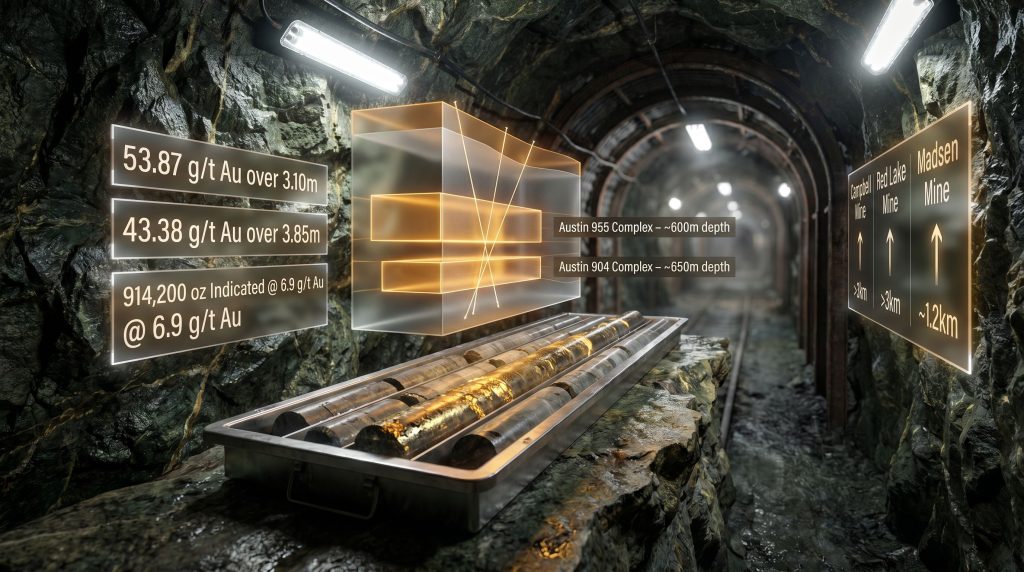
The Austin 955 Complex sits at approximately 600 metres below surface, corresponding to the mine's 12 Level. The latest West Red Lake Gold Madsen Mine drilling results from this zone delivered intercepts that rank among the strongest in the deposit's recent drilling history. Proper drill results interpretation is essential to understanding what these numbers truly represent in context.
| Drill Hole | Intercept Width | Grade (g/t Au) | High-Grade Sub-Interval |
|---|---|---|---|
| MM26D-12-5110-013 | 3.85m | 43.38 g/t | 0.5m @ 291.94 g/t |
| MM26D-12-5110-048 | 3.10m | 53.87 g/t | 0.5m @ 322.89 g/t |
| MM26D-12-5110-024 | 5.25m | 24.03 g/t | 0.5m @ 228.84 g/t |
Several technical observations are worth unpacking here. The sub-interval grades exceeding 290 g/t and 320 g/t Au over 0.5-metre sections reflect what geologists describe as the nugget effect, a phenomenon common in high-grade gold systems where metal is concentrated in discrete coarse grains or visible gold accumulations rather than distributed homogeneously through the rock. The visible gold reported in hole MM26D-12-5110-016 at 69 metres downhole is consistent with this model, indicating that free gold is present at structurally significant positions within the mineralised corridor.
Furthermore, when interpreting drill results of this nature, it is equally important to consider the difference between true and apparent widths. The reported intercept widths represent downhole lengths, and understanding true vs apparent widths is critical to accurately assessing the economic significance of any single result.
Technical Note: In narrow-vein underground mining, intercept widths of 3 to 5 metres are operationally meaningful. Most underground selective mining methods require a minimum mining width of approximately 1.2 to 1.5 metres, meaning these intercepts are wide enough to support efficient stoping without excessive dilution from surrounding waste rock.
The 6.9 g/t Au indicated resource grade for the combined Austin Zone places it well above the threshold typically required for underground gold operations to be economically viable. Industry benchmarks generally require underground deposits to carry grades above 4 to 5 g/t Au to justify the capital intensity of deep mining, making Austin's resource grade a genuine operational differentiator.
Austin 904: Why Panel Geometry Matters as Much as Grade
The Austin 904 Complex, positioned at approximately 650 metres depth on the mine's 13 Level, tells a different but equally important story. Earlier results from this zone established the grade ceiling convincingly: 219.73 g/t Au over 4.8 metres reported in February 2026 and 215.46 g/t Au over 5.35 metres from April 2026 rank among the highest-grade intercepts reported from Madsen in recent years.
However, the strategic significance of Austin 904 lies less in individual intercepts and more in what management has characterised as the panel's largely intact geometry, estimated at approximately 200 metres by 200 metres. This distinction carries real operational weight.
In underground mining terminology, the difference between remnant and non-remnant mineralisation is substantial:
- Remnant blocks are isolated pillars or pockets of ore left between previously mined voids. Accessing them requires navigating around old workings, managing complex ground conditions, and accepting higher dilution and lower stope recovery rates
- Intact panels allow systematic, plan-driven mining with predictable ground behaviour, consistent dilution management, and the ability to apply optimised stoping methods across the full panel area
The Austin 904 is being evaluated through the same framework previously applied to the 4447 panel, a zone that was advanced from definition drilling through to active mine plan integration. That precedent is operationally instructive: it demonstrates a repeatable process for converting drilling confidence into scheduled production, rather than treating each intercept as a standalone event.
Key Insight: An intact 200m x 200m non-remnant panel in a high-grade underground system represents a fundamentally different quality of resource than an equivalent tonnage distributed across fragmented remnant blocks. The intact geometry directly reduces dilution risk, simplifies stope sequencing, and lowers the effective cost per recovered ounce.
How Definition Drilling Builds Mine-Ready Inventory: A Step-by-Step Framework
The current Austin drilling campaigns are classified as definition programs rather than grassroots exploration, and the distinction matters for understanding what they are designed to achieve. Definition drilling has a specific objective: establishing sufficient geological confidence across a panel to support resource reclassification and mine plan integration. Thorough mineral drill result analysis is a critical component of this process.
The process follows a structured sequence:
- Geological target identification using structural models, historic data, and geophysical interpretation to prioritise drill targets
- Infill drilling at closely spaced intervals, typically 10 to 25 metres between holes, to establish grade and width continuity across the panel
- Resource classification upgrade from inferred to indicated as drill density crosses the confidence threshold required under NI 43-101 or equivalent reporting standards
- Geotechnical assessment evaluating rock mass quality, stress conditions, and ground support requirements to inform stope design
- Mine plan integration scheduling confirmed panels into the production sequence with defined extraction methods and sequencing logic
- Stope extraction using the selected mining method, adjusted to the specific ground conditions and panel geometry of each zone
The current Austin 904 and 955 programs are operating at steps 2 and 3 of this process. Management has indicated that areas currently being drilled in 2026 are targeted for integration into the mine plan during the first half of 2027. That timeline reflects the lead time required to move from drill results through resource classification to scheduled production, a sequence that the 4447 panel precedent has already demonstrated is achievable within this system.
A critical logistical advantage at Madsen is the use of underground drill platforms for definition drilling. Drilling from underground stations at equivalent depths to the target zones reduces hole lengths, improves drill precision, and lowers the cost per metre compared to surface programs attempting to reach the same targets from 600 to 650 metres above.
The 13 Level East Drive: Infrastructure as a Geological Multiplier
Underground development rarely generates investor attention at the same intensity as drill results. However, the 13 Level East Drive is worth examining closely, because it is quietly expanding the geometric scope of what can be tested at Madsen over the next several years.
The East Drive extends lateral access eastward from existing mining infrastructure on the 13 Level, creating new drill stations at depth that can test the Austin 904 panel's downward continuation as well as targets farther along strike to the east. The operational logic is straightforward: as the drive advances, the number of angular positions from which drill holes can be collared increases, improving coverage of the panel geometry and reducing the geometric uncertainty in the resource model.
Beyond the immediate Austin zones, the East Drive is improving access to the Derlak area, an eastern target that has received comparatively limited drilling relative to the western portions of the Madsen deposit. The Derlak corridor sits within the same geological setting as the Austin complexes, and the extension of underground infrastructure into this area fundamentally changes the economics of testing it. What would have required expensive, long-inclined surface drill holes can increasingly be tested from underground positions at a fraction of the equivalent cost.
Exploration Context: Underground infrastructure investment functions as a geological optionality multiplier. Each metre of lateral development that opens a new drill platform creates access to targets that may have been economically impractical to test from surface. The Derlak corridor represents precisely this type of low-incremental-cost, high-geological-leverage opportunity.
The next major ASX story will hit our subscribers first
Depth Potential: Benchmarking Madsen Against District Analogues
One of the less widely appreciated aspects of the Madsen system is its depth potential relative to other Red Lake district producers. Current defined mineralisation extends to approximately 1.2 kilometres below surface, which by global underground gold mining standards represents a moderate depth. Within the Red Lake district specifically, that figure takes on additional significance when placed against district benchmarks.
| Deposit | Approximate Defined or Mined Depth | Context |
|---|---|---|
| Madsen Mine | ~1.2 km (current resources) | Active definition drilling underway |
| Campbell Mine | >3 km | Historic Red Lake district producer |
| Red Lake Mine | >3 km | Benchmark for district depth continuity |
The geological argument for deeper potential at Madsen rests on whether the structural controls responsible for gold deposition remain active at depth. In the Red Lake district, the same fault architecture and ultramafic host rock sequences that concentrate gold at shallow levels have been demonstrated to persist to considerable depths at other systems. Whether Madsen shares that characteristic is a question that remains open, pending deeper drilling.
The Upper 8 discovery adds an important dimension to this thesis. This zone, which occurs within the same ultramafic host sequence as the Austin complexes, provides evidence that multiple productive mineralised lenses can exist at different vertical positions within the broader Madsen system. Stacked mineralisation models, where several discrete gold-bearing lenses occur at different elevations within a favourable geological package, are conceptually well supported by both the Upper 8 discovery and the district-wide evidence from Red Lake's deeper producers. Confirming this model at Madsen would require systematic deeper drilling, which remains a longer-term objective contingent on continued underground development.
Investors should note that comparisons to adjacent or analogous deposits are geological inferences, not confirmed continuity. Deeper drilling at Madsen has not yet been completed, and the depth potential thesis remains speculative pending additional data.
Starratt-Olsen and the Hub-and-Spoke Regional Model
Understanding the broader strategic picture at Madsen requires stepping back from the individual drill results and considering the operational architecture being assembled across the property. The hub-and-spoke model, where a central processing facility sources mill feed from multiple satellite deposits, is well established in underground gold mining as a method for improving mill utilisation rates and reducing per-ounce processing costs.
Madsen's permitted processing infrastructure serves as the natural hub in this configuration. The Starratt-Olsen target, located approximately two kilometres southwest of the Madsen Mine, is the most advanced of the regional satellite opportunities currently under evaluation. With eight drill holes totalling approximately 2,500 metres completed as of the most recent reporting, all holes have intersected alteration and mineralisation styles consistent with those documented at Madsen.
The geological knowledge transfer from Madsen to Starratt-Olsen is an underappreciated efficiency factor in this program. Years of detailed geological work at Madsen, including understanding the structural controls on mineralisation, the behaviour of gold within the ultramafic host sequence, and the alteration signatures that reliably precede high-grade intersections, can be applied directly to target selection and drill positioning at Starratt-Olsen. This reduces the typical trial-and-error cost of early-stage exploration at a new target.
Program Status: With approximately half of the Starratt-Olsen drill program complete and target geology intersected in all completed holes, the pending assay results represent a near-term data point that will either strengthen or require reassessment of the geological correlation thesis connecting this target to the Madsen system. Assay results are not yet available at time of publication.
Rowan Project: The High-Grade Growth Pillar
Approximately 80 kilometres from the Madsen Mine, the Rowan Project hosts an indicated mineral resource of 334,825 ounces grading 13.03 g/t Au, updated in 2026. At 13.03 g/t Au, Rowan's grade profile is exceptional by any measure; it sits nearly double the Austin Zone's already impressive 6.9 g/t Au indicated grade and roughly three times the global average cut-off grade for underground gold operations.
The 80-kilometre separation from Madsen introduces logistical complexity that the upcoming combined Pre-Feasibility Study will need to address directly. Key variables include:
- Transport economics for moving ore concentrate or processed material between sites
- The grade premium Rowan would need to deliver to justify transport costs relative to near-mine feed
- Blended mill feed scenarios that optimise throughput across both Madsen's own resource base and Rowan feed schedules
- Capital phasing requirements for developing Rowan to a stage where it can contribute meaningfully to mill utilisation
The combined Madsen-Rowan Pre-Feasibility Study, targeted for delivery in the second half of 2026, will provide the first integrated technical and economic framework for evaluating how these two assets can function within a unified operational strategy. A definitive feasibility study of this nature will serve as a defining reference point for understanding the company's long-term production capacity and capital requirements.
Austin Zone Resource Profile: The Numbers in Context
| Resource Category | Ounces | Grade (g/t Au) |
|---|---|---|
| Indicated | 914,200 oz | 6.9 g/t |
| Inferred | 104,900 oz | Not separately reported |
The 914,200 indicated ounces at 6.9 g/t Au in the Austin Zone represent the combined Austin 955 and Austin 904 complexes. To place these figures in industry context, the World Gold Council and major mining consultancies typically consider underground gold operations economically viable from approximately 4 g/t Au upward, depending on depth, jurisdiction, and infrastructure costs. Austin's 6.9 g/t average is therefore positioned firmly in the upper tier of viable underground grade profiles globally, providing meaningful margin above minimum economic thresholds.
West Red Lake Gold Mines continues to publish detailed technical updates on the Madsen Mine's progress, and the company's latest news releases provide additional context on the 2026 production guidance and planned ramp-up trajectory at the operation.
Key Milestones to Monitor Through 2026 and Into 2027
| Milestone | Expected Timing | Significance |
|---|---|---|
| Continued Austin 904 and 955 definition results | Ongoing through 2026 | Building panel confidence toward mine plan integration |
| Starratt-Olsen assay results | Near-term (program ~50% complete) | Tests geological correlation thesis with Madsen |
| 13 Level East Drive advancement | Ongoing | Opens new drill platforms for Austin 904 depth and Derlak |
| Phase 1 shaft refurbishment progress | H2 2026 | Improves underground access and operational throughput capacity |
| Combined Madsen-Rowan PFS delivery | H2 2026 | First integrated economic assessment across both assets |
| Austin 904/955 panels targeted for mine plan integration | H1 2027 | Converts geological confidence into scheduled production |
Frequently Asked Questions: West Red Lake Gold Madsen Mine Drilling Results
What Were the Strongest Intercepts From the Latest Austin 955 Drilling?
The highest-grade results from the Austin 955 Complex included 53.87 g/t Au over 3.10 metres and 43.38 g/t Au over 3.85 metres, both at approximately 600 metres depth. Sub-interval grades within these intercepts reached 322.89 g/t Au and 291.94 g/t Au respectively over 0.5-metre sections, reflecting the nugget-style gold distribution characteristic of the Red Lake district's highest-grade systems.
Why Is Austin 904's Panel Geometry Considered Strategically Valuable?
An estimated 200 metre by 200 metre intact, non-remnant panel provides the geological and spatial foundation for systematic, plan-driven stoping. Mining intact panels produces lower dilution, better stope recovery, and more predictable cost outcomes compared to mining fragmented remnant blocks between previously extracted areas. The Austin 904 is following the same definition-to-mine-plan conversion process previously applied successfully to the 4447 panel.
What Is the 13 Level East Drive and Why Does It Matter?
The 13 Level East Drive is an underground lateral development extending eastward from current mining infrastructure. It creates new drill platforms to test Austin 904 at depth and improves access to the Derlak corridor and other eastern targets that have received limited drilling to date. Underground access to these targets reduces drilling costs substantially compared to surface programs attempting to reach the same depths.
Does Madsen Have Meaningful Depth Potential Beyond Current Resources?
Defined mineralisation currently extends to approximately 1.2 kilometres below surface. Analogous Red Lake district producers including the Campbell and Red Lake mines were ultimately mined to depths exceeding 3 kilometres. Whether similar depth continuity exists at Madsen is a geological question that requires deeper drilling to confirm. The thesis is supported by the structural setting but has not been confirmed by drilling to date. This remains a speculative upside case.
What Is the Current Status of the Starratt-Olsen Drill Program?
Eight holes totalling approximately 2,500 metres have been completed, with all holes intersecting alteration and mineralisation consistent with Madsen. Assay results are pending at time of publication. The program is approximately halfway complete, making the upcoming assay data a near-term catalyst for the regional exploration thesis.
What Will the Combined Madsen-Rowan PFS Assess?
The Pre-Feasibility Study will provide the first integrated technical and economic evaluation of operating Madsen and Rowan within a unified framework. Rowan holds an indicated resource of 334,825 ounces at 13.03 g/t Au. The PFS is targeted for delivery in the second half of 2026 and will address transport logistics, blended mill feed economics, capital phasing, and production sequencing across both assets. The West Red Lake Gold Madsen Mine drilling results achieved to date suggest a strong technical foundation from which to build this integrated assessment.
This article is intended for informational purposes only and does not constitute financial advice. Forward-looking statements, timelines, resource estimates, and geological interpretations are subject to change and involve inherent uncertainty. Readers should conduct their own due diligence and consult a qualified financial adviser before making investment decisions. Mineral resource estimates referenced herein are as reported by West Red Lake Gold Mines and have not been independently verified.
For further analysis and ongoing coverage of West Red Lake Gold Mines and the Madsen Mine's development trajectory, visit Crux Investor.
Want to Be First When the Next Major Gold Discovery Hits the ASX?
Discovery Alert's proprietary Discovery IQ model scans ASX announcements in real time, instantly identifying high-grade mineral discoveries and turning complex geological data into actionable investment insights — just as it has done for past transformative discoveries like those by De Grey Mining and WA1 Resources. Explore the historic returns major mineral discoveries have delivered and begin your 14-day free trial at Discovery Alert to position yourself ahead of the market.