August 6, 2026
Geographic Bottleneck Analysis: Why Physical Constraints Amplify Risk
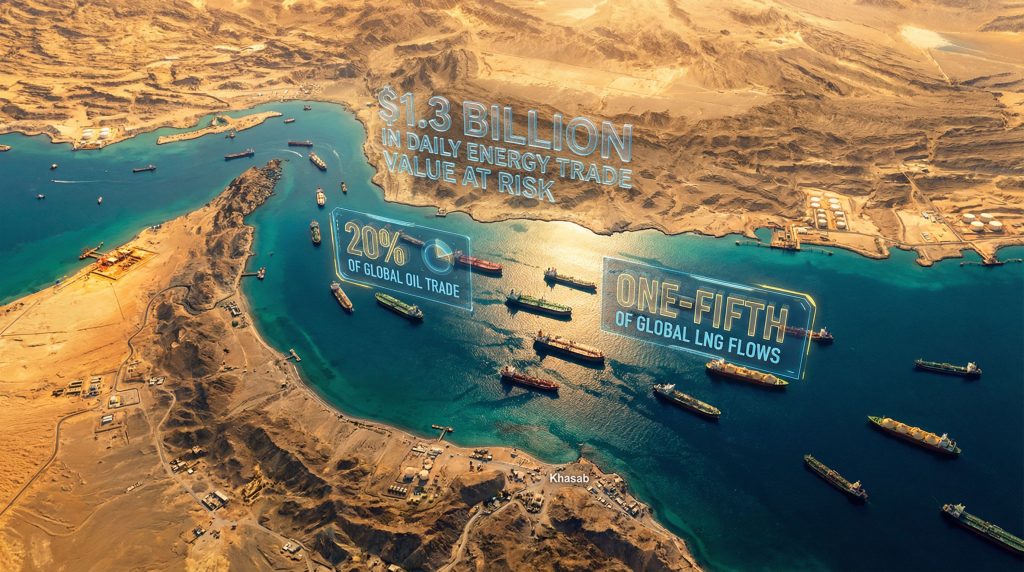
The Strait of Hormuz represents a masterclass in geographic vulnerability, where natural topography creates artificial scarcity in global commodity flows. The waterway narrows to just 33 kilometres at its widest point, with navigable shipping lanes compressed into a 2-mile corridor that must accommodate vessels carrying 20% of globally traded crude oil. This geometric constraint means that any disruption creates immediate capacity limitations that cannot be easily circumvented.
Physical Infrastructure Under Pressure
Daily transit volumes through the Strait reach 17-21 million barrels of oil, representing a continuous conveyor belt of energy supplies that feed Asian manufacturing hubs and European industrial centres. The sheer scale of this operation becomes apparent when considering that a single day's disruption removes approximately $1.3 billion worth of crude oil from global markets, excluding the substantial liquefied natural gas flows that constitute one-fifth of global LNG trade.
Furthermore, recent March 2026 disruptions demonstrated how quickly theoretical vulnerabilities become operational realities. Within 36 hours of initial incidents, approximately 170 containerships totalling 450,000 TEU became effectively trapped inside the Strait, unable to exit safely due to security concerns and insurance coverage withdrawals.
| Global Maritime Chokepoints | Daily Oil Transit (Million Barrels) | % of Global Trade | Alternative Routes Available |
|—|—|—|—|—|
| Strait of Hormuz | 17-21 | 20% | Limited pipeline capacity |
| Strait of Malacca | 16-17 | 19% | Longer shipping routes |
| Suez Canal | 8-10 | 9% | Cape of Good Hope |
| Turkish Straits | 3-4 | 3% | Pipeline alternatives |
| Panama Canal | 2-3 | 2% | Railroad/pipeline |
Concentration Risk Mathematics
The mathematical reality of chokepoint dependency reveals why alternative route development struggles to provide meaningful redundancy. Persian Gulf oil exports funnel 88% of production through this single corridor, creating a dependency ratio that no amount of strategic planning can fully mitigate. Qatar's position exemplifies this vulnerability: 83% of the nation's LNG exports must transit Hormuz to reach global markets, whilst Iran's historical oil export reliance exceeded 90% before current production constraints.
In addition, insurance markets have demonstrated acute awareness of these concentration risks. Following the February 28-March 1, 2026 escalation, marine insurers withdrew war risk coverage entirely for Iranian, Persian Gulf, and adjacent waters. This insurance withdrawal created a secondary disruption mechanism independent of military action, as vessel operators cannot transit without coverage, effectively implementing a de facto blockade through market mechanisms rather than physical obstruction.
When big ASX news breaks, our subscribers know first
Regional Import Dependencies: Mapping Vulnerability Across Continents
Energy security exposure varies dramatically across regions, with Asian economies facing the highest percentage vulnerability among major economic blocs. The interdependence between Middle Eastern production and Asian consumption creates structural fragilities that extend far beyond simple supply arithmetic, highlighting the importance of understanding the broader energy security transition patterns.
Asia-Pacific's Critical Exposure
China imports approximately 40% of crude oil supplies via the Strait of Hormuz, representing over 7 million barrels daily that directly support the world's second-largest economy. This dependency creates severe vulnerability where disruption threatens China's economic growth targets and manufacturing capacity. Chinese government statements during the March 2026 incident emphasised concern over regional spillover, indicating acute awareness of this structural weakness.
Japan faces even more acute vulnerability with 85% overall energy import dependency combined with limited strategic reserves relative to consumption patterns. As the world's largest LNG importer, Japan's exposure extends beyond crude oil into natural gas markets where price volatility can spike industrial costs within days. The Nikkei 225's 1.4% decline during the March 2026 disruption reflected investor recognition of Japan's asymmetric exposure to Persian Gulf supply chains.
Moreover, India's growing Middle Eastern crude reliance represents an emerging vulnerability as the nation scales industrial capacity whilst maintaining limited supplier diversification. India's strategic response during the March 2026 crisis involved immediate reassessment of Russian oil alternatives and accelerated supplier diversification planning, demonstrating how quickly energy security concerns can reshape geopolitical partnerships.
| Country | Hormuz Oil Dependency | Strategic Reserve Duration | LNG Import Reliance | Vulnerability Ranking |
|---|---|---|---|---|
| Japan | 85% | 140-170 days | Highest globally | Very High |
| South Korea | 75% | 100-120 days | High | Very High |
| India | 60%+ | 20-30 days | Growing rapidly | High |
| China | 40% | 40-50 days | Moderate | High |
| Europe (average) | 25% | 60-90 days | Moderate | Moderate |
| United States | 7% | 1,000+ days | Minimal | Low |
European Price Transmission Dynamics
While Europe imports relatively modest quantities directly through Hormuz, the globally integrated oil market ensures European consumers experience price spikes equivalent to Asian importers. Brent crude prices spiked 13% during early Asian trading on March 2, 2026, reaching $82/barrel before settling near $78, demonstrating how regional disruptions immediately affect global pricing benchmarks traded in London.
European vulnerability operates through price transmission mechanisms rather than direct supply disruption. European natural gas prices reflected similar volatility patterns, with spot market premiums extending 2-3 months forward based on supply uncertainty from Qatar's LNG production facilities. These patterns align with broader natural gas forecasts showing increased volatility expectations across global markets.
Probability-Based Scenario Modelling: Quantifying Disruption Pathways
Strategic risk assessment requires moving beyond binary thinking about Strait closure toward probability-weighted scenario analysis that incorporates multiple disruption vectors and their cascading effects across interconnected systems. This analysis benefits from understanding broader oil price rally insights that inform market response mechanisms.
Baseline Tension Scenario (45% Probability)
This scenario assumes ongoing geopolitical tension without full military escalation, characterised by periodic shipping delays and elevated security concerns. Historical insurance data demonstrates that routine tensions increase war-risk premiums from normal rates of 0.5-1% of cargo value to elevated levels of 2-5% of cargo value.
Oil price volatility under baseline scenarios suggests a trading range of $70-85 per barrel, reflecting geopolitical risk premiums above pre-crisis baseline levels of $72-75. This scenario assumes gradual de-escalation over 4-6 weeks with resumption of partial shipping transit capacity, though insurance costs remain elevated throughout the period.
The March 2026 incident initially appeared to follow this baseline pattern, with insurance premiums spiking to multiples of normal rates whilst coverage remained technically available for operators willing to accept elevated costs.
Partial Capacity Reduction (35% Probability)
This scenario models capability limitations through mine deployment, vessel damage, or port infrastructure disruption that reduces effective transit capacity by 30-50% for 2-4 weeks. Historical precedent from the 1984 "Tanker War" demonstrates that sustained capacity reductions of this magnitude drive oil prices toward the $100-120 per barrel range.
Emergency Strategic Petroleum Reserve releases typically activate within 7-10 days under IEA coordination mechanisms, potentially limiting price peaks to $100-110 range rather than exceeding $120. However, the effectiveness of SPR releases depends on coordinated action among multiple consuming nations and cannot fully offset prolonged supply disruptions.
The March 2026 disruption demonstrated rapid movement toward this scenario, with tanker traffic dropping approximately 70% within 36 hours of initial incidents. Major global shipping operators including Mediterranean Shipping Company, CMA CGM, and Hapag-Lloyd formally announced transit suspensions, creating functional closure despite technical navigability. These developments reflect similar patterns noted in analyses of OPEC production impact during regional disruptions.
Complete Blockade Scenario (20% Probability)
This scenario models either intentional closure through declared blockade or catastrophic infrastructure damage affecting multiple refineries and port facilities simultaneously. Oil prices reaching $150+ per barrel reflect both supply loss (20% of global crude) and demand destruction effects as economies reduce consumption at extreme price levels.
Complete blockade scenarios carry significant geopolitical escalation risks, including potential military intervention to restore transit routes. Historical analysis suggests that complete closures lasting 1+ months would trigger coordinated military response from consuming nations, fundamentally altering the risk calculus for regional actors contemplating such action.
The economic modelling for this scenario incorporates potential recession triggers, as sustained oil prices above $130-150 per barrel historically correlate with significant economic contraction in energy-importing economies.
Analysis suggests that partial closure scenarios represent the highest probability risk category, as they can emerge from operational constraints rather than requiring deliberate military escalation by regional powers.
Alternative Supply Infrastructure: Bypass Capacity Assessment
Understanding realistic alternatives to Hormuz transit requires technical analysis of existing infrastructure capacity and expansion potential, rather than theoretical routing possibilities that ignore logistical constraints.
Pipeline Bypass Systems
The Saudi East-West Pipeline represents the most significant alternative route, with current capacity of 5 million barrels per day that can potentially expand to 7 million b/d through infrastructure upgrades. However, this capacity represents only 25-35% of typical Hormuz crude flows, providing partial rather than complete substitution during disruptions.
The UAE Abu Dhabi-Fujairah pipeline adds 1.5 million b/d capacity, whilst Iran's Goreh-Jask pipeline contributes 0.3 million b/d when operational. Combined bypass capacity totals approximately 6.8-8.8 million b/d under optimal conditions, representing roughly 40-50% of normal Strait throughput.
| Bypass Infrastructure | Current Capacity (mb/d) | Expansion Potential | Technical Limitations |
|---|---|---|---|
| Saudi East-West Pipeline | 5.0 | 7.0 | Loading terminal capacity |
| UAE Abu Dhabi-Fujairah | 1.5 | 2.0 | Storage infrastructure |
| Iran Goreh-Jask | 0.3 | 1.0 | Political/operational constraints |
| Total Bypass Capacity | 6.8 | 10.0 | 50% of Hormuz flows |
Strategic Reserve Utilisation Mechanics
IEA member countries collectively maintain approximately 1.5 billion barrels in emergency strategic petroleum reserves, governed by International Energy Agency protocols for coordinated release during supply emergencies. However, release mechanisms require consensus among multiple nations and typically require 7-10 days to activate, creating operational lag during acute crises.
China's strategic petroleum reserve expansion programme has reached 600+ million barrels of capacity as of March 2026, representing substantial expansion from historical levels. This capacity provides China with approximately 40-50 days of import coverage at current consumption levels, offering meaningful but limited buffer capacity during extended disruptions.
The effectiveness of strategic reserve releases depends critically on global coordination and market psychology. Historical precedent suggests that coordinated releases of 60-90 million barrels can stabilise markets during 2-4 week disruptions, but longer disruptions require alternative supply activation or demand reduction measures.
Economic Cascade Analysis: Ripple Effects Across Sectors
Energy price shocks transmit through economic systems via multiple mechanisms that compound initial supply disruptions into broader industrial and financial disruptions affecting sectors with no direct energy exposure.
Immediate Market Response Patterns
Futures market volatility demonstrates how quickly Hormuz tensions translate into financial system stress. Historical correlation analysis shows that Hormuz disruption threats correlate with oil price volatility ranging from 15-40% within 24-48 hours of initial disruption signals. The March 2026 incident followed this pattern precisely, with Brent crude spiking from $77 to $82 within hours, representing a 6.5% adjustment that rippled across commodity and equity markets globally.
Currency impacts cascade through oil-importing economies as energy cost spikes affect trade balances and inflation expectations. The Japanese yen weakened 0.8% against the US dollar during the March 2026 disruption, whilst the Indian rupee faced similar pressure as markets priced elevated import costs into currency valuations.
Stock market sector rotation accelerated dramatically, with energy sector gains offset by consumer discretionary and transportation sector declines. Airlines faced immediate pressure as jet fuel cost projections spiked, whilst chemical companies confronted feedstock price uncertainty that affected production planning across multiple quarters.
Industrial Cost Transmission Mechanisms
Chemical and petrochemical industries face direct feedstock cost increases that multiply through downstream supply chains affecting everything from pharmaceuticals to automotive components. A $20 per barrel oil price increase typically translates to 15-25% increases in key petrochemical feedstock costs, with impacts materialising within 2-3 weeks of initial price shocks.
Aviation fuel availability constraints compound cost increases with operational disruptions. Major airlines reported immediate revision of flight planning and route optimisation during the March 2026 crisis, with some carriers implementing fuel surcharges within 48 hours of initial disruptions.
Consequently, shipping and logistics costs escalate beyond the energy sector through vessel charter rate increases and schedule disruptions. Container shipping rates from Asia to Europe increased 20-30% within days of the March 2026 incident, as operators priced longer routing and higher fuel costs into contract negotiations.
Energy Independence Through System Transformation
Strategic energy security requires fundamental system architecture changes rather than marginal improvements to existing fossil fuel supply chains. The transition toward renewable-based systems offers structural insulation from geopolitical chokepoint vulnerabilities, particularly as developments in lithium supply innovations support this transformation.
Renewable Energy as Geopolitical Strategy
Solar and wind capacity additions in Hormuz-dependent economies accelerated dramatically following the March 2026 disruptions. China announced 200 GW additional solar deployment through 2027, whilst India committed to 150 GW renewable capacity expansion specifically framed as energy security infrastructure rather than climate policy.
Battery storage deployment provides grid stability that reduces dependence on imported natural gas for power generation flexibility. Global battery storage capacity additions reached 50 GW in 2025, with 70% concentrated in Asian markets seeking reduced fossil fuel import dependency.
Green hydrogen production represents the most significant long-term pathway for reducing fossil fuel imports, particularly for industrial processes requiring high-temperature heat and chemical feedstocks. Japan's commitment to 6 million tons annual hydrogen imports by 2030 specifically targets reduced LNG dependency through diversified energy carriers.
| Hormuz-Dependent Countries | 2025 Renewable Investment ($B) | 2027 Capacity Targets (GW) | Import Reduction Goals |
|---|---|---|---|
| China | 180 | +350 solar/wind | 25% oil import reduction |
| Japan | 45 | +50 solar/wind | 30% LNG import reduction |
| India | 35 | +150 solar/wind | 20% oil import reduction |
| South Korea | 25 | +30 solar/wind | 15% energy import reduction |
Industrial Electrification Impact
Energy-intensive industries increasingly relocate production closer to renewable energy sources, reducing exposure to fossil fuel price volatility and supply disruptions. Steel production electrification accelerated following March 2026 price spikes, with several major producers announcing electric arc furnace conversions specifically citing energy security concerns.
Long-term power purchase agreements (PPAs) provide industrial consumers with price certainty and supply security that fossil fuel markets cannot match. Global corporate PPA volumes exceeded 35 GW in 2025, with 60% concentrated in Asia-Pacific markets seeking alternatives to volatile LNG pricing.
Critical mineral sourcing for clean energy infrastructure creates new supply chain dependencies, but these operate through different vulnerability patterns than fossil fuel chokepoints. Lithium, cobalt, and rare earth element supply chains can be diversified across multiple continents and involve stockpiling possibilities that continuous fuel imports do not permit.
The next major ASX story will hit our subscribers first
Military and Diplomatic Security Architecture
Strait security depends on complex military deterrence frameworks and diplomatic mechanisms that operate across multiple levels of regional and international cooperation, as highlighted in recent analyses of regional security vulnerabilities.
Naval Security Coordination
The US Fifth Fleet maintains permanent presence in the Persian Gulf with escort capabilities for commercial shipping during elevated threat periods. However, escort operations require careful coordination with regional allies and cannot scale to protect all commercial traffic during sustained crisis periods.
The International Maritime Security Construct includes participation from multiple nations including the UK, Australia, and several GCC states, but coverage remains limited to specific high-value convoys rather than comprehensive shipping protection.
Regional naval cooperation agreements provide additional security layers, though effectiveness depends on political cooperation among nations with sometimes conflicting strategic interests. The March 2026 incident demonstrated gaps in coordination mechanisms when multiple naval forces operated in proximity without unified command structures.
| Military Assets | Primary Function | Coverage Capacity | Operational Limitations |
|---|---|---|---|
| US Fifth Fleet | Escort/deterrence | High-value targets | Cannot protect all traffic |
| Royal Navy Task Group | Allied coordination | British-flagged vessels | Limited regional presence |
| GCC Naval Forces | Regional security | Territorial waters | Coordination challenges |
| International Patrols | Multi-national effort | Specific convoy routes | Political constraints |
Diplomatic De-escalation Mechanisms
JCPOA nuclear negotiations directly impact Strait security calculations, as comprehensive diplomatic agreements reduce incentives for chokepoint disruption whilst sanctions regimes can increase such incentives. The relationship between nuclear diplomacy and energy security creates complex policy trade-offs for consuming nations.
Gulf Cooperation Council mediation efforts provide regional diplomatic frameworks for managing tensions, though effectiveness varies with the specific nature of conflicts and the interests of member states in particular disputes.
China-Iran economic agreements create stability incentives for Iran to maintain energy exports, whilst also creating potential complications for Western diplomatic and military responses to disruptions. These competing interests demonstrate how energy security intersects with broader geopolitical competition.
Long-Term Structural Risk Reduction
Sustainable Strait of Hormuz energy vulnerability reduction requires coordinated infrastructure investment and policy frameworks that address systemic dependencies rather than managing crisis responses more effectively.
Energy System Transformation Pathways
Electrification of transportation sectors offers the most direct pathway for reducing oil import dependency over 10-15 year timescales. Electric vehicle adoption rates in China, Europe, and Japan accelerated following March 2026 disruptions, with several governments announcing accelerated phase-out timelines for internal combustion engines.
Industrial heat pump adoption for manufacturing processes can displace natural gas consumption in sectors ranging from food processing to chemical production. Industrial electrification investments increased 40% in the six months following March 2026, with specific focus on reducing LNG dependency in price-sensitive industries.
Furthermore, synthetic fuel production using renewable electricity provides pathways for aviation and shipping sectors that face electrification constraints. Green ammonia shipping networks emerged as energy carriers that can substitute for both LNG and oil products in specific applications, though scaling remains limited by production capacity.
Critical Infrastructure Investment Priorities
Inter-regional electricity grid connections enable sharing of renewable energy resources across wider geographic areas, reducing dependence on local fossil fuel supplies. Asian Super Grid proposals gained renewed attention following March 2026, with Japan, South Korea, and several Southeast Asian nations announcing feasibility studies for submarine cable connections.
Pumped hydro storage provides large-scale energy storage that can balance variable renewable generation without requiring fossil fuel backup systems. China's 120 GW pumped hydro expansion programme specifically targets reduced natural gas import requirements for grid balancing services.
Green hydrogen production facilities require substantial infrastructure investment but offer the potential to replace LNG imports for industrial processes and power generation. Australia's hydrogen export targets of 15 million tons annually by 2035 specifically aim to substitute for LNG trade relationships with Asian importers.
Policy Framework Evolution for Energy Security
Comprehensive energy security requires policy coordination across multiple sectors and international cooperation on supply chain resilience that extends beyond traditional energy diplomacy, as explored in recent analyses of energy market disruption impacts.
Carbon Pricing and Security Integration
Carbon pricing mechanisms accelerate clean energy adoption whilst simultaneously reducing geopolitical vulnerability to fossil fuel supply disruptions. EU carbon prices above €80 per ton make renewable energy investments economically attractive independent of energy security considerations, creating dual benefits for climate and security objectives.
Energy security mandates for renewable capacity provide direct policy tools for reducing import dependency. South Korea's renewable energy standard requiring 30% clean electricity by 2030 explicitly incorporates energy security goals alongside environmental targets.
International cooperation on critical mineral access ensures that renewable energy supply chains avoid creating new chokepoint vulnerabilities similar to fossil fuel dependencies. US-Japan-Australia critical minerals partnerships specifically aim to diversify supply sources and reduce dependence on single-country suppliers.
Strategic policy coordination between climate objectives and energy security goals creates mutually reinforcing incentives that accelerate the transition away from chokepoint-dependent energy systems.
The March 2026 Strait of Hormuz disruption served as a vivid reminder that energy security and economic stability remain interconnected through narrow geographic channels that amplify regional conflicts into global economic shocks. While immediate crisis management focuses on alternative routing and strategic reserve deployment, long-term resilience requires fundamental transformation of energy systems toward domestically controlled renewable resources and diversified clean supply chains.
The mathematical reality of chokepoint dependency means that marginal improvements to existing fossil fuel infrastructure cannot eliminate structural vulnerability. Instead, comprehensive electrification, renewable energy deployment, and international cooperation on clean technology supply chains offer pathways toward energy systems that cannot be disrupted by regional conflicts thousands of miles away.
Strategic resilience emerges not from managing chokepoint risks more effectively, but from building energy systems that bypass chokepoints entirely. The countries and companies that accelerate this transition will find themselves increasingly insulated from the recurring geopolitical shocks that will continue to emanate from the Strait of Hormuz and similar vulnerable corridors in the decades ahead.
Are You Positioned for the Next Energy Security Opportunity?
Energy security disruptions like the March 2026 Strait of Hormuz crisis create immediate market opportunities whilst highlighting long-term investment themes in renewable energy infrastructure and critical minerals. Discovery Alert's proprietary Discovery IQ model delivers real-time alerts on significant ASX mineral discoveries, helping investors identify actionable opportunities in the energy transition sectors ahead of the broader market. Start your 14-day free trial today to position yourself strategically as global energy systems evolve beyond traditional chokepoint vulnerabilities.