June 7, 2026
How Geographic Concentration Transforms Maritime Economics
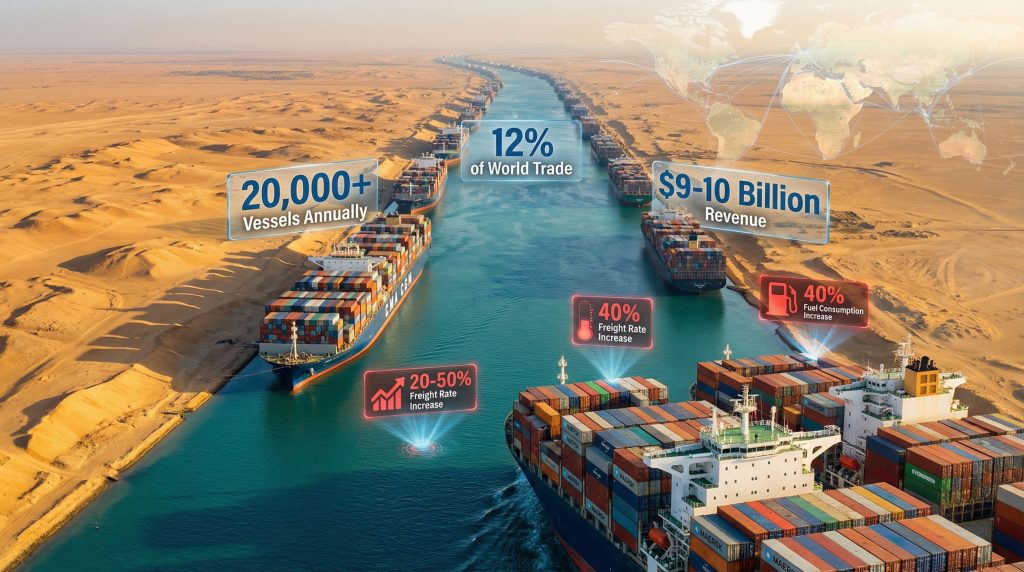
Global shipping networks have evolved into increasingly concentrated systems where massive trade volumes funnel through narrow geographic corridors. This concentration effect creates mathematical vulnerabilities that extend far beyond simple transportation delays. When approximately 12% of international trade flows through a single 120-mile artificial waterway, the economic system becomes exposed to what risk analysts term cascade amplification, where local disruptions generate exponentially larger global consequences. The Suez Canal vulnerability to Middle East tensions and Red Sea insecurity has become a defining characteristic of modern maritime economics.
The Suez Canal's economic significance stems not merely from its traffic volume but from its position as a critical node in interconnected supply networks. Modern manufacturing relies on synchronised component delivery across multiple continents, creating temporal dependencies that make even brief shipping delays catastrophically expensive. Each day of canal disruption forces companies to choose between production shutdowns or costly inventory buffers, fundamentally altering the economics of global manufacturing.
Maritime Chokepoint Economics in Practice
The economic mechanics of chokepoint vulnerability become visible during crisis periods. Egypt's recent experience demonstrates how quickly concentrated trade routes can collapse. Since late 2023, the country has experienced revenue losses of $9-10 billion from its primary foreign currency source, representing a decline of nearly two-thirds in 2024 compared to the record $10.25 billion generated in 2022-2023.
These figures reflect more than simple traffic reduction. They represent a fundamental shift in commercial risk assessment, where shipping companies voluntarily abandoned the most efficient Asia-Europe route due to security calculations. The Yemen-based Houthi group's targeting of Red Sea vessels in solidarity with Gaza created upstream threats that made the entire corridor commercially unviable, despite the physical infrastructure remaining fully operational.
| Economic Impact Category | Immediate Effect | System-Wide Consequence |
|---|---|---|
| Freight Transportation | 25-40% cost increase | Permanent risk premium incorporation |
| Insurance Markets | War risk surcharge activation | Underwriting model restructuring |
| Fuel Consumption | 40% increase via Cape route | Fleet efficiency recalculation |
| Supply Chain Timing | 1-2 week transit extension | Inventory strategy overhaul |
| Port Operations | Capacity strain at alternatives | Infrastructure investment acceleration |
Furthermore, these economic disruptions demonstrate how oil price rally impacts can compound maritime vulnerability, creating multiple layers of supply chain stress.
When big ASX news breaks, our subscribers know first
What Makes Strategic Waterways Systemically Vulnerable?
The Suez Canal's vulnerability extends beyond its narrow physical dimensions to encompass a complex web of upstream dependencies that create multiple failure points. Unlike distributed transportation networks that offer redundant pathways, strategic waterways concentrate risk through geographic necessity, making alternative route development economically prohibitive under normal conditions.
The Dependency Web Structure
Modern maritime economics reveals how single chokepoints create cascading vulnerability chains:
• Red Sea Security Dependencies: The Bab el-Mandeb Strait serves as the southern gateway, where threats from regional conflicts can effectively close the entire northern route regardless of canal conditions
• Regional Port Stability: Terminal operations at Port Said, Suez, and Port Tawfik must maintain consistent service levels to support the intensive scheduling required for modern container shipping
• Insurance Market Functionality: Lloyd's of London and international maritime insurers must provide commercially viable coverage, as prohibitive premiums create the same economic effect as physical blockage
• Fuel Price Calculations: The Cape of Good Hope alternative requires $50,000-100,000 additional fuel costs per vessel, making route selection highly sensitive to oil price volatility
The network effect becomes apparent when considering that shipping companies cannot simply reroute individual vessels. Container shipping operates on hub-and-spoke systems where schedule disruption at one major corridor requires systematic recalibration of global fleet positioning, port slot reservations, and cargo consolidation patterns.
Critical Insight: The vulnerability lies not in the canal's physical infrastructure but in the commercial ecosystem surrounding it. When war risk premiums exceed normal operational margins, even fully functional waterways become economically inaccessible.
Comparative Chokepoint Analysis
The Strait of Hormuz provides instructive comparison for understanding systemic vulnerability. According to the International Monetary Fund, approximately one-fifth of global oil shipments transit this passage, creating similar concentration risk for energy markets. Recent tensions involving Iran and military strikes in the Gulf region have demonstrated how quickly alternative chokepoints can simultaneously face disruption, compounding the economic impact beyond simple mathematical addition.
When both the Suez Canal and Strait of Hormuz face concurrent threats, shipping companies encounter a scenario where no viable alternative routes exist for certain cargo types, forcing temporary market shutdown rather than costly rerouting. Additionally, the interplay with US tariffs and inflation creates further complexities in global trade dynamics.
How Current Regional Tensions Specifically Impact Canal Economics?
The Gaza war's escalation since late 2023 created a new paradigm for maritime risk assessment, where regional solidarity movements could effectively close international shipping lanes without direct military confrontation with major powers. This represents a fundamental shift from historical canal vulnerabilities, which typically involved nation-state conflicts or infrastructure attacks.
Commercial Risk Calculation Framework
Shipping companies now evaluate Suez Canal vulnerability to Middle East tensions and Red Sea insecurity through sophisticated matrices that weigh multiple variables simultaneously:
Primary Risk Factors:
- Real-time threat intelligence from maritime security firms
- Insurance availability and premium structure changes
- Cargo value versus potential loss exposure
- Customer contractual obligations and penalty structures
- Fleet positioning requirements for alternative routes
Secondary Economic Considerations:
- Fuel price volatility projections
- Port congestion at alternative terminals
- Crew scheduling and labour cost implications
- Vessel maintenance timing adjustments
The decision-making process reveals how modern logistics operates on marginal cost analysis. When insurance premiums increase war risk coverage from standard rates to 200-400% surcharges, the mathematical threshold for route abandonment approaches quickly, regardless of actual attack probability.
Market Confidence Dynamics
The transcript reveals a critical behavioural pattern: shipping companies had begun cautiously considering returns to the Suez route during periods of relative calm, but renewed Gulf tensions delayed these plans, demonstrating how market confidence operates on binary rather than graduated scales.
This pattern suggests that Suez Canal vulnerability to Middle East tensions and Red Sea insecurity extends beyond immediate threat assessment to encompass broader regional stability perceptions. Companies require sustained security confidence rather than temporary improvements to justify long-term route commitments.
What Are the Broader Economic Implications for Global Trade Architecture?
The Suez Canal disruptions have accelerated fundamental changes in global trade architecture that extend far beyond temporary shipping route adjustments. Companies worldwide are reassessing the basic assumptions underlying supply chain optimisation, moving from pure efficiency models toward resilience-based strategies.
Supply Chain Philosophy Transformation
The transition reflects a paradigm shift in economic thinking:
Traditional Optimisation Model:
- Minimise transportation costs through direct routing
- Reduce inventory through just-in-time delivery systems
- Concentrate production in lowest-cost geographic regions
- Maximise efficiency through single-source supplier relationships
Emerging Resilience Model:
- Accept higher transportation costs for route diversification
- Increase strategic inventory buffers (3-6 months versus 30-60 days)
- Distribute production across multiple geographic regions
- Develop redundant supplier networks with relationship depth
Inflationary Mechanism Analysis
Canal disruptions create inflationary pressure through four distinct channels that compound rather than simply add to consumer price increases. Moreover, understanding tariffs and market impact becomes crucial in this context:
-
Direct Transportation Cost Transfer: Shipping expense increases of 40-60% eventually pass through to consumer prices, though often with 6-12 month delays as existing contracts expire
-
Inventory Shortage Premiums: Extended transit times create temporary scarcity that allows retailers to implement price increases beyond direct cost justification
-
Insurance Cost Distribution: War risk premiums become embedded in product pricing structures, creating permanent rather than temporary cost inflation
-
Energy Price Volatility: Oil and LNG shipment disruptions through both Suez Canal and Strait of Hormuz create energy cost spikes that affect all economic sectors simultaneously
How Do Different Economic Sectors Experience Chokepoint Vulnerability?
Manufacturing Sector Vulnerability Analysis
Automotive Industry Impact:
Modern automotive production operates on synchronised component delivery where 15-20% production delays during major shipping disruptions can cascade into complete assembly line shutdowns. The industry's transition toward electric vehicle production has increased dependency on Asian battery component suppliers, making Suez Canal vulnerability to Middle East tensions and Red Sea insecurity particularly costly for manufacturers attempting to meet regulatory deadlines.
Electronics and Technology Sector:
High-value technology products face unique vulnerability because their time-sensitive nature makes air freight alternatives economically prohibitive for bulk shipments. Semiconductor supply chains, already strained by capacity constraints, experience compounding delays when maritime routes become unreliable.
Commodity Market Dynamics
Energy Transportation Patterns:
The simultaneous threats to both Suez Canal shipping and Strait of Hormuz oil transit create compound vulnerability for European energy security. Consequently, energy security challenges become more pronounced when traditional shipping routes face disruption. LNG shipments face particular challenges because alternative routes often lack adequate terminal infrastructure, creating bottlenecks that extend beyond simple transportation delays.
Agricultural Product Implications:
Grain shipments from major exporters face extended transit times that increase spoilage risks for temperature-sensitive products. The resulting food price inflation particularly affects import-dependent African economies, creating regional economic instability that extends the original maritime disruption's impact.
What Structural Changes Are Emerging from Chokepoint Vulnerability?
Infrastructure Investment Acceleration
The repeated Suez vulnerabilities have catalysed major infrastructure developments that represent permanent shifts in global trade patterns. The Atlantic Council analysis highlights why the canal's security matters for global stability:
Alternative Route Development:
- Arctic shipping route exploration benefits from climate change, offering seasonal alternatives that reduce dependency on traditional chokepoints
- Trans-Siberian railway capacity expansion provides land-based alternatives for high-value, time-sensitive cargo
- Cape of Good Hope port infrastructure receives increased investment to handle diverted traffic more efficiently
- Regional manufacturing hub development reduces the need for transcontinental shipping
Supply Chain Structural Evolution
Companies are implementing systematic changes that reflect long-term strategic thinking rather than temporary crisis response, incorporating lessons from trade war strategies:
Strategic Evolution: Organisations are transitioning from optimising for cost and speed toward optimising for predictability and resilience, with transportation expenses becoming secondary considerations in total supply chain design.
Observable Pattern Changes:
- Near-shoring initiatives reduce dependency on long-haul shipping by relocating production closer to end markets
- Multi-supplier strategies distribute risk across different geographic regions and transportation corridors
- Enhanced inventory management systems incorporate real-time risk assessment to adjust buffer levels dynamically
- Regional distribution centres proliferate to create localised supply networks less dependent on international shipping
The next major ASX story will hit our subscribers first
What Historical Lessons Inform Current Vulnerability Assessment?
The 1967-1975 Closure Framework
The eight-year Suez Canal closure during Arab-Israeli conflicts provides essential perspective on how maritime chokepoint disruptions create permanent rather than temporary changes to global trade architecture.
Key Historical Adaptations:
- Global shipping routes underwent fundamental restructuring that persisted decades beyond the crisis period
- Alternative infrastructure development accelerated, creating permanent capacity that changed competitive dynamics
- Trade relationships shifted toward regional focus, reducing dependency on transcontinental supply chains
- Transportation cost structures incorporated permanent risk premiums that never fully reverted to pre-crisis levels
Recovery Pattern Analysis:
The historical data reveals that full traffic restoration required 3-4 years following canal reopening, and some trade routes never returned to pre-closure patterns. The shipping industry consolidated around larger, more efficient vessels capable of economically viable Cape route operations, while insurance and risk management practices incorporated permanent enhancements.
Contemporary Application
Current disruptions differ from the 1967-1975 closure in that physical infrastructure remains operational while commercial risk assessment drives avoidance behaviour. This suggests that recovery patterns may follow different timelines, with market confidence restoration potentially requiring longer periods than physical reconstruction.
How Should Economic Stakeholders Prepare for Future Vulnerabilities?
Corporate Risk Management Evolution
Comprehensive Risk Framework Components:
- Develop scenario-based shipping route alternatives with predetermined trigger mechanisms
- Establish strategic inventory buffers calibrated to specific supply chain vulnerability assessments
- Create flexible supplier networks across geographically dispersed regions with validated capacity
- Implement real-time supply chain monitoring systems with automated response protocols
Financial Risk Mitigation:
Companies increasingly incorporate maritime risk premiums into long-term pricing strategies rather than treating disruptions as temporary cost increases. This approach reflects recognition that chokepoint vulnerability represents permanent rather than cyclical risk factors.
Policy and Infrastructure Response Framework
Government-Level Strategic Responses:
- Strategic reserve management for critical commodities incorporates supply chain vulnerability assessment
- Alternative transportation infrastructure investment prioritises redundancy over pure efficiency optimisation
- International cooperation on maritime security extends beyond traditional naval operations to include commercial risk mitigation
- Trade agreement diversification strategies reduce dependency on single-corridor commerce
International Coordination Requirements:
Enhanced naval security cooperation must adapt to non-state threat actors who operate through commercial disruption rather than direct military confrontation. Standardised risk assessment protocols enable coordinated response to chokepoint disruptions, while emergency shipping capacity sharing agreements provide systematic alternatives to market-based solutions.
In conclusion, the ongoing challenges surrounding maritime chokepoints highlight the interconnected nature of global commerce and the need for adaptive resilience strategies that account for both traditional geopolitical risks and emerging security paradigms.
Disclaimer: This analysis is based on publicly available information and should not be considered as financial advice. Maritime shipping investments and supply chain decisions involve significant risks and should be evaluated by qualified professionals. Economic projections and risk assessments may not accurately predict future outcomes.
Ready to Navigate Market Disruptions Like a Seasoned Investor?
Discovery Alert's proprietary Discovery IQ model delivers real-time alerts on significant ASX mineral discoveries, instantly empowering subscribers to identify actionable opportunities ahead of broader market volatility. Begin your 14-day free trial today and secure your market-leading advantage during uncertain economic times.