June 7, 2026
The Aluminium Value Chain's Missing Link: Why Emerging Economies Are Racing to Close the Processing Gap
For decades, resource-rich developing nations have wrestled with the same structural disadvantage: exporting raw materials at baseline commodity prices while importing finished goods manufactured from those very same materials at multiples of the original value. This dynamic, sometimes called the resource curse's quieter sibling, is not about having too little mineral wealth. It is about failing to capture the compounding value that processing and refining create at each successive stage of the industrial chain.
Nowhere is this pattern more clearly illustrated than in the global bauxite and alumina sector. Bauxite, the earthy ore from which aluminium is ultimately derived, is abundant across tropical and subtropical regions. Yet the facilities that transform that ore into alumina, and later into primary aluminium metal, are concentrated in a far smaller number of countries, many of which have no bauxite resources at all. The geographic mismatch between where raw material originates and where value is added has defined the industry for generations.
Guyana is now confronting this mismatch directly. With a proposal taking shape for a Guyana alumina refinery in Berbice, the country faces a pivotal question: can it finally close the processing gap that has left it exporting only the lowest-value tier of one of the world's most strategically important mineral supply chains?
When big ASX news breaks, our subscribers know first
Guyana's Bauxite Sector: Decades of Raw Exports, Limited Value Capture
Guyana's relationship with bauxite stretches back well over a century, and the country's deposits remain among the more significant in the Western Hemisphere. Yet despite sitting on substantial reserves, Guyana has historically participated in only the most rudimentary stage of the aluminium value chain: mining and exporting raw ore.
The country did, briefly, operate a domestic alumina processing facility. Located in the Linden area, historically known as the Mackenzie district, this refinery carried a rated capacity of approximately 300,000 tonnes of alumina per year. Its closure in 1982 marked the end of Guyana's only experience with domestic alumina production, and for more than four decades since, the country has shipped bauxite overseas without refining it.
To appreciate the scale of the opportunity lost during those four decades, consider the value differential embedded in the aluminium supply chain:
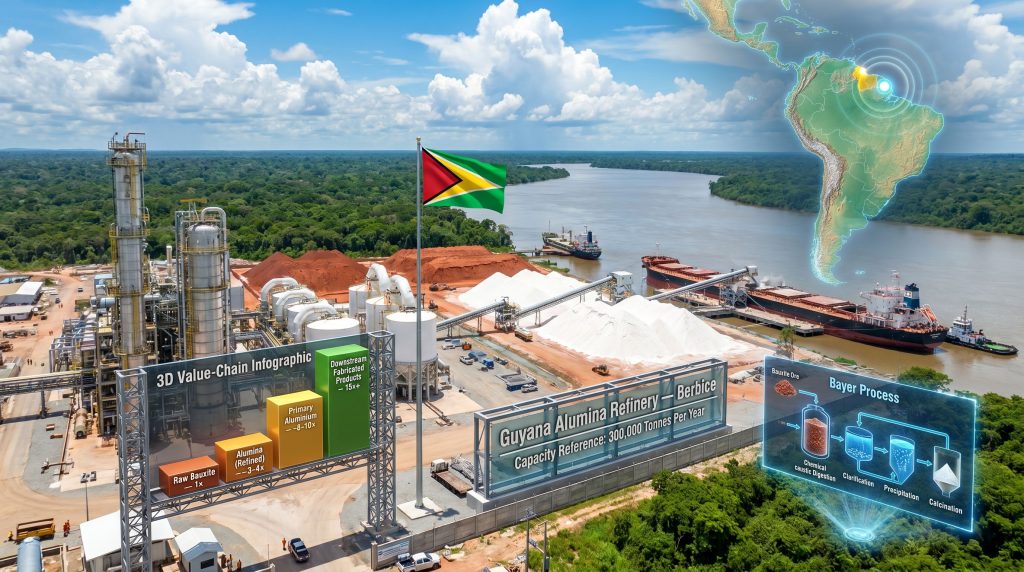
| Value Chain Stage | Approximate Value Multiplier vs. Raw Bauxite |
|---|---|
| Raw Bauxite (exported) | 1x (baseline) |
| Alumina (refined) | ~3 to 4x |
| Primary Aluminium (smelted) | ~8 to 10x |
| Downstream Fabricated Products | 15x or more |
Every tonne of bauxite that leaves Guyana's ports unrefined represents a transfer of economic value to whoever performs the next processing step. Across millions of tonnes and forty-plus years, that cumulative transfer is vast. Furthermore, understanding global bauxite production patterns helps contextualise just how significant this missed opportunity has been.
Industry Perspective: The gap between raw bauxite pricing and alumina pricing is not merely a commodity spread. It reflects the capital investment, technical expertise, energy consumption, and industrial employment that refining requires. Countries that capture this step build industrial capacity, skilled labour forces, and export revenue simultaneously.
What the Berbice Proposal Actually Involves
Location and Industrial Logic
The Berbice River region in eastern Guyana offers a confluence of geographic and logistical attributes that make it a credible candidate for large-scale industrial development. The river provides freshwater access and a natural shipping corridor, while proximity to existing bauxite mining operations reduces the infrastructure burden of feedstock supply.
Planning discussions have centred on developing the mouth of the Berbice River as a multi-sector industrial and petrochemical corridor. Within this broader vision, an alumina refinery would serve as the mineral processing anchor, processing domestically mined bauxite into exportable alumina rather than shipping the raw ore directly. Government statements on the Berbice industrial development confirm the seriousness with which officials are approaching this ambition.
The Bayer Process: How Bauxite Becomes Alumina
Understanding what an alumina refinery actually does clarifies why energy availability is the central enabling factor for this proposal. The dominant industrial method for alumina production is the Bayer Process, a chemical extraction technique developed in the late nineteenth century that remains the industry standard today.
The process works through the following sequence:
-
Digestion: Crushed bauxite ore is mixed with hot caustic soda (sodium hydroxide solution) under elevated pressure. This dissolves the aluminium-bearing minerals while leaving impurities behind.
-
Clarification: The resulting slurry is filtered to remove undissolved solids, known as bauxite residue or red mud. This waste stream requires careful environmental management.
-
Precipitation: The clarified aluminium-rich liquor is seeded with fine aluminium hydroxide crystals, causing aluminium hydroxide to crystallise out of solution.
-
Calcination: The aluminium hydroxide crystals are heated to approximately 1,000 degrees Celsius in rotary kilns, driving off water to produce finished alumina powder.
This sequence is both chemically intensive and extraordinarily energy hungry. The calcination stage alone requires sustained high-temperature heat, and the entire process demands significant electricity and steam generation. A standard refinery requires roughly two to three tonnes of bauxite input to produce one tonne of alumina output.
Energy as the Decisive Variable
Senior government officials in Guyana have been direct about the relationship between energy infrastructure and industrial feasibility. Planned expansions including a proposed second natural gas pipeline and additional electricity generation capacity in the Berbice corridor are considered foundational prerequisites for any large-scale refinery development in the region. Indeed, developments in the Berbice gas corridor are being watched closely by industry observers as a key enabler of this vision.
This is not unusual. Globally, alumina refinery economics are profoundly sensitive to energy costs, with power and fuel typically representing 25 to 35 percent of total operating costs at an efficient facility. Without access to affordable, reliable energy at scale, the operating economics of alumina refining become uncompetitive regardless of feedstock quality.
Critical Insight: The sequencing challenge here is significant. Energy infrastructure must be built and proved before a refinery can be economically justified, yet energy infrastructure investment is easier to attract when large industrial consumers are committed. Breaking this chicken-and-egg dynamic requires either government risk capital or coordinated multi-party investment agreements, both of which take considerable time to structure.
Capital Requirements and Economic Viability
What It Costs to Build a Greenfield Alumina Refinery
Alumina refineries rank among the most capital-intensive industrial facilities a government or private consortium can undertake. Based on recent global project data, greenfield refinery construction costs typically fall in the range of USD $1 billion to $3 billion or more, depending on scale, site conditions, and the extent of supporting infrastructure required.
A meaningful portion of total project cost, often estimated at 30 to 40 percent, relates to infrastructure rather than the refinery plant itself. This includes:
- Port construction or upgrade for bulk alumina export
- Power generation or grid connection infrastructure
- Water supply and treatment systems
- Bauxite handling, storage, and transport infrastructure
- Caustic soda supply chain establishment
- Waste residue management and storage facilities
For a country like Guyana that is simultaneously building out its broader industrial base, these co-investments represent both a cost burden and an opportunity, since infrastructure assets benefit multiple industries beyond the refinery itself.
Feedstock Quality and Reserve Adequacy
Bauxite grade is a critical determinant of refinery economics. Not all bauxite deposits are equal: the ratio of aluminium oxide to silica (the silica modulus) largely determines how much caustic soda is consumed per tonne of alumina produced. Higher-silica bauxite increases reagent costs substantially.
Guyana's bauxite deposits have historically included both calcined (refractory) grade and chemical grade bauxite, with the composition varying across different mining areas. Assessing which ore types are best suited for refinery-grade feed, and whether reserve volumes are sufficient to sustain a multi-decade refinery operation, would be among the first technical tasks in any serious feasibility study. In this context, studying the world's leading bauxite mines provides a useful benchmark for what reserve adequacy and ore quality look like at operational scale.
Market Conditions Favoring New Supply
The global alumina market in mid-2026 is experiencing meaningful supply tightness. A combination of bauxite export restrictions in key producing nations and refinery curtailments in multiple regions has tightened the alumina supply-demand balance. A new mid-scale Guyanese refinery entering production in the late 2020s or early 2030s could encounter favourable market conditions, though alumina pricing cycles are notoriously difficult to predict across multi-year horizons.
Investor Caution: Commodity markets can shift materially over the five to ten year development timeline typical of a greenfield refinery. Project economics that appear attractive at today's alumina prices may look different if supply responds strongly to current tightness. Investors and policymakers should stress-test project economics across a range of price scenarios.
Comparative Lessons: What Other Nations Did With Their Raw Materials
Guyana's situation is not unique, and the global record of resource-rich nations attempting to move up the value chain offers instructive precedents.
| Country | Strategy | Outcome |
|---|---|---|
| Indonesia (Nickel) | Domestic processing mandate; raw ore export ban from 2020 | Rapid surge in domestic nickel processing investment |
| Saudi Arabia (Hydrocarbons) | Petrochemical co-location with energy infrastructure | Development of SABIC-scale industrial diversification |
| Guinea (Bauxite) | Predominantly raw bauxite exporter despite world-class reserves | Minimal value capture relative to reserve endowment |
| Malaysia (Bauxite) | Rapid extraction without processing infrastructure | Environmental controversy and export bans in 2016 |
| Guyana (Proposed) | Energy-enabled industrial complex with alumina refining | Outcome undetermined as of mid-2026 |
The Indonesian nickel precedent is particularly relevant. By mandating domestic processing rather than raw ore exports, Indonesia forced international battery and stainless steel manufacturers to invest in local processing facilities, rapidly building industrial capacity that had taken other nations decades to develop. Whether Guyana would pursue a similarly directive policy approach, or rely on market incentives alone, is an open question with material implications for timeline and investment volumes.
Key Risks That Could Stall the Proposal
Even a well-conceived industrial vision faces execution risks. For the Berbice alumina refinery concept, the most material uncertainties include:
- Energy timeline slippage: If the second gas pipeline or expanded generation capacity faces delays, refinery development would be stalled regardless of political commitment.
- Partner and operator attraction: Guyana lacks existing alumina refinery operating expertise domestically. Attracting a credible international joint venture partner with refinery experience is essential and not guaranteed. For instance, structures similar to a recent aluminium joint venture demonstrate how complex such partnerships can be to assemble.
- Environmental sensitivity: The Berbice River mouth ecosystem requires careful impact assessment. Industrial development at this scale carries real ecological risk that must be managed proactively.
- Capital market conditions: Large-scale industrial financing is sensitive to global interest rates, commodity price cycles, and sovereign credit considerations. Guyana's investment climate, while improved by oil revenues, remains a factor in investor decision-making.
- Geopolitical dynamics: Trade relationships, alumina pricing cycles, and regional political stability all influence the risk appetite of potential international partners.
The next major ASX story will hit our subscribers first
Where the Proposal Stands and What Comes Next
As of mid-2026, the Guyana alumina refinery in Berbice concept remains firmly at the consideration and feasibility exploration stage. No formal investment commitment has been announced, no operator has been publicly selected, and no construction timeline has been confirmed. Government officials have articulated the vision and identified the energy infrastructure preconditions, but the distance between vision and commissioned facility involves years of detailed engineering, environmental assessment, financing, and partner negotiations.
The most realistic scenario for first alumina production from a new Berbice facility, should the project advance without significant delays, would be the early-to-mid 2030s at best. Greenfield refinery development timelines rarely compress below seven to ten years from initial feasibility through to commercial production.
Strategic Observation: The value of announcements at this stage is not in their immediacy but in their directional signal. Guyana is publicly committing to the aspiration of value-added mineral processing. Whether execution follows depends on energy infrastructure delivery, capital attraction, and sustained policy consistency across administrations.
The Bigger Picture: Alumina as a Gateway Industry
The significance of a successful alumina refinery in Berbice would extend well beyond the facility's own economics. Alumina production would establish the technical and logistical infrastructure from which further downstream ambitions, including primary aluminium smelting, become more feasible.
Aluminium smelting requires enormous quantities of both alumina feedstock and electricity. Guyana's emerging gas-to-power infrastructure could theoretically support smelting over the longer term, creating a pathway from raw bauxite miner to integrated aluminium producer. That is a transformation that has taken other nations a generation to achieve, but it begins with a single processing step: refining bauxite into alumina. The top aluminium miners globally demonstrate what integrated operations can look like at maturity.
The global aluminium industry is simultaneously navigating decarbonisation pressure, supply chain regionalisation, and growing demand from electric vehicles, renewable energy infrastructure, and lightweight construction. Consequently, a new, energy-diversified alumina source in the Western Hemisphere carries genuine strategic value in that context, independent of any single nation's industrial policy decisions. Furthermore, examples such as how Rio Tinto is approaching its aluminium energy transition illustrate the direction major producers are heading, and the standards Guyana would need to meet as a credible new entrant.
Whether the Guyana alumina refinery in Berbice ultimately advances from concept to construction will depend on the execution of energy infrastructure, the quality of investment partnerships, and the consistency of long-term policy commitment. The foundation, however, is being publicly laid, and the global market context for new alumina supply has rarely been more receptive.
This article is informational in nature and does not constitute investment advice. Statements relating to project timelines, market conditions, and economic outcomes involve inherent uncertainty and forward-looking assumptions that may differ materially from actual results. Readers should conduct independent due diligence before forming views on commodity market or investment positions.
Want to Stay Ahead of Significant ASX Mineral Discoveries Before the Broader Market?
Discovery Alert's proprietary Discovery IQ model delivers real-time alerts on significant ASX mineral discoveries — including opportunities across the aluminium and broader commodities sector — turning complex mineral data into actionable insights for both short-term traders and long-term investors. Explore Discovery Alert's discoveries page to understand how historic mineral discoveries have generated substantial returns, and begin your 14-day free trial today to position yourself ahead of the market.