June 4, 2026
Geological Foundations of North America's Arctic Gold Frontier
The convergence of ancient geological forces beneath Alaska's wilderness has created one of North America's most significant gold-bearing regions through processes spanning millions of years. Gold mining in Alaska represents a unique intersection of geological opportunity and operational complexity, where understanding these foundational elements reveals why this northern territory continues to attract major mining investments despite challenges that would deter development in most other locations.
Tectonic activity along the Pacific Ring of Fire has generated extensive hydrothermal systems throughout Alaska's geological history. The subduction of oceanic crust beneath continental plates created conditions for mineral-rich fluid circulation through fractured bedrock, depositing gold in veins and disseminated ore bodies across multiple geological terranes.
Pleistocene glaciation subsequently redistributed this primary mineralization, with massive ice sheets grinding gold-bearing bedrock and transporting material through river systems. The Yukon River basin became a natural concentrating mechanism, creating high-grade placer accumulations that remain economically viable for modern extraction operations.
When big ASX news breaks, our subscribers know first
Regional Production Performance and Economic Impact
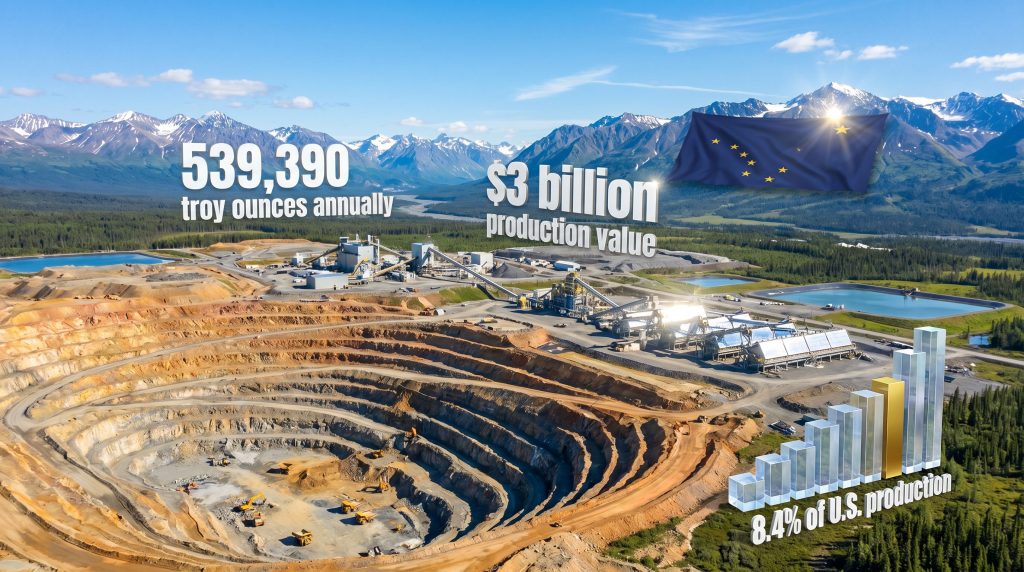
Alaska's position as the second-largest gold-producing state generates substantial economic activity across multiple operational scales. Recent production data indicates annual output of approximately 535,000 troy ounces, representing roughly 8.4% of total United States gold production according to U.S. Geological Survey mineral commodity summaries.
Furthermore, the gold market performance has influenced investment decisions across Alaska's mining sector. The cumulative historical production since large-scale mining began in the 1880s totals approximately 49.3 million troy ounces, establishing Alaska's significance within global gold mining contexts.
This output has supported approximately 4,500 direct mining employment positions, with economic multiplier effects generating an additional 6,750 indirect jobs across transportation, equipment supply, and support services. Moreover, record high gold prices have enhanced project economics throughout the region.
Mineral Distribution Across Geological Districts
Gold mineralisation occurs within distinct geological settings across Alaska, each requiring specialised extraction approaches and technological solutions:
Interior Alaska Deposits: The Fairbanks mining district contains both hard rock and placer resources within the Yukon-Tanana Terrane. Cretaceous granitic intrusions host orogenic gold systems characterised by quartz-carbonate veining and disseminated sulphide mineralisation.
Southeast Alaska Occurrences: Metamorphic terranes contain hydrothermal deposits associated with Tertiary plutonic activity. These systems typically exhibit lower grades but substantial tonnages suitable for large-scale open-pit extraction methods.
Western Alaska Prospects: Sedimentary and volcanic sequences host both epithermal and intrusion-related gold systems. Limited infrastructure development has constrained production from these areas despite significant resource potential.
Advanced Extraction Technologies and Processing Systems
Modern gold mining in Alaska operations employ sophisticated technological frameworks designed to maximise recovery efficiency while maintaining environmental compliance standards. These systems represent significant evolution from historical prospecting methods, incorporating precision engineering and real-time monitoring capabilities.
Additionally, the broader mining industry evolution influences technological adoption across Alaska's operations. Contemporary mining practices benefit from advances in automation and environmental monitoring.
Mechanised Placer Mining Innovations
Contemporary placer operations utilise integrated wash plant configurations capable of processing 100-400 cubic yards per hour depending on material characteristics and equipment specifications. GPS-guided excavation systems reduce operational waste by optimising material handling and minimising unnecessary earthmoving activities.
Advanced sluice box designs incorporate specialised riffle configurations engineered to capture fine gold particles in the 50-200 micron range. Modern riffle materials include:
- Expanded metal riffles: Providing turbulent flow characteristics for enhanced particle capture
- Hungarian riffle systems: Creating specific velocity gradients for improved gold retention
- Nomad matting: Utilising synthetic fibres designed for fine gold recovery applications
Trommel classification systems separate material by size before processing, improving overall plant efficiency by directing appropriately sized material to optimal recovery circuits. These rotating cylindrical screens reduce processing bottlenecks and increase throughput capacity during limited operational seasons.
Hard Rock Mining and Processing Methodologies
Underground operations employ cut-and-fill mining techniques that achieve ore recovery rates exceeding 95% while maintaining geotechnical stability in variable rock conditions. This method involves extracting ore in horizontal slices, with each void backfilled using waste rock or processed tailings before advancing to the next mining level.
Ore processing incorporates multiple concentration stages:
- Primary crushing: Reducing run-of-mine ore to minus-6-inch fragments
- Ball mill grinding: Achieving 80% passing 100 mesh for mineral liberation
- Gravity concentration: Using spirals and shaking tables for initial gold recovery
- Flotation processing: Concentrating sulphide minerals containing locked gold
- Pressure oxidation: Breaking down refractory sulphides to expose gold for cyanidation
- Carbon-in-pulp recovery: Achieving final gold extraction rates of 85-95%
Cyanidation systems employ sodium cyanide solutions to dissolve gold into stable complexes, followed by activated carbon adsorption and electrowinning to produce doré bars. Tailings management includes neutralisation circuits and water treatment systems to ensure discharge compliance with environmental regulations.
Environmental Monitoring and Automation Integration
Real-time monitoring systems track critical operational parameters including:
- Material throughput rates: Optimising plant efficiency and identifying processing bottlenecks
- Recovery performance: Monitoring gold capture across multiple circuit stages
- Environmental compliance: Automated water quality testing and reporting systems
- Equipment condition: Predictive maintenance protocols reducing unplanned downtime
Advanced SCADA systems enable remote monitoring of operations during harsh weather conditions, maintaining production continuity whilst ensuring worker safety and environmental protection.
Automated environmental controls include pH monitoring in tailings facilities, real-time water treatment adjustments, and emergency shutdown protocols activated when parameters exceed regulatory thresholds.
Major Operating Facilities and Production Analysis
Alaska's gold mining landscape features several large-scale operations that define the industry's technological capabilities and economic significance. These facilities demonstrate varying approaches to resource extraction whilst navigating environmental and logistical challenges unique to Arctic mining conditions.
Fort Knox Mine Operations Profile
Located in the Fairbanks mining district, Fort Knox operates as Alaska's largest gold producer under Kinross Gold Corporation management. The facility processes approximately 45,000-50,000 tons of ore daily through open-pit extraction and heap leach recovery systems.
Operational Characteristics:
- Annual Production: 300,000-350,000 troy ounces
- Workforce: 425 direct employees plus 150-200 seasonal contractors
- Processing Capacity: 16.4 million tons per year
- Average Grade: 0.67 grams per ton
- Mine Life: Operations projected through 2030 with potential underground extension
The operation utilises pressure oxidation technology to process refractory ore containing gold locked within sulphide minerals. This advanced processing method achieves gold recovery rates exceeding 90% from ore that would be unsuitable for conventional processing techniques.
Pogo Mine Underground Operations
Operated by Sumitomo Metal Mining Alaska, Pogo represents Alaska's primary underground gold mine located approximately 75 miles northeast of Fairbanks. The facility employs cut-and-fill mining methods to extract ore from narrow, high-grade veins.
Technical Specifications:
- Annual Output: 180,000-220,000 troy ounces (recent years)
- Daily Processing: 2,200 tons per day
- Average Grade: 11.2 grams per ton
- Mining Method: Mechanised cut-and-fill with paste backfill
- Recovery Rate: 92-94% through flotation and cyanidation
Underground development utilises modern ventilation systems and automated materials handling to maintain production efficiency in permafrost conditions. The operation demonstrates successful adaptation of conventional mining techniques to extreme climate conditions.
Kensington Mine Southeast Alaska
Hecla Mining Company operates Kensington as an underground mine on Admiralty Island near Juneau. The facility accesses ore through a 2,000-foot-deep shaft system serving multiple mining levels.
Production Metrics:
- Annual Production: 90,000-120,000 troy ounces
- Workforce: 350-380 personnel
- Processing Rate: 1,000 tons per day
- Reserve Base: 4.5 million ounces proven and probable
- Infrastructure: Deep water port access enabling year-round shipping
The operation benefits from Southeast Alaska's maritime climate, allowing extended operational seasons compared to interior placer mining. Underground mining minimises surface environmental impact whilst accessing high-grade ore bodies.
Placer Mining Sector Performance
Approximately 150 active placer operations contribute significantly to Alaska's total gold production. These operations range from small-scale family enterprises to large mechanised mining companies processing thousands of cubic yards daily.
Large placer operations employ sophisticated equipment including CAT 390 excavators, 777 articulated haul trucks, and custom wash plants processing 200-400 cubic yards per hour. These operations demonstrate remarkable efficiency given seasonal constraints limiting active mining to 120-150 days annually.
Environmental Challenges and Regulatory Framework
Gold mining in Alaska operates within stringent environmental regulations designed to protect wilderness areas, water resources, and wildlife habitats. These requirements significantly influence operational design, processing methods, and long-term mine planning decisions.
However, understanding mining permitting insights proves crucial for successful project development. Environmental compliance requires comprehensive planning and significant financial commitments.
Seasonal Operational Constraints and Permafrost Management
Placer mining faces unique challenges due to Arctic climate conditions that limit active mining seasons. Permafrost conditions require specialised thawing techniques before excavation can commence, typically extending preparation periods by 30-45 days.
Seasonal Mining Calendar:
- April-May: Thawing operations and equipment mobilisation
- June-September: Active mining and processing operations
- October: Equipment winterisation and site preparation
- November-March: Planning, maintenance, and permitting activities
Water availability becomes critical during dry summer periods, requiring operators to maintain adequate water storage systems or develop alternative processing methods. Some operations employ closed-loop water recycling systems achieving 85-90% water reuse rates.
Permafrost management techniques include:
- Steam thawing: Using steam generators to soften frozen ground
- Ground stripping: Removing insulating vegetation to accelerate natural thawing
- Water flooding: Creating thaw ponds to penetrate permafrost layers
- Cold water mining: Processing frozen material without complete thawing
Water Use and Discharge Regulations
Alaska Department of Environmental Conservation enforces strict water quality standards for mining operations. Discharge permits require comprehensive monitoring of suspended solids, pH levels, turbidity, and metals concentrations.
Settling pond systems must demonstrate 90% suspended solids removal efficiency before water discharge. Multi-stage treatment systems typically include primary settling, flocculation, secondary clarification, and polishing ponds.
Land Disturbance and Reclamation Planning
Mining operations must submit detailed reclamation plans before permit approval, demonstrating post-mining land use compatibility with surrounding ecosystems. Reclamation bonds ensure financial resources for site restoration regardless of operational success.
Reclamation activities include:
- Topsoil stockpiling: Preserving organic soil layers for final reclamation
- Revegetation programmes: Establishing native plant species adapted to local conditions
- Stream restoration: Reconstructing natural drainage patterns and fish habitat
- Long-term monitoring: Tracking vegetation success and water quality for 5-10 years post-closure
Successful reclamation projects in Alaska have demonstrated that properly managed mining sites can achieve ecosystem functionality comparable to pre-mining conditions within 10-15 years.
Modern operations increasingly employ concurrent reclamation techniques, restoring mined areas whilst continuing extraction in adjacent zones. This approach reduces total disturbance footprints and accelerates site recovery timelines.
Furthermore, mine reclamation evolution demonstrates advancing techniques for environmental restoration.
Emerging Development Projects and Future Production Potential
Several large-scale projects currently in development phases could significantly expand Alaska's gold production capacity over the next decade. These projects represent billions of dollars in potential investment and demonstrate continued confidence in Alaska's geological potential despite operational challenges.
Donlin Gold Project Development Analysis
Located in western Alaska approximately 280 miles northwest of Anchorage, Donlin Gold represents one of the largest undeveloped gold deposits globally. The project features estimated reserves of 33.9 million ounces of proven and probable gold within a measured and indicated resource base of 54 million ounces.
Project Specifications:
- Total Investment: Estimated $7.4 billion initial capital requirement
- Annual Production: 1.1 million ounces during first five years
- Mine Life: 27+ years based on current reserve estimates
- Processing Capacity: 53,500 tons per day
- Average Grade: 2.09 grams per ton over mine life
Development challenges include constructing 315 miles of natural gas pipeline, building port facilities, and establishing workforce housing for 3,000+ personnel. The project requires collaboration between Barrick Gold Corporation and Newmont Corporation, demonstrating the scale of resources needed for Arctic mining development.
Environmental permitting has involved extensive consultation with local communities and environmental agencies. The project represents potential economic transformation for western Alaska whilst requiring careful balance of development benefits and environmental protection.
Livengood Gold Project Assessment
International Tower Hill Mines owns the Livengood project located 70 miles northwest of Fairbanks. The deposit contains estimated measured and indicated resources of 20.6 million ounces, positioning it among Alaska's most significant potential developments.
Technical Characteristics:
- Resource Base: 20.6 million ounces measured and indicated
- Average Grade: 0.61 grams per ton
- Processing Method: Conventional open-pit with heap leach processing
- Infrastructure Access: Proximity to existing road networks and power transmission
- Development Timeline: Subject to permitting completion and financing arrangements
The project's location within established mining infrastructure reduces development costs compared to remote deposits requiring extensive infrastructure construction. Proximity to existing power lines and transportation networks provides significant economic advantages.
Palmer Project and Other Advanced Prospects
Constantine Metal Resources advances the Palmer project in Southeast Alaska, featuring high-grade copper-zinc-silver-gold mineralisation. While primarily a base metals project, gold content contributes substantially to overall project economics.
Additional projects advancing through development stages include:
- Pebble Project: Massive copper-gold porphyry system with significant gold resources
- Tetlin Gold Project: Advanced exploration stage with defined resource estimates
- Money Knob Deposit: Part of the larger Livengood project area
- Nixon Fork: Historic mine with expansion potential and updated resource estimates
These projects collectively represent over 100 million ounces of gold resources in various development stages, indicating substantial long-term production potential for Alaska's mining industry.
The next major ASX story will hit our subscribers first
Investment Analysis and Market Position Evaluation
Alaska's gold mining sector presents unique investment characteristics combining substantial resource endowments with operational complexities that influence risk-return profiles. Understanding these factors enables informed evaluation of investment opportunities within this specialised market segment.
Production Expansion Scenarios and Market Impact
Current production of approximately 535,000 ounces annually positions Alaska as a significant regional producer with potential for substantial expansion. Development of major projects could increase output by 1.5-2.0 million ounces annually within the next decade.
These expansion scenarios assume successful project development, environmental permitting completion, and adequate financing availability. Market demand for gold and commodity price trends significantly influence project economics and development timing.
Risk Assessment Framework for Alaskan Operations
Investment evaluation must consider multiple risk categories unique to Arctic mining environments:
Operational Risk Factors:
- Climate constraints: Seasonal limitations reducing operational flexibility
- Infrastructure costs: Remote locations requiring substantial support investments
- Permafrost conditions: Technical challenges increasing development complexity
- Workforce logistics: Limited local labour requiring expensive mobilisation programmes
Regulatory and Environmental Risks:
- Permitting delays: Complex approval processes extending development timelines
- Environmental liability: Long-term monitoring and reclamation cost obligations
- Policy changes: Evolving regulations affecting operational permits and costs
- Community relations: Indigenous land rights and local opposition potential
Market and Financial Risks:
- Gold price volatility: Commodity price fluctuations affecting project economics
- Currency exposure: CAD/USD exchange rate impacts for cross-border operations
- Capital availability: Limited financing sources for large Arctic projects
- Operating cost inflation: Remote location cost premiums and supply chain constraints
Successful Alaskan gold mining investments typically require risk premiums of 15-25% above comparable operations in more accessible jurisdictions, reflecting operational complexity and environmental constraints.
Investment Strategy Considerations
Different investment approaches suit varying risk tolerances and capital requirements:
Large-Scale Development Projects:
- High capital requirements ($1-10 billion)
- Extended development timelines (5-15 years)
- Potential for substantial returns but significant execution risk
- Suitable for major mining companies with Arctic experience
Operating Mine Acquisitions:
- Moderate capital requirements ($50-500 million)
- Immediate cash flow generation potential
- Known operational parameters reducing geological risk
- Appropriate for mid-tier mining companies seeking production growth
Placer Mining Operations:
- Lower capital requirements ($1-20 million)
- Seasonal cash flow patterns requiring working capital management
- Limited expansion potential but lower technical risk
- Attractive for regional operators and private investors
Exploration and Development Companies:
- High-risk, high-reward investment profiles
- Significant value creation potential during successful exploration
- Substantial dilution risk through equity financings
- Suitable for speculative investors and resource-focused funds
Recreational Mining and Tourism Integration
Alaska's recreational gold mining sector contributes significantly to local economies whilst providing public access to historical mining areas. These activities support tourism development and maintain cultural connections to the state's mining heritage.
Public Access Programmes and Designated Mining Areas
State and federal land management agencies maintain designated recreational mining areas where individuals can prospect using hand tools and small-scale mechanised equipment. These areas provide controlled access to gold-bearing gravels whilst protecting sensitive environmental areas.
Major Recreational Mining Locations:
- Cooper Landing (Kenai Peninsula): Designated public mining area with guided tour operations
- Chicken Creek (Interior Alaska): Historic placer district with public access permits
- Nome Beach Areas: Tidal zone prospecting opportunities during summer months
- Chena River Recreation Area: Accessible location near Fairbanks with developed facilities
Recreational mining regulations typically limit equipment to:
- Hand tools: Pans, shovels, pickaxes, and small sluice boxes
- Mechanical aids: Small suction dredges under 4-inch diameter
- Metal detectors: Subject to land use restrictions and permit requirements
- Rockers and high-bankers: With appropriate water use permits
Commercial Tourism Operations
Professional guide services offer recreational mining experiences for visitors seeking authentic Alaska adventures. These operations combine historical education with hands-on prospecting activities.
Tourism mining operations provide:
- Equipment rental: Pans, classifiers, and instruction materials
- Professional guidance: Techniques instruction and safety supervision
- Claims access: Privately held mining claims opened for recreational use
- Educational programmes: Geological and historical interpretation services
Annual participation estimates indicate approximately 15,000-20,000 visitors engage in recreational gold mining activities, generating $8-12 million in economic activity across rural communities.
Economic Impact on Rural Communities
Recreational mining supports local businesses through equipment sales, lodging, restaurants, and transportation services. Many rural communities depend on seasonal mining tourism for significant portions of annual revenue.
Small communities like Chicken and Central derive 30-50% of summer economic activity from recreational mining tourism, demonstrating the importance of maintaining public access to traditional mining areas.
Employment opportunities include:
- Guide services: Seasonal employment for local residents
- Equipment rental: Supporting sporting goods and outfitter businesses
- Transportation: Bush pilot services and ground transportation providers
- Hospitality: Lodges, restaurants, and camping facility operators
Historical Context and Industry Evolution
Alaska's gold mining heritage spans over 140 years of technological evolution, economic cycles, and cultural development. Understanding this historical progression provides context for current operations and future industry development patterns.
Klondike Gold Rush Legacy and Infrastructure Development
The 1896 Klondike Gold Rush fundamentally transformed Alaska's transportation networks and settlement patterns. Although the primary deposits were located in Canada's Yukon Territory, Alaska served as the primary access route for prospectors travelling to the gold fields.
Transportation Route Development:
- Chilkoot Trail: 33-mile mountain passage from Dyea to Bennett Lake
- White Pass Route: Alternative route from Skagway with railroad construction
- All-Water Route: Yukon River transportation from St. Michael through Alaska
- Richardson Highway: Military road connecting Valdez to interior mining camps
Town establishment during this period created permanent settlements that continue serving modern mining operations:
- Skagway: Port city and gateway to interior mining districts
- Fairbanks: Founded in 1901 following gold discovery on Pedro Creek
- Nome: Established during 1899 beach gold rush on Seward Peninsula
- Juneau: Developed around Treadwell and Alaska-Juneau mines
Technological Evolution and Production Milestones
Mining technology advancement reflects broader industrial development and adaptation to Arctic conditions:
Peak Production Periods:
- 1906: Annual output reached 1.066 million ounces during Nome beach mining boom
- 1940: Wartime production peaked at 755,900 ounces supporting strategic metal needs
- 1990s: Modern industrial mining achieved consistent 500,000+ ounce annual production
Cultural and Economic Legacy Systems
Gold mining established cultural patterns and economic structures that continue influencing contemporary Alaska society:
Settlement Patterns: Mining camps evolved into permanent communities with distinct cultural characteristics reflecting diverse immigrant populations from Scandinavia, Eastern Europe, and Asia.
Transportation Infrastructure: Mining-driven road and rail development created the backbone for modern Alaska transportation systems, including the Alaska Railroad and highway networks.
Regulatory Framework Evolution: Early environmental damages led to progressive development of mining regulations that now serve as models for sustainable resource extraction in sensitive ecosystems.
The transition from individual prospecting to corporate mining operations demonstrates Alaska's adaptation to changing economic conditions whilst maintaining its frontier mining culture.
Frequently Asked Questions About Alaska Gold Mining
What Makes Alaska's Gold Deposits Unique Compared to Other Regions?
Alaska's geological setting creates distinctive mineralisation patterns through complex tectonic processes. The convergence of Pacific and North American plates generates extensive hydrothermal systems, whilst Pleistocene glaciation redistributed primary deposits into high-grade placer concentrations.
Key characteristics include:
- Diverse deposit types: Both hard rock lode deposits and placer concentrations
- High-grade placer deposits: Glacial concentration creating exceptional placer richness
- Multiple geological terranes: Various formation processes creating diverse mineralisation styles
- Permafrost preservation: Natural refrigeration protecting fine gold from weathering
How Long Does the Mining Season Last in Different Areas?
Mining seasons vary significantly based on geographic location and elevation:
Interior Alaska (Fairbanks District):
- Placer operations: May through September (120-150 days)
- Hard rock mines: Year-round operations with winter preparations
Southeast Alaska:
- Mining season: April through October (180-210 days)
- Maritime climate: Extended seasons compared to interior regions
Western Alaska (Nome Region):
- Beach mining: June through September (90-120 days)
- Permafrost constraints: Shortest operational seasons requiring intensive summer activity
What Are the Main Environmental Concerns for Alaska Mining?
Environmental protection focuses on several critical areas:
Water Quality Protection:
- Preventing acid mine drainage from sulphide-bearing rocks
- Controlling suspended sediments in surface water discharge
- Managing processing chemicals and preventing groundwater contamination
Wildlife Habitat Conservation:
- Protecting salmon spawning areas and migration corridors
- Minimising disturbance to caribou migration routes and feeding areas
- Preserving critical habitat for threatened and endangered species
Land Use Management:
- Limiting surface disturbance footprints through efficient mine planning
- Implementing progressive reclamation during active mining phases
- Ensuring long-term site stability and ecosystem restoration
Can Individuals Still Mine for Gold in Alaska?
Yes, individuals can legally prospect and mine for gold in Alaska through several pathways:
Public Land Opportunities:
- State and federal recreational mining areas open to hand prospecting
- Mineral rights available through competitive bidding on state lands
- Beach mining permits for certain coastal areas during specified seasons
Private Land Access:
- Lease agreements with private landowners holding mineral rights
- Partnership arrangements with established mining operations
- Purchase of existing mining claims through private transactions
Regulatory Requirements:
- Alaska Department of Natural Resources permits for mechanised equipment
- Environmental compliance for water use and land disturbance activities
- Reclamation bonding for operations exceeding specified disturbance thresholds
Most successful individual operations focus on placer mining using small-scale mechanised equipment during summer seasons. Modern individual miners typically process 10-50 cubic yards daily using portable wash plants and recovery systems.
Want to Capitalise on Alaska's Gold Mining Opportunities?
Discovery Alert's proprietary Discovery IQ model delivers instant notifications on significant ASX mineral discoveries, helping investors identify actionable opportunities in gold and other precious metals sectors before the broader market responds. Explore historic examples of exceptional discovery returns and begin your 14-day free trial today to gain a market-leading advantage in mineral investment opportunities.