May 20, 2026
The Geopolitical Architecture of Critical Mineral Dependencies
Global supply chains for advanced manufacturing increasingly depend on critical mineral resources that exhibit concentrated geographic production patterns. China's rare earth industrial strategy demonstrates how strategic resource control creates systemic vulnerabilities across defense systems, renewable energy infrastructure, and semiconductor manufacturing. Understanding these dependencies requires analysing both technical processing requirements and geopolitical leverage mechanisms that shape international trade relationships.
When big ASX news breaks, our subscribers know first
Strategic Control Through Industrial Consolidation
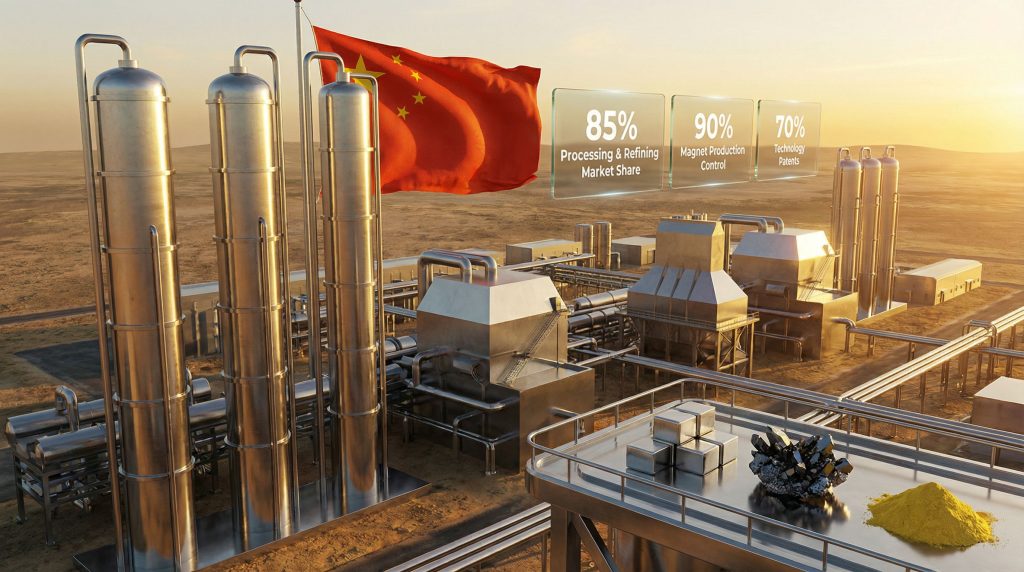
China's rare earth industrial strategy operates through coordinated state enterprise consolidation that extends far beyond traditional mining operations. This approach creates integrated production ecosystems spanning extraction, chemical processing, materials engineering, and advanced manufacturing applications. Furthermore, the strategy prioritises downstream value creation over raw material exports, establishing technical barriers that Western competitors struggle to replicate.
Industrial Integration Metrics
| Processing Stage | Technical Complexity | Investment Requirements |
|---|---|---|
| Mining Operations | Moderate | $100-500 million |
| Chemical Separation | High | $500 million – $2 billion |
| Magnet Manufacturing | Very High | $1-5 billion |
| Advanced Applications | Extreme | $5-20 billion |
The Baogang Group's January 2026 strategic planning session demonstrated this consolidation approach through its emphasis on becoming a world-class enterprise through rare earth industrial leadership and vertically integrated manufacturing services. In addition, the company's 15th Five-Year Plan explicitly targets expansion into advanced materials and integrated solution services rather than focusing solely on extraction activities.
Technology Self-Reliance and Innovation Pathways
China's rare earth industrial strategy prioritises autonomous technological development across separation chemistry, magnetic material fabrication, and specialised alloy production. This technological self-reliance reduces foreign dependency while creating additional competitive barriers for international market entrants. Moreover, the approach encompasses both process innovation and product development across multiple application sectors.
Recent strategic developments emphasise deepened state-directed research and development alongside proprietary technology advancement. The Baogang Group's planning documents specifically highlight technology self-reliance as reinforcing China's rare earth industrial strategy through consolidated processing capacity and coordinated industrial policy implementation.
Key Technology Development Areas:
- Separation Chemistry Optimisation: Advanced solvent extraction processes for heavy rare earth elements
- Magnetic Material Engineering: High-performance permanent magnet compositions for electric vehicle applications
- Recycling Technology Innovation: Closed-loop recovery systems for rare earth elements from end-of-life products
- Digital Process Integration: Automated production control systems for quality consistency
Geographic Consolidation Through Integrated Production Hubs
The "two rare earth bases" concept represents strategic geographic consolidation designed to create full-chain production hubs spanning extraction, separation, materials engineering, and advanced manufacturing applications. This concentration strategy maximises operational efficiency while maintaining centralised quality control and security oversight across the entire supply chain.
Baogang Group's role as the primary industrial backbone for accelerating construction of these integrated bases demonstrates how state-owned enterprises coordinate geographic consolidation efforts. Consequently, the approach creates centralised technical expertise while reducing transportation costs between processing stages.
The geographic concentration model allows for intensive knowledge sharing between processing stages while creating economies of scale that reduce per-unit production costs across the supply chain.
Export Control Mechanisms as Strategic Leverage Tools
Export restrictions on rare earth elements function as calibrated geopolitical instruments that demonstrate supply disruption capabilities while providing negotiation leverage in broader trade relationships. These controls target specific elements essential for advanced manufacturing applications, creating pressure points across multiple industrial sectors.
However, the growing geopolitical mining landscape creates significant challenges for Western supply chains, particularly given China's dominant position. Furthermore, US–China trade war impacts continue to influence rare earth market dynamics and strategic planning decisions.
Export Control Implementation Strategy:
- Selective Element Targeting: Focus on heavy rare earth elements with limited alternative sources
- Graduated Implementation: Phased restrictions allowing market adaptation periods
- Temporary Suspension Mechanisms: Reversible controls that maintain customer relationships
- Technical Specification Requirements: Quality standards that favour established suppliers
The strategic calculus behind these restrictions extends beyond immediate economic considerations to encompass demonstration effects. According to industry analysis, these controls showcase China's ability to influence global manufacturing timelines and production costs.
Western Supply Chain Diversification Challenges
Alternative rare earth supply development faces significant technical and economic barriers that limit near-term diversification success. These challenges include specialised processing expertise requirements, substantial infrastructure capital needs, extended permitting timelines, and environmental compliance costs that exceed those in established production regions.
Critical Development Bottlenecks:
- Technical Expertise Gaps: Limited global knowledge base for efficient separation processes
- Infrastructure Investment: Multi-billion dollar facility requirements for competitive production
- Regulatory Compliance: Extended environmental review processes in Western jurisdictions
- Workforce Development: Shortage of experienced rare earth processing technicians
- Market Access: Established customer relationships favouring incumbent suppliers
Development timelines for alternative supply sources typically require 8-12 years from initial investment through commercial production, creating extended vulnerability periods for Western industrial planning. Even successful projects often operate at smaller scales than established Chinese facilities, limiting cost competitiveness.
The next major ASX story will hit our subscribers first
Industrial Sector Impact Analysis
Defense and Aerospace Applications
Military applications require the highest-grade rare earth materials with stringent quality specifications that limit supplier alternatives. China's control over heavy rare earth element processing particularly affects precision-guided munitions, advanced radar systems, and next-generation aircraft components. Research indicates that defense contractors face extended qualification processes for new suppliers that can require 3-5 years for critical applications.
Renewable Energy Infrastructure Dependencies
Wind turbine generators and electric vehicle motors depend heavily on high-performance permanent magnets containing neodymium, dysprosium, and terbium. China's dominance in magnet production creates supply vulnerabilities for clean energy deployment timelines. Consequently, energy transition minerals face increasing scrutiny from policymakers seeking strategic autonomy.
Solar panel manufacturing also requires various rare earth elements for inverter systems and battery storage applications. Furthermore, the critical minerals pivot strategy emphasises the importance of securing reliable supply chains for renewable energy infrastructure.
Electronics and Semiconductor Supply Chains
Consumer electronics manufacturing requires consistent supplies of multiple rare earth elements for display technologies, battery systems, and processing components. Supply disruptions can cascade through global electronics supply chains, affecting smartphone production, data centre equipment, and automotive electronic systems. The semiconductor industry faces particular challenges due to just-in-time inventory management and complex supply chain coordination requirements.
Long-Term Strategic Scenario Analysis
Scenario: Continued Chinese Market Dominance
Under scenarios where China's rare earth industrial strategy maintains current market positions, global industries will likely adapt through strategic inventory increases, premium pricing acceptance, and gradual technology substitution where technically feasible. This scenario favours Chinese economic interests while constraining Western industrial flexibility and increasing production costs across affected sectors.
Adaptation Mechanisms:
- Strategic stockpiling by major manufacturers
- Long-term supply contracts with premium pricing
- Investment in alternative technology development
- Increased supply chain risk management capabilities
Scenario: Successful Western Supply Diversification
Successful diversification efforts could gradually reduce Chinese leverage over 10-15 year timelines but require sustained government support, private investment coordination, and technological development acceleration. This scenario involves higher costs and extended development periods but offers greater supply security for critical applications.
Success Requirements:
- Coordinated government investment programs
- Technology transfer and workforce development
- Environmental regulation optimisation
- Market access guarantees for new suppliers
Scenario: Hybrid Dependency Models
The most probable outcome involves partial diversification that reduces but does not eliminate Chinese dependencies. Western countries may develop domestic capabilities for critical defense applications while maintaining Chinese suppliers for commercial applications, creating tiered supply chain structures with differentiated security levels.
Strategic Response Frameworks for Stakeholders
Government Policy Recommendations
Western governments should prioritise strategic stockpiling programmes, coordinated research funding for alternative technologies, and international cooperation in rare earth processing capability development. Trade policies must balance supply security concerns with economic efficiency considerations while avoiding protectionist measures that could accelerate trade conflicts.
Policy Priority Areas:
- Strategic Reserve Programmes: Government stockpiles for critical applications
- Research and Development Funding: Alternative technology and recycling innovation
- International Cooperation: Allied nation supply chain coordination
- Regulatory Streamlining: Expedited permitting for critical mineral projects
Corporate Strategy Adaptations
Manufacturing companies should develop supply chain resilience through diversified sourcing strategies, strategic inventory management, and investment in alternative technologies. Risk assessment frameworks should incorporate geopolitical scenarios and supply disruption probabilities while maintaining cost competitiveness requirements.
Additionally, AI in mining innovation presents opportunities for improving processing efficiency and reducing dependency on traditional supply chains through enhanced resource discovery and extraction techniques.
Investment Implications for Resource Markets
Rare earth mining and processing projects outside China command premium valuations due to strategic importance, despite higher operational costs compared to established Chinese facilities. Investors should evaluate projects based on strategic value and government support levels rather than traditional economic metrics alone.
Investment Evaluation Criteria:
- Government backing and strategic importance
- Technical feasibility and processing capabilities
- Market access and customer base development
- Environmental and regulatory risk assessment
Future Market Evolution Pathways
Technology Development Trajectories
Ongoing research into recycling technologies, substitution materials, and processing efficiency improvements may gradually reduce Chinese competitive advantages. However, these developments require sustained investment and face technical challenges that limit near-term commercial impact. Advanced recycling could eventually provide 20-30% of rare earth demand by 2035.
Geopolitical Evolution Scenarios
Future trade relationships between China and Western countries will significantly influence rare earth market dynamics. Cooperation scenarios could reduce supply security concerns through negotiated access agreements, while continued tensions may accelerate diversification efforts despite substantially higher costs.
Market Structure Transformation
The rare earth industry may evolve toward regional supply chains serving specific geographic markets rather than the current globally integrated structure. This transformation would increase production costs but improve supply security for critical applications, particularly in defense and infrastructure sectors.
Regional Hub Development:
- North American processing capabilities
- European Union strategic autonomy initiatives
- Asia-Pacific alternative supply networks
- Recycling and urban mining expansion
Disclaimer: This analysis includes projections and scenarios based on current trends and available information. Actual market developments may differ significantly from these assessments due to technological changes, policy shifts, or unforeseen geopolitical events.
Want to Capitalise on Critical Mineral Market Opportunities?
Discovery Alert's proprietary Discovery IQ model delivers real-time alerts on significant critical mineral discoveries across the ASX, helping investors identify actionable opportunities as geopolitical supply chain tensions create new market dynamics. Begin your 30-day free trial today to position yourself ahead of the market in this strategically important sector.