July 23, 2026
Geopolitical Energy Dependencies: The Structural Challenge of Continental Supply Security
European energy markets operate within a complex framework of geopolitical dependencies that extend far beyond simple supplier-customer relationships. The continent's natural gas requirements create strategic vulnerabilities that influence broader economic and security policies across multiple dimensions. Understanding these dependencies requires examining how energy infrastructure decisions made decades ago continue to shape current strategic options and how energy transition challenges compound these complexities.
The challenge facing European policymakers involves balancing immediate energy security needs against long-term strategic autonomy objectives. This balance becomes particularly complex when considering the infrastructure investments required to support alternative supply routes and the regulatory frameworks that govern energy trade relationships.
Critical Dependency Factors:
• Infrastructure lock-in effects from historical investment patterns
• Regulatory compliance costs affecting supplier viability
• Geopolitical leverage dynamics between supplier and consumer regions
• Market concentration risks from limited alternative sources
• Transportation cost differentials across delivery methods
When big ASX news breaks, our subscribers know first
Current Supply Matrix and Concentration Risk Analysis
The EU natural gas diversification strategy operates within a fundamentally constrained supply environment where traditional pipeline networks must interface with expanding LNG import infrastructure. Current import patterns reveal significant concentration risks that challenge the effectiveness of diversification efforts.
Pipeline Gas Import Structure:
| Supplier | Market Share | Strategic Assessment |
|---|---|---|
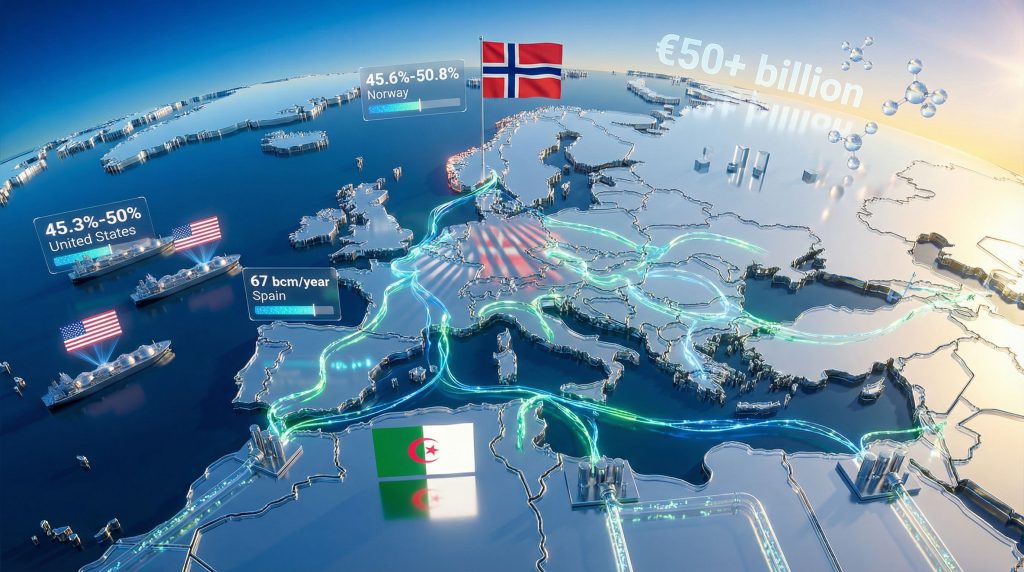
| Norway | 45.6%-50.8% | Weather-dependent reliability |
| Algeria | 19.3% | Mediterranean corridor expansion |
| Russia | 16.6% | Scheduled elimination by 2027 |
| Azerbaijan | Growing | Trans-Caspian potential |
LNG Import Concentration Analysis:
| Supplier | Market Share | Risk Profile |
|---|---|---|
| United States | 45.3%-50%+ | Single-source dependency risk |
| Qatar | Significant | Regulatory compliance conflicts |
| Russia | 17.5% | Sanctions phase-out timeline |
| Other suppliers | Fragmented | Limited capacity scaling |
The concentration of LNG imports from the United States creates a strategic dependency that European officials increasingly recognise as problematic. This dependency becomes particularly concerning when considering the regulatory barriers that limit access to other major LNG suppliers due to methane emissions monitoring requirements.
Infrastructure Transformation Requirements
European gas infrastructure requires comprehensive reconfiguration to support genuine diversification objectives. Current capacity limitations and geographical constraints create bottlenecks that limit the effectiveness of supplier diversification strategies, particularly as energy export challenges globally affect supply chain reliability.
Regional LNG Terminal Capacity:
• Spain: 67 bcm/year regasification capacity (Mediterranean hub strategy)
• France: 40 bcm/year capacity (Atlantic gateway positioning)
• Germany: 11 bcm/year under construction (Baltic Sea access)
• Italy: Adriatic expansion projects in development
• Netherlands: North Sea terminal capacity upgrades
Pipeline Network Modernisation Priorities:
• Southern Gas Corridor expansion from Caspian sources
• Adriatic backbone connecting Balkan suppliers to Western Europe
• Bulgaria-Romania interconnector capacity increases
• Bidirectional flow capabilities for emergency management
• Hydrogen-ready infrastructure preparation for energy transition
The infrastructure transformation requires coordinated investment across multiple member states while addressing technical compatibility issues between different gas quality specifications and pressure systems.
Regulatory Framework Conflicts and Compliance Barriers
EU natural gas diversification faces fundamental conflicts between environmental regulations and supply security objectives. The methane emissions regulation creates compliance barriers that effectively eliminate major global suppliers from consideration.
Methane Tracking Impact Assessment:
• Excluded suppliers: Major US producers, QatarEnergy operations
• Compliance infrastructure: Continuous monitoring and reporting systems
• Supply chain costs: Additional verification and certification requirements
• Market limitations: Reduced LNG availability meeting EU standards
"The EU simultaneously pursues supplier diversification while implementing environmental standards that eliminate the world's largest LNG exporters from full compliance consideration."
Energy Commissioner Dan Jørgensen's recent statements acknowledge growing European concerns about excessive dependence on US LNG supplies. However, the regulatory framework creates a contradiction where diversification goals conflict with environmental compliance requirements, limiting practical alternatives to current supply arrangements.
Regulatory Compliance Cost Structure:
| Cost Category | Impact Level | Strategic Implications |
|---|---|---|
| Monitoring Infrastructure | High | Technology investment requirements |
| Certification Processes | Medium-High | Administrative overhead costs |
| Supply Chain Verification | High | Limited compliant supplier options |
| Reporting Systems | Medium | Ongoing operational expenses |
Economic Trade-offs and Cost Structure Evolution
EU natural gas diversification involves significant economic trade-offs that extend beyond simple price comparisons to encompass infrastructure investments, contract flexibility, and long-term strategic positioning costs. Furthermore, US-China trade impacts on global energy markets add another layer of complexity to pricing considerations.
Diversification Cost Analysis:
• LNG price premiums: 20-40% above pipeline gas equivalent pricing
• Infrastructure investments: Estimated €50+ billion requirement for capacity expansion
• Contract flexibility costs: Higher exposure to spot market price volatility
• Compliance expenses: Methane tracking and verification overhead
The trade agreement commitment involving $250 billion in US energy imports through 2027 creates contractual obligations that may conflict with diversification objectives. European officials acknowledge that actual import values have fallen significantly short of these targets, creating potential diplomatic complications.
Financial Structure Implications:
EU member states face increasing energy costs while attempting to reduce dependency on dominant suppliers. The economic burden of diversification includes both direct procurement costs and indirect expenses related to infrastructure development and regulatory compliance.
Alternative Supplier Assessment and Strategic Viability
Evaluating potential gas suppliers for EU natural gas diversification requires comprehensive risk assessment incorporating political stability, infrastructure capacity, regulatory alignment, and strategic relationship factors. Additionally, trade war supply chain impacts must be considered when assessing supplier viability.
Tier 1 Strategic Suppliers (High Reliability Assessment):
• Norway: Proven delivery reliability, shared regulatory frameworks, mature infrastructure
• Algeria: North African proximity, existing pipeline connections, expansion potential
• Canada: Potential future LNG supplier, regulatory alignment possibilities
Tier 2 Emerging Options (Medium-Term Development Potential):
• Eastern Mediterranean: Israel, Cyprus, Egypt coordination projects
• West Africa: Nigeria, Senegal LNG development initiatives
• Australia: Distance limitations, primary Asian market focus
Tier 3 Constrained Suppliers (Limited Strategic Application):
• Qatar: Methane regulation conflicts, Middle East exposure risks
• Russia: Comprehensive sanctions elimination timeline
• Iran: International sanctions regime limitations
The assessment reveals limited viable alternatives to current US LNG dominance, particularly when considering volume requirements and regulatory compliance constraints.
The next major ASX story will hit our subscribers first
Strategic Scenario Modeling for Diversification Pathways
Multiple scenarios exist for achieving EU natural gas diversification, each presenting distinct risk-reward profiles and implementation challenges. Strategic scenario analysis reveals the complexity of achieving meaningful supplier diversity within current constraints, particularly given US natural gas forecasts suggesting continued market volatility.
Scenario 1: Mediterranean Integration Strategy
• Primary focus: Algeria, Libya, Eastern Mediterranean coordination
• Implementation timeline: 2026-2030 development period
• Capacity potential: 40-50 bcm/year additional supply
• Risk factors: Regional political instability, infrastructure vulnerability
Scenario 2: Atlantic LNG Diversification
• Primary focus: Canada, compliant US producers, West African sources
• Implementation timeline: 2027-2032 capacity development
• Capacity potential: 60-80 bcm/year supply capability
• Risk factors: Development delays, cost escalation pressures
Scenario 3: Accelerated Energy Transition
• Primary focus: Green hydrogen, biomethane, demand reduction strategies
• Implementation timeline: 2025-2035 transformation period
• Impact potential: 30-40% natural gas demand displacement
• Risk factors: Technology scaling challenges, economic viability questions
Each scenario requires substantial coordination between EU member states and significant financial commitments for infrastructure development and supply contract arrangements.
Implementation Framework and Policy Coordination
Successful EU natural gas diversification requires coordinated policy implementation across multiple dimensions, balancing immediate security requirements with long-term strategic objectives. Moreover, aligning these efforts with the EU's phased ban on Russian gas imports adds urgency to diversification efforts.
Priority Implementation Areas:
- Regulatory harmonisation: Resolve methane tracking conflicts through tiered compliance frameworks
- Infrastructure acceleration: Fast-track LNG terminal and pipeline projects under EU funding mechanisms
- Diplomatic strengthening: Develop comprehensive energy partnerships with reliable supplier regions
- Market integration: Enhance internal EU gas connectivity and emergency sharing protocols
- Transition coordination: Align gas diversification with renewable energy acceleration timelines
Success Measurement Framework:
• Supplier concentration ratios maintained below 40% for individual sources
• Infrastructure utilisation rates exceeding 70% for new capacity investments
• Price volatility reduction compared to current LNG market exposure
• Emergency supply capability covering 90-day disruption scenarios
The framework requires balancing competing priorities between environmental regulations, supply security, economic competitiveness, and geopolitical considerations.
Long-term Strategic Implications for European Energy Sovereignty
EU natural gas diversification represents a fundamental shift toward energy sovereignty that extends beyond immediate supply security to encompass broader economic independence and geopolitical positioning objectives. However, as outlined by the European Commission's diversification strategy, achieving these objectives requires sustained commitment and strategic coordination.
Strategic Outcome Assessment:
• Energy sovereignty development: Reduced vulnerability to supplier political pressure and manipulation
• Economic competitiveness maintenance: Stable pricing through diversified supply portfolio management
• Climate alignment achievement: Natural gas as bridge fuel supporting renewable energy transition
• Geopolitical influence enhancement: Improved negotiating position with global energy suppliers
The success of European natural gas diversification efforts will ultimately determine the continent's ability to maintain economic competitiveness while pursuing climate transition objectives and achieving meaningful geopolitical independence in an increasingly complex global energy landscape.
Critical Considerations for Future Development
The EU faces a fundamental challenge in reconciling diversification objectives with regulatory constraints and economic realities. Current policies create contradictions that limit practical alternatives to existing supply arrangements, requiring strategic reassessment of priorities and implementation approaches.
European policymakers must address the tension between environmental compliance requirements and supply security needs while developing infrastructure capacity to support genuine diversification. Consequently, the timeframe for achieving meaningful supplier diversity appears longer and more complex than initially anticipated, requiring sustained political commitment and substantial financial resources across multiple member states.
Ready to Capitalise on Energy Transition Opportunities?
Discovery Alert's proprietary Discovery IQ model delivers real-time alerts on significant mineral discoveries essential for energy infrastructure development, instantly empowering subscribers to identify actionable opportunities ahead of the broader market. Explore how major mineral discoveries have generated substantial returns for early investors and begin your 14-day free trial today to position yourself ahead of the market.