August 13, 2026
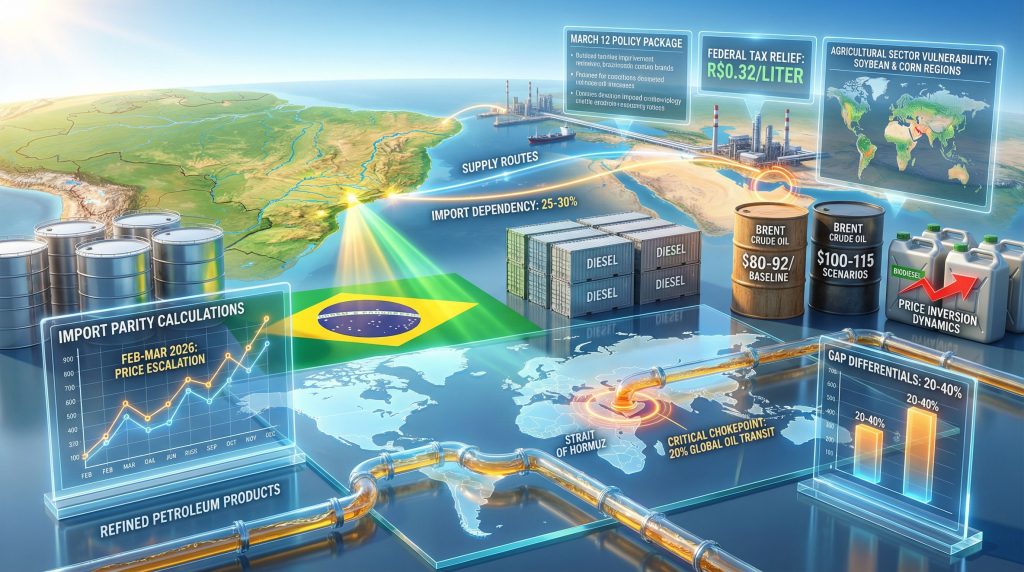
Global energy markets operate within an intricate web of interdependencies where regional conflicts can trigger cascading price disruptions across continents. The contemporary petroleum landscape demonstrates how supply chain vulnerabilities in strategically important regions create systematic risks that extend far beyond initial conflict zones. Understanding these transmission mechanisms becomes essential for energy importers who must navigate volatile pricing environments while maintaining domestic fuel security, as demonstrated by the iran war impact on brazil diesel prices during the recent Middle Eastern conflict.
Understanding the Geopolitical Energy Price Transmission Mechanism
Middle East Supply Chain Vulnerabilities and Global Diesel Markets
The strategic importance of Middle Eastern energy corridors cannot be overstated in global petroleum markets. When refined product flows through critical maritime chokepoints face disruption, the immediate effect reverberates through international pricing mechanisms with remarkable speed and intensity.
Recent market analysis reveals that S10 diesel prices escalated by 45% within an 11-day period from February 28 to March 10, 2026, demonstrating the acute sensitivity of refined product markets to supply disruption signals. This price acceleration occurred as market participants struggled to secure firm procurement contracts amid rapidly fluctuating maritime freight costs and intensifying global demand competition.
The transmission mechanism operates through multiple channels simultaneously. Primary supply route disruptions create immediate demand pressure on alternative sources, particularly from US Gulf Coast and Russian origins. This demand diversion generates competitive bidding for available volumes while freight rates experience parallel inflation due to route diversification requirements.
Market participants reported significant challenges obtaining reliable price quotations during acute volatility periods. The breakdown of normal price discovery mechanisms reflects how geopolitical disruptions can temporarily suspend conventional market operations, creating information gaps that amplify price uncertainty across the supply chain.
Brazil's Strategic Energy Import Dependencies
Brazil's petroleum product import profile reveals fundamental structural vulnerabilities that amplify exposure to external price shocks. The country imported 2.7 billion litres (288,000 barrels per day) of diesel during January-February 2026, representing a 17% increase compared to the same period in the previous year.
This import dependency creates direct exposure to international pricing volatility, particularly given Brazil's reliance on multiple geographic supply sources. The diversified sourcing strategy that typically provides supply security paradoxically increases vulnerability during widespread market disruptions when all alternative sources experience simultaneous price pressures.
Forward supply visibility remains limited to approximately 3-4 week horizons during normal market conditions. Around 1.5 billion litres of diesel was expected to arrive in March 2026, according to shipping analytics data, illustrating the tight supply chain management requirements that leave little buffer capacity during disruption periods.
Import terminal infrastructure at major ports including Paranaguá, Itaqui, and Santos operates with differentiated pricing structures that reflect regional logistics costs and storage capacity constraints. These port-specific variations become magnified during supply disruptions as terminal utilisation rates approach capacity limits.
When big ASX news breaks, our subscribers know first
What Makes Brazil's Diesel Market Particularly Vulnerable to External Shocks?
Structural Import-Export Dynamics
Brazil's unique position as both petroleum product importer and exporter creates complex market dynamics that amplify vulnerability to external price shocks. The country simultaneously imports refined products to meet domestic demand while exporting crude oil and some refined products to international markets.
This dual role generates internal policy tensions between domestic price stability objectives and international market revenue optimisation. During price shock periods, these competing interests create policy decision complexities that can delay market adjustment responses.
The agricultural sector's seasonal demand patterns add another layer of vulnerability. Brazil's continental geography requires extensive distribution networks to serve agricultural regions during planting and harvest seasons. These seasonal demand peaks occur at predictable intervals, creating supply planning challenges that become acute during international market disruptions.
Key Vulnerability Factors:
- Dual importer-exporter status creating policy conflicts
- Seasonal agricultural demand variations
- Continental distribution network requirements
- Limited strategic reserve capacity
- Multiple supply source dependencies
Currency and Pricing Mechanism Complexities
Exchange rate fluctuations between the Brazilian real and US dollar introduce additional volatility layers to import pricing calculations. International petroleum products trade primarily in US dollars, making Brazilian importers vulnerable to both commodity price movements and currency depreciation pressures.
The import parity pricing mechanism becomes particularly complex during market disruptions when normal correlation patterns between crude oil prices and refined product margins break down. Traditional pricing models that rely on historical spread relationships lose predictive accuracy during acute volatility periods.
Petrobras' domestic pricing policy framework must balance shareholder value maximisation with national energy security considerations. This balancing act becomes increasingly difficult during international price spikes when domestic price adjustments lag international market movements, creating import parity gaps that signal market dysfunction.
Analysing the February-March 2026 Price Shock Timeline
Pre-Conflict Market Conditions
Brazilian Diesel Market Baseline (February 2026)
| Metric | Value | Context |
|---|---|---|
| Import Volumes | 2.7 billion litres | Jan-Feb 2026 period |
| Year-over-Year Growth | +17% | Compared to 2025 |
| Forward Supply Visibility | 3-4 weeks | Normal market conditions |
| Expected March Arrivals | 1.5 billion litres | Shipping analytics data |
The pre-conflict period demonstrated relatively stable market conditions with predictable supply flows and manageable price volatility. Import parity calculations remained within normal ranges, allowing distributors to maintain standard procurement strategies without significant hedging requirements.
Market participants operated under conventional risk management frameworks that assumed continuous supply availability from primary source regions. Forward contract structures reflected this assumption through standard pricing mechanisms and delivery terms.
Conflict-Driven Market Disruption Analysis
The initiation of military operations on February 28, 2026 marked an immediate inflection point in global refined product pricing dynamics. The interruption of Persian Gulf fuel exports created instantaneous demand pressure on alternative supply sources, particularly affecting deliveries to Europe, Central America, and South America.
Price Movement Analysis:
- February 28: Conflict initiation date
- March 6: S10 diesel at Paranaguá reached R$5,173/m³
- March 6: Biodiesel averaged R$4,656/m³
- March 10: 45% price escalation completed
- Price inversion: Diesel exceeded biodiesel for first time since October 2023
The speed of price transmission reflects the efficiency of modern commodity markets in processing geopolitical risk information. Electronic trading platforms and algorithmic price discovery mechanisms accelerated the incorporation of supply disruption expectations into forward curve structures.
Furthermore, freight rate volatility became a critical transmission mechanism as shipping costs experienced dramatic increases. Russian diesel offers showed discounts of 11.5 cents per gallon from benchmark futures, while other origins traded at 3.5 cent discounts, reflecting the 8 cent per gallon freight cost differential between supply sources. This complex pricing environment illustrates how an oil price crash analysis becomes crucial during periods of geopolitical uncertainty.
How Are Import Parity Gaps Creating Market Distortions?
The Economics of Diesel Import Arbitrage
Import parity gaps represent fundamental market dislocations that signal pricing mechanism failures during supply disruptions. The inversion where diesel import prices exceeded biodiesel contract prices created unprecedented arbitrage opportunities that market participants struggled to exploit due to supply availability constraints.
The R$517 per cubic metre gap between imported S10 diesel (R$5,173/m³) and biodiesel contracts (R$4,656/m³) on March 6, 2026, represented approximately a 10% pricing premium that would typically generate immediate substitution behaviour under normal market conditions.
However, the theoretical arbitrage opportunity remained largely unexploitable due to supply chain disruptions and procurement uncertainty. Market participants prioritised supply security over cost optimisation, leading to suboptimal pricing outcomes that persisted longer than economic theory would predict.
Regional Price Differentiation Patterns
Port-specific pricing variations became magnified during the supply disruption as terminal capacity constraints and regional logistics costs created significant price spreads between import locations. The Paranaguá terminal pricing reached premium levels compared to other ports, reflecting both storage capacity limitations and regional demand pressures.
Regional Price Impact Factors:
- Port storage capacity utilisation rates
- Distance-weighted transport costs to consumption regions
- Regional demand concentration patterns
- State-level tax policy variations
- Infrastructure bottleneck locations
The geographic dispersion of Brazil's major consumption centres creates natural price differentiation based on transportation costs from import terminals. During supply disruptions, these differentials widen as logistics networks operate at capacity limits and alternative routing becomes necessary.
Government Policy Response Framework and Economic Implications
Federal Tax Relief Mechanisms
Government intervention during energy price crises typically follows predictable patterns designed to provide immediate consumer relief while maintaining fiscal discipline. The policy response framework encompasses multiple intervention mechanisms including tax adjustments, subsidy programmes, and regulatory modifications.
Brazil's comprehensive diesel relief measures eliminated R$0.32 per litre in federal PIS/Cofins taxes while implementing matching producer subsidies, delivering total R$0.64 per litre pump price reductions alongside export restrictions and enhanced regulatory oversight protocols, according to industry sources.
The dual approach of tax relief and producer subsidies reflects recognition that single-instrument policies often create unintended market distortions. By combining consumer-focused tax reductions with producer-targeted support mechanisms, policymakers attempt to maintain market functionality while providing price relief.
Export restriction considerations become important when domestic prices significantly exceed international parity levels. These restrictions prevent arbitrage exports that would exacerbate domestic supply shortages but may create tensions with international trade commitments and reduce foreign exchange earnings.
Strategic Petroleum Reserve and Supply Security
Brazil's Hydrocarbons Regulator (ANP) maintained that fuel activities and supply remained normalised despite international market disruptions, indicating that strategic inventory management successfully buffered domestic markets from immediate supply interruptions.
The regulatory monitoring framework operates on multiple levels including daily supply tracking, forward contract monitoring, and early warning systems designed to identify potential supply disruptions before they affect domestic markets. This proactive approach enables policy interventions during the early stages of international market stress.
Supply Security Monitoring Indicators:
- Daily import arrival tracking
- Port terminal storage levels
- Distribution network flow rates
- Regional inventory balances
- Forward contract fulfilment rates
Cross-border cooperation mechanisms with neighbouring countries provide additional supply security options during extended disruption periods. These arrangements typically involve reciprocal emergency supply agreements and coordinated strategic reserve releases.
Biodiesel Market Dynamics and Alternative Fuel Economics
The Unprecedented Diesel-Biodiesel Price Inversion
The price relationship inversion between fossil diesel and biodiesel represents a fundamental shift in fuel economics that occurs only during extreme market conditions. The previous comparable event during August-October 2023 involved Russian export restrictions and domestic supply bottlenecks, providing historical context for current market dynamics.
Historical Price Comparison:
- August-October 2023: S10 diesel reached R$5,015/m³, biodiesel traded at R$4,316/m³
- March 2026: S10 diesel reached R$5,173/m³, biodiesel averaged R$4,656/m³
- Price gap evolution: From R$699/m³ (13.9%) in 2023 to R$517/m³ (10%) in 2026
The current inversion demonstrates relatively smaller absolute price gaps compared to the 2023 event, suggesting either improved market adjustment mechanisms or different underlying supply disruption characteristics. The reduced gap may indicate enhanced biodiesel production capacity or improved supply chain resilience compared to previous crisis periods.
This price relationship directly influences Brazil's biodiesel blending mandate economics, currently set at 15% with proposed increases under the fuels of the future legal framework. The mandate increase timeline faces technical feasibility testing requirements scheduled between August 2026 and January 2027.
Biofuel Production Capacity and Feedstock Availability
Brazil's biodiesel manufacturing infrastructure demonstrates significant production capacity that becomes economically advantageous during fossil fuel price spikes. The sector's lobbying efforts for increased blending mandates gain political momentum during price inversion periods as the economic case for renewable fuel substitution becomes compelling.
Soybean oil and other feedstock markets experience parallel price movements that affect biodiesel production economics. During periods when diesel prices exceed biodiesel costs, feedstock demand increases, potentially creating upward pressure on agricultural commodity prices and affecting food supply chains.
The environmental and energy security co-benefits of increased biodiesel utilisation become particularly relevant during geopolitical supply disruptions. Enhanced domestic renewable fuel capacity reduces import dependency and provides strategic energy security advantages that extend beyond pure economic considerations.
The next major ASX story will hit our subscribers first
Sectoral Impact Assessment Across Brazil's Economy
Agricultural Sector Vulnerability Analysis
Brazil's agricultural sector represents one of the most diesel-intensive economic segments, creating direct exposure to fuel price volatility that affects both production costs and food security. The sector's seasonal demand patterns coincide with critical planting and harvest periods where fuel availability becomes essential for maintaining agricultural productivity.
Regional agricultural variations create differentiated exposure levels across Brazil's farming regions. Soybean and corn production areas in Mato Grosso and Rio Grande do Sul demonstrate different logistical profiles and diesel consumption patterns that result in varying vulnerability to supply disruptions.
Agricultural Diesel Consumption Factors:
- Seasonal planting and harvest timing
- Regional crop mix variations
- Equipment mechanisation levels
- Transportation distance requirements
- Storage and processing facility needs
The timing of international supply disruptions relative to agricultural seasons becomes critical for assessing economic impact severity. Disruptions during peak agricultural periods create magnified effects compared to off-season periods when fuel demand remains relatively stable. These patterns demonstrate how energy export challenges affect broader agricultural competitiveness in global markets.
Transportation and Logistics Cost Transmission
Brazil's trucking industry serves as the primary mechanism for diesel price transmission throughout the broader economy. Transportation cost increases affect virtually all economic sectors through logistics price adjustments that flow through supply chains to final consumer prices.
Interstate commerce patterns demonstrate how fuel price shocks propagate across Brazil's continental geography. Long-haul trucking routes between major economic centres become particularly vulnerable to fuel cost increases that affect regional price competitiveness and trade flow patterns.
Urban public transportation systems face immediate margin compression during fuel price spikes, creating pressure for fare adjustments or government subsidies to maintain service levels. These adjustments often lag fuel price increases, creating temporary financial stress for transportation operators.
Petrobras Strategic Positioning and Market Power Dynamics
Domestic Pricing Policy vs. International Parity
Petrobras operates within complex policy frameworks that balance commercial objectives with national energy security responsibilities. The company's pricing decisions significantly influence domestic market dynamics while affecting shareholder value and government fiscal considerations.
Historical precedent analysis demonstrates varying response patterns during previous international price shock periods. The company's decision-making process incorporates multiple stakeholder considerations including domestic inflation impacts, international market competitiveness, and strategic energy security objectives.
Policy Decision Framework:
- Domestic price stability objectives
- International market revenue optimisation
- Shareholder value considerations
- Government fiscal impact assessments
- Strategic energy security priorities
The tension between market-based pricing and administered price mechanisms becomes acute during international volatility periods when rapid price adjustments conflict with domestic stability objectives.
Refining Capacity Utilisation and Export Revenue Optimisation
Brazil's refining infrastructure operates with capacity utilisation decisions that affect both domestic supply availability and export revenue generation. During international price spike periods, the trade-off between domestic market supply and export revenue optimisation becomes particularly pronounced.
Strategic inventory management during price volatility requires sophisticated forecasting capabilities that account for both domestic demand patterns and international market timing considerations. The optimal balance between current sales and inventory accumulation depends on price volatility expectations and supply security requirements.
Refinery maintenance scheduling faces potential disruption during extended price volatility periods as the opportunity cost of reduced production increases significantly. However, operational safety and regulatory compliance requirements limit flexibility in maintenance timing adjustments.
Inflation Transmission Mechanisms and Monetary Policy Implications
Energy Price Pass-Through to Consumer Inflation
Inflation Impact Scenarios
| Oil Price Scenario | Estimated Inflation Impact | Timeline |
|---|---|---|
| $100/barrel sustained | +1.5-2.0 percentage points | 3-6 months |
| $115/barrel extended | +2.5-3.0 percentage points | 6-12 months |
| Return to $85/barrel | Neutral to deflationary | 2-4 months |
Energy price transmission to broader consumer inflation operates through multiple channels including direct fuel costs, transportation price adjustments, and indirect effects through production cost increases across economic sectors. The magnitude and timing of these effects vary significantly based on the duration and severity of initial price shocks.
Brazil's inflation deceleration to 3.81% annually in February 2026 provided favourable baseline conditions that could help absorb energy price increases without triggering broader inflationary acceleration. Transport costs contributed to monthly inflation gains even before the major international disruption, suggesting underlying sensitivity to energy price movements.
Food and beverage costs, which carry significant weight in Brazil's consumer price index, demonstrated relative stability with annual rates declining to 1.76% in February from 2.20% in January. This stability could provide inflation offset capacity if energy price increases remain contained to transportation and direct fuel categories.
Central Bank Policy Response Considerations
Brazil's central bank maintained its target interest rate at 15% since June 2025, reflecting commitment to inflation control amid various economic pressures. Energy price shock responses require careful calibration to avoid overreacting to temporary external factors while maintaining credible anti-inflation commitment.
Currency intervention strategies become relevant when import cost increases threaten to generate sustained inflationary pressures. Exchange rate stability during energy price shocks can significantly reduce the domestic currency impact of dollar-denominated petroleum product imports.
Monetary Policy Consideration Factors:
- Temporary vs. permanent price shock duration
- Second-round inflation effect risks
- Exchange rate stability requirements
- Economic growth impact assessments
- Inflation expectation management needs
Communication strategy for inflation expectation management becomes critical during external price shock periods when public attention focuses intensely on fuel price movements and their broader economic implications.
Regional Comparison: How Other Emerging Markets Handle Energy Price Volatility
Comparative Policy Response Analysis
India's fuel subsidy mechanisms provide alternative models for managing energy price volatility through fiscal interventions that absorb international price movements before they reach consumers. The fiscal sustainability of such approaches depends on government financial capacity and oil price volatility duration.
Mexico operates energy price stabilisation funds that accumulate resources during favourable price periods to finance consumer price support during adverse conditions. These counter-cyclical mechanisms require sophisticated fund management and political commitment to maintain reserves during tempting fiscal expansion opportunities.
Indonesia implements targeted subsidy programmes that focus support on lower-income segments while allowing market pricing for higher-income consumers. This approach reduces fiscal costs compared to universal subsidies while maintaining social protection objectives.
Best Practices in Energy Security and Price Stabilisation
Strategic petroleum reserve sizing and management practices vary significantly across emerging markets based on import dependency levels, fiscal capacity, and infrastructure availability. Optimal reserve levels balance storage costs against supply security benefits during various disruption scenario probabilities.
Public-private partnership models for supply security create shared responsibility frameworks where government provides strategic oversight while private sector manages commercial operations. These arrangements can improve efficiency while maintaining public policy objective alignment.
Energy Security Best Practices:
- Diversified supply source management
- Strategic reserve optimal sizing
- Public-private partnership frameworks
- Regional cooperation mechanisms
- Early warning system development
Regional cooperation frameworks for energy resilience enable collective response mechanisms that provide enhanced supply security through mutual support agreements and coordinated strategic reserve management.
Forward-Looking Risk Assessment and Scenario Planning
Geopolitical Risk Premium Persistence Analysis
Historical analysis of Middle Eastern conflict impacts on energy markets reveals varying duration patterns that depend on conflict scope, international intervention effectiveness, and alternative supply source availability. Risk premium persistence typically follows declining patterns as markets adapt to new supply configurations and hedge fund positioning adjusts.
Market memory effects influence risk pricing evolution as previous crisis experiences shape trader behaviour and institutional risk management approaches. The current conflict's impact on future risk premium baseline levels will depend on resolution mechanisms and lasting supply infrastructure changes.
Speculative positioning impacts during geopolitical events can amplify price movements beyond fundamental supply-demand imbalances. Understanding these financial market dynamics becomes essential for assessing price movement sustainability and planning appropriate response strategies.
Brazil's Long-Term Energy Security Strategy Implications
The current supply disruption experience reinforces arguments for domestic refining capacity expansion as a strategic energy security investment. Enhanced domestic processing capability reduces import dependency for refined products while potentially creating export revenue opportunities during favourable market conditions.
Renewable energy transition acceleration could receive political momentum from current fossil fuel price volatility experiences. The demonstrated price advantage of biodiesel during international market disruptions provides compelling evidence for expanded renewable fuel capacity investment. This shift aligns with global energy security transition trends towards more resilient domestic energy systems.
Long-Term Strategic Considerations:
- Domestic refining capacity expansion economics
- Renewable fuel production scale-up requirements
- Regional energy integration opportunities
- Strategic reserve infrastructure development
- Supply source diversification optimisation
Regional energy integration opportunities with neighbouring South American countries could provide enhanced supply security through shared infrastructure development and coordinated policy approaches to external supply disruptions.
Investment and Market Outlook for Brazilian Energy Sector
Equity Market Implications for Energy Companies
Petrobras valuation faces competing pressures from international market revenue potential and domestic pricing policy constraints that limit the company's ability to capture full international price premiums. Investor assessment requires careful analysis of policy response probability and duration expectations.
Independent refiner and distributor margin analysis reveals significant volatility during supply disruption periods as import parity gaps create both opportunities and risks depending on inventory positioning and supply contract terms. Companies with strategic inventory capacity benefit from price volatility while those dependent on spot market procurement face margin compression.
Renewable energy investment acceleration potential increases during periods when fossil fuel price volatility demonstrates the economic advantages of domestic renewable capacity. Biodiesel production capacity expansion becomes particularly attractive when price inversion conditions persist.
Currency and Commodity Market Interconnections
Real depreciation pressures from higher import costs create feedback loops that amplify the domestic currency impact of international energy price increases. Currency hedging strategies become essential for companies with significant dollar-denominated import exposure.
Agricultural commodity export competitiveness faces potential impacts from higher domestic fuel costs that affect production and transportation expenses. The balance between domestic fuel cost increases and international commodity price movements determines net competitiveness effects.
Foreign direct investment flows in energy infrastructure may accelerate as international investors recognise enhanced returns available from Brazilian energy security investments. Strategic infrastructure development becomes more attractive when supply security carries premium valuations.
Brazil's Position in Global Energy Market Dynamics
OPEC Influence and South American Energy Relations
Brazil's unique position outside OPEC membership provides both advantages and challenges during global supply disruptions. While the country avoids production quotas that constrain OPEC members, it also lacks the collective bargaining power and market influence that comes with cartel membership.
The coordination between OPEC+ decisions and Brazil's energy policy becomes particularly relevant during crisis periods when global production adjustments could either alleviate or exacerbate supply pressures. Understanding OPEC production impact helps Brazilian policymakers anticipate market developments and adjust strategies accordingly.
South American regional energy integration offers potential alternatives to traditional supply sources during disruptions. Venezuela's vast reserves, despite political complications, represent potential long-term strategic opportunities that require careful diplomatic navigation.
International Trade Relations and Market Access
The iran war impact on brazil diesel prices demonstrates how quickly international trade relationships can affect domestic energy costs. Trade diversification strategies become essential for reducing dependence on any single supply region or trading partner.
However, trade war market effects between major economies create additional complexity for Brazilian energy procurement. When traditional suppliers face restrictions or sanctions, alternative sources often command premium prices that ultimately affect domestic consumers.
European Union energy security initiatives following recent geopolitical disruptions create new demand competition for Latin American energy exports. This competition could benefit Brazil's export revenues while potentially constraining domestic supply flexibility during crisis periods.
Conclusion: Navigating Energy Price Volatility in an Interconnected World
Key Takeaways for Policymakers and Market Participants
The February-March 2026 energy price shock demonstrates how rapidly geopolitical events can disrupt global supply chains and create significant economic impacts for importing countries. Early warning systems that provide 3-4 week supply visibility offer limited buffer capacity during acute international disruptions, highlighting the need for enhanced strategic planning capabilities.
Balanced approaches between market mechanisms and strategic intervention prove essential for managing external price shocks while maintaining long-term market functionality. Pure market-based responses may create excessive domestic economic disruption while comprehensive intervention risks creating long-term market distortions.
The trade-off between energy security investments and short-term price stability creates ongoing policy challenges that require sophisticated cost-benefit analysis incorporating both economic and strategic security considerations.
Monitoring Indicators for Continued Market Assessment
Import parity gap thresholds provide early warning signals for policy activation requirements. Gaps exceeding 20% for sustained periods typically indicate market dysfunction requiring intervention consideration.
Regional price differential patterns reveal distribution bottlenecks and infrastructure constraints that could require targeted policy responses. Monitoring these differentials enables proactive intervention before supply disruptions create localised shortages.
Critical Monitoring Framework:
- Import parity gap measurements
- Regional price differential tracking
- Strategic inventory level assessment
- Forward contract fulfilment rates
- International crude-product correlation analysis
International crude oil and product market correlation patterns during disruption periods provide insight into pricing mechanism functionality and help distinguish temporary volatility from structural market changes requiring long-term strategic adjustments.
This analysis is based on market conditions and data as of March 2026. Energy markets involve significant risks, and past performance does not guarantee future results. Readers should conduct independent analysis before making investment or policy decisions.
Want to Stay Ahead of Critical Market-Moving Discoveries?
Discovery Alert's proprietary Discovery IQ model delivers real-time alerts on significant ASX mineral discoveries, helping investors identify actionable opportunities before broader market recognition during volatile times like these energy market disruptions. Begin your 14-day free trial today and discover why major mineral discoveries can generate substantial returns by exploring our historic discoveries showcase.