August 13, 2026
When the Pipeline of Processing Breaks Down
The global energy conversation has long been dominated by upstream obsessions: reserve volumes, production quotas, drilling rates, and crude oil price trends. Yet one of the most consequential vulnerabilities in the modern fuel supply chain sits not in the oilfield but in the industrial middle layer that most energy consumers never think about. Refineries, the vast and capital-intensive facilities that transform raw crude into gasoline, diesel, and jet fuel, are now the system's critical chokepoint. And in 2026, that chokepoint is close to maximum compression.
Understanding why the global refining capacity shortage has become the defining energy market challenge of this period requires stepping back from crude supply headlines and examining the structural mechanics of how liquid fuels actually reach end users.
When big ASX news breaks, our subscribers know first
Crude Oil and Refined Products: Two Very Different Problems
There is a fundamental distinction between crude oil availability and refined product supply that most mainstream energy coverage collapses into a single narrative. Crude oil is the raw material. Refined products, including road fuels, aviation kerosene, and heating oil, are the finished goods. The refinery is the factory between them.
When refinery capacity becomes constrained, the consequences are felt at the consumer level regardless of how much crude oil sits in storage or flows through pipelines. A world with abundant crude but insufficient processing capacity still faces genuine fuel shortages. This is precisely the dynamic that has taken hold in 2026, and it represents a qualitatively different problem from the supply disruptions markets have historically navigated by releasing strategic reserves or redirecting crude shipments.
Critical Distinction: Strategic petroleum reserve releases address the upstream layer of the supply chain. They do nothing to resolve a refinery throughput bottleneck. The two interventions solve different problems, and conflating them leads to policy responses that miss the actual constraint entirely.
The Numbers Behind the Global Refining Capacity Shortage
The scale of the current global refining capacity shortage becomes clearest when measured against recent historical benchmarks. S&P Global Energy's Fuels and Refining Research team has estimated that global refinery runs were running approximately 7.5 million barrels per day below year-ago levels in July 2026, a deterioration so severe it represents one of the sharpest single-month drops in throughput seen outside of demand collapse events like the 2020 pandemic.
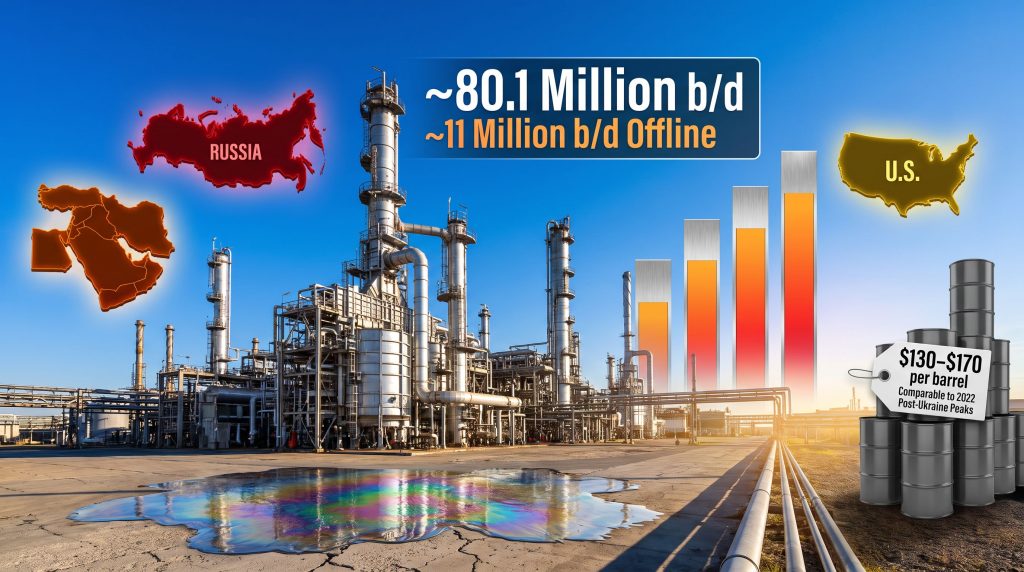
For the second half of 2026, global runs are now forecast at roughly 80.1 million barrels per day, a figure approximately 2.4 million b/d below what was projected in prior outlooks. To contextualise that gap: 2.4 million b/d is roughly equivalent to the entire refining output of a mid-sized refining nation being removed from global supply overnight. Furthermore, tracking current crude oil prices alongside these refinery figures is essential to understanding the full picture.
| Indicator | Current Level | Comparison Benchmark |
|---|---|---|
| Global refinery runs (H2 2026 forecast) | ~80.1 million b/d | 2.4 million b/d below prior outlook |
| Run deficit vs. July 2025 | ~7.5 million b/d below year-ago | Multi-decade low relative to demand |
| Global offline refinery capacity (late July) | ~11 million b/d | Rising to ~12 million b/d by October |
| War-related outages (Iran + Russia-Ukraine) | ~4.94 million b/d combined | ~9% of total global capacity |
| U.S. refinery utilization | ~95-96% | Record or near-record seasonal high |
| Refined product export decline | Down ~30% / ~4 million b/d | vs. same period in 2025 |
| Fuel prices (gasoline, diesel, jet fuel) | ~$130-170 per barrel | Comparable to 2022 post-Ukraine peaks |
Commodity analytics firm Kpler has independently characterised this situation in terms that cut to the core of the issue: refining, rather than crude, now represents the binding supply constraint in global energy markets. That framing is significant because it shifts the entire framework for understanding price formation and supply risk away from upstream variables and toward mid-stream industrial capacity. According to analysis from the EIA's global refining outlook, these structural pressures have been building for several years, making the current crisis a predictable, if severe, consequence of long-term underinvestment.
Four Layers of Pressure Creating the Current Shortage
Layer 1: Geopolitical Disruption as the Immediate Trigger
The most visible driver of the current global refining capacity shortage is conflict-driven capacity removal. Two distinct geopolitical fault lines have combined to withdraw nearly 4.94 million b/d of refining capacity from functional global supply, representing close to 9% of total global capacity. In addition, the trade war oil impacts have further complicated the supply picture across several key regions.
-
Iran conflict-related outages account for an estimated 3.52 million b/d of removed capacity, affecting Middle Eastern refining infrastructure either through physical damage, operational suspension, or logistical paralysis.
-
Russia-Ukraine war impacts have impaired approximately 1.42 million b/d of capacity, with drone strike damage driving Russian throughput to a two-decade low. Critically, Russia has transitioned in certain fuel categories from a net exporter to a domestic importer, an almost unprecedented reversal for a country that has long been a cornerstone of global diesel markets.
-
Russia's diesel export ban, which took formal effect on July 8, 2026, removed roughly 10% of global waterborne diesel supply from international markets. What makes this particularly damaging is that Russian diesel exports had already declined by approximately 500,000 b/d below prior-year levels before the ban was formally imposed, meaning the official policy action compounded an already deteriorating supply picture.
-
Strait of Hormuz disruption has suppressed China's ability to redirect its domestically surplus refining capacity toward international markets. Even where the physical refinery infrastructure exists and is operational, logistical constraints have neutered its potential as a global supply relief valve.
Layer 2: Structural Capacity Erosion Since the Pandemic
The geopolitical shocks of 2026 are landing on an industrial base that was already weakened by years of underinvestment and rationalisation. Between 2020 and 2023, a combination of demand collapse, energy transition pressure, and capital allocation shifts resulted in permanent and semi-permanent refinery closures across Europe, North America, and parts of Asia. Deferred maintenance cycles, aging plant infrastructure, and reduced capital expenditure on refining capacity during the transition debate have collectively compressed the system's operational ceiling.
The U.S. Energy Information Administration estimated global refining capacity at approximately 103.5 million b/d in 2023. Projected new capacity additions for the 2024 to 2028 period range from only 2.6 to 4.9 million b/d globally, a figure that falls well short of the combined impact of war-related outages, structural closures, and incremental demand growth occurring simultaneously.
Layer 3: Regional Operational Constraints Locking In the Shortage
Each of the world's major refining regions is contributing to the capacity deficit through distinct but overlapping mechanisms:
| Region | Key Constraint | Capacity Status | Risk Level |
|---|---|---|---|
| Middle East | Physical damage + logistics disruption | ~1.6 mb/d below 2025 levels | Critical |
| Russia | Drone strikes + export ban | Two-decade throughput low | Critical |
| China | Export quotas + Hormuz disruption | ~2.9 mb/d below year-ago | High |
| Europe | Near seasonal capacity ceiling | Multi-year seasonal highs | Moderate-High |
| United States | Hurricane + maintenance season risk | 95-96% utilization | Moderate |
| Global Aggregate | Cumulative constraint | ~11 mb/d offline (late July) | Systemic |
Middle Eastern regional crude runs are now expected to average approximately 8 million b/d in 2026, roughly 1.6 million b/d below 2025 levels. A significant share of the region's refinery capacity remains either physically impaired, logistically stranded, or unable to restart operations with sufficient operational confidence.
China, which under normal conditions represents one of the most capable incremental supply sources in global refined product markets, has been effectively neutralised. Export quotas imposed by Chinese authorities cap the volume of refined products that can leave the country, while Strait of Hormuz disruption has simultaneously constrained the crude inputs flowing into Chinese refineries from Middle Eastern suppliers. With throughput running approximately 2.9 million b/d below year-ago levels in July, China's potential as a pressure valve for the global system has been largely closed off.
Layer 4: New Capacity Growth Too Slow to Compensate
OPEC's market influence extends beyond crude production into downstream deficit projections that illustrate how long this structural problem is likely to persist. The organisation projects a refining deficit of approximately 0.5 mb/d by 2027, widening to roughly 1.6 mb/d by 2030. Given that new refinery construction typically requires five to ten years from initial planning through to commissioning, the mathematics of near-term relief are unforgiving. No pipeline of new capacity exists that could meaningfully offset current war-related outages within any commercially relevant timeframe.
The United States as the System's Last Load-Bearing Wall
With constrained conditions across the Middle East, Russia, China, and Europe simultaneously, U.S. refiners have become the single most important stabilising element in global fuel markets. S&P Global Energy's Fuels and Refining Research team has characterised American refiners as the keystone holding global product markets together at this juncture, a description that captures both their current indispensability and the fragility that comes with it.
Operating at approximately 95-96% capacity utilisation, U.S. refineries are already at what effectively represents the ceiling of sustainable operations. Running at these levels leaves almost no headroom to respond to unexpected demand spikes or supply interruptions elsewhere. The system is functioning, but it is functioning without a safety net. For a deeper perspective on this oil price volatility guide, the interplay between refinery constraints and price swings is explored in considerable detail.
Tail-Risk Warning: The Atlantic hurricane season and scheduled autumn maintenance windows represent the most immediate systemic threats to global fuel stability. Any significant unplanned outage at a major U.S. Gulf Coast refinery while the system is operating at near-maximum utilisation would remove one of the last meaningful buffers available to global markets, with limited alternative supply sources capable of compensating.
How 2026 Compares to the 2022 Refining Crisis
The fuel price levels of 2026, with gasoline, diesel, and jet fuel in the $130-$170 per barrel range, are numerically comparable to the peaks experienced following Russia's 2022 invasion of Ukraine. However, the structural context is meaningfully different, and arguably more concerning. As noted by Art Berman's refinery crisis analysis, the underlying capacity erosion driving current prices reflects a longer-term structural failure rather than a singular geopolitical event.
| Dimension | 2022 Crisis | 2026 Crisis |
|---|---|---|
| Primary trigger | Russia-Ukraine war + sanctions | Multi-front geopolitical disruptions + structural losses |
| Spare capacity availability | Limited but present | Near-exhausted across most regions |
| Key swing supplier | U.S. + Middle East incremental capacity | U.S. only (Middle East constrained) |
| China's role | Partial export release valve | Capped by quotas and shipping disruption |
| Recovery pathway | Gradual normalization | Uncertain; structural deficits through 2030 |
In 2022, markets could look to the Middle East for incremental refinery throughput increases and to China as a potential outlet for surplus refined product exports. Both of those relief mechanisms are substantially unavailable in 2026. The price signal is similar, but the underlying capacity to respond to that signal has deteriorated significantly.
The next major ASX story will hit our subscribers first
Economic Consequences: From Crack Spreads to Consumer Costs
When global refinery utilisation approaches systemic ceilings, a specific market mechanism known as the crack spread tends to widen sharply. The crack spread is the margin between the cost of crude oil inputs and the value of refined product outputs. Under normal conditions, this margin is self-correcting: high margins attract investment in throughput expansion. Under current conditions, no spare capacity exists to expand, so the price signal cannot translate into additional supply.
The downstream economic consequences of a prolonged global refining capacity shortage extend well beyond visible pump prices:
-
Aviation sector: Jet fuel at $130-$170 per barrel imposes significant cost pressure on airline operating economics, with limited ability to hedge at these price levels without compressing margins substantially.
-
Road freight and agriculture: Diesel price elevation flows directly into transport and food production costs, representing a broad inflationary transmission mechanism that reaches virtually every sector of the economy.
-
Petrochemical industries: Many chemical feedstocks are derived from refinery operations. Constrained throughput reduces feedstock availability and elevates input costs across plastics, fertilisers, and industrial chemicals.
-
Asymmetric risk: With the system operating at near-maximum utilisation across its remaining functional nodes, downside disruptions carry disproportionate consequences. A shock that would have been absorbed as a temporary price spike in a system with 5-10% spare capacity becomes a structural availability crisis when spare capacity is effectively zero.
Resolution Pathways and Their Realistic Timeframes
Short-Term Options and Their Limitations
Several response mechanisms exist on paper but face significant practical constraints:
-
Demand destruction remains the market's historical self-correction mechanism but carries severe social and political costs at current price levels.
-
Strategic petroleum reserve releases address crude availability at the upstream layer but cannot resolve a processing bottleneck downstream.
-
Maintenance deferral extends near-term output from existing facilities but compounds medium-term reliability risk by building up deferred work that must eventually be completed.
-
Shipping route diversification can partially offset logistical constraints but cannot substitute for lost physical throughput capacity.
Medium-Term Pathways
The most immediately available source of incremental refined product supply is Chinese export quota relaxation, conditional on Strait of Hormuz shipping stability being restored. If Chinese authorities were to ease export restrictions while Hormuz access normalised, markets could see 1-2 million b/d of additional supply enter international trade relatively quickly relative to the multi-year timelines associated with new refinery construction.
Geopolitical resolution in the Middle East and Ukraine remains the largest single variable in the medium-term outlook, but the timelines and probabilities associated with diplomatic outcomes are inherently uncertain.
Long-Term Structural Considerations
The energy transition has created an investment paradox that is only now becoming fully visible in operational data. Capital has been redirected away from refining infrastructure on the assumption that liquid fuel demand would decline more rapidly than has actually occurred. Meanwhile, renewable energy buildout has not yet reached the scale required to substitute meaningfully for refined product consumption in aviation, heavy freight, or petrochemicals. The result is a structural underinvestment gap that OPEC projects will manifest as a downstream deficit widening from 0.5 mb/d in 2027 to 1.6 mb/d by 2030.
Three Scenarios for H2 2026 and Beyond
Scenario A: Controlled Deterioration Geopolitical conditions persist without further escalation, U.S. refineries navigate hurricane season without major disruption, and global runs stabilise near the 80 million b/d level. Fuel prices remain in the $130-$160 per barrel range through year-end with no systemic availability crisis but sustained elevated costs across transport and industry.
Scenario B: Compounding Disruption A significant Atlantic hurricane coincides with continued Middle Eastern operational impairment. Global offline capacity rises above 12 million b/d. Fuel prices breach 2022 peaks, triggering demand destruction across price-sensitive sectors and forcing emergency policy responses in multiple major economies.
Scenario C: Partial Recovery Progress on Hormuz shipping access and Chinese export quota relaxation combine to add 1-2 million b/d of incremental refined product supply to international markets. Consequently, prices moderate toward $100-$120 per barrel by the first quarter of 2027, providing relief without resolving the underlying structural deficit.
Key Indicators to Monitor
For investors, energy planners, and policy analysts tracking the evolution of the global refining capacity shortage, the following metrics provide the most timely signal of system stress or recovery:
-
Global offline capacity trajectory: Movement toward or above 12 million b/d through Q4 2026 signals further tightening; a sustained decline toward 7 million b/d (the December projection) signals recovery.
-
U.S. refinery utilisation rate: Any sustained decline from the 95-96% ceiling indicates either demand destruction or unplanned outages, both negative signals for near-term fuel availability.
-
Crack spread levels: Widening margins confirm deepening supply stress; narrowing suggests either demand erosion or capacity recovery.
-
China export quota policy: The single most consequential near-term policy variable for incremental supply availability.
-
Strait of Hormuz shipping status: Directly governs both Middle Eastern throughput recovery and Chinese crude import normalisation.
-
Atlantic hurricane season activity: The primary near-term tail risk for the system's last functional buffer.
Frequently Asked Questions: Global Refining Capacity Shortage
What is a global refining capacity shortage?
A global refining capacity shortage occurs when the world's operational refinery infrastructure cannot process enough crude oil to meet demand for refined fuels, particularly after accounting for geopolitical outages, maintenance requirements, and structural closures. Unlike a crude oil shortage, this constraint exists at the processing layer of the energy supply chain rather than the upstream extraction layer.
How much global refining capacity is currently offline?
As of late July 2026, approximately 11 million barrels per day of global refining capacity was estimated to be offline. This figure is projected to decrease toward 10 million b/d in August before rising again to approximately 12 million b/d in October, with a subsequent decline toward 7 million b/d by December.
Why can't new refineries be built quickly to resolve the shortage?
Refinery construction is among the most capital-intensive and time-consuming industrial projects in the energy sector, typically requiring five to ten years from planning through commissioning. Projected new capacity additions for the 2024-2028 period total only 2.6-4.9 million b/d globally, insufficient to offset the combined impact of war-related outages, structural closures, and ongoing demand growth within any commercially relevant near-term timeframe.
How does the refining shortage affect fuel prices differently from a crude shortage?
When refineries operate near maximum utilisation, the system loses its ability to increase throughput in response to price incentives. Crack spreads widen, signalling that refiners are capturing elevated margins but that no additional processing capacity can be brought online to satisfy demand. Fuel prices therefore remain elevated even if crude supply is adequate, because the bottleneck exists at the conversion stage rather than at the point of extraction.
This article is intended for informational purposes only and does not constitute financial or investment advice. Forecasts, scenario projections, and market estimates referenced herein involve inherent uncertainty. Readers should conduct independent research and consult qualified financial advisers before making investment decisions. Primary data and ongoing analysis can be accessed through the U.S. Energy Information Administration at eia.gov, and through industry research published by S&P Global Energy's Fuels and Refining Research team and commodity tracking platforms such as Kpler.
Want to Stay Ahead of the Commodity Market Shifts Driving ASX Discoveries?
The energy supply disruptions reshaping global markets in 2026 are already rippling through ASX-listed resource companies, and Discovery Alert's proprietary Discovery IQ model delivers real-time alerts the moment significant mineral discoveries hit the exchange, turning complex market signals into actionable investment opportunities. Explore how historic discoveries have generated substantial returns on Discovery Alert's dedicated discoveries page, and begin your 14-day free trial today to position yourself ahead of the broader market.