
August 13, 2026
When One Refinery Moves Markets: The Alumina Supply Equation
There is a fundamental asymmetry built into the global aluminium supply chain that most investors and casual observers overlook. The metal itself attracts the headlines, but the upstream feedstock that makes it possible, alumina, operates in a far less visible market that is simultaneously more concentrated and more fragile. When a major refinery stumbles, the consequences travel rapidly downstream, repricing aluminium futures, shifting equity valuations across multiple exchanges, and exposing just how little buffer the market actually holds. The Norsk Hydro Alunorte production cut announced in August 2026 is a textbook case of how a single upstream disruption can reverberate through an entire industrial ecosystem.
Understanding why that matters requires stepping back from the event itself and examining the structural architecture of alumina refining, the specific vulnerabilities of energy-intensive industrial operations in developing-economy infrastructure corridors, and what the market's reaction reveals about conditions that existed well before the gas supply failure occurred.
When big ASX news breaks, our subscribers know first
Alunorte's Position in the Global Alumina Architecture
Alunorte, short for Alumina do Norte do Brasil S.A., is situated in Barcarena, in the Brazilian state of Pará, and operates as one of the world's largest single-site alumina refineries by nameplate capacity. Norsk Hydro, the Norwegian integrated aluminium producer, holds a controlling interest in the facility, which sits at the centre of a vertically integrated value chain stretching from bauxite mining at the Paragominas mine through to primary aluminium smelting operations elsewhere in Hydro's portfolio. Understanding the bauxite supply chain helps contextualise just how critical Alunorte's role is within this broader structure.
The refinery's strategic importance is rooted in the Bayer process, the chemical methodology through which bauxite ore is digested under high pressure and temperature using caustic soda to extract aluminium hydroxide, which is then calcined at temperatures exceeding 1,000 degrees Celsius to produce alumina. That calcination stage is extraordinarily energy-intensive, and natural gas is the primary thermal energy source for the process. This dependency is not a design flaw but a process necessity, making reliable gas supply a non-negotiable operational input rather than a variable cost that can be easily substituted.
Alunorte's output contributes meaningfully to global seaborne alumina trade. Because aluminium smelting requires approximately two tonnes of alumina to produce one tonne of finished metal, any sustained reduction in refinery output creates amplified scarcity at the smelting stage. The ratio alone explains why curtailments at large refineries carry consequences that feel disproportionate to the volume of production lost.
The Gas Supply Failure: Mechanics Behind the Norsk Hydro Alunorte Production Cut
What Triggered the Curtailment?
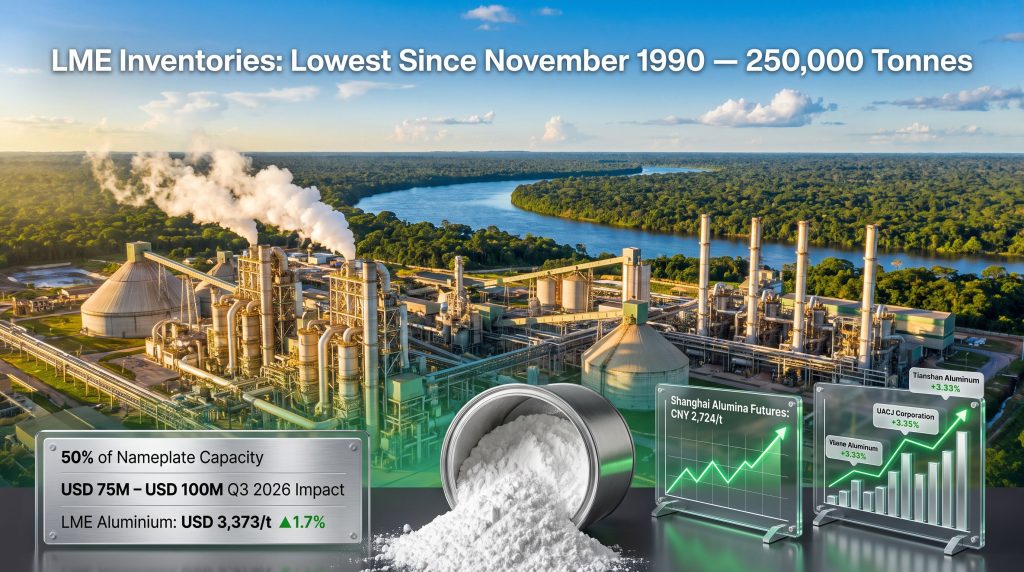
The trigger for the Norsk Hydro Alunorte production cut was a disruption to natural gas supply originating from CELBA, the refinery's contracted gas provider. Faced with insufficient energy input to sustain calcination at full throughput, Hydro made the operational decision to scale production to 50% of nameplate capacity rather than risk equipment damage from unmanaged thermal cycling or process instability.
This is a critical distinction worth emphasising:
- A 50% curtailment is not a shutdown; the refinery continues to operate and produce alumina
- However, it cannot fulfil contracted volumes at reduced throughput, creating immediate supply gaps in the spot and term markets
- Fixed costs, including labour, maintenance, and facility overhead, do not halve alongside output, meaning the financial impact per tonne of alumina produced rises sharply
Hydro's response involved two simultaneous tracks. First, the company entered spot gas markets to procure alternative supply and partially offset the CELBA shortfall. Second, it submitted a formal request for direct access to the Barcarena LNG terminal, which would provide a more stable alternative supply pathway if approved.
Why Is the Region's Infrastructure So Vulnerable?
The structural vulnerability underlying this disruption is not unique to Alunorte. Brazil's Pará region, despite hosting significant industrial capacity, faces persistent infrastructure gaps in its gas distribution network. LNG terminal access in the region is constrained, and the industrial gas supply chain depends on a relatively small number of providers. This concentration of supply risk in a geographically remote industrial corridor creates a systemic fragility that energy diversification strategies have not yet fully addressed.
Quantifying the Financial Damage
Norsk Hydro estimated the financial impact on its Bauxite and Alumina segment at between USD 75 million and USD 100 million for Q3 2026. The range reflects uncertainty around the duration of the curtailment and the effectiveness of spot gas procurement in partially restoring output.
| Financial Metric | Estimated Impact |
|---|---|
| Segment Affected | Bauxite and Alumina |
| Q3 2026 Financial Hit | USD 75M to USD 100M |
| Production Level | 50% of nameplate capacity |
| Root Cause | Natural gas supply disruption via CELBA |
| Recovery Trigger | Normalisation of gas availability |
This is not the first time Alunorte has faced a significant curtailment. In 2018, the refinery was forced to operate at reduced capacity following an environmental compliance dispute with Brazilian regulators, an episode that also generated meaningful price support in the alumina market. The 2026 disruption differs in its cause — energy infrastructure failure rather than regulatory action — but the market mechanics that follow a large-scale curtailment are broadly comparable.
The fixed cost absorption dynamic is particularly important for understanding why the financial damage is asymmetric. When output is halved but fixed costs remain largely constant, the cost per tonne of alumina produced effectively doubles for the constrained portion of capacity. This margin compression is partially offset by higher spot alumina pricing, but the net effect on segment EBITDA is material and immediate.
How the Cut Rippled Through Global Aluminium Pricing
The market's reaction to the Norsk Hydro Alunorte production cut was swift and measurable across multiple instruments. Furthermore, the scale of the price movements underscores just how exposed the aluminum and alumina markets had already become to supply-side shocks:
- LME aluminium prices rose 1.7% to USD 3,373 per tonne in the immediate aftermath of the announcement
- Shanghai alumina futures gained approximately 1% to CNY 2,724 per tonne (equivalent to roughly USD 403.92 per tonne)
- LME aluminium inventories, already at historically depleted levels, sat at approximately 250,000 tonnes, the lowest figure recorded since November 1990
That inventory figure deserves particular attention. A level of 250,000 tonnes against global annual aluminium consumption running at tens of millions of tonnes represents an extraordinarily thin physical buffer. In practical terms, this means the market has almost no capacity to absorb further supply disruptions without immediate price consequences.
"When a single refinery operating at half capacity is sufficient to move global benchmark aluminium prices by nearly 2% and push exchange inventories to a 35-year low, it reveals a market that has been running on fumes from a supply-side perspective for some time. The Alunorte event did not create tightness; it exposed tightness that was already structurally embedded."
The alumina-to-aluminium price transmission is not always linear, but in conditions of extreme inventory tightness, upstream disruptions translate to downstream pricing pressure with unusual speed. Fabricators and end-users purchasing aluminium in spot markets found themselves absorbing higher input costs within hours of the announcement. For broader context on the aluminium market impact of compounding supply pressures, the pattern follows a well-established historical precedent.
Asian Equity Market Response: Who Gained and Why
The equity market reaction across Asian exchanges illustrated a dynamic that experienced commodity investors will recognise: when upstream supply tightens and benchmark prices rise, producers with existing inventory or captive supply benefit from immediate margin expansion and inventory revaluation.
| Company | Exchange | Share Price Movement |
|---|---|---|
| China Aluminum Corp. (Chalco) | Hong Kong | +2.46% |
| China Aluminum Corp. (Chalco) | Shanghai | +1.02% |
| Tianshan Aluminum | Shanghai | +3.33% |
| Yunnan Aluminum | Shanghai | +1.06% |
| Shandong Nanshan Aluminum | Shanghai | +1.64% |
| China Hongqiao Group | Hong Kong | +1.58% |
| UACJ Corporation | Tokyo | +3.35% |
| Daiki Aluminium | Tokyo | +0.38% |
The investor logic operating here is layered. Primary aluminium producers benefit in two ways simultaneously. First, their existing aluminium inventory is revalued upward as benchmark prices rise. Second, market participants anticipate that elevated aluminium prices will persist long enough to expand forward production margins, particularly for producers with secure alumina supply arrangements.
Chinese producers with significant domestic alumina production capacity, such as Chalco and Tianshan, are structurally better insulated from seaborne alumina supply shocks than import-dependent peers. China's domestic alumina output has expanded substantially over the past decade, reducing but not eliminating its exposure to international refinery curtailments. Producers relying on imported alumina face both volume risk and the price risk of a tightening spot market simultaneously, compressing margins even as finished aluminium prices rise.
Japanese producers like UACJ, which is heavily oriented towards aluminium fabrication and relies on imported primary metal and alumina feedstock, saw strong gains reflecting investor expectations that tighter upstream supply would support the value of existing inventory and forward pricing arrangements. Consequently, the performance divergence between captive-supply and import-dependent producers was particularly pronounced across Asian exchanges in the days following the announcement.
The next major ASX story will hit our subscribers first
The Calcination Process and Why Gas Cannot Simply Be Substituted
A less-commonly understood aspect of this disruption is why natural gas cannot be rapidly replaced with alternative energy sources at a facility like Alunorte. The calcination stage of alumina refining demands precise thermal control at sustained high temperatures. Natural gas-fired rotary kilns or fluidised bed calciners are engineered for this input; retrofitting them to accept different fuel types or electrification is a capital-intensive and time-consuming undertaking, not a logistical adjustment.
This technical reality means that when gas supply fails, production must simply be curtailed. There is no rapid switching mechanism available. It also explains why Hydro's pursuit of LNG terminal access at Barcarena is significant; LNG provides a different delivery pathway for the same molecular fuel, allowing the refinery's existing equipment to continue operating without modification, provided supply can be secured at sufficient volumes and commercially viable prices in the spot market.
How Does the Disruption Cascade Through the Market?
The step-by-step cascade from energy disruption to market pricing works as follows:
- Gas supply reduction at refinery level: CELBA reduces natural gas availability, removing the thermal energy required for alumina calcination
- Production curtailment decision: Hydro scales Alunorte to 50% capacity to maintain process integrity and prevent equipment damage from uncontrolled thermal stress
- Spot market intervention: Hydro enters spot gas markets and pursues LNG terminal access as interim supply pathways
- Alumina output shortfall: Contracted and spot alumina volumes fall below market expectations, tightening seaborne supply
- Aluminium price response: LME and Shanghai futures markets reprice aluminium upward reflecting reduced upstream feedstock availability
- Equity market reaction: Asian aluminium producers see share price appreciation as investors anticipate sustained pricing power and margin expansion
- Downstream cost pressure: Aluminium fabricators and end-users absorb higher input costs as both alumina and aluminium prices rise in parallel
Broader Supply Vulnerability: Hormuz, Infrastructure, and a Market With No Slack
The Alunorte disruption does not exist in isolation. Norsk Hydro itself had flagged, in the month prior to this event, that a global aluminium supply deficit exceeding 900,000 tonnes was a plausible scenario if shipping disruptions through the Strait of Hormuz persisted. The strait is a critical transit corridor for energy commodities including the LNG feedstocks used in aluminium-adjacent industrial processes, and sustained disruption there compounds supply chain fragility across multiple industrial sectors simultaneously.
What this context reveals is that the global aluminium market in mid-2026 was operating with multiple overlapping stress factors:
- Physical LME inventory at multi-decade lows, removing the market's ability to absorb supply shocks
- Geopolitical risk around shipping corridors affecting energy and metal logistics simultaneously
- Infrastructure-driven refinery curtailments exposing concentration risk in upstream alumina supply
- Limited near-term capacity to bring new alumina refining capacity online at scale
The combination of these pressures means that events like the Norsk Hydro Alunorte production cut carry amplified consequences relative to what the same event would produce in a well-supplied, high-inventory market environment. Investors and procurement teams alike need to recalibrate their risk frameworks to account for a structurally tighter aluminium and alumina market that may persist well beyond the resolution of any single disruption.
Energy Diversification as the Long-Term Refinery Risk Response
The operational lesson from Alunorte's gas supply failure has implications extending well beyond this specific event. Large-scale alumina refineries in regions with underdeveloped energy infrastructure are increasingly recognising the need to pursue energy diversification strategies that reduce dependence on a single fuel supply contract or transmission network. In addition, alumina refining investment trends globally reflect a growing awareness that supply resilience must be built into project design from the outset.
Practical diversification pathways for facilities like Alunorte include:
- Securing direct LNG terminal access as a backup or primary supply route, decoupling from pipeline-dependent distributors
- Investing in on-site gas storage capacity to provide operational buffer during short-duration supply disruptions
- Evaluating partial electrification of lower-temperature process stages to reduce gas intensity per tonne of alumina produced
- Developing contractual redundancy through multiple gas supply agreements with different counterparties and supply routes
None of these pathways is rapid or inexpensive, but the financial cost of a single quarter of 50% curtailment — quantified by Hydro at up to USD 100 million in EBITDA impact — provides a compelling economic case for investment in supply resilience infrastructure. The top aluminium companies operating at global scale are, consequently, beginning to treat energy infrastructure access as a competitive differentiator rather than a background operational assumption.
Frequently Asked Questions: Norsk Hydro Alunorte Production Cut
What Is Alunorte and Why Does It Matter to Global Aluminium Markets?
Alunorte is one of the world's largest alumina refineries, located in Barcarena, Pará, Brazil, and operated by Norsk Hydro. It converts bauxite into alumina, the essential intermediate feedstock for primary aluminium smelting. Its scale means that any significant output disruption affects seaborne alumina trade volumes and benchmark aluminium pricing.
Why Did Norsk Hydro Cut Alunorte's Production?
The production reduction to 50% of nameplate capacity resulted from a disruption to natural gas supply from CELBA, Alunorte's contracted gas provider. Without sufficient gas to sustain thermal energy requirements for calcination, full production throughput was not operationally achievable.
How Much Will the Cut Cost Norsk Hydro Financially?
Hydro estimated the financial impact on its Bauxite and Alumina segment at between USD 75 million and USD 100 million for Q3 2026, reflecting the margin compression from elevated fixed costs against halved output volume.
How Did Aluminium Prices Respond?
LME aluminium prices rose 1.7% to USD 3,373 per tonne, while Shanghai alumina futures gained approximately 1% to CNY 2,724 per tonne following the announcement.
When Will Alunorte Return to Full Production?
Norsk Hydro indicated that full capacity resumption is contingent on the normalisation of natural gas availability. Spot gas procurement and LNG terminal access are being pursued as interim measures, but no fixed timeline has been confirmed.
What Is the Current State of LME Aluminium Inventories?
LME aluminium inventories stood at approximately 250,000 tonnes at the time of the announcement, the lowest level recorded since November 1990, reflecting sustained tightness in physical aluminium supply that predates the Alunorte curtailment.
Key Takeaways for Aluminium Market Participants in 2026
The Norsk Hydro Alunorte production cut crystallises several structural realities that investors, procurement teams, and industry analysts need to carry forward:
- A 50% curtailment at a single large alumina refinery is sufficient to move global benchmark prices by nearly 2% and lift aluminium equities across multiple Asian markets, confirming the absence of meaningful supply buffers
- The USD 75 million to USD 100 million EBITDA exposure for Hydro in a single quarter underscores the earnings sensitivity of integrated producers to upstream energy infrastructure failures
- LME inventory at its lowest point since 1990 leaves the market structurally exposed; additional supply-side shocks carry amplified pricing consequences in this environment
- Integrated Chinese producers with captive domestic alumina supply are better positioned to benefit from upstream tightness than import-dependent peers facing both volume and price risk simultaneously
- Energy infrastructure reliability is emerging as a first-order operational risk for alumina refining, not a secondary logistical consideration
- The convergence of geopolitical shipping risk, infrastructure fragility, and historically low inventories creates a market environment where supply-side events warrant closer monitoring than typical market conditions would suggest
Readers seeking additional context on global alumina market dynamics and aluminium supply chain developments can explore related industry coverage at AL Circle.
Want to Capitalise on the Next Major Commodity Supply Shock Before the Market Catches On?
Discovery Alert's proprietary Discovery IQ model delivers real-time alerts on significant ASX mineral discoveries — instantly cutting through the complexity of commodity markets like aluminium and alumina to surface actionable opportunities ahead of the broader market. Explore how historic discoveries have generated substantial returns on Discovery Alert's dedicated discoveries page, and begin your 14-day free trial today to position yourself ahead of the next major market-moving event.