June 14, 2026
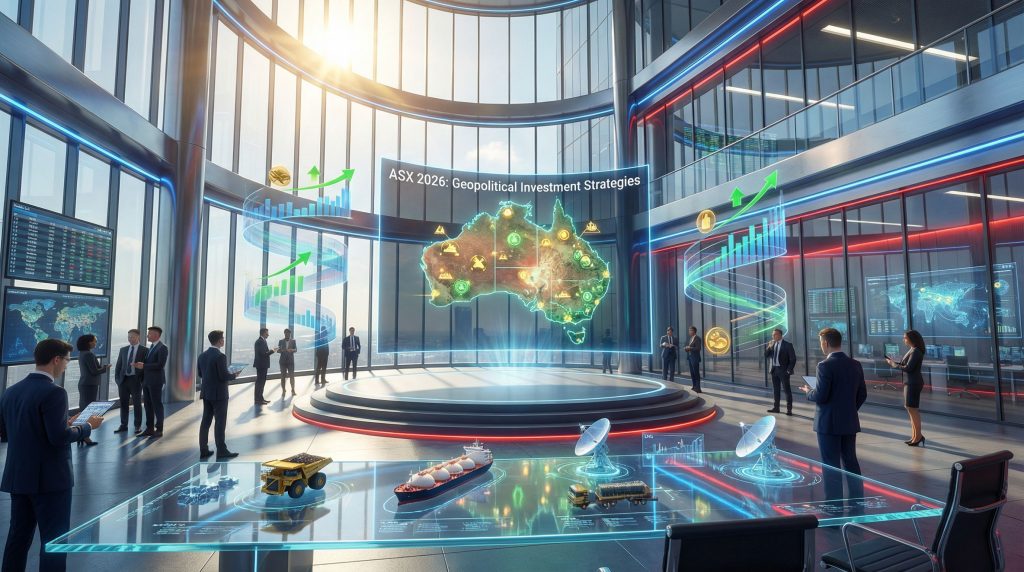
The geopolitical impact on ASX stocks has fundamentally reshaped investment strategies, with traditional market analysis proving inadequate during periods of international tension. Global supply chain vulnerabilities have emerged as a critical investment consideration, fundamentally altering how portfolio managers evaluate risk and opportunity across equity markets. Traditional valuation metrics increasingly prove inadequate when infrastructure chokepoints can instantly reprice entire sectors, forcing a wholesale reassessment of what constitutes defensive positioning in an interconnected world economy.
This transformation extends beyond temporary market volatility into structural shifts that reward companies with geographic diversification, domestic market exposure, and supply chain resilience over those optimised purely for cost efficiency. The April 2026 Strait of Hormuz blockade exemplifies how single geopolitical events can cascade through seemingly unrelated sectors, creating winners and losers based on operational geography rather than fundamental business quality.
What Makes Geopolitical Risk a Primary Driver of ASX Returns?
The fundamental shift from economic optimisation toward security prioritisation represents more than cyclical policy adjustment. Furthermore, the US‑China trade war impacts continue to influence how countries restructure trade relationships based on strategic alignment rather than comparative advantage, creating permanent changes in how global commerce operates and how investors must evaluate exposure.
Energy chokepoint vulnerabilities have become primary valuation drivers, with the Strait of Hormuz blockade demonstrating how infrastructure dependencies can instantly alter sector dynamics. The corridor typically handles approximately 20-30% of global maritime oil trade, making its disruption a systemic rather than regional event affecting global energy pricing.
Oil prices moving above US$100 per barrel following Middle East conflicts illustrate how rapidly geopolitical events transmit through commodity markets into corporate earnings. This represents a departure from gradual economic cycles toward shock-driven volatility that traditional risk models struggle to capture.
Supply chain concentration analysis has evolved from operational consideration to core investment criterion. Companies with single-country sourcing face materially different risk profiles than those with geographically diversified suppliers, creating valuation premiums for operational resilience over cost optimisation.
The emergence of trade fragmentation as structural reality means businesses must navigate tariff and quota environments where policy decisions matter as much as underlying demand fundamentals. Additionally, how tariffs impact markets demonstrates that BlueScope Steel operates in markets where protective measures influence pricing as significantly as steel demand, fundamentally altering traditional industrial analysis.
Currency volatility from safe-haven flows adds another complexity layer, as geopolitical tensions drive capital movements that can overwhelm fundamental currency drivers. This creates secondary effects on companies with international exposure, independent of their operational performance.
When big ASX news breaks, our subscribers know first
Which ASX Sectors Benefit Most from Global Instability?
Energy producers represent the most direct beneficiaries of geopolitical disruption, with companies like Woodside Energy, Santos, Beach Energy, Karoon Energy, and Cooper Energy experiencing immediate cash flow improvements from elevated commodity prices. Consequently, the OPEC oil production impact directly influences this transmission mechanism through higher realised prices flowing directly to margin expansion on relatively fixed cost bases.
| Company Type | Risk Mitigation Factor | Price Sensitivity | Strategic Value |
|---|---|---|---|
| LNG Exporters | Customer geographic diversification | High (oil-linked pricing) | Critical supply security |
| Oil Producers | Domestic market prioritisation | Very High | Energy independence |
| Gas Pipeline | Infrastructure resilience | Medium | Strategic chokepoint control |
| Refiners | Product demand stability | High | Domestic supply security |
The LNG sector particularly benefits from contract structures linking prices to oil benchmarks, creating automatic revenue adjustments when geopolitical events drive energy prices higher. This provides more predictable earnings translation than spot-exposed commodities.
Critical minerals positioning gains strategic premium beyond traditional supply-demand fundamentals. For instance, the critical minerals strategy demonstrates how lithium producers benefit from Australia's dominant production position, though processing concentration in China creates different risk exposures requiring careful analysis.
Rare earth elements demonstrate extreme supply concentration risks, with China controlling approximately 80% of global production. This creates opportunities for non-Chinese producers but also highlights the complexity of developing alternative supply chains in strategically important materials.
| Mineral | Supply Concentration Risk | ASX Exposure Level | Strategic Importance |
|---|---|---|---|
| Lithium | Medium (Australia dominant) | High | Energy transition critical |
| Rare Earths | Very High (China 80%+) | Growing | Technology/defence essential |
| Copper | Medium (Chile/Peru focus) | High | Infrastructure backbone |
| Nickel | High (Indonesia/Russia) | Medium | Battery supply chain |
Precious metals function as portfolio insurance during geopolitical uncertainty, with gold miners positioned as clear winners alongside energy producers. The combination of currency debasement concerns and safe-haven demand creates dual support mechanisms for precious metal valuations.
How Do Supply Chain Disruptions Create Investment Opportunities?
The structural shift toward supply chain resilience over cost efficiency creates opportunities for companies positioned to benefit from reshoring trends. This represents a fundamental reordering of competitive advantages, favouring domestic production capabilities over global optimisation strategies.
Manufacturing capability gaps in strategic industries drive investment in domestic production infrastructure. Companies with existing Australian manufacturing assets gain competitive advantages as businesses seek to reduce geographic dependencies.
Logistics and warehousing companies like Brambles face dual pressures from supply chain disruptions while benefiting from increased inventory stockpiling behaviour. The net effect depends on their geographic exposure and ability to adapt to changing freight patterns.
Freight cost escalation creates margin pressure for import-dependent businesses while favouring domestic suppliers. This cost differential can permanently alter competitive dynamics, making previously uneconomical domestic production viable.
The technology sovereignty imperative drives investment in local capabilities across critical sectors. Moreover, lithium industry innovations extend beyond manufacturing to include research and development infrastructure, creating opportunities for companies with relevant technological expertise.
Regional supply chain development benefits infrastructure providers and logistics companies positioned to support nearshoring initiatives. This includes port facilities, transportation networks, and distribution capabilities serving domestic and regional markets.
What Are the Hidden Costs of Geopolitical Volatility?
Energy price transmission creates cascading effects throughout the economy, with fuel-intensive businesses experiencing immediate margin compression. Qantas exemplifies this dynamic, adjusting capacity and pricing in response to higher fuel costs that directly impact profitability.
Insurance premium escalation for global operations represents an often-overlooked cost of geopolitical instability. Companies with international assets face higher coverage costs that can materially impact operating margins over time.
Currency hedging expenses increase as volatility rises, creating additional overhead for businesses with foreign exchange exposure. This particularly affects companies with long-term contracts denominated in foreign currencies.
Working capital requirements expand as companies build inventory buffers against supply chain disruptions. This ties up cash and reduces return on assets, creating hidden costs that traditional analysis might miss.
Fixed-price contract exposure becomes a significant liability during input cost spikes. Companies locked into delivery agreements face margin compression when raw material or energy costs exceed contractual assumptions.
How Should Investors Position for Prolonged Geopolitical Uncertainty?
Defensive positioning requires fundamental rethinking of what constitutes safety in portfolio construction. Traditional defensive sectors may prove vulnerable if they depend on global supply chains or have significant energy input costs.
Domestic-focused businesses with pricing power offer better protection than global companies with cost efficiencies. The ability to pass through higher costs becomes more valuable than operational leverage during periods of input price volatility.
Essential services with regulatory protection provide stability when market mechanisms break down. Utilities, infrastructure operators, and healthcare services maintain revenue streams independent of global trade disruptions, as highlighted in analysis of market volatility.
Resource companies with long-life, low-cost assets benefit from higher commodity prices while maintaining production flexibility. This combination provides both defensive characteristics and upside participation in commodity price appreciation.
Technology companies with sovereign capability value gain strategic importance beyond their financial metrics. Government prioritisation of domestic technological capabilities can provide revenue stability and growth opportunities.
Opportunistic positioning focuses on quality companies temporarily affected by supply chain disruptions. Market overreactions to geopolitical events can create entry opportunities in fundamentally sound businesses.
Which Traditional Investment Metrics Are Becoming Less Reliable?
Discount rate models require adjustment for geopolitical risk premiums that traditional finance theory cannot adequately capture. The assumption of stable, efficient markets breaks down when political decisions can instantly reprice assets.
Supply chain resilience scoring becomes as important as financial ratios in company evaluation. Traditional metrics like return on equity may miss critical vulnerabilities to geographic disruption or input cost shocks.
Historical correlation analysis proves unreliable during geopolitical stress periods. Asset classes that typically move independently can suddenly correlate during crisis periods, undermining diversification strategies.
Scenario-based earnings modelling replaces single-point estimates as the standard for valuation. Companies must be evaluated across multiple geopolitical scenarios rather than assuming stable operating environments.
Due diligence frameworks must expand to include geographic revenue concentration analysis, supplier dependency mapping, and regulatory jurisdiction risk assessment. These factors can override traditional financial strength indicators.
The next major ASX story will hit our subscribers first
What Does This Mean for Portfolio Construction in 2026?
Strategic asset allocation shifts reflect the new reality where the geopolitical impact on ASX stocks fundamentally influences returns. Energy and resource weightings increase from traditional 15-20% to 25-30% of portfolio allocation to capture supply security premiums.
| Asset Class | Traditional Weight | Geopolitical Adjustment | Rationale |
|---|---|---|---|
| Energy/Resources | 15-20% | 25-30% | Supply security premium |
| Domestic Cyclicals | 25-30% | 20-25% | Reduced global exposure |
| Technology | 15-20% | 20-25% | Sovereign capability value |
| Defensive Income | 20-25% | 15-20% | Inflation risk adjustment |
Correlation breakdown management becomes critical as traditional diversification assumptions fail during geopolitical stress. Portfolio construction must account for periods when seemingly unrelated assets move together due to external shocks.
Liquidity considerations gain importance as market mechanisms can freeze during crisis periods. Maintaining adequate cash positions and avoiding illiquid assets becomes essential for portfolio management flexibility.
Currency exposure management requires active oversight rather than passive hedging strategies. However, research on geopolitical impacts shows that geopolitical events can drive rapid currency movements that overwhelm fundamental economic drivers.
Sector rotation timing strategies must account for geopolitical event cycles rather than purely economic indicators. Political developments can drive market leadership changes faster than economic data suggests.
How Can Investors Identify Tomorrow's Geopolitical Winners?
Forward-looking analysis requires understanding policy alignment between companies and government strategic priorities. Businesses operating in sectors classified as strategically important gain advantages beyond their operational performance.
Supply chain independence capabilities provide competitive moats during disruption periods. Companies with domestic sourcing or diversified supplier bases command valuation premiums for their operational resilience.
Government procurement exposure offers revenue stability during uncertain periods. Long-term contracts with sovereign entities provide cash flow visibility that market-dependent businesses cannot match.
Crisis performance historical analysis reveals companies with operational flexibility during stress periods. Management teams with demonstrated ability to navigate disruption become increasingly valuable.
Monitoring frameworks must track geopolitical risk indicators alongside traditional financial metrics. Policy announcements, trade relationship changes, and strategic partnership developments require systematic tracking for investment decision-making.
Market sentiment shift detection helps identify timing opportunities as investor psychology adapts to new realities. Understanding how sentiment translates to sector rotation provides tactical positioning advantages.
The transformation of global markets toward security prioritisation over efficiency optimisation represents a permanent shift requiring fundamental changes in investment approach. In conclusion, the geopolitical impact on ASX stocks demonstrates that companies and investors who adapt to this new paradigm position themselves to benefit from structural changes rather than resist them.
"Investment decisions must now factor in geopolitical scenarios as primary drivers of returns, not secondary considerations." – Market analysts increasingly recognise this shift as permanent rather than cyclical.
Investment Disclaimer: This analysis contains forward-looking assessments and scenario-based projections that involve significant uncertainty. Geopolitical events are inherently unpredictable, and investment outcomes may differ materially from expectations. Past performance does not guarantee future results, and all investments carry risk of loss. Investors should conduct their own research and consider their individual circumstances before making investment decisions.
Ready to Navigate Geopolitical Market Shifts More Effectively?
Discovery Alert's proprietary Discovery IQ model helps investors identify ASX mineral discoveries that could benefit from the structural shift towards resource security and supply chain resilience. Explore how major discoveries have historically delivered substantial returns during periods of geopolitical uncertainty, and start your 14-day free trial to gain a market-leading advantage in identifying tomorrow's critical mineral opportunities.