August 25, 2026
The complexity of modern energy markets extends far beyond simple supply and demand dynamics. The geopolitical impact on oil prices has evolved into a sophisticated mechanism where market psychology, strategic national interests, and real-time risk assessment converge to create volatile pricing environments that respond to both tangible supply disruptions and perceived threats to global energy security.
Energy commodity markets operate as forward-looking pricing mechanisms that incorporate not just current production capacity and consumption patterns, but also probability-weighted scenarios for future disruptions. This risk-adjusted pricing creates what economists term the geopolitical risk premium, which manifests as additional price volatility during periods of international tension.
Understanding the Geopolitical Risk Premium in Energy Markets
Current market conditions exemplify how geopolitical factors create measurable price distortions in crude oil markets. As of late December 2025, Brent crude trades at $62.03 per barrel, while WTI crude sits at $58.13 per barrel, reflecting a complex interplay between supply fundamentals and risk perception. According to Naeem Aslam, Chief Market Analyst at Zaye Capital Markets, market participants find themselves navigating conflicting signals where political tensions provide price support even as structural oversupply pressures push valuations lower.
Three distinct transmission mechanisms channel geopolitical uncertainty into oil price rally insights. Supply disruption fears emerge when conflicts threaten production infrastructure or transportation routes, creating immediate price premiums that may persist even when actual supply interruptions prove minimal. Demand destruction through economic uncertainty occurs as geopolitical tensions reduce global economic growth expectations, subsequently lowering projected energy consumption.
Speculative risk premiums reflect market psychology, where traders incorporate uncertainty scenarios into their positioning strategies, often amplifying price movements beyond what fundamental analysis would suggest. Furthermore, the current pricing environment demonstrates these mechanisms in action.
Analyst projections for 2025 show remarkable convergence, with the U.S. Energy Information Administration forecasting Brent crude averaging $68.91 per barrel, while Macquarie estimates $68.21 per barrel. However, 2026 projections reveal significant downward pressure, with EIA projecting $55.08 per barrel and BofA Global Research estimating approximately $60 per barrel.
This forward curve structure suggests markets are pricing current geopolitical tensions as temporary factors rather than permanent structural changes. In addition, market participants increasingly rely on sophisticated risk assessment models that incorporate multiple variables beyond traditional supply-demand metrics.
When big ASX news breaks, our subscribers know first
What Drives Oil Price Volatility During International Crises?
Supply Chain Vulnerability Assessment
Global energy infrastructure operates through critical chokepoints where geographic constraints concentrate enormous volumes of crude oil transit through narrow passages. The Strait of Hormuz, Suez Canal, and Bab el-Mandeb strait represent strategic vulnerabilities where localised conflicts can disrupt substantial portions of global energy flows.
Critical chokepoint analysis reveals how geographic concentration creates systemic risk. The Strait of Hormuz controls approximately 21% of global petroleum liquids transit, making regional tensions in the Persian Gulf immediately relevant to worldwide energy security. The Suez Canal facilitates roughly 12% of global trade, including significant crude oil and refined product flows between Middle Eastern producers and European consumers.
The Bab el-Mandeb strait connects the Red Sea with the Gulf of Aden, serving as a critical link between Asian importers and African producers. Consequently, strategic petroleum reserve utilisation patterns during geopolitical escalations demonstrate how governments attempt to mitigate supply disruption risks.
Historical precedents show varying effectiveness of these intervention mechanisms:
- 1973 Oil Embargo: Price increases of 400% over six months despite reserve releases
- 1979 Iranian Revolution: Supply reduction of 5.6 million barrels per day created lasting market dislocations
- 1990 Gulf War: Strategic reserve releases successfully offset 4.3 million barrel daily shortage
- 2019 Saudi Aramco Attacks: 5.7 million barrel temporary production halt demonstrated modern market resilience
Pipeline infrastructure exposure to regional conflicts creates additional vulnerability layers. Eastern European pipeline networks linking Russian production to Western European consumers have demonstrated how energy infrastructure becomes weaponised during diplomatic crises.
Market Psychology and Risk Premiums
Fear-based trading patterns amplify price movements beyond fundamental supply-demand imbalances through psychological mechanisms that create self-reinforcing volatility cycles. Current market dynamics illustrate this phenomenon, where actual supply disruptions remain limited but uncertainty about potential disruptions maintains elevated price floors.
According to analysis from Enverus Intelligence Research, global inventory levels approach highs last seen during the pandemic, suggesting abundant physical supply availability. However, understanding oil geopolitics dynamics prevents prices from falling proportionally to inventory buildups, indicating that market psychology incorporates disruption scenarios that override current abundance signals.
Hedge fund positioning strategies during geopolitical uncertainty periods typically involve long crude oil futures to capture potential spike scenarios, short equity positions in sectors vulnerable to higher energy costs, and volatility trading strategies that profit from price swings rather than directional movements. These positioning patterns can create feedback loops where financial market activity influences physical market pricing.
Furthermore, insurance and shipping cost fluctuations affect delivered crude prices through risk premiums that transportation companies charge for operating in potentially dangerous regions. War risk insurance rates fluctuate based on conflict intensity assessments, while charter rates for tanker vessels reflect crew safety concerns and potential cargo delays.
Regional Conflict Impact Analysis: Middle East Tensions
Iran Sanctions and Nuclear Programme Disputes
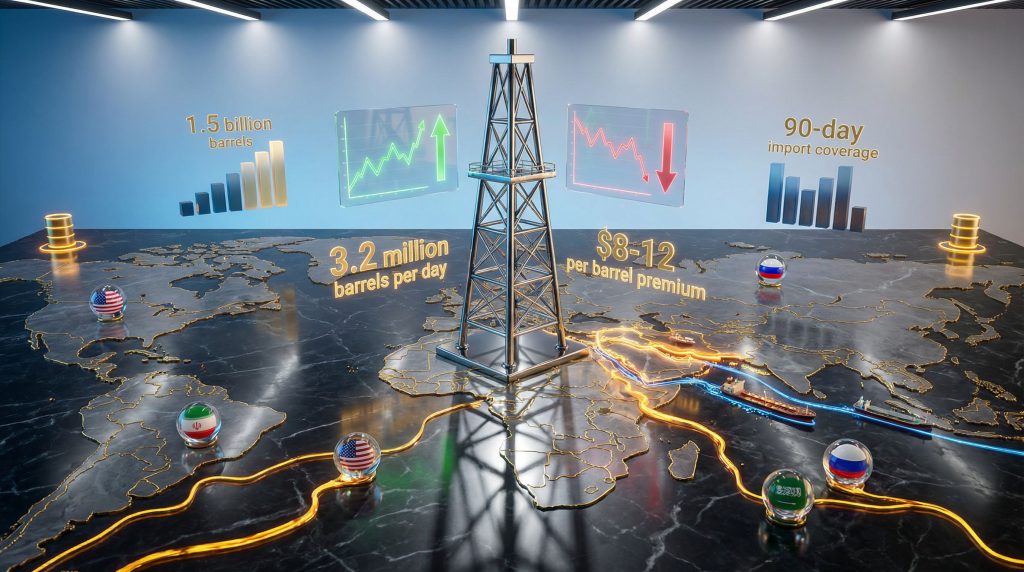
Iranian production capacity represents a significant variable in global oil supply calculations, with current estimates suggesting approximately 3.2 million barrels per day of potential output under normalised conditions. Sanctions regimes have historically created immediate market reactions ranging from $8-12 per barrel premium during escalation periods, reflecting both actual supply constraints and uncertainty about future policy developments.
Nuclear programme negotiations create recurring cycles of market tension as diplomatic progress or setbacks influence expectations about sanctions relief or tightening. The relationship between nuclear compliance and energy sanctions has established a direct link between arms control diplomacy and global oil pricing, where geopolitical developments in Vienna conference rooms generate immediate price movements in London and New York trading floors.
Iranian crude oil quality characteristics make substitution challenges more complex than simple barrel-for-barrel replacement calculations. Iranian heavy crude serves specific refinery configurations, particularly in Asian markets, where alternative heavy crude sources may require premium pricing or operational modifications to achieve equivalent processing outcomes.
Israel-Palestine Regional Spillover Effects
Proxy conflict implications extend beyond direct combatant territories through alliance structures that link regional conflicts to broader energy infrastructure networks. Lebanese and Syrian oil transit routes, while limited in absolute volume terms, represent strategic alternatives for regional distribution that become increasingly valuable during primary route disruptions.
Saudi Arabia defensive spending patterns influence oil revenue allocation decisions, where increased security expenditures reduce available capital for capacity expansion projects. This creates longer-term supply implications that extend beyond immediate crisis periods, as sustained regional tensions may constrain future production growth rather than current output levels.
Regional alliance shifts affect production coordination agreements through changing diplomatic relationships that influence OPEC+ decision-making processes. When traditional allies become strategic competitors due to regional conflicts, oil production coordination becomes subordinated to broader geopolitical objectives, potentially reducing cartel effectiveness in managing global supply.
How Do Major Power Rivalries Affect Energy Security?
US-China Strategic Competition
Technology transfer restrictions impact Chinese refinery modernisation through export controls that limit access to advanced processing equipment and optimisation software. These constraints affect refinery efficiency and product yield optimisation, creating indirect effects on crude oil demand patterns as Chinese facilities operate below optimal capacity utilisation rates.
Belt and Road Initiative energy infrastructure investments in Central Asia represent strategic attempts to diversify supply sources and reduce dependency on traditional maritime transportation routes. Pipeline projects connecting Central Asian producers directly to Chinese markets bypass potential naval chokepoints, creating alternative supply architectures that influence global flow patterns.
Moreover, examining US-China trade impact reveals how trade war spillover effects on crude oil import patterns emerge through tariff structures and financing restrictions that influence purchasing decisions. Chinese refiners may adjust crude slate composition based on trade policy developments, favouring suppliers from countries with favourable diplomatic relationships over purely economic optimisation criteria.
Russia-NATO Tensions and Energy Weaponisation
Pipeline politics in Eastern Europe affect Brent crude benchmarks through supply disruption fears that create premium pricing for non-Russian crude alternatives. European buyers increasingly seek supply diversification, creating demand premiums for African and Middle Eastern crudes that can substitute for pipeline-delivered Russian volumes.
Arctic drilling sanctions limit long-term Russian production capacity by restricting access to advanced exploration and extraction technologies required for extreme environment operations. These constraints create future supply tightness scenarios that influence forward curve pricing despite minimal immediate production impacts.
Alternative supply route development reduces European energy dependency through LNG infrastructure expansion and alternative pipeline projects. Norwegian pipeline capacity increases, African LNG project development, and renewable energy acceleration all contribute to reduced Russian energy leverage over European energy security.
OPEC+ Coordination Challenges During Geopolitical Stress
Internal Alliance Dynamics
OPEC+ member coordination faces increasing complexity as geopolitical pressures create conflicting incentives for production decisions. According to Enverus Intelligence Research, OPEC-12 liquids output approaches historic highs while maintaining untested spare capacity that could accommodate future production increases. This combination of high current output and available expansion capacity creates strategic flexibility but also coordination challenges.
The production return announcement in June 2024 demonstrates how alliance dynamics can override price optimisation objectives. BofA Global Research notes that crude oil prices have declined steadily since OPEC+ announced idle production returns, suggesting that OPEC+ production challenges influenced production decisions despite negative price impacts.
| Member Category | Production Flexibility | Geopolitical Constraints |
|---|---|---|
| Gulf Monarchies | High spare capacity | Regional security concerns |
| African Producers | Limited infrastructure | Civil unrest risks |
| Former Soviet States | Pipeline dependencies | Sanctions exposure |
Market Share Protection Strategies
Voluntary production cuts versus market-driven price support mechanisms create ongoing tension within OPEC+ coordination frameworks. BofA Global Research analysis suggests that while a projected global surplus of 2 million barrels per day in 2026 should drive substantially lower prices, OPEC+ members are unlikely to permit Brent crude to fall below $50 per barrel due to fiscal requirements across member nations.
Non-OPEC producer responses to cartel pricing decisions have reduced OPEC+ market influence over the past decade. Independent production growth from shale operations, Canadian oil sands, and Brazilian deepwater projects has created alternative supply sources that respond to price signals outside cartel coordination mechanisms.
Shale oil break-even economics create price ceiling effects that limit OPEC+ pricing power in higher price ranges. When crude prices exceed break-even thresholds for major shale formations, increased U.S. production can offset OPEC+ production cuts, creating natural price ceilings that constrain cartel revenue maximisation strategies.
Economic Transmission Mechanisms: From Conflict to Crude Prices
Demand-Side Impacts
The geopolitical impact on oil prices operates through uncertainty that reduces global GDP growth through confidence effects that translate into measurable oil demand destruction. Economic modelling suggests that major geopolitical crises typically reduce global growth by 0.2-0.4 percentage points, corresponding to oil demand reductions of approximately 400,000-800,000 barrels per day.
Current market conditions exemplify this demand-side transmission mechanism. Despite geopolitical tensions providing price support, analysts project substantially lower average prices for 2026 due to weakening demand signals. EIA forecasts suggest Brent crude averaging $55.08 per barrel in 2026, down from $68.91 per barrel in 2025, reflecting economic uncertainty impacts on consumption growth.
Financial Market Contagion
Currency volatility effects on dollar-denominated oil transactions create additional complexity for international energy trade. When geopolitical tensions drive flight-to-quality flows into U.S. dollars, importing countries face higher crude oil costs in local currency terms even when dollar-denominated prices remain stable.
Credit market tightening affects energy project financing through reduced capital availability for long-term development projects. During geopolitical stress periods, financial institutions typically increase risk premiums for energy sector lending, particularly for projects in politically sensitive regions.
Commodity futures positioning amplifies price discovery mechanisms through speculative activity that can temporarily disconnect futures prices from physical market fundamentals. Current market dynamics show this effect, where near-dated crude prices have declined significantly while long-dated prices have fallen only modestly, suggesting speculative positioning influences different contract maturities differently.
The next major ASX story will hit our subscribers first
Supply Disruption Scenarios and Market Response Patterns
Modern Resilience Factors
Strategic petroleum reserves across IEA member countries total approximately 1.5 billion barrels, providing 90-day import coverage during supply interruptions. This buffer capacity represents a substantial increase from historical levels and contributes to market resilience during supply disruption scenarios.
Modern inventory management systems enable more efficient allocation of available supplies during crisis periods. Real-time shipping tracking, refined product optimisation, and demand response programmes allow market participants to minimise disruption impacts through improved logistics coordination.
Emergency response coordination between major consuming countries has improved substantially since the 1970s oil crises. Coordinated strategic reserve releases, demand management programmes, and alternative supply procurement agreements provide multiple tools for crisis response that were unavailable during earlier disruption periods.
Historical Precedent Analysis
Historical supply disruption events reveal evolving patterns in market response mechanisms. The 1973 oil embargo created 400% price increases over six months due to limited alternative supply sources and minimal strategic reserve capacity. In contrast, the 2019 Saudi Aramco attacks caused temporary supply loss of 5.7 million barrels per day but generated relatively modest price impacts due to improved market resilience mechanisms.
Each historical crisis contributed to institutional learning that improved subsequent crisis response capabilities. The 1979 Iranian Revolution prompted strategic reserve development, while the 1990 Gulf War demonstrated effective coordinated response mechanisms. Recent events have validated these institutional improvements while revealing new vulnerability areas.
Technology and Geopolitics: Shale Revolution Impact
US Energy Independence Implications
Shale production growth has fundamentally altered U.S. energy security calculations and corresponding foreign policy flexibility. Reduced Middle East dependency enables more independent diplomatic positioning during regional crises, while export capacity growth provides geopolitical leverage through energy supply relationships.
Fracking technology export controls serve as diplomatic tools through selective technology sharing that influences global production capacity development. Countries with access to advanced extraction technologies can develop unconventional resources more efficiently, while those without such access remain dependent on conventional production methods.
Global Production Diversification
Non-OPEC production growth has reduced cartel market control from approximately 55% to 38% over the past decade through technological advances that enabled previously uneconomic resource development. This diversification has created more competitive market structures where cartel pricing power faces increasing constraints from independent production sources.
Technological diffusion beyond U.S. shale formations has enabled production growth in Argentina, China, and other regions with significant unconventional resources. This geographic diversification of production technology reduces concentration risks while creating more complex coordination challenges for traditional oil market management mechanisms.
Climate Policy Integration with Geopolitical Risk Assessment
Energy Transition Geopolitics
Critical mineral dependencies for renewable energy infrastructure create new forms of geopolitical risk that parallel traditional oil security concerns. Lithium, cobalt, and rare earth element supply chains concentrate in specific geographic regions, potentially creating future chokepoint vulnerabilities for energy transition technologies.
Carbon border adjustments affect oil-exporting nation revenues through indirect mechanisms that influence energy transition economics. Countries heavily dependent on oil export revenues face fiscal pressures from declining long-term demand that may influence geopolitical calculations and conflict probability assessments.
Green technology export controls create new areas of international tension as countries seek advantages in renewable energy technology development and deployment. Competition for technological leadership in energy transition may generate conflicts that influence traditional energy markets through economic linkage effects.
Stranded Asset Risks
Long-term oil demand projections incorporating climate policy scenarios suggest peak demand scenarios between 2028-2035, influencing geopolitical calculations around resource development investments. Countries with high production costs may face earlier economic obsolescence, potentially increasing incentives for resource extraction acceleration while economically viable.
Investment allocation decisions increasingly incorporate climate policy scenarios that may render some oil resources economically unviable before physical depletion. This creates temporal urgency for resource-dependent nations that may influence conflict probability and diplomatic positioning strategies.
Investment Implications and Portfolio Risk Management
Sector Allocation Strategies
Energy security premiums in developed market equity valuations reflect investor recognition that the geopolitical impact on oil prices creates persistent volatility that traditional portfolio optimisation models may underestimate. This has led to increased allocation to energy sector hedging strategies and infrastructure investments that provide diversification benefits during crisis periods.
Emerging market oil producer sovereign debt risk assessment incorporates both commodity price volatility and political stability factors that create complex correlation structures. Countries with high oil export dependence face fiscal vulnerabilities during low price periods that may be compounded by geopolitical tensions affecting market access.
Infrastructure investment in alternative supply route development has become a strategic priority for energy-importing nations seeking to reduce dependency on geopolitically sensitive transportation networks. LNG terminal construction, pipeline diversification projects, and renewable energy development all serve dual purposes of energy security and economic development.
Hedging Mechanisms for Geopolitical Risk
Crude oil futures curve analysis during political crisis periods reveals characteristic patterns where near-term contracts exhibit higher volatility than longer-dated contracts, reflecting uncertainty about immediate supply impacts versus longer-term market adjustment mechanisms. However, understanding gold safe haven insights provides alternative hedging perspectives.
Cross-commodity correlation patterns between oil, gold, and defence stocks strengthen during geopolitical stress periods, providing diversification opportunities for portfolio managers seeking to hedge energy price volatility while maintaining exposure to conflict-related investment themes.
Currency hedge effectiveness for international energy investments varies significantly based on crisis duration and geographic scope. Short-term geopolitical events may create currency volatility that overwhelms energy price hedging strategies, while longer-term conflicts may establish more stable hedging relationships.
Forecasting Framework: Geopolitical Risk Integration
Quantitative Risk Models
Modern econometric models incorporate approximately 15 geopolitical variables, including conflict intensity indices, sanctions severity scores, and diplomatic relationship stability metrics. These multifactor models attempt to quantify subjective geopolitical assessments in ways that enable systematic risk management and pricing decisions.
Machine learning applications in geopolitical risk assessment utilise natural language processing of news flows, satellite imagery analysis of production infrastructure, and social media sentiment analysis to create real-time risk indicators. These technological approaches supplement traditional analytical methods with higher frequency data inputs.
Scenario Planning Methodologies
Base case scenarios assume current tensions maintain $3-5 geopolitical risk premiums while avoiding major supply disruptions. This reflects market consensus that existing conflicts remain contained within manageable parameters that do not threaten global energy security architecture.
Escalation scenarios incorporate major supply disruption possibilities that could add $15-25 per barrel to crude prices through either physical supply loss or extreme risk premium expansion. These scenarios typically involve conflicts that affect multiple production regions simultaneously or threaten critical transportation infrastructure.
De-escalation scenarios envision risk premium compression to $1-2 per barrel through diplomatic progress that reduces conflict probability assessments. Such scenarios require sustained diplomatic engagement and measurable progress toward conflict resolution rather than temporary ceasefire agreements.
Regional Market Integration and Price Discovery
Asian Premium Dynamics
The geopolitical impact on oil prices in the Middle East typically increases Asian crude premiums by $2-4 per barrel due to transportation route vulnerabilities and regional demand concentration. Asian refiners often pay premium prices for supply security during crisis periods, creating persistent price differentials that reflect geographic risk assessments.
Chinese strategic storage activities influence regional price discovery mechanisms through inventory building patterns that may reflect geopolitical concerns rather than commercial optimisation. BofA Global Research notes that Chinese crude oil inventories continued expanding recently, even though much oil likely enters strategic storage rather than commercial use.
European Energy Security Calculations
Russian pipeline dependency reduction strategies affect Urals crude pricing through supply substitution efforts that create demand premiums for alternative crude sources. European refiners increasingly optimise crude slates for non-Russian supplies, generating price differentials that reflect energy security priorities.
North Sea production decline increases import vulnerability while LNG infrastructure expansion provides crude oil demand substitution options. These competing trends create complex optimisation problems for European energy security planning that influence both gas and oil market dynamics.
Navigating Geopolitical Complexity in Energy Markets
The intersection of geopolitics and oil pricing reflects a complex adaptive system where traditional supply-demand fundamentals interact with risk perception, strategic behaviour, and technological disruption. Current market conditions demonstrate these interactions through competing pressures where geopolitical tensions provide price support against structural oversupply forces.
Successful market participants must integrate multiple analytical frameworks to understand both immediate price volatility and longer-term structural shifts in global energy security architecture. The evolution from oil scarcity concerns toward energy transition challenges creates new forms of geopolitical risk while traditional supply security issues persist.
Market resilience has improved substantially since the major oil crises of the 1970s through strategic reserve development, supply diversification, and improved crisis response coordination. However, new vulnerabilities emerge through critical mineral dependencies, cyber security threats, and climate policy implementation that require ongoing adaptation of risk management strategies.
The geopolitical impact on oil prices will likely remain a permanent feature of global energy markets as long as geographic concentration of resources creates strategic dependencies between nations. Understanding these dynamics requires continuous monitoring of diplomatic developments, technological advances, and economic structural changes that influence the complex relationships between international relations and energy security.
Seeking Your Next Market-Moving Discovery?
Discovery Alert delivers instant notifications when significant mineral discoveries hit the ASX, powered by its proprietary Discovery IQ model that transforms complex mining data into clear, actionable trading opportunities. Explore how major mineral discoveries have historically generated exceptional returns and begin your 30-day free trial today to position yourself ahead of market-shifting announcements.