
August 5, 2026
Understanding the Geopolitical-Precious Metals Correlation Framework
Complex geopolitical dynamics create distinct patterns in precious metals markets that extend far beyond simple supply and demand fundamentals. Geopolitical uncertainty and precious metals form an intricate relationship where international tensions consistently drive investors toward these traditional safe-haven assets. Modern portfolio theory increasingly recognises these metals as essential components of diversified holdings, particularly when traditional correlations between asset classes break down during periods of international tension.
The relationship between global uncertainty and precious metals valuations operates through multiple transmission mechanisms. Currency debasement fears, supply chain vulnerabilities, and institutional flight to safety create cascading effects that amplify price movements across gold, silver, platinum, and palladium markets.
Defining Geopolitical Risk Categories in Metal Markets
Sovereign conflicts and territorial disputes generate immediate safe-haven demand as investors seek assets immune to political intervention. The silver market squeeze exemplified this dynamic when tariff concerns triggered metal movement from London to New York, creating physical displacement that combined with surging Indian demand to drive silver over $50 per ounce for the first time.
Monetary policy independence threats represent another critical risk category. When central bank autonomy comes under political pressure, precious metals provide portfolio insurance against policy unpredictability. Furthermore, since the start of the Trump 2.0 administration, the abrupt and often unpredictable nature of U.S. policy moves has remained a key driver of sentiment towards gold, according to precious metals market analysts.
Trade war escalations and sanctions regimes create both direct and indirect pressures on metal markets. Tariff-driven market pressures include supply chain disruptions and transportation bottlenecks, while indirect consequences manifest through currency volatility and reserve diversification strategies by affected nations.
Regional supply chain disruptions demonstrate how concentrated production creates vulnerability amplification. South African flooding disrupted platinum mining in 2025, exacerbating tight physical supply conditions that combined with Chinese jewellery demand rotation to drive exceptional price performance.
Historical Precedents: When Uncertainty Triggers Metal Rallies
Cold War era gold accumulation patterns established the template for modern precious metals investment strategies during geopolitical stress. Central banks accumulated physical gold as insurance against currency warfare and payment system disruptions, creating structural demand that persisted across multiple economic cycles.
The 2008 financial crisis demonstrated how monetary policy responses to systemic risk create secondary demand drivers for precious metals. Quantitative easing programmes, by definition representing monetary expansion, reduce real interest rates and opportunity costs for non-yielding assets like gold and silver.
Brexit referendum effects showcased how political uncertainty translates into immediate portfolio reallocation flows. The combination of currency volatility and constitutional uncertainty drove investors toward precious metals as neutral stores of value immune to domestic political outcomes.
COVID-19 pandemic investment shifts revealed how supply chain concerns amplify industrial metals demand. Silver's dual role as both monetary metal and industrial input created exceptional volatility as pandemic-related supply disruptions combined with unprecedented monetary stimulus.
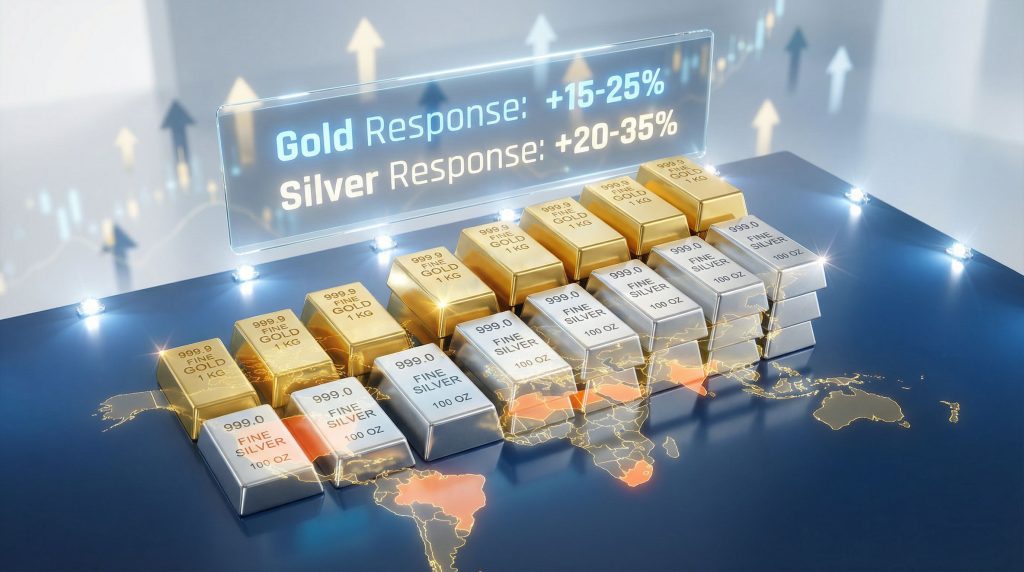
Geopolitical Events vs. Precious Metals Performance (2020-2025)
| Event Type | Gold Response | Silver Response | Duration |
|---|---|---|---|
| Military conflicts | +15-25% | +20-35% | 3-6 months |
| Central bank crises | +8-18% | +12-28% | 2-4 months |
| Trade sanctions | +5-12% | +8-20% | 1-3 months |
| Currency devaluation | +10-20% | +15-30% | 4-8 months |
When big ASX news breaks, our subscribers know first
What Makes Gold the Ultimate Geopolitical Hedge?
Gold's unique position as the ultimate geopolitical hedge stems from its role as the only asset simultaneously functioning as store of value, unit of account, and medium of exchange across all major economies and political systems. Unlike currency-denominated assets, physical gold cannot be devalued by policy decisions or eliminated through digital manipulation.
The metal's 5,000-year history as monetary foundation provides psychological anchoring that persists regardless of technological changes or political evolution. This deep cultural acceptance creates liquidity and recognition that transcends national borders and ideological differences.
Central Bank Accumulation Strategies During Crisis Periods
Reserve diversification away from vulnerable currencies has accelerated dramatically over recent years. Central banks globally have increased their gold reserves by over 1,000 tonnes annually for three consecutive years, with 2024 achieving 1,126 tonnes representing the third-largest expansion on record. This compares to an average of just 473 tonnes annually between 2010 and 2021.
The shift represents a 138% increase from historical baseline rates, indicating fundamental changes in central bank portfolio strategy. Gold's geopolitical boost recently overtook U.S. Treasuries as the world's biggest foreign reserve asset, marking a structural transformation in global reserve composition.
Physical gold storage location considerations have become increasingly strategic as geopolitical tensions rise. Central banks are prioritising domestic storage capacity and geographic diversification to reduce counterparty risks associated with foreign vault storage arrangements.
Bilateral trade settlement mechanisms involving gold have emerged as alternatives to traditional currency-based systems. In addition, US‑China trade war effects and President Trump's aggressive stance towards Greenland are likely to underpin ongoing de-dollarisation trends, creating sustained demand for non-dollar settlement mechanisms.
Institutional Investment Flow Patterns
Portfolio rebalancing triggers during uncertainty follow predictable patterns as institutional risk management protocols activate automatic precious metals allocation increases. Conservative strategies typically maintain 5-10% precious metals exposure, while crisis-driven allocations can reach 25-40% of total portfolio value.
ETF inflow acceleration metrics demonstrate how quickly institutional capital can move into precious metals during stress periods. Even with firmer retail investment, institutional flows drive much of the price upside during geopolitical uncertainty and precious metals correlation events as professional managers seek portfolio protection.
Hedge fund positioning strategies increasingly treat precious metals as currency hedges rather than commodity plays. This shift reflects growing recognition of metals as insurance against policy errors and monetary system instability rather than purely inflation hedges.
Over 1,000 tonnes of gold have been purchased by central banks annually for four consecutive years, with emerging market banks leading acquisition strategies amid dollar weaponisation concerns.
Why Silver Outperforms During Geopolitical Stress?
Silver's exceptional performance during geopolitical uncertainty and precious metals rallies stems from its unique dual character as both precious metal and critical industrial input. This combination creates multiple demand channels that can reinforce each other during crisis periods, generating outsized price movements relative to gold.
The metal's smaller market capitalisation compared to gold creates inherent volatility amplification. When investment flows enter precious metals markets during uncertainty, silver's limited liquidity translates the same dollar amounts into larger percentage price movements.
Industrial Demand Resilience vs. Safe-Haven Premium
Technology sector supply security concerns drive defensive stockpiling behaviours that compound monetary demand during geopolitical stress. Silver's essential role in electronics, solar panels, and medical applications makes it strategically critical for economic security.
Defence industry precious metals requirements create additional demand layers during international tensions. Military applications for silver in electronics, communications, and weapons systems generate procurement demand that is relatively price-insensitive.
Solar energy infrastructure buildout acceleration represents a structural demand shift that interacts with geopolitical developments. Energy security concerns drive renewable energy investment, creating sustained industrial silver demand even during economic uncertainty.
Silver demand has outstripped supply for four consecutive years, with the Silver Institute projecting 2025 as the fifth consecutive deficit year. The structural market deficit reached 148.9 million ounces in 2024, creating a four-year cumulative shortfall of 678 million ounces equivalent to approximately 10 months of mining supply.
Market Size Amplification Effects
Lower liquidity creates price volatility advantages for investors positioned ahead of major moves. Silver's smaller market size means physical tightness translates more directly into price appreciation than in larger, more liquid gold markets.
Retail investor accessibility drives momentum effects as smaller denomination prices allow broader participation. However, when precious metals enter public consciousness during crisis periods, silver's lower unit price attracts retail flows that amplify professional positioning.
Supply deficit compounding during disruptions creates feedback loops between physical tightness and price appreciation. The October 2025 silver squeeze evolved into silver squeeze 2.0 in December, briefly pushing prices over $80 as physical displacement combined with ongoing deficits.
Silver Market Fundamentals Under Geopolitical Pressure
| Factor | Impact Level | Price Sensitivity |
|---|---|---|
| Supply disruptions | High | +25-40% |
| Industrial hoarding | Medium | +15-25% |
| Investment demand surge | Very High | +30-50% |
| Currency hedge flows | Medium | +10-20% |
How Do Regional Conflicts Reshape Precious Metals Supply Chains?
Regional conflicts create immediate disruptions to established precious metals supply chains through direct mining interruptions, transportation bottlenecks, and financing constraints. These effects cascade through global markets regardless of the conflict's geographic scope or political significance.
Mining operations in politically unstable regions face escalating operational risks that translate into supply uncertainty premiums. Even conflicts that don't directly affect major producing regions create risk perception changes that influence global pricing dynamics.
Mining Operation Vulnerability Assessment
Politically unstable regions production analysis reveals concentration risks that amplify geopolitical premium effects. South Africa's platinum production dominance means regional flooding or political instability has global price implications, as demonstrated in 2025's market disruption.
Transportation route security considerations become critical during regional tensions. Precious metals require secure logistics networks, and conflict-related transportation disruptions can create physical bottlenecks even when mine production continues normally.
Alternative sourcing strategy development involves identifying backup supply chains and storage locations that remain accessible during various conflict scenarios. This redundancy planning creates additional demand for physical metal storage in politically stable jurisdictions.
Refining Capacity Concentration Risks
Geographic bottlenecks in processing infrastructure create single points of failure that geopolitical events can exploit. Furthermore, refining capacity limitations become apparent during supply chain stress, when raw material availability exceeds processing capability.
Strategic stockpile implications involve both government and private sector inventory management during uncertainty periods. Emergency supply protocol activation requires pre-positioned inventories and alternative supply arrangements that increase baseline demand.
Physical liquidity in London markets remains tight driven by strong investment demand, tariff uncertainty keeping substantial silver stocks in the U.S., refining capacity bottlenecks, and structural deficits. Given silver's smaller market size, these factors amplify price movements with three-digit peaks appearing likely.
What Role Do Currency Wars Play in Metal Valuations?
Currency wars fundamentally alter precious metals dynamics by positioning these assets as neutral alternatives to politically influenced monetary systems. When nations weaponise their currencies through sanctions, trade restrictions, or monetary manipulation, precious metals provide portfolio refuge from currency-specific risks.
Modern currency conflicts extend beyond traditional devaluations to include payment system restrictions, asset freezes, and digital surveillance mechanisms. These developments drive institutional demand for assets immune to political intervention.
Dollar Weaponisation Impact on Precious Metals Demand
De-dollarisation trends accelerate metal adoption as nations seek alternatives to dollar-denominated reserve assets. Concerns about persistent fiscal deficits, rapid U.S. debt accumulation, and questions surrounding Federal Reserve independence raise doubts about long-term debt sustainability and the dollar's reserve currency role.
Bilateral trade settlement gold usage provides concrete alternatives to traditional currency-based international commerce. As weaponisation concerns grow, precious metals offer settlement mechanisms that bypass potential political interference in currency-based systems.
Reserve currency diversification strategies increasingly incorporate precious metals as insurance against currency system breakdown. The recent shift of gold overtaking U.S. Treasuries as the World Bank research confirms world's largest foreign reserve asset demonstrates this institutional pivot.
Inflation Hedge Positioning During Policy Uncertainty
Real interest rate calculations under political pressure create complex dynamics for precious metals valuations. Despite elevated inflation, Federal Reserve rate cuts and renewed quantitative easing in late 2025 created negative real interest rates supporting non-yielding assets.
Monetary policy independence erosion effects manifest through market pricing of policy uncertainty premiums. When central bank autonomy comes under political influence, precious metals provide insurance against unpredictable monetary experiments.
Fiscal deficit sustainability concerns create long-term debasement fears that support gold's inflation hedge role as stores of value. Layered worries about persistent deficits and debt accumulation rates raise fundamental questions about currency stability.
How does geopolitical uncertainty affect precious metals prices?
Geopolitical uncertainty drives precious metals prices higher through multiple channels: safe-haven investment flows, supply chain disruptions, currency debasement fears, and central bank diversification strategies. Gold typically rises 15-25% during major conflicts, while silver can surge 20-35% due to its smaller market size and dual industrial-monetary role.
Which Geopolitical Scenarios Pose Greatest Upside for Metals?
High-impact geopolitical scenarios for precious metals involve combinations of monetary system stress, supply chain vulnerabilities, and institutional confidence breakdown. Multiple simultaneous pressures create exponential rather than linear effects on metal valuations.
Trade war escalation scenarios pose significant upside potential when they involve critical supply chains or major economic powers. The interaction between tariff policies and physical metal movement, as seen in the 2025 silver squeeze, demonstrates how trade tensions translate into immediate supply dynamics.
High-Impact Event Probability Matrix
Trade war escalation scenarios involving precious metals-producing regions or major consuming nations create both supply and demand pressures simultaneously. Tariff uncertainty keeping substantial silver stocks in specific geographic regions exemplifies how policy decisions create physical market effects.
Central bank independence erosion represents a systemic risk factor with major implications for precious metals demand. Questions surrounding Fed independence raise doubts about monetary policy predictability, driving institutional diversification toward non-political assets.
Regional conflict expansion risks create cascading effects when they involve major commodity production or transportation routes. Even conflicts in secondary producing regions can trigger global supply security concerns that benefit precious metals pricing.
Sanctions regime broadening affects precious metals through both direct trade disruption and indirect currency weaponisation concerns. As sanctions become broader policy tools, nations seek alternatives immune to such restrictions.
Portfolio Allocation Strategies for Different Risk Levels
Conservative hedging percentages typically range from 5-10% of portfolio value during normal market conditions. This baseline allocation provides insurance without significantly impacting overall portfolio performance during benign market environments.
Aggressive positioning strategies involving 15-25% allocations become appropriate when multiple geopolitical risk factors align simultaneously. Professional managers increase precious metals exposure when traditional asset correlations break down during crisis periods.
Crisis-driven allocation increases reaching 25-40% of portfolio value represent maximum protective positioning during systemic uncertainty. Such extreme allocations require careful timing and exit strategy planning to avoid opportunity costs during recovery periods.
The next major ASX story will hit our subscribers first
How Should Investors Position for Ongoing Geopolitical Volatility?
Strategic positioning for geopolitical volatility requires understanding both the timing and magnitude of precious metals responses to different uncertainty categories. Successful approaches combine baseline insurance allocations with tactical increases during specific risk escalation patterns.
Investment vehicle selection becomes crucial during geopolitical stress when counterparty risks and liquidity considerations matter more than cost efficiency. Physical metals, ETFs, mining equities, and derivatives each offer different risk-return profiles during crisis periods.
Physical vs. Paper Precious Metals Considerations
Storage security during crisis periods represents the primary advantage of physical metals ownership. When payment systems face disruption or counterparty risks escalate, physical possession eliminates financial system dependencies.
Liquidity access under stress conditions varies significantly between physical and paper precious metals positions. While physical metals provide ultimate security, they may be less liquid during rapid market movements compared to exchange-traded alternatives.
Counterparty risk elimination benefits of physical ownership become particularly valuable during banking system stress or financial market disruption. Physical metals require no functional financial system to retain value or transferability.
Timing Strategy Development
Early warning indicator monitoring involves tracking central bank gold purchases, currency volatility patterns, and geopolitical tension escalation metrics. Central banks purchasing over 1,000 tonnes annually for consecutive years indicates structural demand that supports higher pricing.
Accumulation during calm periods allows investors to build positions before geopolitical premiums fully emerge in market pricing. Following exceptional price gains, efforts to reduce usage accelerate, but strong investment demand mitigates impact.
Profit-taking during peak uncertainty requires careful judgement about whether specific geopolitical events represent temporary disruption or permanent structural shifts. Market surpluses emerge at record prices but are readily absorbed by strong institutional investment.
Investment Vehicle Comparison During Geopolitical Crisis
| Vehicle Type | Liquidity | Security | Upside Potential |
|---|---|---|---|
| Physical metals | Low | Very High | High |
| ETFs | High | Medium | Medium |
| Mining stocks | High | Low | Very High |
| Futures | Very High | Low | Very High |
What Are the Long-Term Implications for Precious Metals Markets?
Structural demand shifts toward precious metals appear permanent rather than cyclical, driven by fundamental changes in global monetary architecture and geopolitical stability patterns. These developments create sustained tailwinds for precious metals that extend beyond traditional economic cycles.
The emergence of gold as the world's largest foreign reserve asset, overtaking U.S. Treasuries, represents a historical inflection point that suggests lasting portfolio allocation changes across institutional investors globally.
Structural Demand Shift Analysis
Permanent portfolio allocation increases reflect institutional recognition of precious metals as essential diversification tools rather than speculative positions. Central bank behaviour leading this transition suggests sustained rather than temporary demand patterns.
Generational wealth preservation strategies increasingly incorporate precious metals as insurance against currency system evolution and political instability. Younger investors demonstrate growing scepticism about fiat currency stability over multi-decade investment horizons.
Institutional adoption acceleration occurs as traditional portfolio theory adapts to recognise correlation breakdown during crisis periods. Professional investment management increasingly treats precious metals as separate asset classes with unique risk-return characteristics.
Supply Response to Sustained Higher Prices
Mining investment cycle implications involve long development timelines that create delayed supply responses to price increases. Higher prices eventually incentivise exploration and development, but geological realities limit supply elasticity in the short term.
Recycling rate optimisation provides more immediate supply response mechanisms as higher prices make previously uneconomical recovery processes viable. Industrial users accelerate efforts to reduce precious metals usage when prices reach elevated levels.
Exploration activity expansion requires sustained price levels to justify the multi-year investment cycles necessary for new mine development. Current price environments support increased exploration spending, but new supply requires years to reach markets.
Geopolitical uncertainty has fundamentally altered precious metals investment dynamics, creating sustained demand from both institutional and retail investors seeking portfolio protection against an increasingly volatile global landscape.
Investment Outlook Considerations
Looking ahead, persistent economic and geopolitical uncertainties continue to support portfolio diversification toward precious metals. For white metals specifically, U.S. tariff uncertainty and favourable underlying fundamentals provide additional price support beyond traditional monetary factors.
Physical liquidity in precious metals markets remains tight driven by strong investment demand, policy uncertainty, and structural deficits. Given smaller market sizes for metals like silver, these factors amplify price movements with significant upside potential remaining likely.
The combination of supply deficits, central bank accumulation, currency system concerns, and institutional adoption creates multiple supporting factors for sustained geopolitical uncertainty and precious metals outperformance during ongoing volatility periods.
Ready to capitalise on geopolitical-driven precious metals opportunities?
Discovery Alert's proprietary Discovery IQ model delivers real-time alerts on significant ASX mineral discoveries, instantly empowering subscribers to identify actionable opportunities ahead of the broader market during periods of heightened geopolitical uncertainty. Begin your 30-day free trial today and secure your market-leading advantage in precious metals and mining investments.