August 6, 2026
Understanding the Geopolitical Risk Premium in Energy Markets
Modern energy markets operate as complex systems where fundamental supply-demand mechanics intersect with geopolitical uncertainty, creating volatile pricing environments that reflect both immediate physical realities and forward-looking risk assessments. The current global energy landscape demonstrates how traditional market stability can be disrupted when major producing regions experience political tension, forcing traders and investors to navigate unprecedented uncertainty. With U.S.-Iran tensions oil prices increasingly reflecting geopolitical risk premiums, market participants must carefully assess the potential for supply disruptions and their cascading economic effects.
Iran's Strategic Position in Global Oil Supply
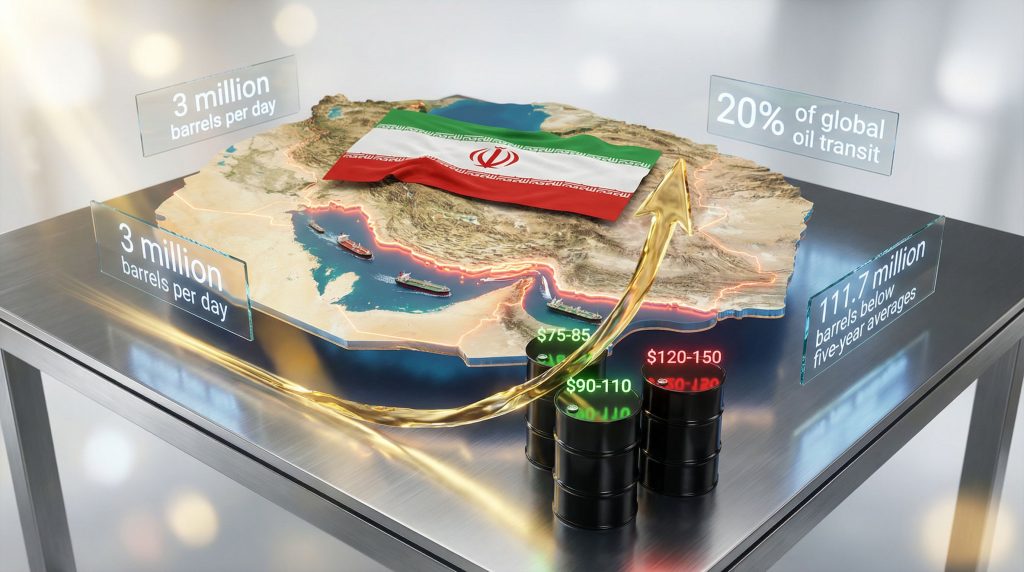
Iran maintains a critical position within global energy markets through multiple channels of influence that extend far beyond its direct production capacity. The nation produces approximately 3 million barrels per day, representing roughly 3% of global crude oil output. While this percentage may appear modest, the strategic significance becomes apparent when considering Iran's geographic position and regional influence networks.
The Strait of Hormuz serves as perhaps the most critical energy chokepoint globally, with approximately 20% of all seaborne oil transit passing through this narrow waterway. Iran's ability to influence or potentially disrupt this passage creates systemic risk for global energy security that far exceeds its direct production contribution.
Regional proxy networks affiliated with Iranian interests maintain presence across multiple oil-producing territories throughout the Middle East, creating potential for coordinated disruption beyond Iran's borders. These networks have demonstrated capabilities to target petroleum infrastructure, though the frequency and effectiveness of such operations remain limited historically.
Iranian energy partnerships with Russia have intensified recently, particularly in oil field development projects. Furthermore, this cooperation with Saudi exploration licenses represents a strategic shift toward alternative financing and technical expertise outside Western sanctions frameworks, potentially enhancing Iran's long-term production capacity despite current restrictions.
Current Market Fundamentals vs. Risk Perception
The narrative of global oil oversupply, which dominated energy market analysis throughout much of 2024 and early 2025, faces increasing scrutiny when examined against actual inventory data and spare production capacity metrics. However, recent developments suggest this oversupply narrative may be fundamentally flawed.
Current global crude oil inventories stand at 111.7 million barrels below five-year averages, according to Joint Organizations Data Initiative reporting from December 2025. This substantial deficit contradicts widely-held assumptions about market oversupply and suggests that traditional inventory cushions have eroded significantly.
OPEC+ spare production capacity has declined to approximately 2.5% of total production capacity, falling below the recommended minimum threshold of 3%. Consequently, this reduction limits the organisation's ability to rapidly compensate for supply disruptions through increased output from other member nations, as reflected in recent OPEC production impact assessments.
The apparent abundance of crude oil in floating storage primarily consists of sanctioned Russian supplies that cannot freely substitute for Middle Eastern crude in Western markets due to geographic and commercial restrictions. This creates an artificial supply cushion that may prove unavailable during actual disruption scenarios.
Non-OPEC production growth, while contributing to overall supply statistics, occurs primarily in regions with higher extraction costs and longer development timelines, limiting its effectiveness as an immediate buffer against sudden supply shocks.
When big ASX news breaks, our subscribers know first
What Are the Key Escalation Scenarios and Their Price Impacts?
Strategic scenario modelling reveals four distinct pathways for U.S.-Iran tensions, each carrying specific probability weightings and corresponding price implications based on supply disruption magnitude and market response mechanisms. These scenarios directly influence how U.S.-Iran tensions oil prices respond to evolving geopolitical conditions.
Limited Diplomatic Breakdown (Probability: 40%)
Price Impact: $75-85 per barrel
This scenario envisions renewed comprehensive sanctions targeting Iranian oil exports without direct military confrontation. The United States would implement enhanced enforcement of existing sanctions whilst expanding restrictions to include additional Iranian energy sector entities and international partners facilitating oil trade.
Iranian response would likely focus on diplomatic channels and regional proxy activities rather than direct military engagement. Threatened closure of the Strait of Hormuz would serve primarily as negotiating leverage without actual implementation.
Market pricing would incorporate a $10-15 risk premium above baseline levels, reflecting uncertainty about future Iranian export capacity and potential for escalation to more severe scenarios. For instance, physical oil supply disruption would remain minimal, with price increases driven primarily by forward-looking risk assessment rather than immediate shortages.
Key characteristics:
- Enhanced U.S. military presence in Persian Gulf
- Iranian diplomatic protests through United Nations channels
- Regional allies increase security cooperation
- Emergency response protocols remain on standby
Regional Military Confrontation (Probability: 35%)
Price Impact: $90-110 per barrel
Military escalation would begin with targeted U.S. strikes against Iranian nuclear facilities, triggering Iranian retaliation against Gulf state oil infrastructure. This scenario assumes limited geographic scope with both sides seeking to avoid full-scale regional war.
Temporary supply disruption of 1-2 million barrels daily would result from damage to Iranian production facilities and retaliatory attacks on Saudi or UAE oil infrastructure. Duration would likely span days to weeks rather than months, as international diplomatic intervention would intensify rapidly.
Strategic Petroleum Reserve releases would activate across G7 nations, providing temporary market stabilisation. The United States maintains approximately 630 million barrels in strategic reserves, whilst collective G7 emergency stocks total roughly 1.5 billion barrels.
Emergency coordination mechanisms established after previous oil crises would facilitate rapid international response, including coordinated reserve releases and temporary demand reduction measures in major consuming nations. In addition, this would likely trigger broader trade war oil impact considerations across global markets.
Full-Scale Conflict with Hormuz Closure (Probability: 15%)
Price Impact: $120-150 per barrel
The most severe scenario involves complete blockade of Strait of Hormuz shipping lanes combined with Iranian attacks on major Saudi and UAE oil production facilities. This would create global supply disruption of 15-20 million barrels daily, representing approximately 15-20% of total global supply.
Iranian naval and missile capabilities could effectively close the Strait of Hormuz for extended periods, though U.S. and allied military forces would work to reopen the waterway. Alternative transportation routes through longer pipeline systems would add $2-5 per barrel in transportation costs whilst providing only partial supply replacement.
Coordinated international emergency response would require unprecedented cooperation among consuming nations, including:
- Massive strategic petroleum reserve releases
- Emergency rationing programmes
- Temporary industrial demand destruction
- Accelerated deployment of alternative energy sources
- Military convoy protection for remaining tanker traffic
Negotiated Resolution (Probability: 10%)
Price Impact: $55-65 per barrel
Comprehensive nuclear agreement between the United States and Iran would enable gradual lifting of oil export sanctions, returning approximately 1.5 million barrels daily to global markets over a 12-18 month period.
Complete removal of geopolitical risk premiums from oil pricing would occur as diplomatic normalisation reduces perceived threats to Persian Gulf stability. This scenario assumes successful verification mechanisms for nuclear programme restrictions and gradual rebuilding of commercial relationships between Iran and Western energy companies.
Market pricing would reflect normalised supply-demand fundamentals without additional risk premiums, though baseline prices would remain influenced by other global factors including spare capacity constraints and non-Iran related geopolitical risks.
How Do Market Dynamics Amplify Geopolitical Shocks?
Financial market mechanisms and supply chain vulnerabilities create multiplicative effects that amplify initial geopolitical disruptions far beyond their immediate physical impact on oil supply and demand. These dynamics become particularly pronounced when analysing U.S.-Iran tensions oil prices volatility patterns.
Supply Chain Vulnerability Assessment
Refining Capacity Constraints represent a critical bottleneck in global energy systems. Available spare refining capacity globally remains limited, meaning that crude oil supply disruptions can create cascading effects even when alternative crude sources become available. Different crude oil grades require specific refinery configurations, limiting substitution flexibility.
Transportation Infrastructure dependencies extend beyond the Strait of Hormuz to include multiple potential chokepoints. Alternative shipping routes around the Cape of Good Hope add approximately 15 days to delivery times and $2-5 per barrel in additional transportation costs. Pipeline capacity connecting alternative supply sources remains insufficient to fully compensate for major maritime disruptions.
Storage Infrastructure provides limited buffer capacity against extended supply disruptions. Global strategic petroleum reserves maintain 30-90 day supply buffers at maximum utilisation, though political and logistical factors typically limit actual release rates to lower levels during crisis periods.
Financial Market Leverage mechanisms amplify price movements through commodity trading strategies and derivative instruments. Futures market positioning and algorithmic trading systems can create 2-3x amplification of underlying supply-demand imbalances, as margin calls and stop-loss orders trigger automated selling or buying during volatility spikes. This relates directly to broader oil price rally patterns observed in recent months.
Demand Response Mechanisms
Price Elasticity Factors demonstrate that short-term oil demand destruction typically begins when crude prices exceed $100 per barrel for sustained periods. Consumer behaviour modification includes reduced discretionary driving, increased public transportation usage, and accelerated adoption of fuel-efficient vehicles.
Substitution Effects toward alternative energy sources accelerate during high oil price periods, though implementation timelines limit immediate impact. Electric vehicle adoption rates, renewable energy investment, and natural gas forecast substitution for oil in industrial applications all receive increased emphasis during energy security crises.
Economic Feedback Loops create secondary effects as higher energy costs reduce overall economic growth by approximately 0.1-0.3% for each sustained $10 per barrel increase in oil prices. Reduced economic activity eventually decreases oil demand, creating natural price stabilisation mechanisms over longer time periods.
What Are the Broader Economic Implications Beyond Oil Prices?
Energy price volatility creates cascading effects throughout global economic systems, influencing monetary policy decisions, sectoral performance, and international trade balances in ways that extend far beyond direct energy costs. Moreover, these implications become more complex when considering geopolitical tensions.
Inflation and Monetary Policy Impacts
| Scenario | Oil Price Range | Inflation Impact | Central Bank Response |
|---|---|---|---|
| Limited Escalation | $75-85 | +0.3-0.5% CPI | Pause rate cuts |
| Regional Conflict | $90-110 | +0.8-1.2% CPI | Emergency coordination |
| Full Conflict | $120-150 | +1.5-2.5% CPI | Crisis intervention |
Central banking institutions face complex policy tradeoffs during energy price shocks, as traditional inflation targeting frameworks conflict with economic growth objectives. Emergency coordination mechanisms among major central banks would likely activate during severe scenarios, including potential coordinated interest rate adjustments and liquidity provision to stressed financial markets.
Core inflation typically experiences delayed but persistent increases following energy price spikes, as transportation costs and energy-intensive production processes transmit higher costs throughout the economy. This creates sustained inflationary pressure beyond the immediate energy component.
Sectoral Economic Disruption
Transportation Industry faces immediate margin pressure from higher fuel costs, with airlines particularly vulnerable due to limited ability to quickly pass through cost increases. Major global carriers would face $2-4 billion in additional annual fuel costs during moderate price increase scenarios, potentially triggering capacity reductions and route cancellations.
Chemical Manufacturing sectors dependent on petrochemical feedstocks experience dual pressures from both higher input costs and reduced demand from price-sensitive downstream markets. Feedstock cost increases of 15-25% would force production adjustments and supply chain reconfiguration throughout plastics, fertilisers, and specialty chemicals industries.
Agriculture faces compound pressures from both higher fuel costs for equipment operation and increased fertiliser prices, as natural gas-based nitrogen fertiliser production becomes economically stressed. Food price inflation accelerates through multiple transmission mechanisms, creating particular hardship for developing nations with high food import dependencies.
Emerging Markets with significant oil import requirements face potential balance of payments crises as energy costs consume larger portions of foreign currency reserves. Countries with fixed exchange rate regimes become particularly vulnerable to currency pressure and potential devaluation during sustained high energy price periods.
How Should Investors Position for Different Tension Scenarios?
Investment strategy during geopolitical energy crises requires understanding both direct sectoral impacts and secondary effects across asset classes, currencies, and geographic markets. Furthermore, positioning must account for the unique characteristics of U.S.-Iran tensions oil prices dynamics.
Energy Sector Investment Strategies
Upstream Oil Companies present complex risk-reward profiles during geopolitical tensions. Whilst higher prices improve profitability metrics, operational risks increase in unstable regions. Companies with diversified geographic exposure and strong balance sheets typically outperform during crisis periods.
Renewable Energy sectors often experience accelerated investment flows during energy security crises, as governments and private investors seek alternatives to volatile fossil fuel markets. Solar, wind, and energy storage technologies benefit from both increased policy support and improved economic competitiveness relative to high-priced conventional energy.
Natural Gas markets experience substitution demand increases during oil supply disruptions, particularly in industrial applications and power generation. Liquefied natural gas (LNG) infrastructure and transportation assets gain strategic value as alternative energy supply routes become critical.
Energy Infrastructure assets, including pipeline systems, storage facilities, and refining capacity, typically appreciate during supply disruption scenarios as their strategic value increases. Master Limited Partnerships (MLPs) and infrastructure funds focusing on energy transportation often outperform during geopolitical stress periods.
Defensive Portfolio Positioning
Gold and Precious Metals serve traditional safe-haven functions during geopolitical conflicts, though performance varies based on inflation expectations and currency movements. Physical gold allocation of 5-10% of portfolio value provides insurance against currency debasement and financial system stress.
Defence Contractors benefit from increased military spending during regional tensions, particularly companies specialising in missile defence systems, naval assets, and intelligence technologies relevant to Middle Eastern operations.
Agricultural Commodities gain from both direct energy cost impacts and food security concerns during regional conflicts. Wheat, corn, and rice futures often appreciate as supply chain disruptions raise food inflation expectations.
Currency Hedging becomes critical for portfolios exposed to oil-importing nations, as higher energy costs typically weaken currencies relative to the U.S. dollar. Emerging market currencies face particular pressure during energy price spikes.
What Historical Precedents Guide Current Market Behaviour?
Analysis of previous Middle Eastern crises provides framework for understanding potential market responses, though each situation contains unique elements that limit direct comparability. However, examining market tensions and commodity impacts reveals consistent patterns across different time periods.
Comparative Analysis of Past Crises
| Crisis Event | Duration | Peak Price Impact | Recovery Timeline |
|---|---|---|---|
| 1979 Iran Revolution | 18 months | +150% | 3 years |
| 1990 Gulf War | 6 months | +100% | 12 months |
| 2019 Saudi Attacks | 2 weeks | +15% | 1 month |
| 2020 Soleimani Strike | 1 week | +5% | 2 weeks |
The 1979 Iranian Revolution created the most severe and prolonged oil price disruption in modern history, with prices rising from approximately $12 per barrel to over $30 per barrel (in nominal terms). Recovery required three years as alternative supply sources came online and global recession reduced demand.
1990-1991 Gulf War demonstrated the effectiveness of coordinated international response mechanisms, as Strategic Petroleum Reserve releases and OPEC spare capacity deployment limited price increases despite complete loss of Iraqi and Kuwaiti production for six months.
Recent crises including the 2019 Saudi Aramco attacks and 2020 Soleimani assassination showed relatively contained market responses, reflecting both improved emergency response capabilities and market confidence in U.S. military superiority in the region.
Market Learning and Adaptation
Strategic Reserve Coordination among G7 nations has evolved significantly since the 1970s oil crises. Current emergency stockpiles totalling 1.5 billion barrels provide substantial buffer capacity, though political coordination mechanisms for release timing and volumes continue developing.
Alternative Supply Routes have expanded through pipeline infrastructure development, reducing dependence on Middle Eastern maritime chokepoints. However, these alternatives typically carry higher transportation costs and limited capacity compared to traditional tanker routes through the Strait of Hormuz.
Financial Market Sophistication has improved through development of energy derivative markets, allowing for more precise risk pricing and hedging mechanisms. Nevertheless, this sophistication also creates potential for amplified volatility through algorithmic trading and leveraged positioning.
Diplomatic Intervention Processes have accelerated compared to historical precedents, as major powers recognise the global economic consequences of sustained energy supply disruption. International mediation mechanisms typically activate within days of crisis escalation.
The next major ASX story will hit our subscribers first
Navigating Uncertainty in Global Energy Markets
The intersection of U.S.-Iran tensions with current global energy market conditions creates a uniquely complex risk environment that demands multifaceted analytical approaches. Whilst global oil markets have developed greater resilience through strategic reserves, alternative supply routes, and improved coordination mechanisms, fundamental vulnerabilities remain concentrated in geopolitically unstable regions.
Current market pricing appears to incorporate limited risk premium relative to potential supply disruption scenarios, suggesting either exceptional confidence in diplomatic resolution or systematic underpricing of low-probability, high-impact events. The $71 per barrel Brent crude price as of February 2026 reflects recent tension escalation but may prove insufficient given the magnitude of potential supply disruptions.
Inventory deficits of 111.7 million barrels below five-year averages, combined with 2.5% OPEC+ spare capacity, create structural vulnerability that amplifies geopolitical risk impacts. Traditional market cushions that historically absorbed supply shocks have eroded significantly, increasing sensitivity to disruption scenarios.
Investment strategies must account for multiple scenario pathways ranging from diplomatic resolution enabling Iranian oil exports to full-scale regional conflict requiring emergency international coordination. The 10% probability assigned to negotiated resolution suggests limited market confidence in near-term diplomatic success, whilst 15% probability for full Hormuz closure indicates non-trivial risk of extreme disruption.
"The convergence of reduced spare capacity, depleted inventories, and escalating geopolitical tensions creates the most precarious energy security environment since the early 2000s. Current oil prices may prove inadequate insurance against supply disruption risks that could push Brent crude toward $120-150 per barrel during severe conflict scenarios."
Successful navigation of this environment requires understanding both immediate supply-demand mechanics and longer-term structural changes that geopolitical tensions accelerate within global energy systems. The transition toward renewable energy sources, strategic reserve utilisation policies, and international crisis coordination mechanisms will all experience testing during any significant escalation of U.S.-Iran tensions oil prices volatility.
Ready to Navigate Energy Market Volatility?
As geopolitical tensions continue to drive oil price uncertainty and supply chain risks intensify, Discovery Alert's proprietary Discovery IQ model provides real-time alerts on significant ASX mineral discoveries that can offer portfolio diversification beyond traditional energy markets. Subscribers gain instant access to actionable investment opportunities across over 30 commodities, helping navigate market volatility with comprehensive discovery insights and begin their 14-day free trial today to secure a market-leading advantage.