August 25, 2026
Understanding Geopolitical Risk Premium Components in Contemporary Energy Markets
Global energy markets operate through sophisticated pricing mechanisms where fundamental supply-demand dynamics intersect with probability-weighted assessments of political disruption. Contemporary crude oil pricing reflects a permanent layer of uncertainty that extends far beyond traditional market forces, creating what traders recognise as the geopolitical risk premium in oil markets.
This premium represents the additional cost embedded in oil prices due to the perceived likelihood of supply disruptions from political conflicts, sanctions, infrastructure attacks, or diplomatic tensions. Unlike historical oil shocks that manifested as reactive price spikes, modern markets now incorporate geopolitical risk prospectively through continuous repricing mechanisms.
When big ASX news breaks, our subscribers know first
Quantifying Risk Premium Architecture in Oil Pricing
Current market conditions demonstrate this dynamic clearly. WTI crude oil traded at $59.67 per barrel as of December 5, 2025, representing a weekly gain of $1.12 despite persistently weak fundamental indicators. This price elevation occurred whilst the U.S. Energy Information Administration reported a 574,000-barrel crude inventory build, extending previous week increases and contradicting draw expectations.
The disconnect between price appreciation and inventory accumulation illustrates the geopolitical risk premium in oil markets in action. Markets priced elevated uncertainty following the fifth Ukrainian strike on Russia's Druzhba pipeline system in 2025, despite operators maintaining uninterrupted throughput. The threat perception alone justified price premiums as traders incorporated probability-weighted disruption scenarios into forward contracts.
Key Risk Premium Components Include:
- Probability-weighted disruption assessment calculating likelihood and duration of potential supply outages
- Insurance cost integration through war risk premiums embedded in tanker freight rates
- Forward curve distortion creating steeper contango in near-term versus deferred contracts
- Volatility premium expansion reflected in elevated options pricing and widened spreads
Furthermore, modern financial markets enable instantaneous risk repricing through algorithmic trading systems that monitor satellite imagery, shipping data, diplomatic communications, and social media sentiment. This technological evolution allows markets to price geopolitical risk in seconds rather than the weeks or months required during historical oil shocks.
Insurance and Freight Rate Integration Mechanisms
War risk insurance premiums provide quantifiable measures of geopolitical risk premium calculation. When tensions escalate in critical shipping corridors, Lloyd's of London and other maritime insurers immediately adjust premiums for vessels transiting affected areas. These costs transmit directly into delivered crude oil prices at refineries.
Recent Red Sea shipping disruptions exemplify this mechanism. Houthi-affiliated attacks on commercial vessels forced major shipping lines to reroute around the Cape of Good Hope, adding approximately 14 additional transit days and substantially increasing shipping costs. Consequently, the market response included elevated option volatility and widened front-month spreads as traders priced sustained disruption probability into forward oil contracts.
| Risk Factor | Market Response Time | Price Impact Duration | Quantification Method |
|---|---|---|---|
| Pipeline attacks | Minutes to hours | Days to weeks | Options volatility increase |
| Sanctions announcements | Seconds to minutes | Months to years | Forward curve steepening |
| Shipping disruptions | Hours to days | Weeks to months | Freight rate correlation |
| Diplomatic tensions | Minutes to days | Variable | Sentiment analysis algorithms |
The Kremlin's warning that it may target vessels owned by countries supporting Ukraine demonstrates how geopolitical actors can weaponise chokepoint vulnerabilities. This threat alone elevated freight rates and option volatility across Black Sea tanker routes, even without actual implementation.
Critical Global Supply Chain Vulnerabilities
Energy supply chain concentration creates asymmetric leverage points where relatively small disruptions generate disproportionate market impacts. Four critical maritime chokepoints handle the majority of global oil transit, each presenting unique vulnerability profiles that amplify geopolitical risk premiums.
Strategic Chokepoint Risk Assessment
Strait of Hormuz Vulnerability:
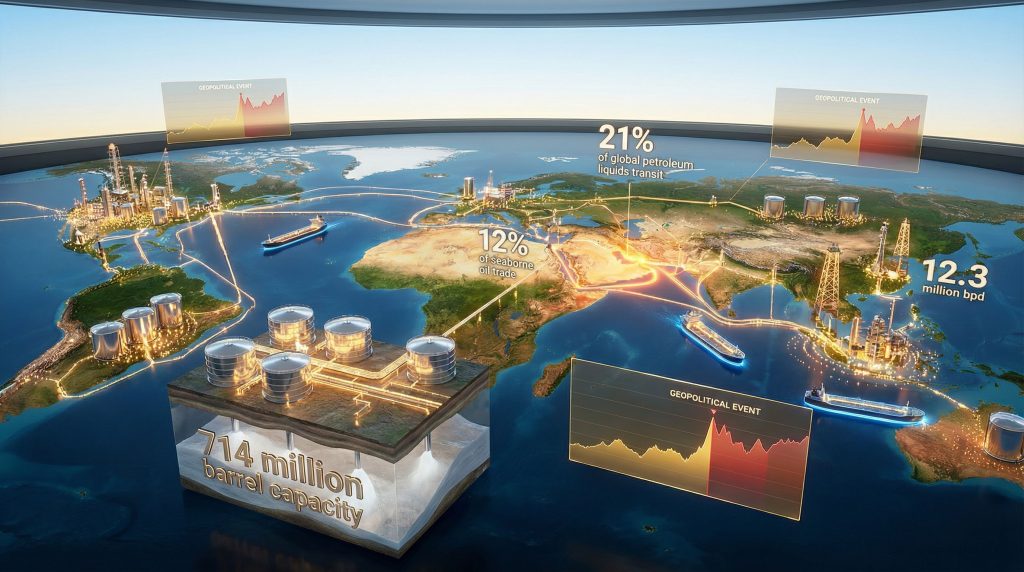
The Strait of Hormuz processes approximately 21% of global petroleum liquids transit, representing 35-38 million barrels per day of oil and oil products. Iran's geographic control over this waterway provides asymmetric bargaining power during international tensions. Any closure or restriction would immediately consume global spare production capacity within 12-18 days, after which prices would rise indefinitely until demand destruction equilibrates supply.
Suez Canal and SUMED Pipeline Complex:
This system handles approximately 12% of seaborne oil trade, processing 2-3 million barrels per day of crude oil plus refined products. The SUMED Pipeline provides alternative bypass capacity of 1.1-1.3 million barrels per day, but routing through the Red Sea introduces additional geographic risk exposure, as demonstrated by recent attacks on commercial vessels.
Bab el-Mandeb Strait Strategic Importance:
Connecting the Red Sea to the Indian Ocean, this chokepoint processes approximately 4-5% of global oil trade. Recent vessel attacks have significantly increased insurance premiums and caused shipping delays, forcing carriers to implement alternative routing strategies that increase delivery costs and transit times.
Turkish Straits Regulatory Constraints:
The Bosphorus and Dardanelles handle approximately 3-4% of global oil trade, primarily servicing Eastern European and Russian exports. The Montreux Convention of 1936 grants Turkish authorities significant control over passage rights, creating potential diplomatic leverage during regional conflicts.
Infrastructure Targeting Patterns and Market Psychology
Contemporary geopolitical actors increasingly target energy infrastructure to achieve strategic objectives without direct military confrontation. Ukraine's repeated strikes on Russia's Druzhba pipeline system exemplify this asymmetric warfare approach, where weaker adversaries impose costs on stronger opponents through infrastructure vulnerability exploitation.
The Druzhba pipeline carries approximately 1.0-1.2 million barrels per day destined for Hungary, Slovakia, and other Eastern European nations. Despite five successful strikes in 2025, operators maintained throughput through redundant systems and rapid repair capabilities. However, markets still maintained elevated risk premiums because each attack reduced system redundancy and increased vulnerability to cascading failures.
Infrastructure Attack Strategic Logic:
- Asymmetric cost imposition allowing weaker parties to influence stronger opponents
- Third-party pressure creation affecting energy security for dependent nations
- Diplomatic leverage generation through supply uncertainty for allied countries
- Economic warfare escalation targeting revenue streams and export capacity
In addition, global refinery capacity concentration presents additional vulnerability. Unplanned outages and maintenance reduced global refinery runs by 2.9 million barrels per day in October 2025, demonstrating how processing bottlenecks can amplify supply chain disruptions even when crude oil production remains stable.
The repeated attacks kept option volatility elevated, demonstrating that infrastructure targeting creates persistent uncertainty premiums even when operational disruption remains minimal.
Economic Mechanisms Behind Risk Premium Calculations
Financial markets employ sophisticated mathematical models to decompose crude oil prices into fundamental components and risk premiums. Options markets provide the primary mechanism for quantifying and trading geopolitical uncertainty through implied volatility measures and probability-weighted outcome scenarios.
Volatility-Based Risk Premium Indicators
Crude oil options markets experienced elevated implied volatility during the Russia-Ukraine conflict escalation, with traders pricing greater probability of unexpected supply outages. This volatility elevation allows options sellers to demand higher premiums for providing price insurance to market participants seeking downside protection.
Volatility Measurement Framework:
- Implied Volatility Analysis – Extracting market expectations from options pricing
- Historical Volatility Comparison – Benchmarking current uncertainty against past periods
- Term Structure Assessment – Analysing volatility expectations across different time horizons
- Put-Call Ratio Monitoring – Measuring directional bias in options positioning
The widening of front-month spreads during geopolitical events reflects traders' willingness to pay premium prices for immediate delivery versus deferred contracts. For instance, this contango steepening indicates that markets expect current disruptions to normalise over time, but maintain uncertainty about near-term supply availability.
Algorithmic Trading Amplification Effects
High-frequency trading systems monitor real-time news feeds, satellite imagery, and shipping data to execute trades within milliseconds of geopolitical developments. This technological capability creates both price discovery efficiency and amplification effects during crisis periods.
When Ukrainian forces strike Russian pipeline infrastructure, algorithmic systems immediately parse news reports, assess infrastructure damage through satellite analysis, and execute trades based on pre-programmed probability matrices. This automation enables rapid price adjustment but can also create momentum amplification during periods of elevated uncertainty.
Algorithmic Response Patterns:
- News sentiment analysis driving immediate buying or selling pressure
- Satellite imagery processing confirming or denying infrastructure damage
- Shipping route optimisation calculating alternative delivery costs
- Correlation trading across energy commodities and related financial instruments
Market liquidity withdrawal represents another amplification mechanism. During periods of elevated geopolitical risk, many market makers reduce position limits and widen bid-ask spreads, creating additional transaction costs that effectively increase the geopolitical risk premium in oil markets for all market participants.
Regional Conflict Asymmetric Market Impacts
Different geographic regions generate varying degrees of market impact based on their production capacity, strategic importance, and alternative supply availability. However, Middle Eastern conflicts typically generate higher risk premiums due to concentrated production and limited alternative sources, whilst conflicts in other regions may have more muted effects.
Middle East Production Concentration Effects
Saudi Arabia's production capacity of 12.3 million barrels per day represents approximately 12% of global oil supply, making any threat to Saudi infrastructure immediately systemically significant. The kingdom's strategic petroleum reserves and spare capacity provide some buffer against short-term disruptions, but sustained attacks could create severe global supply constraints.
Iran's potential production swing of 2.5 million barrels per day creates ongoing uncertainty in sanctions implementation and diplomatic negotiations. Markets continuously price the probability of Iranian supply returning to global markets versus potential supply removal through enhanced sanctions enforcement.
Iraq Production Risk Assessment:
Iraq's 4.9 million barrels per day production capacity faces multiple vulnerability sources including political instability, infrastructure attacks, and regional conflict spillover effects. The country's export dependence on southern terminals and northern pipeline systems creates geographic concentration risk that amplifies during regional tensions.
Russia-Ukraine Conflict Market Dynamics
The Russia-Ukraine conflict created unique market dynamics through sanctions implementation, infrastructure targeting, and alternative supply development. Russian crude stored on tankers increased by approximately 20% over three months, signalling delivery delays and growing congestion in shadow-fleet logistics operations.
U.S. sanctions on Rosneft and Lukoil, representing more than half of Russian national production, deterred major Asian buyers including India and China. These measures created artificial supply tightness in certain crude grades whilst simultaneously increasing availability of discounted Russian oil for willing purchasers.
European Energy Security Transformation:
European Union natural gas imports from Russia declined from approximately 40% pre-conflict to near zero by 2024, requiring massive infrastructure investment in LNG terminals, alternative pipeline connections, and renewable energy acceleration. This transformation cost represents one component of the long-term geopolitical risk premium in oil markets embedded in European energy pricing.
Furthermore, the development of alternative supply sources including increased U.S. shale production, Canadian oil sands expansion, and Brazilian offshore development provides some market resilience against single-source disruptions. However, the time required to develop alternative capacity means that short-term supply shocks can still generate significant price impacts.
Strategic Reserve Deployment and Market Stabilisation
Strategic petroleum reserves serve as both market stabilisation tools and geopolitical instruments, with coordinated releases capable of dampening supply shock impacts whilst unilateral deployments can signal political priorities and market intervention willingness.
International Energy Agency Coordination Mechanisms
The International Energy Agency coordinates strategic reserve releases among member countries maintaining collective emergency stocks equivalent to 90 days of import coverage. This reserve system provides market confidence during supply disruptions, knowing that coordinated government intervention can offset major production losses.
Strategic Reserve Deployment Framework:
- Trigger Mechanism Assessment – Evaluating disruption severity and market impact
- Coordinated Release Planning – Synchronising timing and volume across member countries
- Market Communication Strategy – Managing expectations and preventing panic buying
- Replenishment Planning – Developing strategies for reserve restoration post-crisis
The effectiveness of strategic reserve releases depends on market psychology and timing precision. Early deployment can prevent price spirals and panic buying, whilst delayed intervention may require larger volumes to achieve equivalent market impact.
National Energy Security Policy Variations
The United States Strategic Petroleum Reserve maintains 714 million barrel capacity, representing the world's largest government-controlled oil inventory. Recent drawdowns to address price inflation demonstrated how strategic reserves can serve both economic and political objectives beyond traditional energy security purposes.
China's strategic reserve accumulation patterns reflect long-term energy security planning and opportunistic purchasing during price downturns. Chinese reserve building during low-price periods provides market support, whilst potential releases during high-price periods could dampen price rallies.
Regional Strategic Reserve Policies:
- United States: Market intervention for economic and political objectives
- China: Long-term strategic accumulation with opportunistic timing
- European Union: Coordinated emergency response with import diversification
- Japan: Comprehensive energy security integration with alternative energy development
European emergency response protocols emphasise coordination among member states whilst developing alternative supply sources including renewable energy acceleration and LNG infrastructure expansion. This comprehensive approach reduces long-term dependence on potentially unstable supply sources.
The next major ASX story will hit our subscribers first
How Do Financial Markets Amplify Energy Risk Signals?
Modern energy markets integrate with broader financial systems through commodity derivatives, energy equity investments, and macroeconomic policy transmission mechanisms. This integration creates amplification effects where geopolitical energy risks influence broader financial market stability and investment flows.
Investment Flow Redirection During Energy Crises
Geopolitical energy risks trigger portfolio reallocation across multiple asset classes as investors reassess risk-return profiles and geographic exposure concentrations. Energy equity investments become both beneficiaries and victims of geopolitical tensions, with company-specific impacts depending on geographic exposure and operational flexibility.
Safe-Haven Asset Rotation Patterns:
- Energy sector equity volatility increases during geopolitical tensions
- Sovereign wealth fund reallocation toward energy security investments
- Private equity energy investment adjustments based on geographic risk assessment
- Renewable energy investment acceleration driven by energy independence objectives
Sovereign wealth funds from energy-importing nations increasingly prioritise energy security investments including renewable energy development, strategic reserve accumulation, and alternative supply source development. This capital reallocation creates long-term structural changes in global energy investment patterns.
Macroeconomic Policy Transmission Mechanisms
Persistent geopolitical risk premium in oil markets transmit through multiple economic channels including inflation expectations, central bank policy responses, and fiscal policy adjustments. Energy price elevation creates inflationary pressure that influences monetary policy decisions and economic growth forecasts.
Economic Transmission Pathways:
- Inflation Transmission through energy cost increases in consumer prices
- Central Bank Response via interest rate adjustments to combat energy-driven inflation
- Fiscal Policy Impact through energy subsidy costs and strategic reserve management
- Economic Growth Effects via energy cost impacts on productive capacity and consumption
The International Energy Agency's projection of a 2026 market surplus, expecting global inventories to rise by 2.2 million barrels per day, suggests that fundamental supply-demand balance may eventually override geopolitical risk premiums. However, the timing and magnitude of this transition depend on conflict resolution and alternative supply development success.
Long-Term Structural Market Evolution
Persistent geopolitical tensions accelerate structural changes in global energy systems including renewable energy adoption, supply chain diversification, and energy independence policy development. These long-term adaptations reduce vulnerability to traditional geopolitical risk sources whilst potentially creating new dependency patterns.
Energy Transition Acceleration Through Risk Premium Justification
High geopolitical risk premiums provide economic justification for renewable energy investments that might otherwise face cost competitiveness challenges. When oil prices ease following reduced uncertainty, renewable energy projects achieve earlier break-even points and attract increased investment capital.
Renewable Energy Investment Drivers:
- Price volatility reduction through domestic renewable resource utilisation
- Energy security enhancement via reduced import dependency
- Long-term cost predictability compared to volatile fossil fuel pricing
- Technological innovation acceleration supported by increased investment flows
Electric vehicle adoption rates correlate with sustained periods of elevated oil prices, as consumers factor long-term energy cost uncertainty into vehicle purchasing decisions. Consequently, geopolitical risk premiums effectively subsidise electric vehicle competitiveness by increasing the total cost of ownership for conventional vehicles.
Global Supply Chain Restructuring Implications
Energy importing nations increasingly prioritise supply source diversification and domestic energy resource development to reduce exposure to geopolitical supply disruptions. This restructuring creates new trade patterns, infrastructure requirements, and international relationship dynamics.
Supply Chain Diversification Strategies:
- Multiple supplier development reducing single-source dependency
- Strategic partnership formation with politically stable energy producers
- Domestic resource development including previously uneconomical reserves
- Alternative energy infrastructure investment for import substitution
The emergence of regional energy security blocs reflects this diversification trend, with countries forming strategic partnerships based on geographic proximity, political alignment, and resource complementarity rather than purely economic efficiency considerations.
Furthermore, resource nationalism trends may increase as countries prioritise domestic energy security over global market efficiency. This political evolution could create additional sources of geopolitical risk premiums as export restrictions and strategic resource controls become more prevalent policy tools.
Investment Strategy Navigation in Volatile Energy Markets
Professional investors employ multiple approaches to navigate geopolitical risk premiums in oil markets, including direct commodity exposure, energy equity investments, and derivative-based hedging strategies. Successful navigation requires understanding both fundamental market dynamics and geopolitical risk assessment frameworks.
Portfolio Hedging and Risk Management Approaches
Energy sector diversification involves balancing exposure across different geographic regions, production methods, and value chain segments to reduce concentration risk whilst maintaining energy sector investment benefits. This approach requires continuous monitoring of geopolitical developments and their potential impact on different energy subsectors.
Diversification Framework Components:
- Geographic distribution across politically stable and unstable regions
- Technology diversification including conventional and renewable energy
- Value chain exposure spanning exploration, production, refining, and distribution
- Currency hedging addressing foreign exchange risk in international investments
Derivatives-based protection mechanisms include options strategies that provide downside protection during geopolitical crises whilst maintaining upside participation in favourable market conditions. These strategies require sophisticated understanding of options pricing and volatility dynamics.
Fundamental Versus Risk Premium Decomposition Analysis
Successful energy investment requires separating sustainable price increases driven by supply-demand fundamentals from temporary price elevation due to geopolitical risk premiums. This decomposition enables investors to identify when elevated prices reflect temporary uncertainty versus structural market changes.
Risk-Adjusted Valuation Methods:
- Scenario-based modelling incorporating multiple geopolitical outcome probabilities
- Volatility-adjusted returns accounting for risk premium uncertainty
- Correlation analysis understanding relationships between geopolitical events and price movements
- Mean reversion assessment evaluating whether current premiums are sustainable
Long-term energy price forecasting models must incorporate both fundamental supply-demand projections and geopolitical risk evolution scenarios. For instance, the Energy Information Administration's Brent outlook projecting prices declining to $54 in the first quarter of 2026 assumes geopolitical tensions moderate whilst supply from the US oil production decline, Canada, Brazil, and higher OPEC+ quotas exceeds demand growth.
What Future Risks Will Shape Oil Market Premiums?
Emerging risk factors including climate policy uncertainty, cyber warfare threats, and resource nationalism trends will likely reshape how markets calculate and price geopolitical risk premiums. Understanding these evolving dynamics provides insight into future energy market structure and investment opportunity development.
Technological Disruption Impact on Traditional Risk Factors
Decentralised energy systems reduce vulnerability to traditional chokepoint disruptions whilst potentially creating new cyber security and grid stability risks. This transition may reduce geographic concentration risk whilst increasing technology-dependent infrastructure vulnerability.
Emerging Risk Categories:
- Cyber warfare targeting of energy infrastructure and trading systems
- Climate policy uncertainty affecting long-term investment viability
- Resource nationalism expansion limiting international energy trade
- Technology supply chain vulnerabilities in renewable energy systems
Regional market integration versus fragmentation trends will determine whether energy markets become more resilient through diversification or more vulnerable through increased complexity and interdependence. Current geopolitical tensions suggest a movement toward regional energy security blocs rather than global market integration.
Market Structure Evolution Predictions
The development of alternative energy sources, improved storage technologies, and enhanced energy efficiency reduces the strategic importance of traditional oil and gas resources. This technological evolution may gradually reduce the geopolitical leverage associated with fossil fuel control whilst creating new dependency patterns around critical mineral resources required for renewable energy systems.
Structural Change Indicators:
- Renewable energy cost competitiveness reducing fossil fuel strategic importance
- Energy storage deployment enabling greater supply flexibility and security
- Critical mineral dependency creating new geopolitical vulnerability sources
- Digital infrastructure integration increasing cyber security risk exposure
However, the potential for an oil price rally driven by trade tensions demonstrates how traditional geopolitical factors remain relevant even as energy systems evolve. Similarly, oil price movements continue to reflect the complex interplay between geopolitical events and market fundamentals.
The possibility of oil price stagnation suggests that markets may increasingly price competing political and economic pressures rather than clear directional risks. Market participants must balance traditional geopolitical risk assessment with emerging technological and policy uncertainties to develop effective long-term investment and hedging strategies.
The evolution of geopolitical risk premium in oil markets reflects broader changes in global energy systems, international relations, and technological capabilities that will continue reshaping energy market dynamics throughout the decade ahead.
Ready to Navigate Energy Market Volatility?
Discovery Alert's proprietary Discovery IQ model delivers real-time alerts on significant ASX mineral discoveries, helping subscribers identify actionable opportunities whilst energy markets experience heightened volatility and geopolitical uncertainty. Discover how major discoveries have generated substantial returns through Discovery Alert's dedicated discoveries page, then begin your 30-day free trial today to position yourself ahead of market disruptions.