August 3, 2026
The Structural Shift Hiding Inside India's Power Data
Energy transitions rarely announce themselves cleanly. They tend to arrive embedded inside contradictions: output rising in absolute terms while shrinking in relative importance, infrastructure records broken while legacy systems simultaneously expand. India's electricity sector in July 2026 is a textbook example of this dynamic, and understanding what is actually happening beneath the headline numbers requires pulling apart several interacting forces at once.
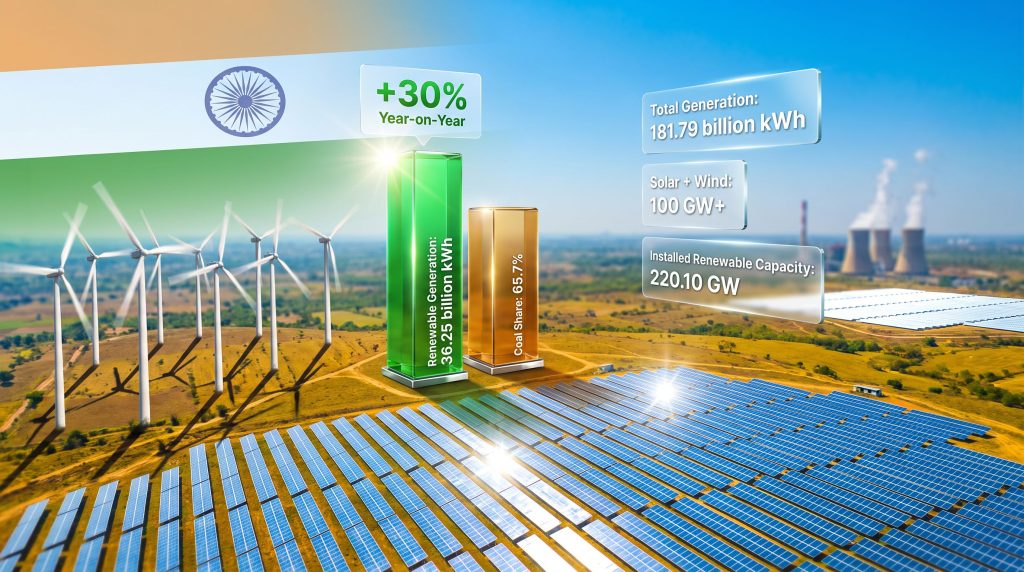
The central fact is this: India's renewable energy record high coal power share decline became unmistakable in July 2026, with the country generating a record 36.25 billion kWh from renewable sources, representing a 30% year-on-year increase. Total electricity output reached 181.79 billion kWh, up 10.4% from the same month in the prior year. Coal's proportional share compressed from 69% in June to 65.7% in July, its lowest level in approximately 12 months. Simultaneously, coal-fired generation in absolute volume actually increased by 12.8% year-on-year to 119.40 billion kWh.
That apparent contradiction is not a data error. It is the defining characteristic of India's current transition phase.
When big ASX news breaks, our subscribers know first
What the Record Really Reflects: Additive Growth vs. Substitutive Displacement
There is an important conceptual distinction between renewable energy adding to a grid and renewable energy replacing what was already there. In a substitutive displacement scenario, coal plants run fewer hours as solar and wind capacity absorbs their load. In an additive scenario, demand is growing fast enough that renewables fill incremental growth while coal continues to run at or near capacity to meet baseline needs.
India in July 2026 sits firmly in the additive phase, though the data suggests the transition toward substitution is mathematically closer than it has ever been. When renewable generation grows at 30% year-on-year while total demand grows at 10.4%, the gap between those two rates is compressing coal's share even without reducing coal's absolute output. This is the mathematical engine behind the headline shift.
A declining coal share does not necessarily mean declining coal output. When total electricity demand grows faster than coal's own growth rate, renewables can displace coal's proportional dominance even as coal plants run harder. This is the dynamic currently playing out in India's power sector.
The structural significance of this moment should not be understated. For coal's share to fall while coal's absolute generation rises, renewables must be growing at a rate that outpaces total demand expansion. That condition, now observable in monthly data, is precisely the trajectory that long-term decarbonisation models require in order to eventually reach substitution at scale.
Solar and Wind: The Infrastructure Behind India's Renewable Energy Record High
Capacity as the Foundation
India's installed renewable energy capacity reached 220.10 GW by 31 March 2025, up from 198.75 GW the prior fiscal year. This infrastructure base is the physical foundation that makes record monthly generation figures possible. Importantly, there is a distinction between nameplate capacity and actual generation output: capacity measures what a system can produce under ideal conditions, while generation measures what it actually produces given weather, grid constraints, and operating conditions.
July's record reflects both expanding capacity and favourable seasonal conditions. Summer solar irradiance in India peaks during this period, and the onset of monsoon season generates elevated wind speeds across the western coastline and central plateau regions. The convergence of these seasonal factors with a substantially larger installed base produced the 100 GW combined solar and wind output milestone for the first time in a single month.
On 13 July 2026 specifically, solar and wind supplied a record 42.8% of India's electricity, according to government data. That single-day figure illustrates the peak capacity that variable renewables can now deliver to the national grid during optimal conditions. Furthermore, this milestone reflects the broader renewable energy solutions that are reshaping electricity generation globally across multiple sectors.
Solar's Influence on Peak Demand Architecture
Beyond raw generation volume, solar energy is fundamentally changing the shape of India's daily demand curve. Historically, peak demand in India followed a pattern tied to industrial activity and residential cooling loads, with mid-morning and early evening peaks placing the greatest stress on dispatchable generation assets.
As solar penetration increases, the daytime peak is increasingly absorbed by photovoltaic generation, shifting the residual demand curve into what energy engineers call the "duck curve" pattern: lower net demand requirements during midday hours, followed by a steep ramp-up requirement in the late afternoon as solar output declines. Analysis from the Centre for Research on Energy and Clean Air indicates that a growing proportion of daytime peak demand is now being absorbed directly by solar generation, a structural change in how grid operators at Grid-India must manage dispatch sequencing throughout each 24-hour cycle.
The Coal Paradox: Why Output Rises While Share Falls
El Niño and the Hydropower Gap
The July 2026 data contains a complicating variable that partially offsets the renewable narrative. Hydropower generation declined for the second consecutive month, falling to a 22.1% share of the overall generation mix. The cause is well-understood: El Niño weather patterns disrupt India's monsoon rainfall distribution, reducing reservoir inflows and limiting the water available to generate hydroelectric output.
This matters because hydropower is a dispatchable renewable, capable of generating electricity on demand regardless of time of day. When hydro output falls, the gap must be filled by something else. In India's current grid configuration, that something is predominantly coal.
Analysis from the Centre for Research on Energy and Clean Air estimated that reduced hydropower output combined with rising electricity demand could create a generation shortfall of approximately 18 billion kWh, a volume that coal-fired power stations are required to absorb in the near term.
| Power Source | July 2026 Share | July 2026 Volume | Year-on-Year Change |
|---|---|---|---|
| Renewables (total) | 20% | 36.25 billion kWh | +30% |
| Coal | 65.7% | 119.40 billion kWh | +12.8% |
| Hydropower | 22.1% | Declining | Negative |
| Solar + Wind combined | 100 GW+ milestone | Record monthly output | First-ever crossing |
| Total generation | 100% | 181.79 billion kWh | +10.4% |
The Nighttime Demand Problem
El Niño's effect on India's power sector extends beyond reduced rainfall. Above-normal nighttime temperatures, a characteristic El Niño signature, amplify cooling loads after sunset precisely when solar generation has ceased entirely. This creates a dual pressure point: reduced dispatchable renewable supply from hydro combined with elevated demand during hours that solar cannot serve.
This is the structural limitation that battery storage infrastructure is designed to address. India's grid-scale storage deployment remains in its early stages relative to the scale required to meaningfully buffer evening demand. Until pumped hydro, battery storage, and demand-side management programmes are deployed at sufficient scale, dispatchable baseload generation — predominantly coal — remains structurally necessary to maintain grid stability through overnight hours.
The 2025 Baseline: Why Last Year's Data Matters for Interpreting 2026
The July 2026 record does not exist in isolation. In 2025, India's renewable generation grew by a record 98 TWh annually, contributing to a 3.3% decline in fossil power generation and approximately a 3% fall in coal-fired output. That annual coal decline was only the second such full-year reduction in roughly 50 years, a historically rare occurrence that signals a genuine structural shift rather than a seasonal anomaly. According to Reuters reporting on this milestone, India's record renewable generation in July cut coal's share in the power mix to a one-year low.
| 2025 Metric | Data Point |
|---|---|
| Renewable generation growth | +98 TWh (record annual increase) |
| Impact on fossil power generation | Fossil output declined by 3.3% |
| Coal-fired power generation change | Approximately -3% |
| Installed renewable capacity (March 2025) | 220.10 GW |
| Historical significance | Only second full-year coal decline in ~50 years |
The 2025 baseline matters because it establishes that the structural momentum visible in July 2026's monthly record is not an isolated data point. It reflects a compounding trajectory: a larger installed capacity base generating progressively larger incremental output, layered on top of a prior-year foundation that was already historically significant.
Industrial Implications: What the Coal Power Share Decline Means for Energy-Intensive Sectors
Aluminium and the Grid Carbon Intensity Connection
Among the sectors most directly affected by shifts in India's generation mix, primary aluminium smelting stands out. Aluminium production is one of the most electricity-intensive industrial processes in existence, with smelting operations consuming roughly 13 to 15 megawatt-hours per tonne of primary aluminium produced. The carbon intensity of that electricity is therefore a direct determinant of the lifecycle emissions profile of the metal.
As coal's share of India's grid declines and renewables expand, the emissions intensity of each unit of industrially consumed electricity falls correspondingly. For domestic aluminium producers, this creates a long-run pathway toward lower Scope 2 emissions without requiring on-site generation investments, provided the grid transition continues at its current pace. This mirrors the broader energy transition in mining sectors globally, where decarbonising electricity supply is a fundamental lever for reducing industrial emissions.
There is also a cost dimension. Coal-fired generation is subject to fuel price volatility, logistics constraints, and increasingly, carbon-related regulatory pressure. A grid with a progressively higher renewable share introduces a structurally different cost dynamic — one with higher upfront capital requirements but lower marginal operating costs per kilowatt-hour. For energy-intensive industries planning decade-long capital expenditure cycles, this distinction carries significant strategic weight. In addition, the mining decarbonisation benefits that flow from cleaner grid electricity extend well beyond aluminium to steel, copper, and other metals-intensive sectors.
Grid Stability and the Transmission Infrastructure Imperative
As India's renewable share approaches and periodically crosses 20%, grid management complexity increases materially. Variable generation sources introduce forecast uncertainty, require more sophisticated dispatch scheduling, and place greater demands on transmission infrastructure to move power from generation-rich regions — typically solar-dominant western and southern states — to demand centres in the north and east.
Grid-India's role in balancing this increasingly complex portfolio is expanding. Furthermore, investment in transmission capacity, smart grid technology, and interconnection infrastructure is as critical to the energy transition as the generation capacity additions themselves. A renewable megawatt that cannot be dispatched to where demand exists is, functionally, a stranded asset. This challenge connects directly to the broader question of critical minerals and energy security, as grid infrastructure itself depends on copper, aluminium, and rare earth materials to function.
The Green Metals Connection
India's India renewable energy record high coal power share decline carries implications that extend beyond its own borders. As major economies decarbonise their grids, demand for the metals required to build and sustain clean energy infrastructure intensifies. Solar panels require silver, silicon, and aluminium. Wind turbines require steel, copper, and rare earths. Battery storage requires lithium, cobalt, and nickel.
Australia's position as a supplier of many of these materials means that India's accelerating renewable buildout translates directly into sustained demand for Australian mineral exports. Consequently, green metals leadership is increasingly relevant to how Australia positions itself in response to the energy transitions occurring across Asia, including India's rapidly evolving power sector.
The next major ASX story will hit our subscribers first
Frequently Asked Questions
Why Did Coal's Share Fall to 65.7% in July 2026 if Coal Output Actually Increased?
Coal's proportional share declined because renewable generation grew at a significantly faster rate (30% year-on-year) than overall electricity demand (10.4% year-on-year). This means renewables captured a larger fraction of total generation, compressing coal's percentage contribution even as coal's absolute output volume also rose.
What Caused Hydropower to Decline in July 2026?
Analysts attributed the decline to El Niño-linked disruption of India's monsoon rainfall patterns, which reduced reservoir inflows and limited the operational output of hydroelectric facilities. Hydropower's share fell to 22.1%, declining for the second consecutive month.
What Was Significant About 13 July 2026?
On that date, solar and wind generation combined supplied a record 42.8% of India's electricity, the highest single-day contribution from variable renewables ever recorded, reflecting the scale that India's installed renewable fleet has now reached.
How Does July 2026 Connect to the 2025 Annual Data?
In 2025, India recorded only the second annual decline in coal-fired generation in approximately 50 years, with coal output falling roughly 3% and fossil generation overall declining by 3.3%. July 2026's record monthly figures confirm that the structural momentum from 2025 is continuing to build rather than reverting.
What Is the 18 Billion kWh Generation Gap?
Analysis from the Centre for Research on Energy and Clean Air estimated that the combination of reduced hydropower output and rising electricity demand could create a power generation shortfall of approximately 18 billion kWh, a gap that coal-fired generation is required to fill in the near term, explaining why coal's absolute output rose even as its share fell.
Disclaimer: This article contains forward-looking analysis, projections, and third-party estimates. Figures cited reflect data available as of the reporting period. Energy transition timelines and generation mix projections involve inherent uncertainty and should not be interpreted as investment advice. Readers should consult primary data sources including Grid-India's publicly available generation datasets and independent energy research organisations for verification of specific figures.
Want To Capitalise on the Mineral Discoveries Powering India's Renewable Surge?
As India's renewable buildout accelerates, demand for the critical minerals underpinning solar, wind, and battery storage infrastructure is intensifying — and Discovery Alert's proprietary Discovery IQ model delivers real-time alerts on significant ASX mineral discoveries, transforming complex geological data into actionable investment insights. Explore historic returns from major mineral discoveries and begin your 14-day free trial at Discovery Alert to position yourself ahead of the market.