August 3, 2026
The Structural Flaw Inside India's Aluminium Economy
Raw material pricing regimes rarely attract mainstream attention, yet they can quietly determine whether an entire manufacturing ecosystem thrives or stagnates. Across India's downstream aluminium sector, the India aluminium import levy MSME raw material costs debate has been compressing margins, constraining capacity utilisation, and forcing thousands of small manufacturers into a competitive straitjacket that their international counterparts simply do not face. Understanding why this is happening requires looking past the headline tariff number and examining the mechanics of how domestic metal prices are formed.
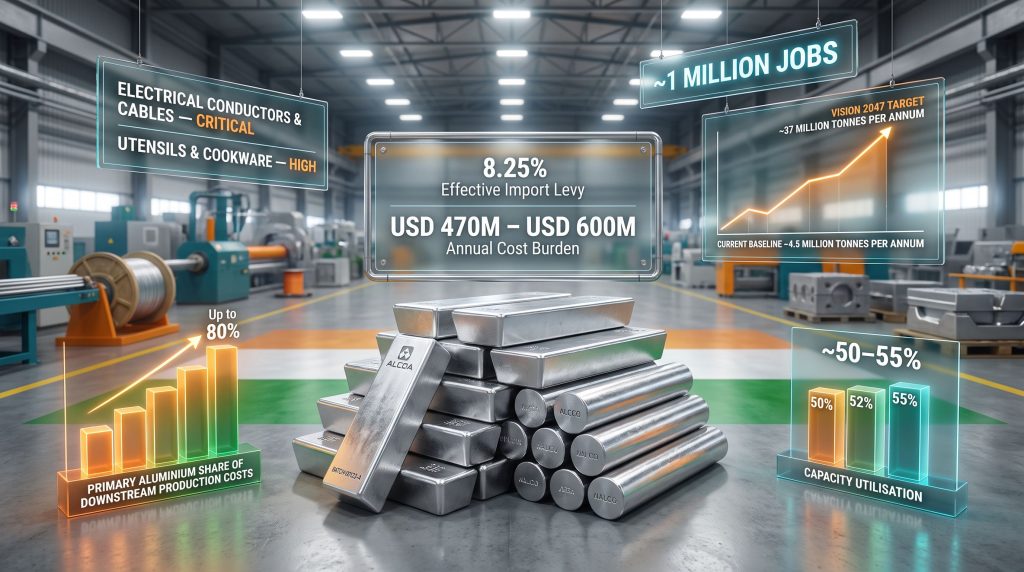
India holds a paradoxical position in the global aluminium landscape. As the world's second-largest producer of primary aluminium, the country generates approximately 4.5 million tonnes per annum of the metal. Yet the downstream manufacturers who depend on that metal as their core raw material are operating at an estimated 50 to 55 per cent of installed capacity. That gap between upstream abundance and downstream underperformance is not accidental.
It reflects a pricing dynamic that has transferred the cost burden of import protection onto the very industries that were supposed to benefit from domestic production. Furthermore, understanding this dynamic requires examining the role of top aluminium producers in shaping global pricing benchmarks that flow directly into India's domestic market.
When big ASX news breaks, our subscribers know first
Import-Parity Pricing: The Invisible Tax on Domestic Buyers
To understand why the India aluminium import levy affects MSME raw material costs even when no metal crosses a border, it is necessary to understand how import-parity pricing actually works.
Primary aluminium prices globally are anchored to the London Metal Exchange benchmark, adjusted for regional delivery premiums, freight, insurance, and currency factors. Import-parity pricing takes this logic one step further: domestic metal is priced as though it were being imported, incorporating not just the international benchmark but also the cost components associated with physically importing the metal into the country.
The practical consequence is significant. When a small extrusion unit in Gujarat or a cable manufacturer in Tamil Nadu purchases domestically produced aluminium, the price they negotiate is calibrated against what imported metal would cost. Because India's Basic Customs Duty on primary aluminium sits at 7.5 per cent, with an additional 0.75 per cent Social Welfare Surcharge, the effective import levy reaches approximately 8.25 per cent.
That tariff, designed to protect upstream smelters from foreign competition, becomes embedded in the price that downstream buyers pay for domestic metal. Consequently, aluminium tariff impacts of this nature are not unique to India, though the domestic transmission mechanism through import-parity pricing represents a particularly acute structural challenge.
Import-parity pricing effectively means that Indian MSME manufacturers are indirectly absorbing the cost of a tariff that was never intended for them. They pay a price that reflects import protection, even when the metal they purchase has never left Indian soil.
This is the structural contradiction at the heart of India's aluminium pricing debate. The tariff does its job at the border. Then, through the pricing mechanism, it reaches into every domestic transaction further down the value chain.
Breaking Down the 8.25% Levy: What Each Component Represents
The India aluminium import levy is not a single instrument but a composite of two overlapping charges.
| Duty Component | Rate |
|---|---|
| Basic Customs Duty (BCD) on Primary Aluminium | 7.5% |
| Social Welfare Surcharge (SWS) on BCD | 0.75% |
| Effective Total Import Levy | ~8.25% |
The Social Welfare Surcharge, applied as a percentage of the Basic Customs Duty, is often overlooked in policy discussions. While 0.75 per cent may appear negligible in isolation, it compounds across the value chain. Each stage of downstream processing that incorporates primary aluminium carries this embedded cost, meaning the effective burden on the final manufactured product can exceed the nominal levy on the raw input.
For context, comparable economies that have developed strong downstream aluminium manufacturing sectors have generally maintained lower effective input costs for value-added producers. The structural asymmetry created by India's tariff design has been a persistent friction point for organisations representing downstream interests. In addition, bauxite supply importance plays a foundational role in determining the upstream cost base against which these tariff structures operate.
The USD 470 Million Problem: Quantifying the MSME Cost Burden
Abstract policy arguments gain traction when translated into concrete financial terms. The Ministry of Mines' own Aluminium Vision framework has provided one of the most cited figures in this debate.
Industry stakeholders referencing that framework have pointed to estimates suggesting India's downstream aluminium manufacturers collectively paid approximately USD 470 million in excess raw material costs in 2022 as a direct consequence of import-parity pricing dynamics. Secondary industry analyses have placed annual estimates as high as USD 600 million.
To appreciate why this figure matters so acutely for MSMEs specifically, consider how differently aluminium cost movements affect large integrated producers versus small standalone manufacturers:
- Primary aluminium can constitute up to 80 per cent of total production costs for downstream manufacturers.
- Large producers typically access sophisticated financial instruments including LME hedging, long-term offtake agreements, and volume-based discounts that insulate them from spot price volatility.
- MSMEs generally purchase on shorter contract cycles, with limited hedging access and minimal purchasing leverage.
- For a small manufacturer where raw material accounts for 80 per cent of costs, a price elevation of even 5 to 8 per cent can eliminate operating margins entirely.
The downstream sector, despite operating below half its installed capacity, still supports an estimated one million direct and indirect jobs across India's MSME and manufacturing economy. That employment footprint makes the pricing question a social and economic policy issue, not merely a trade technicality. According to analysis from the Economic Times, high raw material costs are already impacting small aluminium manufacturers in ways that demand urgent structural responses.
Which MSME Segments Face the Highest Exposure
The pricing burden does not fall evenly across downstream sectors. Some manufacturing segments are structurally more exposed than others based on the intensity of primary aluminium in their production processes.
| MSME Segment | Aluminium as % of Input Cost | Estimated Exposure Level |
|---|---|---|
| Electrical Conductors and Cables | Very High | Critical |
| Utensils and Cookware | High | High |
| Extrusions and Architectural Profiles | High | High |
| Automotive Castings and Components | Moderate to High | Moderate to High |
| Packaging Foils | Moderate | Moderate |
Electrical conductor and cable manufacturers represent perhaps the most acute case. Aluminium conductors are a direct substitute for copper in many power transmission and distribution applications, with price competitiveness being the primary selection criterion. When raw material costs are structurally elevated, Indian conductor manufacturers lose ground against imports from countries with lower effective input costs.
Utensil and cookware manufacturers face a different challenge: their end markets are intensely price-sensitive and populated by domestic consumers who have alternative choices. Labour costs, overhead, and thin retail margins leave virtually no room to absorb elevated metal costs.
Industry Associations and the Push for Tariff Rationalisation
The Federation of All India Aluminium Utensils Manufacturers (FAIAUM) and the Cable and Conductor Manufacturers Association of India (CACMAI) escalated the debate formally in July 2026, submitting a joint representation to the Ministry of Mines on July 14, 2026, seeking rationalisation of the effective 8.25 per cent customs levy on primary aluminium. The Aluminium Secondary Manufacturers Association (ASMA) and broader downstream coalitions have independently maintained similar policy positions over an extended period.
When industry associations speak of rationalisation, three specific policy pathways are typically under discussion:
- Full removal of the 7.5 per cent Basic Customs Duty on primary aluminium, creating a level playing field between domestic and international procurement costs.
- Partial reduction to a lower rate, such as 2.5 to 5 per cent, potentially paired with a phased review mechanism tied to domestic production benchmarks.
- Sector-specific exemptions for MSME-designated downstream manufacturers, preserving upstream protection while relieving small producers of the indirect pricing burden.
Each option carries different implications for India's primary aluminium producers, government revenue, and the broader investment case for upstream smelting capacity. Furthermore, aluminium industry restructuring observed in other markets offers instructive precedents for how tariff reform can be sequenced alongside structural industry changes. The CUTS-CITEE briefing paper on reforming India's aluminium ecosystem provides a detailed framework for understanding how tariff rationalisation could be implemented whilst maintaining competitive pricing for MSME growth.
The next major ASX story will hit our subscribers first
The Aluminium Scrap Debate: A Parallel Reform Opportunity
Running alongside the primary aluminium tariff discussion is a separate but related debate about the 2.5 per cent import duty on aluminium scrap. Secondary aluminium production, which uses scrap as feedstock rather than primary metal, offers downstream manufacturers a potentially lower-cost raw material pathway.
The Ministry of Mines has reportedly considered recommending the elimination of the scrap import duty as a complementary measure to primary aluminium tariff reform. For recyclers and scrap-intensive downstream manufacturers, this would have a meaningful impact on input economics. However, recycling capacity expansion trends across the broader materials sector suggest that structural investment in domestic recycling infrastructure must accompany any tariff relief to deliver lasting benefit.
Secondary aluminium production also carries substantially lower energy requirements compared to primary smelting, making it strategically aligned with India's broader sustainability and carbon reduction objectives. The secondary aluminium pathway represents an underappreciated lever in this policy debate. Expanding the availability of competitively priced scrap could partially offset the input cost disadvantage facing MSMEs, without necessarily requiring changes to the primary aluminium tariff structure that upstream producers have strongly defended.
The Free Trade Agreement Complication
India's aluminium tariff challenge is further complicated by the country's free trade agreement commitments. Under the ASEAN-India Free Trade Agreement, qualifying finished aluminium products manufactured in ASEAN member countries can enter India at preferential or zero tariff rates, subject to applicable rules of origin requirements.
This creates a structurally asymmetric competitive environment:
- A domestic MSME manufacturer producing aluminium extrusions or fabricated components faces input costs inflated by import-parity pricing linked to the 8.25 per cent levy.
- A competing foreign manufacturer exporting finished aluminium products into India under an applicable FTA may face zero or minimal tariff at the Indian border.
- The result is that foreign value-added products can enter the Indian market at a structural cost advantage over equivalent domestically manufactured goods.
Rules of origin provisions are intended to prevent this asymmetry from being exploited through simple transshipment. However, their practical effectiveness in preventing genuine competitive disadvantage for Indian manufacturers has been questioned by downstream industry representatives. The product categories most affected by this FTA asymmetry include aluminium extrusions, rolled products, conductor components, and fabricated building and construction materials.
The Primary Producers' Counter-Argument
Any balanced analysis of the India aluminium import levy and MSME raw material costs debate must acknowledge that India's primary aluminium producers hold a legitimate counter-position.
Primary aluminium smelting is among the most capital-intensive and energy-intensive industrial processes in existence. Indian smelters compete in a global market where state-subsidised energy costs in certain producing nations, accumulated excess capacity, and differential carbon pricing regimes create significant structural cost advantages for foreign producers. Removing or significantly reducing import tariffs could expose Indian smelters to a wave of competitively priced foreign primary metal, potentially threatening the investment case for future smelting capacity.
The policy tension is real: protecting upstream capacity may inadvertently handicap downstream competitiveness, while liberalising downstream input costs may undermine the viability of the very upstream industry that supplies those inputs.
Vision 2047 and the Value-Addition Imperative
The Ministry of Mines' Aluminium Vision Document, released in July 2025, frames the scale of India's upstream ambition in striking terms.
| Vision 2047 Metric | Current Position | Target by 2047 |
|---|---|---|
| Primary Aluminium Production | ~4.5 million tonnes per annum | ~37 million tonnes per annum |
| Bauxite Production Capacity | Current baseline | 150 million tonnes per annum |
| National Aluminium Recycling Rate | Current baseline | Doubled |
| Required Additional Investment | — | Exceeding INR 20 trillion |
Scaling primary production roughly eightfold over two decades is an extraordinarily ambitious target. But the Vision document's implicit logic contains a critical assumption that is easy to overlook: that expanded primary production will translate into expanded downstream manufacturing and value-added exports. That translation is not automatic.
Without a competitive raw material cost environment for downstream manufacturers, India risks building enormous upstream production capacity that continues to export primary metal rather than transforming it into higher-value fabricated products. The economic return per tonne of aluminium in extrusions, cables, automotive components, and aerospace-grade products is multiples higher than the return on primary metal.
MSMEs are the structural bridge that converts primary aluminium into economic complexity. If their cost competitiveness remains constrained by the import-parity pricing mechanism, the Vision 2047 ambition may produce more smelters but fewer downstream success stories.
Policy Options Available to New Delhi
The Indian government faces a set of genuine trade-offs in resolving this upstream-downstream tension. Several credible policy options exist:
- Targeted tariff reduction for downstream-designated buyers: Differential duty treatment based on end-use declarations, preserving upstream protection while reducing input costs for certified MSME manufacturers.
- A domestic pricing mechanism decoupled from import parity: Establishing a reference pricing framework for domestic aluminium transactions that reflects actual domestic production costs rather than import-equivalent benchmarks.
- Production-Linked Incentive (PLI) schemes for MSME aluminium manufacturers: Offsetting input cost disadvantages through output-based incentives, similar to PLI structures already in place in other manufacturing sectors.
- FTA renegotiation or safeguard mechanisms: Addressing the competitive asymmetry created by preferential finished-goods imports through revised rules of origin or targeted safeguard measures.
Each pathway carries trade-offs across employment, investment incentives, government revenue, and India's international trade commitments. No single measure is likely to fully resolve a structural tension that has accumulated over decades of tariff policy design.
Key Statistics: India's Aluminium MSME Cost Pressure at a Glance
| Metric | Figure |
|---|---|
| Effective Import Levy on Primary Aluminium | 8.25% |
| Primary Aluminium as Share of Downstream Production Cost | Up to 80% |
| Estimated Annual Excess Cost Burden (Downstream Manufacturers) | USD 470M to USD 600M |
| India's Current Primary Aluminium Production | ~4.5 million tonnes per annum |
| Downstream Capacity Utilisation Rate | ~50 to 55% |
| Direct and Indirect Jobs Supported by Downstream Sector | ~1 million |
| Aluminium Scrap Import Duty Under Review | 2.5% |
Frequently Asked Questions
What is India's current import duty on primary aluminium?
India levies a 7.5 per cent Basic Customs Duty on primary aluminium, plus a 0.75 per cent Social Welfare Surcharge, bringing the effective total import levy to approximately 8.25 per cent.
Why do MSMEs pay import-parity prices even when buying domestically produced aluminium?
Domestic aluminium is priced with reference to international benchmarks plus associated import costs, a mechanism known as import-parity pricing. This means the tariff burden is embedded in the domestic price regardless of whether the metal was actually imported.
Which industry associations are lobbying for tariff reform?
FAIAUM (Federation of All India Aluminium Utensils Manufacturers), CACMAI (Cable and Conductor Manufacturers Association of India), and ASMA (Aluminium Secondary Manufacturers Association) are among the key organisations seeking rationalisation of the current tariff structure.
What is the difference between the aluminium scrap duty and the primary aluminium import levy?
The primary aluminium import levy of 8.25 per cent applies to unwrought aluminium, while a separate 2.5 per cent duty on aluminium scrap applies to secondary feedstock. Reform of both is under consideration as complementary measures.
How does the ASEAN-India FTA affect domestic aluminium manufacturers?
Under the agreement, qualifying finished aluminium products from ASEAN nations may enter India at preferential tariff rates, potentially at lower effective cost than the same products manufactured domestically using primary aluminium subject to import-parity pricing.
What is India's aluminium production target under Vision 2047?
The Ministry of Mines has outlined a target to increase primary aluminium production from approximately 4.5 million tonnes per annum to 37 million tonnes per annum by 2047, requiring investment exceeding INR 20 trillion.
Could reducing the import levy harm India's primary aluminium producers?
Primary producers have argued that tariff protection is necessary given the capital and energy intensity of smelting and the prevalence of globally distorted aluminium markets. Any reduction would need to be carefully calibrated to avoid undermining the investment case for domestic smelting capacity.
Resolving the Upstream-Downstream Divide Cannot Wait
India's aluminium sector embodies a policy dilemma that is common across industrialising economies: the protective mechanisms that build upstream capacity can inadvertently suppress the downstream industries that should represent the next stage of industrial evolution. The India aluminium import levy and its transmission into MSME raw material costs through import-parity pricing is a textbook example of this dynamic.
The USD 470 million annual excess cost burden on downstream manufacturers, the 50 to 55 per cent capacity utilisation rate, and the employment footprint of one million workers in the downstream sector collectively make this a structural reform priority that extends well beyond a narrow tariff adjustment.
India's Vision 2047 aluminium ambitions require both a competitive upstream and a thriving downstream. Achieving that balance will demand more than incremental adjustments to a tariff schedule. It will require a deliberate policy architecture that allows India to capture the full economic value of its aluminium resources, from the bauxite mine to the finished component, rather than exporting the value-addition opportunity along with the primary metal.
Disclaimer: This article contains forward-looking statements, policy analysis, and industry estimates sourced from publicly available frameworks and industry stakeholder representations. Figures including cost burden estimates and capacity utilisation rates reflect industry-cited data and should not be treated as audited financial information. Readers should conduct independent analysis before drawing investment or business conclusions based on this content.
Want to Identify the Next Major ASX Mineral Discovery Before the Market Does?
Discovery Alert's proprietary Discovery IQ model delivers real-time alerts on significant ASX mineral discoveries — instantly converting complex mineral data into actionable investment insights for both short-term traders and long-term investors. Explore historic discoveries and the returns they generated, then begin your 14-day free trial at Discovery Alert to position yourself ahead of the market.