
August 3, 2026
The Hidden Fragility Inside Global Aluminium Trade Routes
Most commodity markets carry a quietly accepted assumption: that the physical infrastructure connecting producers to consumers will remain functional, even under stress. This assumption has historically held through wars, recessions, and pandemics, sustained by the redundancy built into diversified trade networks. But when a single maritime corridor handles the majority of a region's exports and feedstock imports simultaneously, that redundancy disappears.
The result is not a disruption in the conventional sense. It is a structural exposure, one that transforms a geopolitical flashpoint into a commodity supply crisis with global manufacturing consequences.
The Middle East aluminium downstream supply chain disruption unfolding across 2025 and beyond is precisely this type of event. It has moved well past the category of logistics noise to expose something more fundamental: decades of capacity concentration in a region whose trade infrastructure flows through a single, contestable chokepoint.
When big ASX news breaks, our subscribers know first
Why the GCC Occupies a Critical Position in Global Aluminium Networks
Primary Production as a Foundation for Downstream Capacity
The Gulf Cooperation Council's role in global aluminium markets extends far beyond what most buyers and analysts typically account for in their risk models. The region produces approximately 6 to 6.5 million tonnes of primary aluminium annually, with an estimated 5 to 5.5 million tonnes directed toward international markets each year. That export volume represents roughly 9% of total global primary aluminium trade.
This production base did not emerge organically. It was built over several decades by leveraging the GCC's structural cost advantages: abundant and historically low-cost natural gas for energy-intensive smelting operations, access to deep-water port infrastructure, and proximity to high-growth demand markets in Asia, Europe, and Africa. Facilities such as Alba in Bahrain and EGA's Al Taweelah complex in the UAE rank among the largest aluminium smelters in the world by production capacity, providing both the volume and consistency that global buyers require.
The Underappreciated Downstream Dimension
What receives far less attention in mainstream commodity analysis is the GCC's growing role as a downstream aluminium manufacturer, not merely a primary metal supplier. The region has progressively invested in value-added processing capacity, including extrusion plants, rolling mills, foil production lines, wire rod capacity investment, and fabricated component manufacturing.
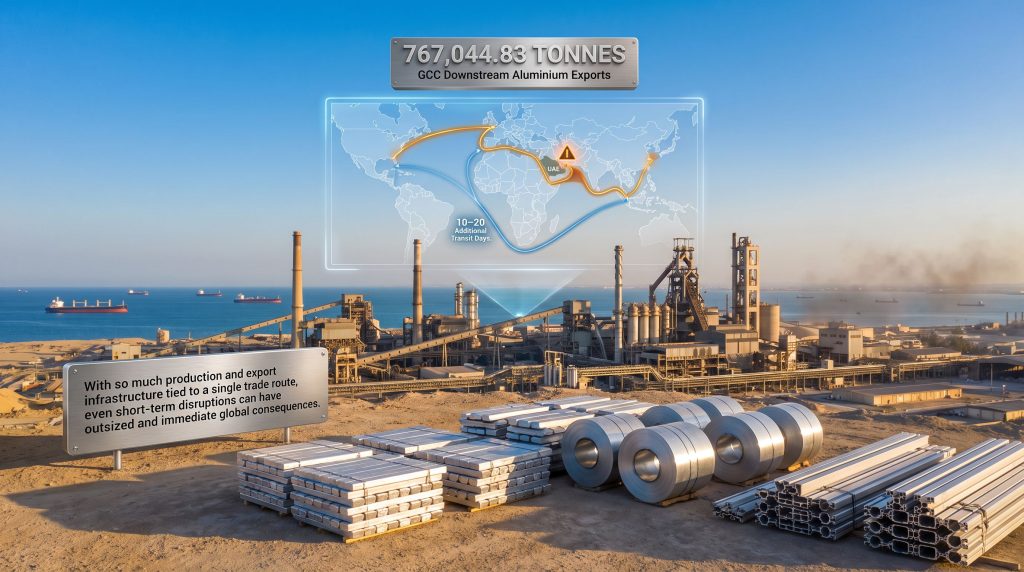
As of 2025, GCC countries (excluding Kuwait) exported approximately 767,044.83 tonnes of aluminium downstream products to international markets. This positions the Middle East as a meaningful supplier of processed aluminium inputs to manufacturing sectors across Asia, Europe, and beyond.
The downstream product spectrum originating from the GCC includes:
- Aluminium extrusions used in construction profiles, automotive components, and industrial frameworks
- Rolled coil and sheet for automotive body panels, industrial cladding, and general fabrication
- Aluminium foil for food packaging, pharmaceutical blister packs, and flexible packaging applications
- Wire rod for electrical conductors and cable manufacturing
- Fabricated components for aerospace, defence, and consumer durables
Critical Insight: The GCC is not simply a bulk metal exporter. It is embedded within global fabrication networks across multiple industries simultaneously. When its downstream export capacity is disrupted, the consequences propagate through automotive assembly lines, construction project schedules, food packaging supply chains, and renewable energy equipment pipelines at the same time.
The Mechanics Behind the Current Disruption
The Strait of Hormuz as a Single Point of Failure
The Strait of Hormuz is one of the most strategically consequential maritime passages in the world, approximately 33 kilometres wide at its narrowest navigable point. For the GCC aluminium industry, it functions as the sole practical maritime exit for outbound product shipments and the primary entry corridor for imported alumina and bauxite feedstocks.
The escalation of geopolitical tensions involving Iran, Israel, and the United States introduced severe disruption risk to this corridor, constraining or halting vessel traffic and forcing shipping operators to evaluate alternative routing. This created what analysts describe as an asymmetric risk structure: a region with enormous production capacity concentrated behind a single, geopolitically exposed trade gateway.
Uday Patel, Principal Analyst at Wood Mackenzie, has noted that with production and export infrastructure tied to a single trade route, even short-term disruptions can produce outsized and immediate global consequences. The same analyst has observed that the disruption has clearly illustrated how concentrated and fragile aluminium supply chains have become.
The Feedstock Paradox: High Output, External Dependency
A less commonly understood vulnerability within the GCC aluminium model is the region's structural dependence on imported raw materials. Despite being a world-leading aluminium producer, the GCC has no meaningful domestic bauxite or alumina resources. Smelters and downstream processors rely on imported alumina, largely sourced from Australia, Guinea, and Brazil, to maintain production continuity. Furthermore, alumina market pressures have compounded this dependency in recent months.
When the Strait of Hormuz faces disruption, the consequence is not merely blocked outbound product flows. Inbound feedstock shipments are simultaneously constrained, creating a two-sided squeeze:
- Outbound finished and semi-finished aluminium products cannot reach buyers on schedule
- Inbound alumina and bauxite shipments face delays or rerouting, reducing feedstock availability at smelters
- Reduced smelter throughput contracts the supply of billets and slabs available to downstream converters
- Downstream processors face both input shortages and rising procurement costs simultaneously
This feedback loop between export blockage and feedstock starvation is what transforms a logistics disruption into a genuine supply chain fracture.
Operational Curtailments at Key Regional Producers
The pressures described above have translated into reported output reductions and operational disruptions at major Gulf aluminium facilities, including Alba in Bahrain and EGA's Al Taweelah complex in the UAE. When anchor producers of this scale reduce throughput, the downstream processing ecosystem feels it almost immediately. Rolling mills, extrusion plants, and fabricators dependent on consistent billet and slab supply from these facilities face tightening input availability, forcing them into spot market procurement or production rescheduling.
A Multi-Dimensional Cost Inflation Environment
The financial impact of the disruption is not confined to freight costs. It operates across multiple cost dimensions simultaneously:
| Cost Driver | Mechanism | Downstream Impact |
|---|---|---|
| Freight rerouting | Vessels diverted via Cape of Good Hope | 10-20 additional transit days; higher per-tonne costs |
| War risk insurance | Elevated underwriting for conflict-adjacent zones | Increased total delivered cost for all aluminium inputs |
| Energy cost volatility | Regional gas supply disruptions affecting smelters | Compressed operating margins for downstream converters |
| Inventory buffer requirements | Precautionary stock building by buyers | Working capital strain for fabricators and OEMs |
Downstream Sectors Facing the Highest Exposure
Extrusion and Rolling Operations
Extrusion and rolling mills represent the most directly exposed segment of the downstream aluminium processing industry. These operations require a steady, predictable supply of billets and slabs as their primary input. Most operate on lean inventory models, carrying only a few weeks of buffer stock at any given time, which leaves them structurally vulnerable when supply chains tighten abruptly.
Sourcing replacement billets from non-GCC suppliers is possible in principle, but practical constraints apply. Alternative suppliers in Europe, North America, and Asia face their own demand pressures and limited surplus capacity. Lead times for redirected procurement typically extend by weeks, and delivered cost premiums can be significant.
Automotive Manufacturing
Modern vehicle platforms have become increasingly aluminium-intensive. Lightweight body structures, chassis components, heat exchangers, and powertrain housings all rely on rolled or extruded aluminium inputs sourced from global supply networks. GCC-origin rolled and extruded products feed directly into Tier 1 automotive supplier networks across Europe and Asia.
Supply delays of 10 to 20 days, combined with rising input costs, flow through to OEM production scheduling and component pricing. In an industry already navigating semiconductor supply complexity and electrification investment pressures, additional raw material disruptions compound operational stress considerably.
Construction and Infrastructure
Aluminium extrusions and cladding systems are critical inputs for large-scale commercial construction, from curtain wall systems and window frames to structural profiles and roofing components. Project timelines across Asia, Europe, and the Middle East itself face schedule risk when fabricated aluminium components experience delivery delays.
The strategic irony here is notable: several of the largest construction programmes currently underway globally, including major GCC Vision 2030 development projects and Asian infrastructure pipelines, are generating strong demand for aluminium fabrication precisely at the moment when regional supply capacity is under stress.
Packaging and Pharmaceutical Supply Chains
Aluminium foil manufactured in the GCC serves as a critical feedstock for food packaging, flexible packaging, and pharmaceutical blister pack production globally. Unlike many industrial materials, aluminium foil has very limited functional substitutes at commercial scale. When foil supply tightens, food and pharmaceutical manufacturers face genuine input scarcity rather than simply higher costs.
Renewable Energy Equipment
Solar panel frames, wind turbine nacelle components, and battery enclosures for energy storage systems are all aluminium-intensive. The global clean energy equipment manufacturing pipeline relies on consistent access to extruded and rolled aluminium. Disruptions to GCC downstream supply introduce bottlenecks across renewable energy supply chains at precisely the moment when installation volumes are accelerating worldwide.
How Markets and Operators Are Responding
Rerouting Economics and Transit Extensions
The primary operational response to Strait of Hormuz disruption has been vessel rerouting via alternative maritime corridors, most notably the Cape of Good Hope passage around southern Africa. While this maintains physical trade flow, it introduces an estimated 10 to 20 additional transit days per shipment, with corresponding increases in fuel costs, vessel charter rates, and port handling fees.
For just-in-time supply chains common in automotive and packaging manufacturing, a two-to-three week extension in transit time is not a minor inconvenience. It forces buyers to either build significantly larger inventory buffers or accept periodic production interruptions, both of which carry substantial cost implications.
Procurement Diversification Gaining Momentum
Faced with single-corridor dependency risk, major aluminium buyers have begun accelerating diversification of their supplier base. This involves extending procurement relationships with producers in Australia, Canada, Norway, and India, regions that offer production capacity without exposure to Middle Eastern geopolitical risk. In addition, leading aluminium producers outside the GCC are increasingly positioned as strategic alternatives for buyers seeking supply security.
However, diversification at scale takes time. Qualifying new suppliers, establishing logistics infrastructure, and renegotiating long-term supply agreements are months-long processes. In the immediate term, buyers remain substantially exposed to GCC supply conditions.
Physical Premiums and Price Discovery
Physical aluminium premiums — the above-LME-price charges buyers pay for delivery of actual metal — have responded to supply uncertainty with upward pressure. The combination of pre-disruption low inventory levels across major trading hubs and constrained supply has amplified price responses beyond what the volume displacement alone would typically warrant. Reporting from Reuters and S&P Global has documented market tightening conditions, with rising premiums and reduced available stock reported across key trading hubs. Consequently, these dynamics reflect broader global metals demand trends that were already under strain heading into 2025.
Scenario Analysis: What a Prolonged Disruption Looks Like
Short-Term Window (0-3 Months): Elevated Stress, Managed Impact
In the immediate period, rerouting absorbs the majority of volume displacement at elevated cost. Downstream processors draw down existing inventory buffers. Physical premiums rise but remain within historical volatility parameters. The primary burden falls on lean-inventory fabricators and OEMs with limited buffer capacity.
Medium-Term Window (3-9 Months): Structural Deficit Conditions
If disruption persists beyond the short-term window, feedstock constraints begin forcing meaningful curtailments at GCC smelters and downstream processors. Inventory buffers across the supply chain become exhausted, pushing buyers into spot procurement at elevated premiums. Automotive, construction, and packaging manufacturers begin revising production schedules. Structural deficit conditions emerge as supply shortfalls compound.
Long-Term Window (9+ Months): Supply Chain Reconfiguration
A disruption sustained beyond nine months would likely trigger irreversible changes in global aluminium procurement architecture. Furthermore, the aluminium tariff impacts already reshaping trade flows would interact with these structural shifts, compounding the pressure on buyers seeking to rebalance their supply chains.
- Permanent shift toward multi-source procurement strategies among major buyers
- Accelerated investment in aluminium production capacity outside the Middle East
- Long-term market share erosion for GCC producers even after the physical corridor reopens
- Migration of downstream manufacturing investment toward regions with more secure logistics profiles
Industry Perspective: Analysts have consistently warned that the concentration of production capacity behind a single trade corridor represented a systemic fragility waiting for an activation event. The current crisis has provided that event, and its legacy may be a fundamental restructuring of how global buyers approach aluminium supply security.
The next major ASX story will hit our subscribers first
Frequently Asked Questions: Middle East Aluminium Downstream Disruption
What downstream aluminium products does the GCC export?
GCC countries export a broad range of value-added aluminium products including extrusions, rolled coil, foil, wire rod, and fabricated components. Combined GCC downstream exports (excluding Kuwait) reached approximately 767,044.83 tonnes as of 2025.
Why is the Strait of Hormuz so critical to aluminium supply chains?
The Strait serves simultaneously as the primary maritime exit for GCC aluminium exports and the main entry corridor for imported alumina and bauxite feedstocks. Its disruption creates a two-sided squeeze, restricting outbound product flows while simultaneously constraining inbound raw material supply.
Which industries face the greatest exposure to this disruption?
Automotive manufacturing, construction and infrastructure, food and pharmaceutical packaging, and renewable energy equipment production carry the highest exposure, all relying on consistent supplies of extruded, rolled, or fabricated aluminium components sourced from GCC facilities.
How much additional transit time does rerouting add?
Industry estimates indicate that rerouting via the Cape of Good Hope adds approximately 10 to 20 days to standard transit times, with corresponding increases in freight costs and insurance premiums.
Could this crisis accelerate long-term supply chain restructuring?
Analysts suggest a prolonged disruption would likely trigger structural procurement diversification toward non-GCC aluminium sources in Australia, Canada, Norway, and India, reducing long-term single-corridor dependency regardless of whether the Strait of Hormuz returns to full functionality.
Key Structural Vulnerabilities Exposed by This Crisis
The Middle East aluminium downstream supply chain disruption has brought into sharp focus a set of structural vulnerabilities that were previously acknowledged in risk assessments but rarely stress-tested in real operating conditions. Several conclusions now appear well-supported:
- The GCC operates as both a primary production hub and a significant downstream manufacturing base, meaning disruption affects multiple product categories and multiple industries simultaneously
- The Strait of Hormuz represents a genuine single point of failure, creating symmetric risk across both export capacity and feedstock import flows
- Lean inventory models common across automotive, packaging, and construction supply chains provide minimal buffer against a 10 to 20 day transit extension
- Physical aluminium premiums amplify supply shock signals rapidly when pre-disruption inventory levels are already low
- Structural deficit conditions become increasingly probable the longer disruption extends beyond the short-term window
- The crisis has validated long-standing analytical concerns about concentrated supply chains and the systemic risks inherent in single-corridor trade dependency
For buyers, producers, and investors across aluminium-intensive industries, this event is likely to function as a defining reference point in how aluminium supply security is assessed, priced, and managed for years to come.
Want to Stay Ahead of the Next Major Commodity Supply Disruption?
As geopolitical pressures reshape global aluminium supply chains and drive structural shifts across commodity markets, Discovery Alert's proprietary Discovery IQ model delivers real-time alerts on significant ASX mineral discoveries — instantly translating complex market signals into actionable investment opportunities for both short-term traders and long-term investors. Explore how historic mineral discoveries have generated substantial returns and begin your 14-day free trial today to position yourself ahead of the market.