August 3, 2026
India's Coal Supply Chain Is Quietly Undergoing a Structural Transformation
For decades, the architecture of India's coal supply has rested almost entirely on a single pillar: Coal India Limited (CIL), the state-owned behemoth that has long served as the nation's primary domestic coal source. Yet beneath that dominant structure, a secondary supply tier has been gathering momentum with a consistency that is now too significant to treat as marginal. The captive and commercial mining segment, reshaped by landmark reforms and driven by industrial demand, is evolving into a structurally embedded component of India's energy supply equation — part of a broader coal supply transformation reshaping markets globally.
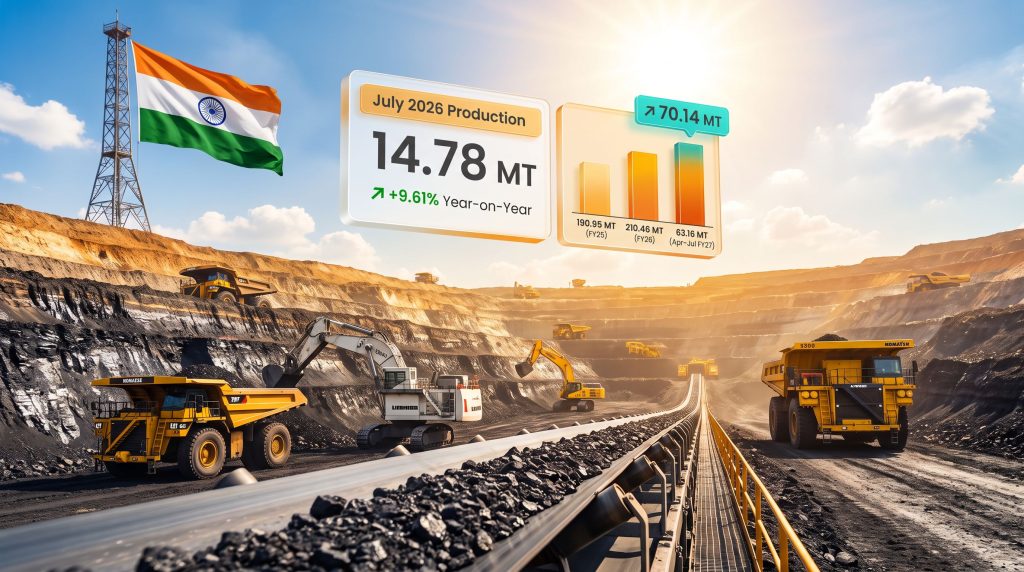
The latest data from the Ministry of Coal confirms that India captive and commercial coal mines production rises 9.6% year-on-year in July 2026, reaching 14.78 million tonnes (MT) for the month. This figure, when placed within the broader multi-year trajectory, tells a story not just of incremental output gains, but of a sector transitioning from a high-volatility ramp-up phase into a more durable, compounding growth cycle.
When big ASX news breaks, our subscribers know first
Understanding the FY27 Production and Dispatch Data in Full Context
The July 2026 Numbers: What Do They Actually Mean?
The headline output figure of 14.78 MT represents a 9.61% year-on-year increase over July 2025. While that growth rate is lower than the exceptional figures recorded in some prior periods, context is essential. The sector is now operating from a substantially larger base, meaning absolute volume additions are proportionally more significant than the percentage alone suggests.
Perhaps more instructive than the production figure itself is the dispatch data. In July 2026, dispatches reached 17.49 MT against production of 14.78 MT, creating a 2.71 MT gap in which outbound coal volumes exceeded fresh mine output. This divergence is not a sign of supply stress; it reflects industrial consumers actively drawing down stockpiles, which points to robust downstream demand and improving logistics integration between mine gates and consumption centres.
The cumulative picture reinforces this trend across a longer window:
| Period | Cumulative Production (Apr-Jul) | Cumulative Dispatches (Apr-Jul) |
|---|---|---|
| FY 2024-25 | 53.72 MT | 45.97 MT |
| FY 2025-26 | 59.42 MT | 66.02 MT |
| FY 2026-27 | 63.16 MT | 70.14 MT |
A critical structural shift is visible in this table. In FY25, production exceeded dispatches by nearly 8 MT, indicating the sector was building inventory faster than it could move coal to consumers. By FY26 and FY27, however, that relationship inverted sharply, with dispatches running 6–7 MT ahead of production. This inversion signals that logistics maturity, industrial offtake velocity, and supply chain responsiveness have all improved substantially.
The Multi-Year Growth Arc: Normalisation, Not Deceleration
| Period | Production Volume | YoY Growth |
|---|---|---|
| FY 2024-25 (Full Year) | 190.95 MT | +29.79% |
| FY 2025-26 (Full Year) | 210.46 MT | +10.22% |
| FY27 Cumulative (to July) | 63.16 MT | vs. 59.42 MT in FY26 |
| July 2026 (Monthly) | 14.78 MT | +9.61% |
The deceleration from FY25's remarkable 29.79% growth rate to FY26's 10.22% and FY27's emerging trajectory of 6–10% is frequently misread as a slowdown. A more accurate interpretation is base effect normalisation. When mines move from initial ramp-up through to stable production phases, growth rates moderate even as absolute volume contributions continue climbing. FY25's exceptional pace reflected first-mover mines hitting full operational stride; the current trajectory reflects a maturing sector.
The Captive vs. Commercial Mine Distinction: Why It Matters for Supply Dynamics
Two Different Market Structures, One Production Pool
Understanding India's non-CIL coal production requires distinguishing between its two operational models:
- Captive mines are allocated to specific industrial end-users, predominantly steel manufacturers, cement producers, and power utilities. Coal extracted must be consumed by the allocated entity for its designated industrial purpose. These mines reduce input cost volatility for operators by providing a predictable, internally controlled coal supply.
- Commercial mines, introduced under the landmark 2020 reforms, operate without any end-use restriction. Operators can extract coal and sell freely to any buyer at market-determined prices. This model introduced genuine price discovery mechanisms and created a domestically sourced alternative to seaborne imports for buyers with flexible quality specifications.
The coexistence of these two structures creates a layered supply market. Captive mines provide supply security for integrated industrial operators; commercial mines introduce competitive pricing dynamics. Furthermore, together they reduce the systemic risk of depending on either CIL as a sole domestic supplier or international seaborne markets as a price benchmark. Proposals such as the India coal trading exchange could further formalise these dynamics in the years ahead.
Coal Quality and Grade Considerations: The Ash Content Variable
One dimension of India's coal mining that receives insufficient attention in production-focused analyses is coal quality heterogeneity. Indian domestic coal is generally characterised by higher ash content (often ranging from 28% to 45%) compared to seaborne benchmarks, which typically specify ash below 15%. This quality gap has historically driven import demand from industrial users requiring low-ash coal, particularly in metallurgical applications.
Captive mines allocated to steel producers face this quality constraint most acutely. Coking coal for blast furnace operations requires very specific quality parameters that most Indian domestic deposits cannot meet, meaning that even as captive and commercial mine output grows, import dependence for high-grade coking coal is unlikely to be fully eliminated by domestic production growth alone.
For thermal coal applications, however, the quality gap is more manageable. Power utilities operating with high-ash-tolerant boiler designs and washery infrastructure can increasingly substitute domestic captive and commercial output for imports. This substitution dynamic is where the import reduction narrative is most credible in the near term.
The Import Substitution Arithmetic: Foreign Exchange and Energy Security
Quantifying the Economic Case for Domestic Supply Expansion
Every percentage point of import displacement achieved through domestic captive and commercial mine growth translates directly into foreign exchange conservation at whatever prevailing international thermal coal prices hold at the time of substitution.
With Newcastle FOB thermal coal benchmark prices historically oscillating between USD 100 and USD 200 per tonne depending on supply-demand cycles, a sustained output base of 63+ MT per April-July period from captive and commercial mines represents a meaningful shield against import cost exposure. If even a portion of this volume displaces equivalent seaborne purchases, the current account benefit compounds over successive fiscal years.
India's coal import bill has historically been a significant contributor to its current account deficit pressure. The Ministry of Coal has explicitly framed rising domestic output as a mechanism to conserve foreign exchange reserves and reduce exposure to international commodity price cycles, according to official ministry communications reported by ET EnergyWorld. Consequently, coal and energy security considerations now sit firmly at the centre of India's resource policy planning.
Key dimensions of the import substitution argument include:
- Price volatility insulation: Domestic production costs, once mines are at steady-state, are far less volatile than seaborne benchmark prices subject to global supply shocks, freight rate fluctuations, and currency movements.
- Supply chain control: Domestic captive mines, often co-located with industrial facilities, eliminate port demurrage, inland freight, and quality uncertainty risks inherent in import logistics chains.
- Strategic leverage: A larger domestic production base reduces India's exposure to geopolitical disruptions in key coal-exporting nations, including Australia and Indonesia, which together supply the majority of India's seaborne coal imports.
Operational Efficiency Drivers Behind the Production Gains
What Is Actually Improving at the Mine Level?
The Ministry of Coal has cited improvements in operational efficiency, mining productivity, and capacity utilisation across the captive and commercial sector. Breaking this down into operational mechanisms:
- Ramp-up maturity: Mines awarded in the first waves of post-liberalisation auctions are now past their capital-intensive development phases and operating at designed production capacities.
- Mechanised extraction advancement: Deployment of surface miners, draglines, and continuous miners has increased tonnes-per-shift ratios at larger opencast operations. India's coal geology, predominantly characterised by flat-lying to moderately dipping seams in the Gondwana formations of Jharkhand, Odisha, Chhattisgarh, and Madhya Pradesh, is generally well-suited to high-productivity opencast mining.
- Overburden management efficiency: Better planning of overburden removal sequences and external dump management has reduced non-productive downtime at active mines.
- Real-time production monitoring: Digital systems for equipment tracking, production reporting, and maintenance scheduling have reduced unplanned downtime and improved shift utilisation rates.
Infrastructure Bottlenecks That Could Constrain Future Growth
Operational improvements at mine level mean little if coal cannot be efficiently evacuated to consumption centres. Rail connectivity remains the sector's most significant structural constraint:
- First-mile connectivity gaps: Many captive and commercial mines, particularly those in newly developed blocks in Chhattisgarh and Odisha, lack direct rail sidings. Coal must be trucked to the nearest railhead, adding cost and logistical complexity.
- Dedicated freight corridor utilisation: While India's broader freight corridor expansion programme improves bulk commodity movement, integration of mine-cluster rail spurs with the main freight network remains a work in progress.
- Washery infrastructure: Processing facilities to reduce ash content and improve calorific value of domestic coal before dispatch to sensitive end-users are underbuilt relative to growing raw output volumes.
These bottlenecks explain why dispatch volumes, even as they exceed production in aggregate cumulative terms, may underperform potential capacity at certain mine clusters during peak demand periods.
The Regulatory Architecture Enabling Private Sector Participation
The 2020 Reforms: A Structural Break in India's Coal Market Design
The regulatory foundation enabling the current growth trajectory was laid by the 2020 commercial coal mining reforms, which eliminated the mandatory end-use linkage that had previously confined captive mine output to designated industrial consumers. This change was architecturally significant for several reasons:
- It created a genuine market for domestically mined non-CIL coal, with buyers and sellers able to transact freely.
- It incentivised private capital to compete aggressively in block auctions, knowing that commercial flexibility protected investment returns.
- It introduced price discovery dynamics that did not exist when all captive mine coal was effectively consumed at internal transfer pricing.
Subsequent auction rounds have progressively expanded the pipeline of operational mines, with each tranche of awarded blocks contributing to the medium-term production base once development timelines are completed. In addition, ongoing coal policy reforms in other major economies demonstrate how pivotal regulatory design is in shaping domestic production trajectories.
Progressive Policy Signals and Sector Governance
The Ministry of Coal has indicated a continued commitment to sustaining production growth through progressive policy interventions and regulatory oversight. Key elements of the ongoing regulatory framework include:
- Auction mechanics refinement: Revenue sharing models and upfront payment structures have evolved across successive auction tranches to balance government revenue capture with operator commercial viability.
- Penalty structures: Lessees failing to meet production targets face financial penalties, creating incentive alignment between block award and actual mine development progress.
- Environmental clearance processing: Efforts to reduce approval timelines for Environmental Impact Assessments and forest clearances, whilst maintaining ecological safeguards, have sought to reduce the gap between block award and production commencement.
The next major ASX story will hit our subscribers first
Coal's Role Within India's Energy Transition Calculus
Baseload Dependency in a Renewables-Expanding System
India's commitment to 500 GW of non-fossil electricity capacity by 2030 is a genuine and ambitious policy target. Yet the intermittency characteristics of solar and wind generation mean that thermal coal-fired capacity continues to operate as essential baseload, particularly during evening demand peaks when solar generation is unavailable and grid storage remains insufficient at scale. This mirrors global patterns in coal in energy transition, where coal continues to serve as a reliability backstop even as renewables expand.
Plant load factors at coal-fired stations have remained elevated, reflecting tight power demand conditions driven by industrial expansion, urbanisation, and rising household energy consumption. Under these conditions, consistent domestic coal supply is not merely an economic preference; it is an operational requirement for grid stability.
The practical implication for the captive and commercial mining sector is that demand from the power sector alone provides a durable volume floor for domestic coal offtake, independent of industrial consumption cycles.
Industrial demand adds further resilience to this floor. Integrated steel plants, aluminium smelters, and cement manufacturers are capital-intensive, long-cycle operations whose energy input requirements do not track short-term economic fluctuations with any agility. Once a captive mine is developed to serve an adjacent industrial facility, its offtake volume is effectively anchored for the operational life of both assets. This makes coal and energy security an enduring consideration for India's long-term resource planning.
Frequently Asked Questions: India Captive and Commercial Coal Mine Production
What is the difference between a captive coal mine and a commercial coal mine in India?
A captive coal mine is allocated to a specific industrial end-user, and the extracted coal must be consumed by that entity for its designated purpose. A commercial coal mine, introduced under the 2020 mining reforms, has no end-use restriction, allowing the operator to sell coal freely on the open market to any buyer at prevailing prices.
How much did captive and commercial coal mines produce in July 2026?
Official Ministry of Coal data records production of 14.78 MT in July 2026, a 9.61% year-on-year increase over July 2025.
What is the cumulative FY27 production figure for captive and commercial mines?
As of July 2026, cumulative FY27 production stands at 63.16 MT, compared with 59.42 MT in the same period of FY26 and 53.72 MT in FY25.
How do dispatch volumes compare to production volumes?
Cumulative FY27 dispatches reached 70.14 MT against production of 63.16 MT for the same period, meaning consumers are drawing coal at a rate exceeding current mine output by approximately 7 MT, reflecting strong demand absorption and improved logistics throughput.
What annual growth rates has the captive and commercial coal sector achieved in recent years?
The sector recorded 29.79% year-on-year growth in FY25, followed by 10.22% growth in FY26 to reach 210.46 MT for the full year, with FY27 tracking within the 6–10% band based on early cumulative data.
Key Metrics at a Glance
| Metric | Value |
|---|---|
| July 2026 Production | 14.78 MT |
| July 2026 YoY Growth | +9.61% |
| July 2026 Dispatches | 17.49 MT |
| FY27 Cumulative Production (to July) | 63.16 MT |
| FY27 Cumulative Dispatches (to July) | 70.14 MT |
| FY26 Full-Year Production | 210.46 MT |
| FY25 Full-Year Production | 190.95 MT |
| FY25 YoY Growth Rate | +29.79% |
The trajectory of India captive and commercial coal mines production rises as a reflection of a deliberate, policy-enabled transformation of the country's domestic energy supply architecture. With dispatch volumes consistently outpacing production, logistics integration improving, and the regulatory framework continuing to evolve in favour of private sector participation, the sector is no longer a supplementary source of domestic coal. It is becoming a structural pillar of India's energy security, with compounding volume gains likely to deepen the import substitution dynamic through FY28 and beyond. The Ministry of Coal's official data releases continue to provide the primary authoritative source for tracking this evolution quarter by quarter.
Disclaimer: Production and dispatch data cited in this article are sourced from official Ministry of Coal announcements as reported by ET EnergyWorld. Forward-looking observations regarding growth trajectories, policy outcomes, and import substitution potential are analytical interpretations and should not be construed as investment advice or financial forecasts. Actual outcomes may differ materially from projections based on regulatory, operational, or macroeconomic developments.
For ongoing coverage of India's coal sector, ET EnergyWorld at energy.economictimes.indiatimes.com provides regular Ministry of Coal data releases and energy policy analysis.
Want To Stay Ahead of Major Mineral Discoveries Driving the Next Energy Shift?
As India's coal supply transformation highlights how rapidly commodity markets can restructure, Discovery Alert's proprietary Discovery IQ model delivers real-time ASX mineral discovery alerts, turning complex data across 30+ commodities into clear, actionable insights for traders and investors at every level — explore historic discoveries and their remarkable returns, then begin your 14-day free trial to position yourself ahead of the market.