August 3, 2026
The Supply Chain No One Talks About: How Jet Engines Are Reshaping Critical Metal Markets
Most commodity analysts spend their time tracking lithium, copper, and rare earths in the context of the energy transition. Yet one of the most structurally compelling demand stories unfolding right now sits inside a very different industrial system: the jet engine. Specifically, the accelerating production of next-generation turbine powerplants is creating durable, technically irreplaceable demand for two materials that rarely dominate headlines the same way battery metals do. Jet engines driving nickel and PQ titanium demand is not a cyclical story driven by sentiment or short-term procurement swings. It is a materials science story, anchored in thermodynamics, and it is only getting more intense.
When big ASX news breaks, our subscribers know first
Why Jet Engines Create Uniquely Inelastic Demand for Specific Metals
The operating environment inside a modern commercial turbine engine is genuinely extreme. High-pressure turbine blades rotate at tens of thousands of revolutions per minute while exposed to gas stream temperatures that can exceed 1,200°C in the most advanced designs. At these conditions, conventional metals fail. Steel softens. Aluminium alloys are structurally irrelevant. Even titanium cannot survive the thermal load in the hot section of the engine without catastrophic oxidation.
This is the fundamental reason why nickel-based superalloys are not merely preferred for turbine hot sections; they are the only viable option available at commercial scale. The metallurgical properties that matter most in this environment — including resistance to creep deformation, oxidation resistance, and the ability to retain tensile strength at temperatures approaching the material's melting point — are uniquely concentrated in nickel superalloy chemistry. For a deeper understanding of nickel properties and uses, these characteristics explain why there is simply no substitute in this application.
What makes this demand particularly durable from an investment and supply chain perspective is the near-total absence of substitution pathways. Unlike battery cathode chemistry, where lithium iron phosphate can compete with nickel manganese cobalt formulations, there is no alternative turbine blade material waiting in the wings for commercial deployment. Ceramic matrix composites are being developed and partially adopted in specific static components, but rotating turbine blades in the hot section remain a nickel superalloy domain for the foreseeable future.
| Engine Component | Operating Temperature Range | Primary Material |
|---|---|---|
| Turbine blades (high pressure) | 900°C to 1,200°C+ | Nickel-based superalloy |
| Combustor liners | 800°C to 1,100°C | Nickel superalloy |
| High-pressure turbine discs | 600°C to 900°C | Nickel superalloy |
| Fan blades | Up to 500°C | PQ titanium alloy |
| Compressor discs | Up to 600°C | PQ titanium alloy |
| Exhaust casings | 500°C to 800°C | Nickel superalloy / titanium |
Understanding PQ Titanium: The Specification That Changes Everything
Titanium occupies the front end of the engine architecture, specifically the fan and compressor stages, where temperatures are cooler but mechanical stress remains extreme. The critical property here is strength-to-weight ratio. Fan blades on modern high-bypass turbofan engines are enormous structures rotating at high speed, and reducing their mass directly improves fuel efficiency.
However, not all titanium is created equal for these applications. The term premium-quality (PQ) titanium describes billet and bar stock produced to aerospace rotating-part specifications, which impose a significantly tighter standard than commercial-grade material. The distinction matters enormously:
- Inclusion content must be minimised to aerospace rotating-grade limits, as even microscopic non-metallic inclusions can act as crack initiation sites under fatigue loading
- Microstructural consistency must be maintained through the entire billet cross-section, requiring tight control of the thermomechanical processing route
- Chemical composition tolerances are narrower than for structural or non-rotating applications
- Traceability and certification requirements are extensive, as every billet used in a rotating component must be tracked through its entire production and processing history
The qualification process for new PQ titanium sources is inherently slow. An aerospace OEM cannot simply switch to an alternative certified supplier overnight. Testing, qualification runs, and airworthiness approvals take years. This structural lag between supply disruption and qualified alternative supply is exactly what makes the current geopolitical reshaping of titanium sourcing so significant. The broader context of the US titanium supply chain illustrates precisely why these qualification timelines create lasting market vulnerability.
The 2026 Engine Delivery Acceleration: What the Numbers Actually Mean
The most direct market signal for aerospace metals procurement comes from engine delivery volumes. Data from aerospace ramp-ups confirms a meaningful acceleration across multiple programmes in the first half of 2026, reported by Argus Media following the Farnborough International Airshow:
| OEM / Program | H1 2025 Deliveries | H1 2026 Deliveries | Year-on-Year Change |
|---|---|---|---|
| GE Aerospace widebody | 222 units | 269 units | +21% |
| Rolls-Royce widebody | 122 units | 157 units | +29% |
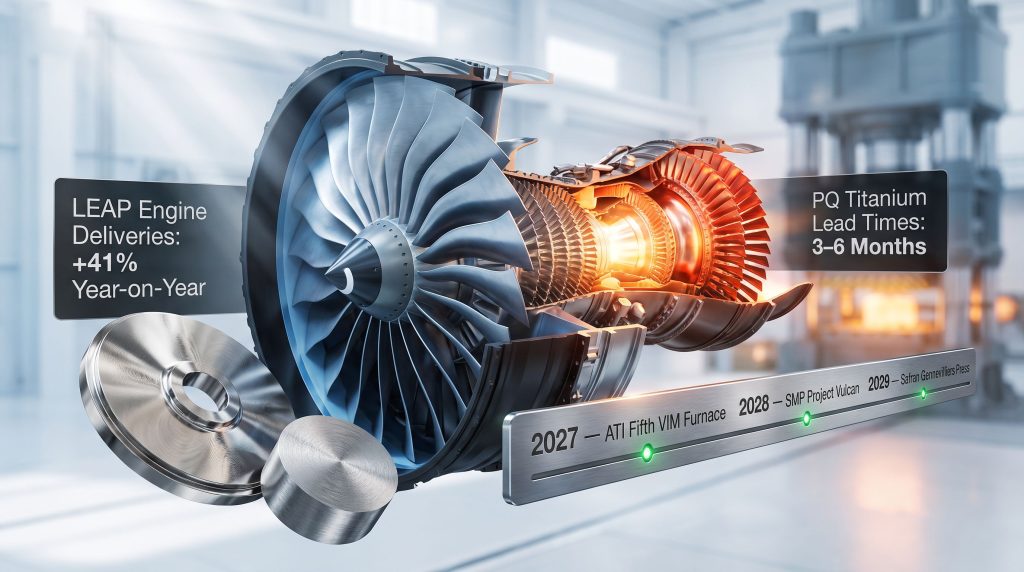
| CFM International LEAP | 729 units | 1,030 units | +41% |
| Pratt & Whitney (narrowbody) | Not disclosed | Not disclosed | +15% (Q2 only) |
The 41% year-on-year increase in CFM LEAP deliveries represents one of the most significant single-programme delivery accelerations in the modern history of commercial aviation. Given that each LEAP engine contains substantial volumes of nickel superalloy castings, forgings, and PQ titanium rotating components, this ramp-up is translating directly into procurement pressure across the entire upstream materials supply chain.
The bottleneck picture is also shifting. For much of the 2024 to 2025 period, constrained engine supply limited aircraft delivery rates at both Airbus and Boeing. The mid-2026 data suggests this dynamic is beginning to resolve, though not uniformly across all programmes.
Boeing has indicated that delays affecting GEnx engines for its widebody aircraft are expected to resolve, enabling production to rise toward 10 aircraft per month before the end of 2026, though seat certification challenges remain a secondary constraint. For Airbus, the A350 production rate ceiling has shifted from engine availability to cabin interior supply — specifically a shortage of lavatories, galleys, and lining components — which represents the principal barrier to reaching rate 12 by 2028. The ongoing dispute between Airbus and Pratt & Whitney over geared turbofan deliveries for the A320neo family remains unresolved.
The PQ Titanium Tightening: Lead Times and the Russian Displacement Effect
The PQ titanium market is experiencing measurable supply tightness that is visible in procurement lead times. A market participant reported at Farnborough that delivery lead times for PQ billet had extended to 3 to 6 months from point of order as of June 2026, which represents a material stretch from historical norms in this market. Several forces are converging to produce this outcome:
- Rising OEM build rates are consuming certified billet inventory at a pace that outstrips the qualification and delivery rate of new supply
- Geopolitical supply chain restructuring has created a structural shift away from Russian-origin titanium, historically a significant source of aerospace-grade sponge and semi-finished products, following export restrictions and geopolitical disruption post-2022
- Qualification bottlenecks for alternative Western sources are slowing the pace at which new certified supply can enter the market, as rotating-grade approval is a multi-year process
- Compounding demand from defence aerospace programmes, which compete for the same certified billet pool as commercial aviation
The Russian titanium displacement effect deserves particular attention because it is not simply a volume problem. Russia, through VSMPO-AVISMA, was historically the largest single producer of aerospace titanium globally and a primary supplier to Airbus. Western OEMs have been working to qualify alternative sources since 2022, but the timeline for full qualification of replacement supply chains runs into years, not months. This structural gap is a key reason why PQ lead times have extended even as Western titanium producers invest in new capacity.
The Upstream Commodity Cascade: Alloying Elements Under Pressure
The demand surge from jet engines driving nickel and PQ titanium demand extends well beyond these two materials alone. Nickel superalloy chemistry is complex, typically incorporating a suite of high-temperature alloying elements in precise proportions, each contributing specific performance characteristics. As engine production accelerates, demand for all of these elements rises in concert.
| Alloying Element | Function in Superalloy | Current Market Condition |
|---|---|---|
| Rhenium | Creep resistance in single-crystal turbine blades | Tight supply, elevated pricing |
| Tantalum | Oxidation resistance in advanced alloy systems | Supply constrained |
| Hafnium | Thermal barrier coating adhesion enhancement | Limited global production base |
| Cobalt | Structural matrix reinforcement | Price elevated |
| Tungsten | High-density strengthening contribution | Demand-driven price pressure |
| Niobium | Grain boundary strengthening | Rising aerospace procurement volumes |
The simultaneous price appreciation observed across tungsten, rhenium, tantalum, niobium, hafnium, and cobalt over the past year is analytically significant. When multiple alloying elements move together under demand pressure, it confirms that the underlying driver is structural and broad-based rather than isolated to a single material or a single end-market disruption.
Why Is Rhenium So Acutely Sensitive to Engine Production Rates?
One particularly underappreciated dynamic involves rhenium. Approximately 80% of global rhenium consumption goes into nickel superalloy turbine blades, making it arguably the most aerospace-concentrated of all critical metals. Rhenium is a byproduct of molybdenum smelting, which in turn is often a byproduct of copper mining, meaning its supply cannot be easily adjusted in response to aerospace demand signals.
This supply inelasticity, combined with concentrated demand from a single end-use, makes rhenium pricing acutely sensitive to engine production rate changes. Furthermore, the tungsten strategic importance to superalloy chemistry follows a similar logic, with demand pressure compounding across multiple alloying elements simultaneously.
The Cobalt Dimension
In addition to rhenium and tungsten, cobalt plays a structural role in nickel superalloy matrix reinforcement. Global cobalt production faces its own supply concentration risks, with a significant share of output originating from politically sensitive jurisdictions. Consequently, the aerospace sector's cobalt requirements are increasingly competing with battery supply chains for the same constrained production base.
The next major ASX story will hit our subscribers first
Capacity Expansion Programmes: The 2027 to 2030 Investment Cycle
The aerospace materials industry is in the early stages of its most significant capacity expansion cycle in at least a decade. Multiple producers announced or progressed major investment programmes through 2026, with the majority of new melting and forging capacity scheduled to commission between late 2027 and 2030.
Key investment programmes currently underway:
- ATI (USA): Adding a fifth vacuum induction melting furnace at its Monroe, North Carolina facility, expected to increase capacity by approximately 8 to 10%, equivalent to roughly 9,000 tonnes per year. Commissioning is targeted for the second half of 2027.
- Doncasters (UK): Committing $50 million to construct a new superalloy production facility in Auburn, Alabama, targeting compressor and turbine disc and blade production.
- Special Melted Products (SMP, UK): Signed multi-year supply agreements with Rolls-Royce valued at approximately $240 million. Under its Project Vulcan expansion, SMP has contracted for one 18-tonne vacuum induction melting furnace, two 20-tonne electro slag remelting furnaces, and two 20-tonne vacuum arc remelting furnaces, all scheduled for commissioning in 2028. SMP has also acquired a 7,000-tonne forging press from Danieli Group, scheduled to begin operations in 2025.
- Safran (France): Renewed a long-term forged parts supply contract with Aubert and Duval for CFM LEAP engine components. Safran is also commissioning a new 30,000-tonne hydraulic press at Gennevilliers and adding production lines for complex rotating parts at Le Creusot by 2029, alongside a new turbine casting facility in Rennes due to open in 2025.
- GKN / TPC Components (UK): Melrose-owned GKN continues to invest in its foundry operations following its 2025 acquisition of TPC Components, strengthening in-house superalloy castings capability to support engine OEM supply chains.
The concentration of new capacity commissioning in the 2027 to 2030 window is strategically significant. Upstream nickel, cobalt, rhenium, and other superalloy input suppliers that can position themselves ahead of this ramp-up phase face a structurally favourable demand environment. The material procurement requirements associated with filling new furnace capacity will generate incremental demand that compounds on top of already rising build rates.
A critical and often overlooked detail concerns the triple-melt process that PQ and superalloy aerospace materials require. Most commercial metals require only a single melt. Aerospace rotating-grade materials typically require vacuum induction melting followed by either electro slag remelting or vacuum arc remelting — or both in a triple-melt sequence. This process intensiveness is why building new aerospace-grade melting capacity is capital-intensive, time-consuming, and difficult to scale quickly, reinforcing the supply tightness dynamic across both nickel superalloys and PQ titanium.
Fasteners as a Leading Indicator: What Small Components Reveal About Big Trends
Among the less-discussed market signals in aerospace metals is fastener demand. Titanium alloy and Inconel 718 fasteners are consumed in direct proportion to OEM build rates, and multiple producers reported strong demand conditions at Farnborough in mid-2026. Because fastener procurement typically precedes final engine assembly by several weeks, sustained fastener demand growth functions as both a coincident and leading indicator of production trajectory.
The fact that multiple fastener producers are reporting strong demand conditions in 2026 — across both titanium alloy and Inconel 718 variants — provides independent confirmation that the engine production acceleration is not isolated to a single OEM or a single programme. It is a broad-based, multi-platform build-rate expansion. Research into nickel alloys in aerospace engineering further confirms why Inconel 718 in particular dominates fastener specifications for high-temperature aerospace applications.
Defence and Industrial Gas Turbines: The Competing Demand Problem
Alloy producers serving commercial aerospace do not do so exclusively. Defence aerospace and industrial gas turbine applications — including power generation turbines and oil and gas compression trains — compete for the same melting, casting, and forging capacity. As commercial aerospace accelerates, this three-way competition for constrained specialty alloy capacity creates a structural tension that will limit how quickly new engine programmes can scale.
| End Market | Demand Trajectory (2026–2030) | Competition for Alloy Capacity |
|---|---|---|
| Commercial aerospace | Strongly rising | High |
| Defence aerospace | Elevated and rising | High |
| Industrial gas turbines | Steady to rising | Moderate to High |
This competitive dynamic is one reason why alloy producers are investing so heavily in new capacity rather than simply reallocating existing furnace time. The market is not facing a reallocation problem; it is facing an absolute capacity shortage across all three end-market segments simultaneously.
Long-Term Demand Pillars: Why This Cycle Extends Through the Decade
The structural case for continued aerospace metals demand growth through 2030 and beyond rests on five durable pillars that are independent of near-term production fluctuations. Furthermore, with the broader critical minerals demand surge already reshaping global supply chains, aerospace requirements are adding additional structural pressure to an already strained system.
- Fleet replacement cycle: The global commercial fleet is transitioning to next-generation narrowbody and widebody platforms. Each new aircraft requires more nickel superalloy and titanium content per engine than the platform it replaces.
- Engine content intensification: Each successive engine generation burns hotter and more efficiently, requiring more heat-resistant alloy volume per unit. Rising build rates therefore understate true materials demand growth.
- OEM production rate commitments: Airbus targets rate 12 for the A350 by 2028; Boeing is working toward 10 widebody aircraft per month by end-2026. These targets represent multi-year material procurement obligations.
- MRO and aftermarket baseline: The maintenance, repair, and overhaul market for in-service engines generates persistent baseline demand for nickel superalloy replacement components and PQ titanium parts that grows with the global fleet.
- Supply chain geopolitical restructuring: Western aerospace primes are actively diversifying away from geopolitically exposed material sources. This creates premium procurement flows for certified Western-origin materials and sustains pricing above historical norms.
Taken together, these structural factors describe a demand environment for jet engines driving nickel and PQ titanium demand that is not only rising but compounding. The combination of higher build rates, greater material intensity per engine, and supply chain qualification constraints creates a market dynamic where demand signals are durable, substitution options are absent, and the penalty for supply disruption falls entirely on production schedules measured in billions of dollars per aircraft.
Disclaimer: This article is intended for informational and educational purposes only and does not constitute financial, investment, or commodity trading advice. Forward-looking statements, production rate targets, and market projections referenced herein are subject to change and involve uncertainty. Readers should conduct their own research and consult qualified advisors before making investment or procurement decisions.
Want to Track ASX Mineral Discoveries Tied to Critical Metals Demand?
As aerospace-driven demand for nickel, titanium, and superalloy elements reshapes global supply chains, Discovery Alert's proprietary Discovery IQ model delivers real-time alerts the moment significant ASX mineral discoveries are announced — turning complex commodity signals into actionable investment insights. Explore historic discovery returns to understand the potential scale of major finds, and begin your 14-day free trial at Discovery Alert to position yourself ahead of the broader market.