August 6, 2026
Geopolitical Risk Transmission Through Energy Supply Chains
Modern energy markets operate within a complex framework where geopolitical tensions translate directly into measurable financial impacts across maritime logistics networks. The U.S.-Iran tensions impact on oil tanker rates exemplifies how regional conflicts escalate beyond political rhetoric, creating tangible disruptions that reshape global energy distribution patterns and freight pricing mechanisms.
War risk insurance represents one of the most immediate transmission channels through which political uncertainty affects energy transport costs. During periods of heightened regional tension, insurance underwriters adjust their risk assessments dramatically, often increasing premiums by factors of 10-25 times baseline rates within days of significant incidents.
The London War Risk Underwriters Association operates sophisticated risk designation protocols that can rapidly transform stable shipping routes into high-cost corridors requiring specialised coverage. Furthermore, when regions transition from standard to war risk status, vessel operators face immediate cost increases that must be passed through to energy consumers via elevated freight charges.
Alternative routing requirements compound these insurance-driven cost increases. When primary shipping lanes become unsuitable due to security concerns, energy carriers must utilise longer transit paths that significantly increase voyage distances, fuel consumption, and crew rotation requirements. These operational adjustments create cascading effects throughout global energy pricing structures, particularly influencing market volatility hedging strategies.
Insurance Premium Escalation Mechanisms
War risk insurance operates as a separate policy category from standard marine hull coverage, with premium calculations based on geographic risk designations updated continuously by specialised underwriting committees. The Lloyd's of London market serves as the primary hub for these risk assessments, with premium adjustments often occurring within 24-48 hours of significant geopolitical developments.
During the 2023-2024 Red Sea crisis involving Houthi maritime attacks, war risk premiums for vessels transiting affected waters increased from approximately $10,000-15,000 per voyage to $150,000-250,000 per voyage. These dramatic adjustments demonstrate how efficiently the impact of US-China trade war tensions reflects across multiple geopolitical scenarios.
Premium calculations incorporate multiple risk factors including:
- Vessel type and cargo classification
- Transit duration through designated risk zones
- Historical incident frequency and severity data
- Regional military capability assessments
- Diplomatic relationship stability indicators
The speed and magnitude of these premium adjustments demonstrate how efficiently financial markets translate geopolitical uncertainty into quantifiable economic impacts across global energy supply chains.
Route Diversification Economic Impact
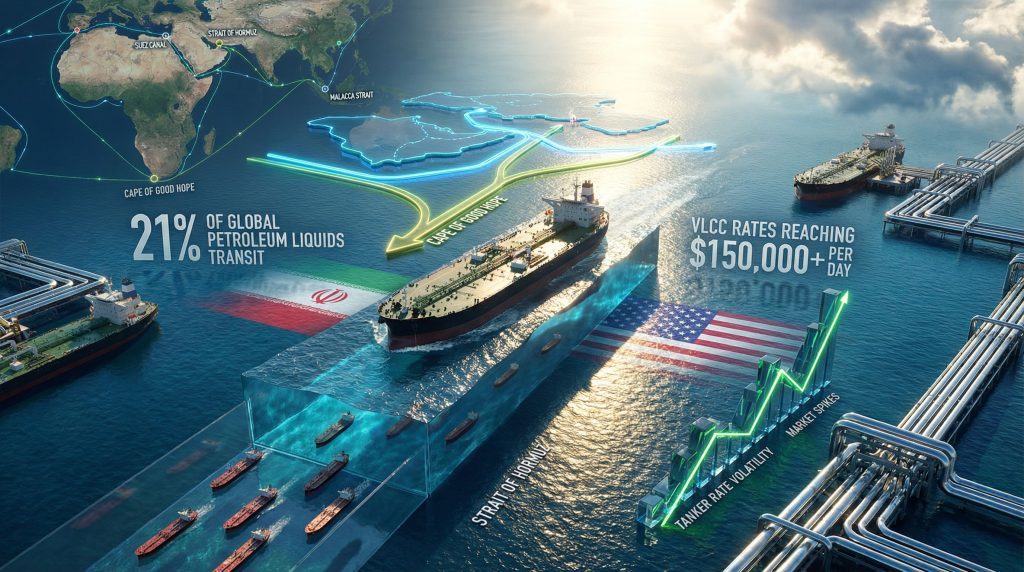
When primary energy transport corridors face disruption risks, vessel operators must evaluate alternative routing options that fundamentally alter voyage economics. The Strait of Hormuz to Asian markets route exemplifies these dynamics, with Cape of Good Hope alternatives adding approximately 6,000-7,000 nautical miles to standard transit distances.
This extended routing creates multiple cost categories:
- Additional fuel consumption: $200,000-400,000 per VLCC voyage
- Extended crew rotation requirements: Maritime labour regulations mandate specific rest periods
- Increased vessel utilisation time: 7-10 additional days per voyage
- Higher maintenance scheduling needs: Extended sea time accelerates component wear
Fuel cost calculations vary significantly based on current bunker prices, with Heavy Fuel Oil 380 typically ranging $450-550 per metric ton. A standard VLCC consuming approximately 80-100 tons daily faces substantial additional fuel expenses during extended routing scenarios.
These operational adjustments create supply chain bottlenecks that extend beyond individual voyage economics, affecting global vessel availability and creating upward pressure on freight rates across multiple regional markets simultaneously, particularly impacting oil price movements.
When big ASX news breaks, our subscribers know first
Strategic Chokepoint Vulnerability Assessment
The global energy system depends on several critical maritime passages where geographic constraints create natural bottlenecks for crude oil and petroleum product flows. These chokepoints represent systemic vulnerability points where localised disruptions can affect global energy security and pricing mechanisms.
The Strait of Hormuz exemplifies this vulnerability, handling approximately 21-24% of global crude oil transit, equivalent to 17-24 million barrels per day. This concentration means that even partial disruptions within this corridor can affect worldwide energy availability and pricing structures within days.
Current U.S.-Iran tensions impact on oil tanker rates through multiple transmission mechanisms that operate simultaneously across different market segments. VLCC (Very Large Crude Carrier) rates serve as primary indicators for these effects, with standard charter rates ranging $40,000-60,000 per day during stable periods.
During elevated tension periods, several factors converge to drive rate increases:
- Insurance companies designate higher-risk zones requiring premium coverage
- Vessel operators reduce fleet deployment in affected regions
- Alternative route requirements increase operational costs
- Strategic petroleum reserve preparations affect demand patterns
Escalation Scenario Modelling
Strategic planners utilise sophisticated scenario frameworks to assess potential disruption impacts across multiple probability levels. These models incorporate historical precedents, current military capabilities, and economic interdependencies to project potential rate evolution pathways.
Limited Disruption Scenario:
Insurance premiums increase 200-400% above baseline levels, reflecting elevated caution without operational restrictions. VLCC rates typically reach $100,000-150,000 per day, representing 150-250% increases over normal market conditions. Historical examples include brief diplomatic crises with minimal physical infrastructure impact.
Moderate Disruption Scenario:
Temporary operational restrictions lasting 24-72 hours create vessel queuing and schedule disruptions. Rate spikes can reach $200,000-300,000 per day as available tonnage becomes scarce and alternative routing requirements intensify. Emergency rerouting via Cape of Good Hope affects approximately 15-20 million barrels per day of crude flows.
Extended Disruption Scenario:
Sustained operational constraints lasting weeks or months force comprehensive supply chain restructuring. Historical precedents suggest rates could potentially reach $350,000-450,000 per day, though documented examples of extended disruptions remain limited. Such scenarios would likely trigger coordinated strategic petroleum reserve releases and emergency supply protocols.
Regional Supply Reconfiguration Dynamics
Extended chokepoint disruptions necessitate comprehensive reconfiguration of regional energy supply patterns. Asian markets, particularly China and India, face the greatest exposure due to their substantial dependence on Middle Eastern crude imports via Strait of Hormuz transit.
China imports approximately 10-12 million barrels per day of crude oil, with 60-70% originating from Middle Eastern producers requiring Strait passage. Alternative supply sources include Russian crude via pipeline and maritime routes, West African producers, and potential increases in Western Hemisphere imports.
Supply reconfiguration creates differential impacts across global markets:
- Asian refiners face higher crude acquisition costs due to extended transport distances
- European markets benefit from redirected Atlantic Basin crude previously destined for Asia
- Strategic petroleum reserve deployment becomes critical for demand balancing
- Regional price differentials widen as transportation costs vary by supply source
These reconfiguration processes typically require 4-8 weeks to fully materialise as existing supply contracts adjust and new procurement patterns establish equilibrium pricing levels.
Market Structure Evolution and Concentration Effects
The global tanker fleet has experienced significant consolidation over the past decade, with ownership concentration among major operators increasing substantially. This structural evolution amplifies the transmission effects of geopolitical tensions through reduced competitive dynamics and enhanced pricing power during supply constraints.
The world's top five VLCC operators now control approximately 40-45% of global Very Large Crude Carrier capacity, compared to roughly 30% concentration levels in 2015. This increased market power enables strategic fleet deployment decisions that can significantly affect regional rate structures during crisis periods.
Consolidated operators demonstrate sophisticated crisis response strategies including:
- Selective route avoidance to maintain vessel safety and insurance compliance
- Strategic capacity withholding during elevated-risk periods
- Enhanced utilisation of forward freight agreements (FFAs) for rate hedging
- Coordinated positioning to capitalise on premium routing opportunities
Forward Freight Agreement Market Dynamics
The growth of Forward Freight Agreement trading has created additional complexity in how geopolitical tensions affect tanker rate discovery. FFAs enable operators and charterers to lock in future freight rates, potentially reducing spot market participation during volatile periods.
During the 2022-2024 Red Sea crisis, FFA trading volumes increased substantially as market participants sought to hedge against unpredictable rate volatility. This hedging activity can create artificial scarcity in spot markets as contracted capacity becomes unavailable for immediate charter requirements, similar to patterns seen in trump tariffs impact scenarios.
Baltic Exchange FFA settlement prices often provide early indicators of market sentiment regarding geopolitical risk evolution. When FFA prices for future delivery periods rise significantly above current spot rates, this suggests market expectations of continued or escalating tensions.
Fleet Utilisation and Availability Constraints
Sanctions regimes have historically removed significant vessel capacity from global trading patterns, creating structural supply tightness that amplifies geopolitical risk transmission. Between 2011-2023, approximately 70-80 VLCCs were removed from non-sanctioned operation due to various restrictions, representing 10-12% of global VLCC capacity.
This capacity reduction creates baseline market tightness that magnifies the impact of additional disruptions. When geopolitical tensions reduce available vessel supply further, even modest capacity constraints can generate substantial rate increases due to inelastic demand for energy transportation services.
Modern vessel operators increasingly utilise sophisticated fleet management systems that incorporate real-time risk assessment, insurance cost optimisation, and route planning algorithms. These technological capabilities enable rapid response to changing geopolitical conditions but also create potential for coordinated market behaviour among major operators.
Financial Market Integration and Risk Premium Calculation
Contemporary oil tanker markets demonstrate increasing correlation with broader financial market volatility indicators, creating complex feedback loops between geopolitical risk assessment and freight pricing mechanisms. This integration reflects the financialisation of commodity transport markets and institutional investor participation in shipping assets.
VLCC tanker rates show correlation coefficients of 0.65+ with volatility indices like the VIX during periods of geopolitical tension. This relationship suggests that tanker markets increasingly respond to general risk sentiment rather than solely fundamental supply and demand factors, particularly during events like opec meeting impact announcements.
Currency dynamics add another layer of complexity to rate determination during geopolitical crises. Since tanker charter rates are typically denominated in U.S. dollars, exchange rate movements affect the real cost of freight services for importers using other currencies.
Risk Premium Decomposition Analysis
Modern tanker rate structures incorporate multiple risk premium components that respond differently to various geopolitical developments:
- Base operational risk: Standard maritime hazards including weather, mechanical issues, and port congestion
- War risk premium: Direct conflict-related insurance and operational restrictions
- Sanctions compliance risk: Legal and regulatory compliance costs for trade restrictions
- Currency and credit risk: Financial counterparty and exchange rate exposures
- Force majeure risk: Contract cancellation or modification possibilities
During heightened U.S.-Iran tensions impact on oil tanker rates scenarios, each risk category experiences different adjustment patterns. War risk premiums typically respond most rapidly, while sanctions compliance and force majeure risks build more gradually as diplomatic situations evolve.
Commodity Market Spillover Effects
Elevated tanker rates create direct spillover effects into crude oil pricing through increased transportation cost components. Each $10,000 per day increase in VLCC charter rates translates to approximately $0.15-0.25 per barrel in additional transportation costs for long-haul crude movements.
This transmission mechanism creates regional price differentials that reflect transportation cost variations. During periods of elevated tanker rates, crude oil prices in importing regions like Asia tend to rise relative to producing regions like the Middle East, reflecting the increased cost of maritime transport.
Strategic petroleum reserve policies interact with these market dynamics through coordinated release mechanisms designed to offset supply disruptions. The International Energy Agency maintains protocols for emergency crude release that can partially counteract the price effects of elevated transportation costs.
Technology Integration and Operational Adaptation
Modern tanker operations incorporate sophisticated risk management technologies that significantly influence rate discovery during geopolitical crises. Advanced navigation systems, real-time intelligence integration, and automated route optimisation enable dynamic response to changing security conditions.
Satellite-based monitoring systems provide continuous vessel tracking and threat assessment capabilities that allow operators to adjust routing decisions within hours of developing situations. This technological infrastructure enables more precise risk pricing and route optimisation compared to previous decades.
Artificial intelligence applications in fleet management include predictive maintenance scheduling that accounts for extended voyage requirements during crisis periods. When vessels must utilise longer alternative routes, maintenance intervals require adjustment to account for increased engine hours and component stress.
Enhanced Communication and Coordination Systems
Maritime security coordination has evolved substantially through improved communication between vessel operators, naval forces, and intelligence services. Real-time threat information sharing enables more precise risk assessment and route planning decisions.
Modern vessels incorporate hardened communication systems that maintain connectivity even in high-risk environments. These systems enable continuous monitoring of vessel positions and security status, reducing insurance company uncertainty and potentially moderating premium increases.
Digital documentation systems streamline compliance with rapidly changing sanctions requirements and port entry procedures. Automated compliance checking reduces delays and operational costs during periods of frequent regulatory updates.
Predictive Analytics for Risk Assessment
Energy companies increasingly utilise machine learning algorithms to analyse multiple data sources for geopolitical risk prediction. These systems incorporate diplomatic communications analysis, military asset positioning data, and economic indicator trends to generate risk probability assessments.
Predictive models enable proactive contract negotiation and hedging strategies that can reduce exposure to sudden rate increases. Companies with sophisticated risk management capabilities gain competitive advantages through superior timing of transportation procurement decisions.
Weather pattern analysis integrated with geopolitical risk assessment enables optimised seasonal contracting strategies. Operators can identify periods when alternative route availability might be constrained by seasonal weather patterns, affecting the viability of emergency routing options.
Investment Strategy Framework for Energy Logistics
Tanker rate volatility creates distinct investment opportunities across multiple segments of the maritime energy logistics sector. Understanding these dynamics enables strategic positioning across various market scenarios and risk profiles.
Large-cap tanker operators benefit from enhanced dividend sustainability during elevated rate periods, with many companies implementing variable dividend policies that increase payouts during high-rate environments. These operators also possess sufficient balance sheet capacity to fund fleet modernisation and strategic acquisitions during market downturns.
Specialised vessel categories demonstrate different risk-reward profiles during geopolitical tensions. Product tanker markets often show more stable performance characteristics compared to crude tanker volatility, while LNG carriers maintain strategic importance for energy security diversification strategies.
Infrastructure Investment Themes
Terminal and storage capacity investments gain strategic value during periods of elevated transportation costs and supply chain uncertainty. Strategic petroleum reserve expansions and commercial storage development provide buffer capacity that can moderate price volatility during disruption periods.
Regional refining capacity optimisation becomes increasingly important when transportation costs rise substantially. Refineries located closer to major consumption centres gain competitive advantages when crude transportation costs increase, creating investment themes around regional energy security infrastructure.
Alternative route infrastructure development represents long-term investment opportunities in ports, terminals, and logistics facilities that support diversified supply chains. These investments provide strategic value during crisis periods and generate steady returns during normal market conditions.
Risk Management Implementation Strategies
Sophisticated energy companies employ multi-layered risk management frameworks combining financial hedging, operational flexibility, and strategic inventory positioning. Forward freight agreements enable rate protection while time charter arrangements provide supply security during volatile periods.
Geographic diversification protocols reduce dependence on single transportation routes or supply sources. Companies with flexible refinery feedstock capability can optimise procurement decisions based on relative transportation costs and crude availability patterns.
Strategic inventory positioning at multiple locations provides operational flexibility during supply chain disruptions. Companies maintaining buffer stocks near major consumption centres reduce exposure to transportation disruptions and can capitalise on temporary price dislocations.
The next major ASX story will hit our subscribers first
Monitoring Framework and Leading Indicators
Effective assessment of tanker rate trajectory requires systematic monitoring of multiple indicator categories spanning diplomatic, operational, and financial metrics. This comprehensive approach enables early identification of trend changes and risk evolution patterns.
Primary operational indicators include Baltic Exchange route assessments for major tanker categories, war risk insurance premium levels published by Lloyd's underwriters, and Strait of Hormuz transit volume data from maritime traffic monitoring services. These metrics provide immediate feedback on market conditions and operational constraints.
Secondary indicators encompass regional crude price differentials that reflect transportation cost impacts, strategic petroleum reserve utilisation rates indicating government response patterns, and alternative route capacity utilisation showing market adaptation progress.
Diplomatic and Military Intelligence Integration
Leading indicators for geopolitical risk evolution include diplomatic engagement intensity metrics derived from public communications analysis and international meeting frequency patterns. Military asset positioning data provides insights into escalation probability and potential operational constraint scenarios.
Energy company hedging activity levels serve as market sentiment indicators, with increased FFA trading volumes and longer-duration contract preferences suggesting expectations of continued volatility. Corporate earnings call commentary analysis reveals management perspectives on risk duration and market outlook.
Intelligence community assessments, when publicly available through congressional testimony or official reports, provide authoritative perspectives on threat persistence and escalation probability that inform long-term planning decisions.
Quantitative Model Development
Effective monitoring systems integrate multiple data streams through quantitative models that generate probability assessments for various rate trajectory scenarios. These models incorporate historical precedent analysis, current market structure factors, and forward-looking risk indicators.
Correlation analysis between tanker rates and broader market indicators helps identify when geopolitical premiums are approaching unsustainable levels or when market sentiment shifts suggest risk reduction. These analytical frameworks support tactical trading decisions and strategic investment timing.
Machine learning applications can identify pattern recognition opportunities in large datasets combining diplomatic, military, economic, and market variables. These analytical capabilities provide competitive advantages in risk assessment and market timing decisions for sophisticated market participants.
The U.S.-Iran tensions impact on oil tanker rates continues to evolve as a critical factor in global energy security planning. However, as recent analysis from rate-focused trading publications suggests, market participants must maintain vigilance regarding both operational constraints and speculative risk premiums.
Disclaimer: This analysis is for informational purposes only and does not constitute investment advice. Geopolitical risk assessment involves significant uncertainty, and actual market outcomes may differ substantially from scenario projections. Readers should conduct independent research and consult qualified professionals before making investment decisions based on geopolitical risk analysis.
Looking to Capitalise on Energy Market Volatility?
Discovery Alert's proprietary Discovery IQ model delivers real-time alerts on significant ASX mineral discoveries, including critical energy materials and commodities that drive market movements during geopolitical tensions. Subscribers gain immediate insights into actionable opportunities across the resources sector, positioning themselves ahead of market developments that can generate substantial returns during volatile periods like these. Begin your 14-day free trial today to secure your market-leading advantage in energy and commodities investing.