June 11, 2026
Navigating Turbulent Waters in Global Commerce
Maritime commerce stands at a crossroads where traditional efficiency models collide with an increasingly volatile geopolitical landscape. The interconnected network of global shipping routes, once optimised purely for speed and cost-effectiveness, now requires sophisticated risk assessment frameworks that account for regional conflicts, proxy wars, and strategic chokepoint vulnerabilities. This fundamental shift represents more than temporary disruption – it signals a permanent recalibration of how international trade operates in an era where geopolitical tension affecting shipping routes has become a primary consideration in supply chain planning.
When big ASX news breaks, our subscribers know first
Understanding Critical Maritime Chokepoints Under Pressure
The world's most vital shipping arteries have evolved into strategic pressure points where geopolitical tensions directly translate into economic consequences. These narrow waterways, originally designed by nature and optimised by decades of maritime engineering, now serve dual roles as commercial highways and potential conflict zones.
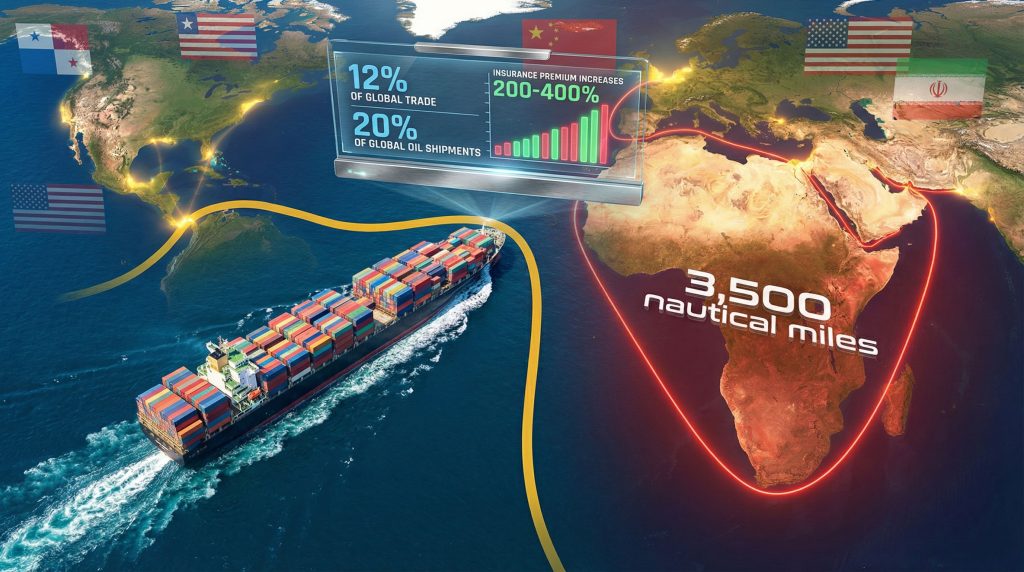
The Red Sea corridor processes approximately 12% of global maritime trade, making it one of the most economically sensitive waterways worldwide. Recent regional conflicts have forced major shipping companies to implement dynamic risk assessment protocols, with some vessels adding 3,500 nautical miles to their standard routes by diverting around the Cape of Good Hope.
This rerouting decision creates cascading effects throughout the global supply chain, affecting everything from consumer goods delivery schedules to raw material procurement timelines. Furthermore, the impact of US tariffs and inflation compounds these disruptions, creating additional cost pressures for international traders.
Similarly, the Strait of Hormuz facilitates the passage of 20% of global oil shipments and 22% of liquefied natural gas exports. The strategic importance of this 21-mile-wide waterway cannot be overstated – daily closure costs are estimated at $35 billion in trade value. Political tensions in the Persian Gulf region create immediate ripple effects across energy markets, forcing shipping companies to maintain alternative routing contingencies that add 6,000+ nautical miles to standard Gulf-Europe shipments.
Insurance Market Transformation
Maritime insurance markets have undergone dramatic restructuring as geopolitical tension affecting shipping routes becomes a quantifiable business expense. Traditional insurance models, based on historical shipping patterns and predictable risk factors, prove inadequate when regional conflicts can emerge with minimal warning.
War Risk Premium Increases:
- Red Sea transits: 200-400% above standard rates
- Persian Gulf routes: 300-500% premium escalation
- Alternative route coverage: 150-250% standard rate increases
- Cargo delay insurance: New product category emergence
These insurance cost escalations reflect more than simple risk adjustment – they represent a fundamental shift in how the maritime industry prices geopolitical uncertainty. Companies now budget for insurance volatility as a standard operating expense rather than an exceptional cost.
Economic Impact Analysis of Route Diversification
The financial implications of geopolitical shipping disruptions extend far beyond simple fuel cost increases. Modern container shipping operates on razor-thin profit margins, where route optimisation directly correlates with operational viability.
| Cost Category | Standard Operations | High-Risk Alternatives | Financial Impact |
|---|---|---|---|
| Fuel Consumption | Baseline efficiency | +40-60% increase | 1.4-1.6x multiplier |
| Insurance Premiums | Standard maritime rates | +200-400% escalation | 3-5x cost increase |
| Transit Duration | Optimised scheduling | +14-21 additional days | 1.5-2x time extension |
| Port Congestion Fees | Established tariffs | +20-80% surcharges | 1.2-1.8x cost multiplier |
These cost structures create compound effects throughout the shipping ecosystem. Longer transit times reduce vessel utilisation efficiency, forcing shipping companies to deploy additional capacity to maintain service frequency.
Consequently, this capacity reallocation creates temporary shortages in other markets, driving up shipping rates across multiple trade routes simultaneously. The US–China trade war effects further complicate these dynamics by adding tariff considerations to routing decisions.
Capacity Utilisation Challenges
Container vessels designed for specific route efficiencies face operational challenges when forced to adapt to alternative passages. A ship optimised for 14-day Asia-Europe transits via the Suez Canal requires fundamental operational adjustments when rerouted on 35-day journeys around Africa.
Operational Adjustments Include:
- Fuel capacity planning for extended voyages
- Crew rotation scheduling modifications
- Container equipment repositioning strategies
- Maintenance scheduling disruptions
- Customer delivery commitment renegotiations
Supply Chain Management Adaptation Strategies
Organisations worldwide have developed sophisticated contingency frameworks to address route instability. These strategies represent a shift from traditional "just-in-time" inventory models toward more resilient "just-in-case" approaches.
Multi-Modal Transportation Integration
Companies increasingly deploy hybrid transportation models that reduce dependency on any single chokepoint. These integrated approaches combine maritime, rail, and air freight to maintain supply chain continuity during crisis periods.
Strategic Transportation Combinations:
- Maritime-Rail Hybrid: Europe-Asia trade via Trans-Siberian Railway backup
- Air-Sea Coordination: High-value cargo air transport during maritime disruptions
- Regional Hub Distribution: Intermediate warehousing in geopolitically stable regions
- Alternative Port Utilisation: Secondary port networks for emergency cargo handling
Inventory Buffer Optimisation
Safety stock calculations now incorporate geopolitical risk assessments alongside traditional demand variability factors. Companies adjust inventory holding costs based on route reliability assessments, with higher political risk correlating directly to increased buffer stock requirements.
However, the complexity of modern supply chains means that market volatility hedging strategies must evolve beyond traditional financial instruments to include physical inventory positioning.
Modern Lead Time Planning:
- Traditional Model: 30-day procurement cycles
- Geopolitical Risk Model: 45-90 day extended planning horizons
- Crisis Contingency: 120+ day emergency inventory reserves
- Supplier Diversification: Multiple geographic sourcing regions
Technology Solutions for Route Uncertainty
Advanced analytics platforms now integrate geopolitical intelligence with real-time maritime tracking data, enabling dynamic route optimisation based on evolving security conditions. These technological solutions represent the maritime industry's adaptation to an era where political developments directly impact commercial operations.
Real-Time Risk Assessment Platforms
Modern shipping companies utilise sophisticated software that combines multiple data streams to provide actionable routing recommendations. For instance, geopolitical conflict research indicates that real-time data integration is crucial for effective risk management.
Integrated Data Sources:
- Satellite vessel tracking systems
- Regional conflict monitoring feeds
- Insurance rate fluctuation alerts
- Port congestion status updates
- Weather pattern analysis
- Fuel price regional variations
These platforms enable shipping companies to make route decisions based on comprehensive risk-reward calculations rather than purely geographic considerations.
Blockchain Documentation Systems
Distributed ledger technology helps maintain cargo documentation integrity across multiple route changes, reducing administrative complexity when vessels must alter their planned passages. This technology proves particularly valuable when ships change destinations multiple times during a single voyage due to evolving geopolitical conditions.
Regional Power Responses to Maritime Vulnerabilities
Nations worldwide recognise maritime chokepoint control as strategic leverage, leading to accelerated infrastructure investments and diplomatic initiatives aimed at maintaining commercial shipping access.
Infrastructure Development Acceleration
Notable Regional Investment Initiatives:
- Middle Eastern Security Partnerships: Joint naval patrol agreements in Red Sea corridors
- Asian Pacific Infrastructure: Expanded port facilities in politically stable regions
- European Arctic Investment: Feasibility studies for northern shipping route development
- African Atlantic Development: West African port capacity expansion projects
These infrastructure investments reflect long-term strategic thinking about maritime trade route diversification. Countries position themselves as reliable alternatives to traditional chokepoints, attracting international shipping traffic through political stability and operational efficiency.
Diplomatic Maritime Frameworks
Multilateral agreements increasingly focus on maintaining commercial shipping access during regional conflicts. While enforcement mechanisms remain limited, these frameworks establish diplomatic protocols for crisis management.
Key Diplomatic Initiatives:
- Safe Passage Agreements: International protocols for commercial vessel protection
- Neutral Corridor Designation: Internationally recognised safe shipping zones
- Emergency Port Access: Reciprocal agreements for crisis cargo handling
- Information Sharing Networks: Real-time security threat communication systems
The next major ASX story will hit our subscribers first
Long-Term Implications for Global Trade Patterns
The current geopolitical environment suggests permanent structural changes to global shipping patterns rather than temporary disruptions. Traditional hub-and-spoke models give way to more distributed networks designed to minimise single-point-of-failure risks.
Shipping Network Decentralisation
Maritime commerce increasingly resembles a complex web of interconnected routes rather than a few dominant corridors. This transformation affects port investment priorities and regional economic development patterns.
Decentralisation Trends:
- Multiple Hub Strategy: Regional distribution centres replace mega-hub dependency
- Route Redundancy Planning: Parallel shipping corridors for critical trade lanes
- Intermediate Port Development: Secondary ports gain strategic importance
- Regional Supply Chain Shortening: Localised production to reduce shipping dependency
In addition, Trump tariff implications may accelerate these decentralisation trends as companies seek to minimise exposure to trade policy uncertainties.
Energy Trade Route Evolution
Hydrocarbon exporters actively diversify their shipping dependencies, leading to new pipeline projects and alternative export terminal development. These infrastructure investments reshape global energy security calculations and create new geopolitical dynamics.
Energy Infrastructure Adaptations:
- Alternative Export Terminals: New facilities in geopolitically stable regions
- Pipeline Network Expansion: Overland alternatives to maritime transport
- Floating LNG Facilities: Mobile export capabilities reducing fixed infrastructure vulnerability
- Regional Energy Hub Development: Distributed storage and processing capabilities
The relationship between energy markets and geopolitical tension affecting shipping routes becomes increasingly apparent as oil futures trends reflect route uncertainty premiums.
Investment Framework Analysis
Investors increasingly analyse maritime-related opportunities through geopolitical stability lenses rather than purely economic metrics. This analytical shift creates new investment categories and valuation methodologies.
Port Infrastructure Investment Criteria
Modern Port Valuation Factors:
- Political Stability Index: Government continuity and policy predictability
- Strategic Military Value: Potential for requisition during conflicts
- Geographic Diversification: Distance from major conflict zones
- Infrastructure Resilience: Capacity to handle crisis-driven traffic increases
- Diplomatic Relations: Host country international relationships
Ports in neutral territories or those with strong security partnerships command premium valuations as investors recognise their strategic value during global shipping disruptions.
Maritime Technology Investment Opportunities
High-Growth Technology Sectors:
- Autonomous Vessel Systems: Reduced crew risk in dangerous waters
- Satellite Tracking Enhancement: Real-time security monitoring capabilities
- AI Route Optimisation: Dynamic routing based on risk assessment
- Alternative Fuel Technologies: Reduced dependency on regional fuel supplies
- Cargo Security Systems: Enhanced protection against piracy and seizure
These technology investments reflect the maritime industry's adaptation to an operating environment where traditional assumptions about safe passage no longer apply.
Risk Management Framework Development
Organisations develop sophisticated contingency planning models based on different geopolitical escalation scenarios. These frameworks represent a fundamental shift from reactive crisis management to proactive risk mitigation.
Scenario-Based Planning Models
Multi-Scenario Planning Structure:
- Baseline Scenario: Normal operations with standard geopolitical risks
- Elevated Tension: Increased insurance costs and alternative routing preparation
- Active Conflict: Complete route avoidance and emergency supply chain activation
- Extended Crisis: Long-term operational model adjustments and supplier diversification
Each scenario includes pre-negotiated alternative routing agreements, supplier arrangements, and financial hedging strategies that activate automatically when specific risk thresholds are reached.
Insurance Product Evolution
Maritime insurance markets create new product categories specifically addressing geopolitical risks. Moreover, global shipping challenges highlighted by international organisations demonstrate the urgent need for these enhanced coverage options.
Emerging Insurance Products:
- Route Deviation Coverage: Compensation for additional costs due to security-related rerouting
- Cargo Delay Insurance: Protection against time-sensitive shipment losses
- Political Risk Maritime: Coverage for government seizure or requisition
- Crisis Response Insurance: Emergency logistics and communication costs
How Will Global Shipping Adapt?
The transformation of global shipping networks represents more than operational adaptation – it signals a fundamental restructuring of international commercial relationships. Companies that develop sophisticated geopolitical risk management capabilities will maintain competitive advantages in an increasingly uncertain global environment.
Structural Changes Include:
- Relationship Diversification: Multiple supplier and customer geographic regions
- Financial Hedging Strategies: Currency and commodity risk management tied to shipping routes
- Operational Flexibility: Rapid route switching capabilities and alternative logistics networks
- Information Intelligence: Real-time geopolitical monitoring and decision-making systems
Maritime commerce increasingly resembles a complex risk management exercise where traditional efficiency optimisation must balance against security considerations and route diversification requirements.
Consequently, organisations that successfully navigate this transformation will emerge stronger and more resilient, while those that fail to adapt face increasing operational challenges and competitive disadvantages.
The evolution of global shipping from a purely commercial endeavour to a geopolitically-aware strategic operation represents one of the most significant structural changes in international trade since the containerisation revolution. This transformation will likely accelerate as regional conflicts become more frequent and traditional assumptions about safe passage continue to erode.
Disclaimer: This analysis is for informational purposes only and should not be considered investment advice. Maritime shipping investments carry significant risks, including but not limited to geopolitical instability, regulatory changes, and market volatility. Readers should conduct thorough research and consult with qualified financial advisors before making investment decisions.
Ready to Navigate Geopolitical Investment Opportunities?
As shipping routes face unprecedented disruptions, Discovery Alert's proprietary Discovery IQ model delivers real-time alerts on significant ASX mineral discoveries, helping investors identify opportunities in resource companies less dependent on volatile maritime trade routes. Discover why major mineral discoveries can generate substantial returns by exploring Discovery Alert's dedicated discoveries page, showcasing historic examples of exceptional market outcomes during periods of global uncertainty.