August 12, 2026
When Rational Behaviour Breaks Markets: The Hidden Economics of Fuel Tax Anticipation
Every fuel market analyst understands price elasticity. Far fewer pay close attention to temporal elasticity — the capacity of consumers and commercial operators to shift when they purchase a commodity, not just how much they purchase. This distinction sits at the heart of one of the most instructive market episodes in recent European energy history: the deliberate, coordinated collapse in German fuel demand during April 2026, driven entirely by the anticipation of a government-mandated price reduction taking effect on 1 May.
Understanding why German fuel demand drops ahead of a tax cut requires more than reading a policy announcement. It requires examining the intersection of consumer psychology, wholesale contract mechanics, refinery-level pricing dynamics, and geopolitical commodity shocks — all operating simultaneously in one of Europe's largest road fuel markets.
When big ASX news breaks, our subscribers know first
The Policy Architecture: How Germany's Energy Tax Relief Was Structured
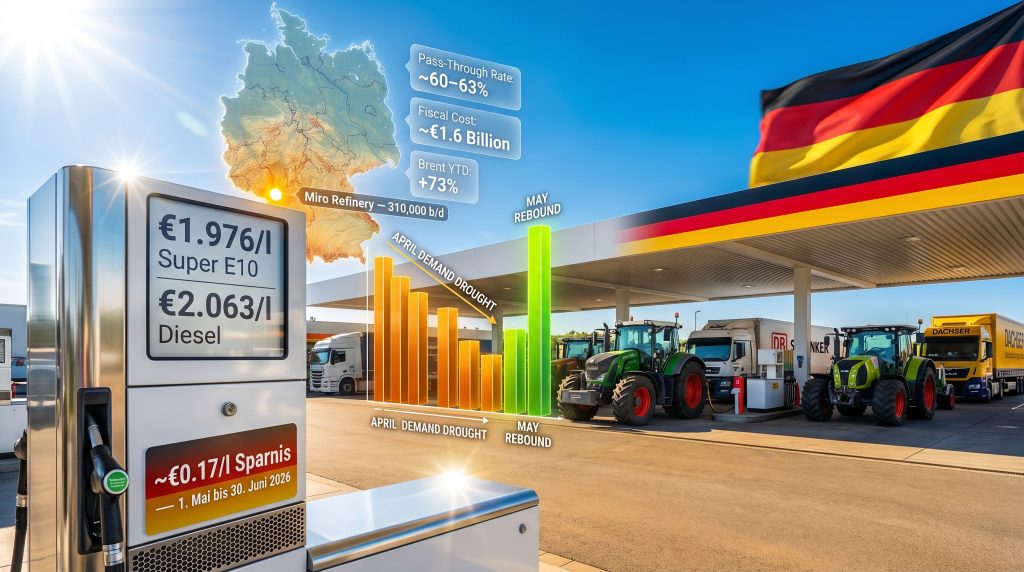
The German federal government enacted a temporary reduction in the Energiesteuer — the national energy tax applied to road fuels — effective from 1 May 2026 through 30 June 2026. The reduction amounts to €14.04 per 100 litres across eligible fuel categories. Once Germany's standard 19 percent value-added tax is applied on top of this relief, the effective consumer-facing benefit reaches approximately €0.17 per litre, or roughly 17 cents at the pump. The total estimated fiscal cost of this two-month window is approximately €1.6 billion, according to reporting by Argus Media on 4 May 2026.
The scope of eligible fuels is broader than many consumers realise:
| Fuel Type | Covered by Tax Reduction | Estimated Consumer Saving (incl. VAT) |
|---|---|---|
| Diesel | Yes | ~€0.17/litre |
| Gasoline (Super E10 / Super Plus) | Yes | ~€0.17/litre |
| Hydrotreated Vegetable Oil (HVO) | Yes | ~€0.17/litre |
| Liquefied Petroleum Gas (LPG) | No | Not applicable |
| Compressed Natural Gas (CNG) | No | Not applicable |
The inclusion of HVO alongside conventional diesel and petrol is a technically significant detail. HVO is a renewable diesel substitute produced from waste fats, vegetable oils, and other biological feedstocks. It can be used in diesel engines without modification and is typically blended at ratios ranging from 10 to 100 percent. By including HVO under the same relief framework, the policy effectively treats it as a petroleum-equivalent road fuel — a classification with implications for the biofuel sector's competitiveness during the relief window.
The exclusion of LPG and CNG is equally telling. These alternative fuels serve a relatively small share of the German vehicle fleet, and their exclusion suggests the policy was designed as a broad relief measure for mainstream road fuel consumers rather than a technology-neutral fuel intervention. Furthermore, LPG pricing benchmarks remain entirely unaffected by this measure, reinforcing the targeted nature of the relief.
The political rationale for the measure stemmed from surging crude oil prices following the outbreak of the US-Iran war on 28 February 2026. The resulting supply disruptions through the Strait of Hormuz sent global crude benchmarks sharply higher, with the impact cascading through to German pump prices in ways that threatened transport affordability for households, farmers, and freight operators alike.
The Demand Deferral Mechanism: Why Consumers Stopped Filling Up in April
The phenomenon that played out across German fuel markets through April 2026 has a precise economic description: intertemporal substitution of demand. When rational actors possess reliable information about a near-term price reduction on a storable good, they will delay purchases to capture the lower future price — provided the cost of delay (storage, inconvenience, risk) is lower than the anticipated saving.
In April 2026, all conditions for large-scale deferral were satisfied:
-
The price reduction was publicly confirmed and precisely dated — consumers faced no uncertainty about whether the tax cut would occur, only about how fully it would be passed through at the pump.
-
The saving per transaction was financially meaningful — at €0.17 per litre applied to a typical 55-litre tank, a single fill-up deferred by five to seven days yielded a gross saving of approximately €9.35 per vehicle, assuming full pass-through.
-
The time horizon was short — fuel can be stored in vehicle tanks and commercial facilities without significant degradation over a one to two week period.
-
Storage costs were negligible relative to the anticipated saving, particularly for commercial fleet operators and agricultural enterprises running on-farm diesel storage.
According to Argus Media's market reporting (4 May 2026), traded spot volumes for both diesel and gasoline reported to commodity price assessors declined consistently week-on-week throughout April. In the final days of the month — roughly 27 to 30 April — market participants described the demand environment as effectively at a standstill, with both retail consumers and commercial end-users deliberately running storage levels down to minimal operating thresholds ahead of the 1 May changeover.
The critical interpretive point here is that this demand collapse carried no signal about structural fuel consumption trends in Germany. It was a purely temporal shift — volume that disappeared from April's ledger was overwhelmingly destined to reappear in May, concentrated into a compressed rebound window.
This distinction matters enormously for anyone reading short-term volume data without context. A week-on-week demand decline that appears alarming in isolation may be entirely rational and self-correcting when viewed through the lens of known policy changes. Indeed, commodity market volatility of this nature is often amplified by behavioural timing effects rather than genuine shifts in underlying consumption.
Wholesale Market Dislocation: What Happened Inside the Supply Chain
While retail consumers managed the deferral with relative ease, the wholesale market experienced considerably more stress. The pressure fell most acutely on suppliers operating under term supply contracts — structured agreements that typically specify minimum lifting volumes from contracted customers over defined periods, with financial penalties for underselling.
When customer demand collapsed through April, suppliers faced a difficult commercial calculus. The options were effectively binary: progressively reduce diesel offer prices to incentivise contracted customers to lift volumes and avoid end-of-month penalties, or absorb the penalty costs directly. Many chose the former, creating a cascading series of price reductions through the final weeks of April, as reported by Argus Media on 4 May 2026.
This dynamic produced an unusual statistical artefact in market price assessments: abnormally wide bid-ask spreads in the week ending 1 May 2026. Distressed low-price offers from suppliers attempting to clear April volumes diverged sharply from standard market assessments, creating a fragmented pricing landscape that obscured the true underlying market level.
The Miro Refinery: Southwest Germany's Epicentre of Oversupply
The geographic concentration of this supply pressure was notable. Oversupply conditions were most severe in southwest Germany, centred on the Miro refinery at Karlsruhe — Germany's largest refining facility, operating at a capacity of 310,000 barrels per day. The scale of Miro's output relative to regional demand means that any sustained suppression of local lifting activity creates price dislocations that are difficult for the broader system to absorb quickly.
According to Argus Media, April diesel prices for prompt (same-day) loadings at Miro at times broke away entirely from movements in ICE Gasoil futures — the standard European benchmark for middle distillate pricing. The ICE Gasoil contract reflects global forward market expectations; when physical market prices at a specific terminal diverge from it substantially, this signals that local supply-demand imbalances have overwhelmed broader market pricing mechanisms.
The most striking illustration came on 30 April 2026, when same-day diesel collection offers at the standard (pre-cut) tax rate were priced at near-parity with May-delivery product already incorporating the reduced tax rate. This extraordinary convergence meant suppliers were effectively subsidising buyers to lift old-tax-rate product immediately, rather than waiting 24 hours for cheaper May-rate material — a pricing structure that reveals the depth of regional supply distress.
| Market Condition | Late April (Pre-Cut Period) | Early May (Post-Cut Period) |
|---|---|---|
| Tax Rate Applied | Standard Energiesteuer | Reduced (minus €14.04 per 100 litres) |
| Regional Supply Status | Oversupplied, distressed | Rapid demand rebound anticipated |
| ICE Gasoil Correlation | Partially to fully decoupled | Expected to normalise |
| Bid-Ask Spread | Abnormally wide | Narrowing as demand recovered |
| Dominant Commercial Pressure | Supplier-side (penalty avoidance) | Buyer-side (volume competition) |
The Pass-Through Problem: Why Pump Prices Didn't Fall by the Full Amount
One of the most closely watched questions as 1 May arrived was whether filling station operators would transmit the full €0.17 per litre tax saving to consumers. The early evidence was mixed. According to Argus Media's reporting, Super E10 gasoline averaged approximately €1.976 per litre on 1 May — a decline of roughly 10.7 cents per litre from the prior period — while diesel averaged approximately €2.063 per litre, down approximately 10.4 cents per litre.
These figures imply an effective pass-through rate of approximately 60 to 63 percent of the theoretical €0.17 per litre saving. Several structural factors explain why the full benefit was not immediately visible at the pump:
-
Inventory timing arbitrage: Filling stations that replenished their underground tanks immediately before midnight on 30 April did so at the old tax rate. Selling that fuel at post-cut prices would compress their margins, creating an incentive to hold prices higher until pre-cut inventory was cleared.
-
ICE Gasoil futures volatility: Ongoing geopolitical disruption linked to the US-Iran war maintained persistent upward pressure on the global middle distillate benchmark. A portion of the tax saving at the government level was effectively absorbed by rising wholesale input costs at the refinery and trading level.
-
Regional pricing variation: In areas where the April supply glut had already pushed end-of-month prices below their normal level, the comparative price fall on 1 May appeared smaller in absolute terms — even if the structural tax saving was identical.
-
Retailer margin restoration: Some operators used the transition moment to partially rebuild profit margins that had been compressed during the preceding months of elevated wholesale costs, rather than transmitting the full saving to customers.
The German government publicly urged fuel retailers and oil companies to pass the full tax saving on to end consumers, framing anything less than complete transmission as contrary to the stated policy intent. Consequently, the impact on consumer prices remained a point of active scrutiny throughout the opening days of May.
The Geopolitical Wildcard: How the US-Iran War Complicates German Relief
Germany's domestic tax policy does not exist in isolation from global commodity markets, and the 2026 context makes this interdependence unusually acute. The US-Iran war, which began on 28 February 2026, effectively closed the Strait of Hormuz to normal commercial shipping flows. The Strait handles a substantial share of global crude oil and refined product exports from the Middle East Gulf. Its closure created an immediate structural undersupply in global oil markets that sent ICE Gasoil futures — and therefore European fuel prices — sharply higher.
This creates a fundamental tension at the heart of Germany's tax relief policy: the fixed-value tax saving of €0.17 per litre can be partially or completely eroded by a corresponding rise in the underlying benchmark commodity price. If ICE Gasoil futures move upward by €0.17 per litre between the policy announcement date and the end of June 2026, German consumers will have received no net price benefit whatsoever — the government will have spent €1.6 billion to hold prices steady rather than reduce them.
The trade war impact on oil markets adds yet another layer of complexity, as shifting geopolitical alliances and sanctions regimes influence both supply availability and benchmark pricing in ways that are difficult to model with precision. European jet fuel markets offer a parallel illustration of this dynamic. As reported by Argus Media, European jet fuel premiums to ICE Gasoil futures fell to their lowest levels since the early days of the US-Iran war by late April 2026, as confidence built around near-term supply adequacy.
Yet outright jet fuel prices in Europe remained close to double pre-war levels, reflecting the extent to which the underlying benchmark itself had been repriced upward by the conflict. The same upward benchmark pressure applies to diesel and gasoline. Monitoring crude oil price trends therefore remains essential for assessing the real-world value of Germany's tax relief in the weeks ahead.
A secondary geopolitical complexity involves cross-border arbitrage. A temporary reduction in German fuel taxation creates a price differential between Germany and neighbouring EU member states — the Netherlands, Belgium, France, Austria, and others — that have not implemented equivalent measures. Commercial operators crossing these borders for fuel purchases, as well as bulk buyers exploiting the differential, would effectively export a share of Germany's tax relief to non-German consumers, diluting the domestic demand stimulus.
The next major ASX story will hit our subscribers first
International Comparisons: Germany's Approach in a Global Context
Germany's two-month energy tax reduction is one of several policy responses to the 2026 oil supply crisis observed across major economies. A comparative view reveals meaningfully different approaches to the same underlying challenge:
| Country | Policy Instrument | Duration | Estimated Consumer Benefit |
|---|---|---|---|
| Germany | Energiesteuer reduction (diesel, petrol, HVO) | 2 months (May-June 2026) | ~€0.17/litre |
| Japan | Direct retail fuel subsidy (gasoline price cap) | Ongoing (2026) | Targeting |
| South Australia | Expanded fuel rationing framework (proposed) | Up to 90 days per activation | Structural supply protection |
| United Kingdom | Refiner output maximisation directive | Ongoing | Supply-side stabilisation |
Japan's approach is particularly instructive as a policy design contrast. Rather than reducing a tax rate — which relies on retailers and supply chain actors to transmit the saving — Japan intervenes directly at the retail level through a fuel subsidy mechanism targeting a ¥170 per litre (~€1.08 per litre) cap on gasoline prices. As S&P Global reported, Japan's nationwide average gasoline price had reached ¥169.7 per litre as of 27 April, demonstrating near-perfect alignment between policy target and market outcome.
Japan's prime minister noted at the time that this subsidised retail price was roughly half the level observed in European countries — a comparison that underscores both the effectiveness of direct retail intervention and the scale of price divergence between heavily-subsidised and tax-reduction-based approaches.
The German tax-cut model carries the advantage of a defined, finite fiscal commitment (€1.6 billion over two months) without requiring ongoing market monitoring at the retail level. However, its structural reliance on supply chain pass-through introduces the risk of incomplete transmission documented in the 1 May data.
South Australia's contemporaneous legislative proposal — expanding fuel rationing authority from a seven-day to a 90-day activation window, as reported by Argus Media on 4 May 2026 — represents a third model: one focused on supply security and preventing market misconduct during disruptions rather than directly subsidising price. Proposed fines of up to A$1 million for price exploitation during supply shortages reflect a regulatory rather than fiscal approach to the same underlying problem.
The Demand Cliff: What Happens When the Tax Cut Expires on 30 June
Germany now faces a mirror-image risk at the end of June 2026. The same rational consumer behaviour that suppressed April demand will likely operate in reverse as the 30 June expiry approaches. Fleet operators, agricultural businesses, and filling station operators who understand the policy window will have strong incentives to maximise purchases and rebuild storage in the final days of June — before standard tax rates resume on 1 July.
This anticipated pull-forward of demand creates several downstream risks:
- A sharp demand spike in late June as buyers race to stock up at reduced tax rates, potentially creating localised supply tightness
- A corresponding demand trough in early July as consumers draw down elevated inventories rather than purchasing at market
- Renewed pricing pressure on suppliers managing term contracts during the July pullback period
The structural asymmetry of this outcome is worth noting: while the April demand deferral created oversupply and price pressure on suppliers, the late-June demand surge could create undersupply and price pressure on consumers — a compressed version of the same temporal demand shift, but in the opposite direction.
Whether the German government extends the programme beyond 30 June will depend on crude price trajectory, geopolitical developments in the Middle East, and the federal budget's capacity to absorb further relief costs. The €1.6 billion price tag for two months sets a significant fiscal threshold for any extension. As of early May 2026, no official announcement of an extension had been made.
Frequently Asked Questions: German Fuel Tax Cut May 2026
How much will German drivers save per fill-up under the May 2026 tax cut?
Based on the €0.17 per litre saving (inclusive of VAT) applied to a standard 55-litre tank, a typical fill-up would cost approximately €9.35 less under the reduced rate — assuming full retailer pass-through. Early data suggests actual savings on 1 May were closer to €5.70 to €5.85 per fill-up, reflecting the approximately 60 to 63 percent pass-through rate observed in the opening days.
How long does the German fuel tax reduction last?
The temporary Energiesteuer reduction runs for two months, from 1 May 2026 to 30 June 2026, after which standard rates are scheduled to resume. No extension has been announced as of early May 2026.
Why did German fuel demand fall before the tax cut took effect?
Consumers and commercial buyers rationally deferred non-essential fuel purchases throughout April 2026, anticipating lower prices from 1 May. This demand deferral is a predictable market response to any pre-announced and confirmed price reduction on a storable commodity. For further context, German motorists expressed frustration over high fuel prices in the days immediately preceding the relief taking effect.
Will diesel prices fall by the full tax cut amount at the pump?
Early data indicates approximately 60 to 63 percent of the theoretical €0.17 per litre saving was passed through on 1 May 2026. Full pass-through is constrained by inventory timing at filling stations, ongoing ICE Gasoil futures volatility, and individual retailer pricing decisions.
Which German regions were most affected by the April demand drought?
Southwest Germany — centred on the 310,000 b/d Miro refinery at Karlsruhe — experienced the most acute oversupply conditions, with diesel prices for prompt loadings at times fully decoupling from ICE Gasoil futures benchmarks in the final weeks of April 2026.
Does the May 2026 tax cut apply to HVO renewable diesel?
Yes. Hydrotreated vegetable oil (HVO) and other similarly taxed road fuel products are included in the Energiesteuer reduction alongside conventional diesel and gasoline. LPG and CNG are not covered by the measure.
This article draws on market reporting published by Argus Media on 4 May 2026. All price figures, volume trends, and policy parameters are sourced from that reporting and contemporaneous Argus market commentary. Forward-looking statements regarding demand recovery, pass-through rates, and policy extension represent analytical assessments based on available information and should not be treated as financial advice or market forecasts. Commodity markets are subject to rapid change, and readers should consult current market data before making commercial or investment decisions.
Want to Capitalise on Real-Time Commodity Market Opportunities?
When geopolitical shocks like the US-Iran war send fuel and energy commodity prices into turmoil, the ripple effects extend well beyond pump prices — they reshape investment landscapes across the entire resources sector. Discovery Alert's proprietary Discovery IQ model instantly identifies significant ASX mineral discoveries as they are announced, translating complex commodity market shifts into actionable investment insights for both short-term traders and long-term investors. Explore how historic mineral discoveries have generated substantial returns on Discovery Alert's dedicated discoveries page, and begin your 14-day free trial today to position yourself ahead of the market.