
May 16, 2026
The Hidden Metal Powering Modern Defence and Communications
Most commodity investors can name the metals driving the energy transition. Lithium, cobalt, nickel, and copper dominate headlines. Yet one metalloid sits quietly beneath all of them in terms of strategic sensitivity, irreplaceability in defence applications, and structural vulnerability to supply disruption. Germanium rarely earns a mention in mainstream financial media, but it underpins some of the most consequential technologies in modern civilisation, from the thermal imaging systems carried by infantry soldiers to the fibre optic cables transmitting the world's internet traffic.
What makes the current moment significant is not just germanium's demand trajectory, but the fundamental fragility of how it reaches the market. Understanding that fragility is the starting point for appreciating why Titan Mining germanium from New York mine waste has rapidly moved from a speculative concept to a serious industrial evaluation with one of North America's most sophisticated metallurgical operators.
When big ASX news breaks, our subscribers know first
What Germanium Actually Does and Why It Cannot Be Easily Replaced
The Physics Behind the Strategic Value
Germanium occupies an unusual position in the periodic table, element 32, sitting directly below silicon with properties that make it genuinely indispensable in specific applications rather than merely convenient. Its band gap of approximately 0.67 electron volts, substantially narrower than silicon's 1.12 eV, enables it to absorb and transmit infrared radiation in the 2 to 14 micron wavelength range. This physical characteristic is not replicated by any commercially scalable alternative material at comparable cost and purity levels.
The practical consequences of this property are significant across multiple sectors, and given the surge in critical minerals demand, the stakes have never been higher:
-
Defence optics: Germanium lenses form the optical cores of military thermal imaging and night-vision systems, enabling detection of thermal signatures in complete darkness across all weather conditions. These systems require optical-grade germanium with purity levels of 99.999% or higher, specifications that most germanium sources cannot satisfy.
-
Fibre optic infrastructure: Germanium dioxide is introduced into silica glass at concentrations typically between 3% and 5% to elevate the refractive index of the fibre core relative to the cladding, enabling total internal reflection of light pulses. Every kilometre of high-performance optical fibre in global telecommunications networks depends on this germanium-enabled mechanism.
-
Silicon-germanium semiconductors: SiGe alloys exploit germanium's substantially higher electron mobility (approximately 3,900 cm²/V·s against silicon's 1,500 cm²/V·s) to build heterojunction bipolar transistors operating at higher frequencies with lower power consumption than pure silicon equivalents. These transistors appear in 5G infrastructure hardware, radar systems, and increasingly in artificial intelligence processing chips.
-
Emerging quantum computing: Germanium-silicon heterostructure quantum dots are demonstrating compelling results for spin qubit implementations, potentially relevant to fault-tolerant quantum computing architectures in the medium term.
The irreplaceability argument is most compelling in defence applications. Night-vision and thermal imaging systems designed around germanium optics cannot be redesigned around alternative materials without fundamental platform redesign spanning years and billions in development expenditure. Furthermore, the critical mineral applications seen across analogous materials reinforce how difficult substitution truly is in practice.
The Byproduct Problem That Creates Structural Vulnerability
Germanium's supply chain has a structural flaw that price signals alone cannot fix quickly. Commercial germanium production is almost entirely a byproduct of zinc smelting, with secondary contributions from coal fly ash processing in certain regions. This means germanium production volumes are determined not by germanium demand economics but by zinc smelter throughput and the technical capabilities of each facility to recover germanium from zinc concentrate streams.
China currently controls an estimated 60 to 70% of refined global germanium supply. Global production runs at roughly 120 to 130 metric tons annually, an extraordinarily small market by industrial metal standards. The thinness of this market amplifies price volatility considerably, and China demonstrated its willingness to weaponise this position when it implemented germanium export controls in 2023, triggering immediate price surges in consuming nations.
"The structural disconnect between germanium demand signals and production capacity means that even sustained high prices cannot rapidly stimulate new supply. New zinc smelters take a decade to permit and build, and not every zinc facility has the technical configuration to extract germanium from its concentrate stream."
Outside China, the production landscape is sparse. The only commercial-scale facility in North America currently recovering germanium from primary feedstock sources is Teck Resources' Trail Operations complex in southern British Columbia. It processes zinc and lead concentrates from Teck's Red Dog Mine in Alaska and third-party sources, recovering germanium alongside silver, gold, indium, and cadmium. However, the defence supply risks evident across comparable critical minerals illustrate precisely how exposed Western supply chains remain.
Empire State Mines: Where a Century of Zinc Production Creates a New Critical Mineral Opportunity
The Geological Setting and Its Strategic Reinterpretation
Titan Mining's Empire State Mines operation sits in St. Lawrence County in northern New York, approximately 48 kilometres south of the Canadian border. The district has one of the longest operating histories in northeastern U.S. zinc production, with intermittent mining spanning more than a century and a geological system estimated to have originally contained roughly 8.7 billion pounds of zinc.
The ore deposits are classified as Mississippi Valley Type (MVT) mineralisation, with zinc-lead sulphides hosted in Ordovician-aged Beekmantown Group carbonates. Primary ore minerals are dominated by sphalerite (zinc sulphide), and the metallurgical processing uses conventional froth flotation to separate zinc sulphide from waste rock, producing zinc concentrates for sale. Current measured and indicated resources stand at approximately 9.5 million tons grading around 5.2% zinc.
The district's zinc mineralisation follows consistent structural and stratigraphic controls, which has enabled economical extraction across its long operational history. However, the geological characteristic that gives this project its new strategic dimension is not found in the sphalerite ore body itself.
Why Germanium Behaves Differently at Empire State Mines
At most zinc mining and processing operations globally, germanium tracks through the sphalerite concentrate. It follows the zinc sulphide through the flotation circuit and reports to the concentrate product, where it is subsequently recovered downstream at the smelter. This is the conventional byproduct pathway.
At Empire State Mines, the germanium mineralisation is not associated with the primary zinc sulphide ore. The germanium is present in trace concentrations dispersed through the carbonate host rock matrix rather than locked within the sphalerite crystal structure. Consequently, when ore is processed through the flotation circuit to separate zinc sulphide from gangue, the germanium does not follow the zinc concentrate. Instead, it partitions into the processing waste streams, specifically the tailings circuits, where it accumulates at measurable grades with no current recovery pathway.
This geological quirk transforms a liability into a potential asset. The germanium has been discarded continuously throughout the mine's operational life because no economic recovery mechanism existed for material in this form. Titan Mining's initiative with Teck is the first serious technical evaluation of whether that accumulated waste stream value can be captured.
Quantifying the Germanium Flowing Through Empire State Mine Waste Streams
Breaking Down the Annual Inventory
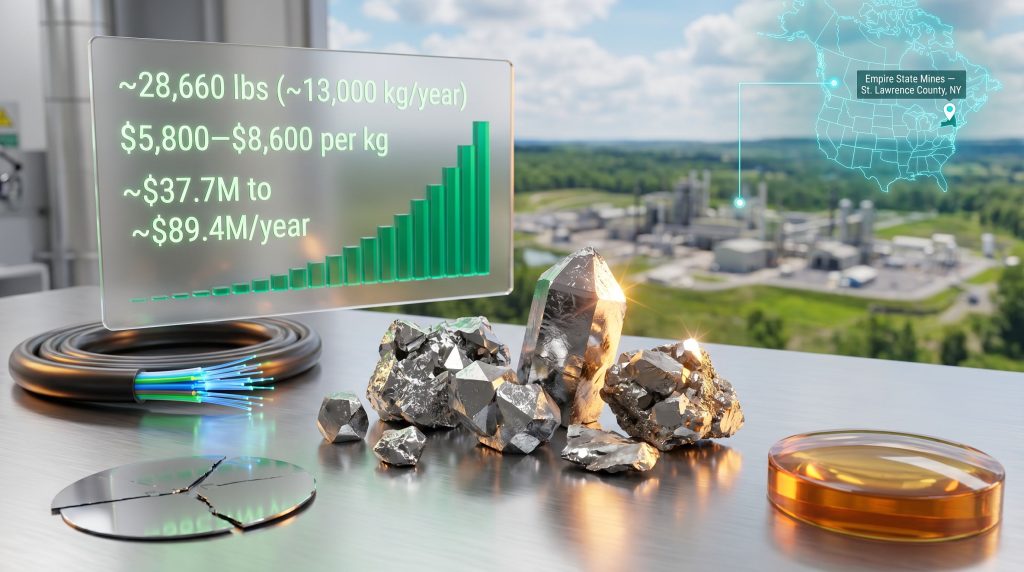
Based on current processing volumes, Titan Mining has estimated that approximately 28,660 pounds (13,000 kilograms) of germanium flows into its waste streams annually. This figure derives from two distinct circuit outputs:
| Waste Stream | Annual Volume | Germanium Grade | Relative Characteristics |
|---|---|---|---|
| Scavenger Tailings | ~600,000 short tons (544,000 mt) | 23 g/t | Large-volume, lower-grade, primary focus |
| Pre-Float Tailings | ~5,400 short tons (4,900 mt) | 69 g/t | Higher-grade, smaller-volume stream |
| Combined Estimate | — | — |
The scavenger tailings circuit is identified as the primary focus of the evaluation programme due to its much larger volume, even though the pre-float tailings carry nearly three times the germanium grade. The pre-float tailings stream, at 69 grams per tonne, is notably high grade by any standard for waste material, and its smaller volume may make it a more tractable starting point for feedstock upgrading experiments.
Understanding the Economic Scale: A Gross Value Assessment
With germanium trading in U.S. warehouses between $5,800 and $8,600 per kilogram as of late April 2026, the contained germanium in these waste streams represents a substantial gross in-situ value before any processing costs or metallurgical recovery losses are applied.
| Scenario | Recovery Rate | Recovered Volume | Price Point | Gross Revenue Estimate |
|---|---|---|---|---|
| Conservative | 50% | ~6,500 kg/year | $5,800/kg | ~$37.7M/year |
| Base Case | 65% | ~8,450 kg/year | $7,200/kg | ~$60.8M/year |
| Optimistic | 80% | ~10,400 kg/year | $8,600/kg | ~$89.4M/year |
Disclaimer: These figures are illustrative estimates based on publicly disclosed waste stream volumes and current spot price ranges. Actual outcomes will depend on metallurgical recovery rates established through testwork, feedstock payability terms negotiated with the processing partner, and processing costs not yet publicly disclosed. These scenarios do not constitute financial forecasts.
"An important nuance for investors to understand: germanium is not traded on major commodity exchanges like the London Metal Exchange. Pricing is determined through bilateral negotiations or assessed against spot prices in key consuming markets. The relatively thin trading volumes in this market mean that price assessments can reflect short-term availability constraints rather than long-run equilibrium values, adding complexity to revenue projections."
The Teck Resources Partnership: Why Trail Operations Is the Only Viable Processing Pathway
What Trail Operations Actually Represents
Teck Resources' Trail Operations complex in southern British Columbia is not simply a zinc smelter. It is one of the most metallurgically sophisticated base and critical metal recovery facilities on the continent, with established circuits for recovering germanium, indium, cadmium, silver, and gold alongside its primary zinc and lead output. Trail currently processes concentrate from Teck's Red Dog Mine in Alaska, one of the world's largest zinc operations, as well as third-party concentrate sources.
Critically, Trail Operations is confirmed as the sole commercial-scale facility in North America with an active germanium recovery circuit operating from primary feedstock. This is not a minor technical distinction. It means that any new U.S.-origin germanium feedstock entering North American supply chains must, under current infrastructure conditions, pass through Trail. There is consequently no alternative domestic processing pathway for primary germanium production at scale.
Teck has characterised itself as one of the world's largest global producers of germanium and a key supplier of germanium to the United States, with Trail's recovery capabilities underpinning North American supply of a material described as essential to defence, semiconductor production, and advanced chip manufacturing.
The Structure of the Cooperation Agreement
The agreement between Titan Mining and Teck is explicitly a technical and commercial evaluation framework, not a confirmed production deal. Its structure involves three sequenced workstreams:
-
Feedstock qualification: Assessing whether upgraded Empire State waste stream material can meet the minimum germanium content and impurity tolerance specifications required by Trail's recovery circuit.
-
Technical feasibility assessment: Evaluating whether the scavenger tailings and pre-float tailings can be sufficiently concentrated through upgrading processes to achieve Trail's required feedstock specifications at commercially viable cost.
-
Commercial framework development: If technical thresholds are met, defining potential volumes, payability structures, transportation logistics, and the parameters of a long-term offtake arrangement.
The agreement does not guarantee a commercial outcome. Both companies have acknowledged that success is contingent on the Empire State material meeting Trail's processing specifications and demonstrating economic viability under realistic commercial terms.
The Waste-to-Value Model: Capital Efficiency in Critical Mineral Development
Why This Approach Differs Fundamentally From Conventional Mine Development
One of the most compelling aspects of the Titan Mining germanium from New York mine waste initiative is its capital structure, or more precisely, its relative absence of the capital requirements that make most critical mineral supply chain development projects slow and expensive.
Greenfield critical mineral mines typically require:
- Exploration drilling programmes spanning multiple years
- Feasibility studies costing tens of millions of dollars
- Environmental impact assessments and permitting processes that routinely take a decade or more in the United States
- Construction capital expenditures measured in hundreds of millions to billions of dollars
- A significant period of commissioning and production ramp-up before positive cash flow
The Empire State germanium recovery programme requires none of these prerequisites in their conventional form. The germanium-bearing material is already being generated continuously as a result of ongoing zinc mining operations. No new mining, no additional land disturbance, and no new extraction permits are required for the evaluation phase or, if the technical work is successful, the recovery programme itself.
The revenue opportunity is additive rather than substitutive. It layers onto existing zinc operational cash flows, reducing the risk profile relative to any standalone germanium project and compressing the timeline from evaluation to potential first production compared to conventional mine development pathways.
A Multi-Commodity Platform in Evolution
The germanium recovery initiative represents the newest layer of Titan Mining's broader strategic repositioning of Empire State Mines from a single-commodity zinc operation into a multi-critical-mineral platform. The concurrent development tracks at the site now include:
- Zinc production as the operational and revenue foundation
- Graphite concentrate production through the Kilbourne demonstration facility
- Germanium waste-stream recovery, currently under formal technical evaluation
This layered approach reflects a sophisticated reading of how critical mineral value is increasingly being extracted in the industry, by maximising the number of recoverable commodities per tonne of material processed rather than simply expanding mine footprints or production volumes. In addition, advances in critical minerals processing are making these multi-stream recovery strategies progressively more viable.
The next major ASX story will hit our subscribers first
The North American Germanium Processing Bottleneck and Why It Matters
A Supply Chain Constrained by Infrastructure, Not Just Geology
The United States faces a germanium supply challenge that is not primarily geological. North American geology contains germanium in multiple settings. The challenge is metallurgical infrastructure. Outside of Trail Operations, no other facility in North America currently operates a commercial-scale germanium recovery circuit from primary sources.
This processing bottleneck creates a counterintuitive situation: even if multiple new U.S. germanium feedstock sources were identified and qualified tomorrow, the capacity to convert those feedstocks into refined germanium metal is limited to one facility in one country. The Titan-Teck partnership is structurally significant precisely because it proposes to route new U.S.-origin germanium feedstock through the only available North American processing infrastructure, without requiring parallel investment in new refining capacity.
For defence planners and semiconductor supply chain managers who have increasingly flagged germanium as a national security concern, this is a meaningful development. The bottleneck at the processing stage cannot be resolved by discovering new deposits. It requires either building new processing capacity, a multi-year and capital-intensive undertaking, or maximising utilisation of the Trail circuit with diverse domestic feedstock sources.
The Defence and Semiconductor Dependency That Cannot Wait
Germanium's applications in U.S. defence systems are not peripheral. The thermal imaging and night-vision platforms deployed across U.S. military ground, air, and naval systems depend on germanium-based infrared optics that currently have no cost-competitive material substitute in production-scale applications. Furthermore, the broader strategic concerns around defence critical materials illustrate that this vulnerability is recognised across allied nations, not just within the United States.
The fibre optic networks that underpin both commercial telecommunications and military communications infrastructure are built around germanium-doped optical fibre. The SiGe semiconductor architectures increasingly central to high-speed electronics, 5G hardware, and radar systems represent a growing demand vector that adds to rather than replacing existing consumption.
A speed record-setting silicon-germanium chip achieved a performance milestone in early 2026, further demonstrating the material's expanding role in next-generation semiconductor architectures. Developments of this kind intensify the strategic urgency already attached to domestic germanium supply development.
What Has to Happen Before Commercial Production Becomes Possible
The Technical Pathway From Agreement to Output
The cooperation agreement establishes a structured evaluation process with clearly defined sequential milestones:
Phase 1: Metallurgical Characterisation
- Representative sampling of both the scavenger tails and pre-float tails circuits
- Laboratory-scale testwork examining germanium upgradeability from current grades
- Determination of whether the material can be concentrated to meet Trail's minimum feed specifications at technically feasible cost
Phase 2: Feed Specification Alignment
- Trail Operations defines the required germanium content, physical form, and impurity tolerance parameters for acceptable feedstock
- Titan evaluates whether processing modifications at Empire State Mines can achieve the required upgrade ratio economically within these specifications
Phase 3: Commercial Term Negotiation
- Volume commitments, payability percentages, transportation logistics, and pricing mechanisms are defined
- Long-term offtake structure is developed, subject to technical results confirming economic viability across realistic price scenarios
Phase 4: Transition to Commercial Agreement
- If technical and economic thresholds are satisfied, the cooperation agreement converts into a formal commercial offtake arrangement
- First germanium shipments from Empire State Mines to Trail Operations would represent the introduction of a new U.S.-origin germanium feedstock into North American processing infrastructure from a waste-stream source
The distinction between a cooperation agreement and a commercial agreement is significant for anyone tracking this development. The current phase confirms intent and establishes a technical roadmap. It does not confirm production, revenue, or commercial viability.
Mine Waste as a Critical Mineral Frontier: The Broader Industry Context
Why Tailings Are Being Reassessed Globally
The Empire State germanium initiative exists within a broader industry-wide trend that is reshaping how mining companies and governments think about historical and current waste streams. Globally, billions of tonnes of mine tailings contain concentrations of critical minerals that were either undetectable with historical analytical technology or economically subthreshold given the processing capabilities and commodity prices of their time.
Advances in several technical areas have changed this calculus:
- Hydrometallurgical processing techniques now enable selective extraction of specific metals from complex mixed-mineral matrices at grades that were previously uneconomic
- Sensor-based ore sorting and analytical technologies can characterise waste streams at far higher resolution than was possible even a decade ago
- Selective leaching approaches can target specific mineral phases within tailings without requiring full reprocessing of the entire waste mass
Comparable initiatives emerging across North America illustrate the scale of this trend:
- Coal fly ash recovery programmes targeting rare earth elements across Appalachian coal-producing regions
- Phosphate processing waste streams being evaluated for uranium and rare earth co-recovery in Florida and Idaho
- Copper tailings in Arizona and Nevada being reassessed for lithium and cobalt content using updated analytical methodologies
The common thread across all of these initiatives is a fundamental reframing: industrial waste streams are increasingly recognised as untapped domestic critical mineral inventories rather than environmental liabilities requiring indefinite management.
Environmental Alignment as an Additional Driver
There is a dimension to waste-stream recovery that extends beyond the economic. Long-term tailings storage imposes ongoing environmental management obligations, regulatory compliance costs, and liability exposure for mining operators. Recovering value from tailings volumes reduces the mass of material requiring permanent storage, potentially lowering the environmental footprint of existing operations while simultaneously generating critical mineral supply.
This alignment between economic incentive and environmental outcome strengthens the policy case for waste-stream recovery programmes and may facilitate engagement with regulatory processes at both state and federal levels, though any specific approvals or governmental support would need to be confirmed through official announcements rather than assumed.
Key Questions Answered: Titan Mining's Germanium Recovery Initiative
What makes germanium so difficult to source outside China?
The fundamental challenge is structural rather than geological. Germanium is almost never mined as a primary product. Its commercial production is tethered to zinc smelting economics because it reports to zinc concentrates as a trace byproduct in most deposits. This means germanium supply cannot be independently scaled in response to its own price signals.
China has both the zinc smelting capacity and the technical infrastructure to recover germanium systematically, while most non-Chinese zinc smelters lack the germanium recovery circuits necessary to capture this value. Outside Trail Operations, no other North American facility currently operates at commercial scale for primary germanium recovery.
Why does Empire State Mines have germanium in its waste streams rather than its concentrates?
The answer lies in the mineralogy of this specific deposit. In most zinc operations, germanium is associated with the sphalerite (zinc sulphide) mineral, so it follows the zinc concentrate through processing. At Empire State Mines, however, the germanium is not bound within the sphalerite crystal structure. It is distributed through the carbonate host rock matrix, which means it does not respond to the flotation circuit the way zinc sulphide does.
When zinc sulphide is separated from gangue during processing, the germanium stays with the gangue and reports to tailings rather than concentrate. This metallurgical behaviour, while unusual, is precisely what creates the Titan Mining germanium from New York mine waste recovery opportunity.
How should investors interpret the cooperation agreement announcement?
The cooperation agreement establishes a structured technical and commercial evaluation framework. It confirms that both Titan Mining and Teck Resources consider the opportunity worthy of formal investigation and that Teck is prepared to evaluate Empire State material as a potential Trail feedstock. It does not guarantee commercial production, revenue generation, or a confirmed offtake agreement.
Investors should treat this as a significant de-risking step in a multi-phase evaluation process, with commercial outcomes contingent on metallurgical testwork results and economic assessments not yet completed. As with any resource-stage development initiative, outcomes remain uncertain until technical programmes are completed and results published.
What is the current price of germanium and what drives its volatility?
Germanium was priced in U.S. warehouses between approximately $5,800 and $8,600 per kilogram as of late April 2026. Unlike base metals, germanium is not traded on major commodity exchanges, so price discovery occurs through bilateral negotiation or spot market assessments in key consuming regions.
This market structure, combined with the small absolute volume of global production and China's dominant market position, creates conditions for significant price volatility. Export restriction signals from Chinese authorities, shifts in demand from major consuming sectors, and any disruption to Trail Operations' output can all generate outsized price movements given the thinness of the market.
This article is intended for informational purposes only and does not constitute financial or investment advice. All financial scenarios and projections are illustrative estimates based on publicly available data and are subject to material change pending metallurgical test results and commercial negotiations. Readers should conduct their own due diligence before making investment decisions.
Want to Track the Next Critical Mineral Discovery Before the Broader Market Does?
Discovery Alert's proprietary Discovery IQ model scans ASX announcements in real time, instantly identifying significant mineral discoveries across germanium, zinc, and more than 30 other commodities — including the critical minerals increasingly central to defence and semiconductor supply chains. Explore how historic discoveries have generated substantial returns and begin your 14-day free trial at Discovery Alert to position yourself ahead of the market.